
You are here
It’s 6:10 a.m. You’re standing in the corner of OR 4, holding retractors with half-numb fingers, trying not to contaminate the field. The attending is talking through the steps of a laparoscopic cholecystectomy. The chief casually asks, “So, have you decided what you’re going into yet?”
You mumble something noncommittal.
Inside, though, you know this: you like the OR. Maybe love it. But you have no idea how to turn “I like surgery” into “I have a smart rank list and a realistic shot at matching into the right surgical residency.”
This is the bridge we’re going to build. Step by step. From first OR case to certified rank list.
Below is your chronological guide: what you should be doing month-by-month and then week-by-week, so that by the time you click “Certify List,” you’re not guessing. You’re choosing.
Phase 1: Early Clinicals – First OR Case to End of Core Surgery (Months 0–6)
Months 0–1: The “Do I even like this?” phase
At this point you should:
Collect raw experiences, not conclusions.
Stop trying to decide “surgery or not” after your first cool case. You need reps.Prioritize:
- Variety: general surgery, trauma, vascular, colorectal, minimally invasive, breast
- Settings: big academic main OR vs. community site vs. ambulatory surgery center
- Times: a weekday call, one weekend, at least one overnight if allowed
Log reactions, not just cases.
End of each day, write 3–4 bullet points:- What energized you? (time in the OR, rounding, the pace, the acutely sick)
- What drained you? (clinic? chronic disease management? endless notes?)
- How did you feel at 5 a.m. and 7 p.m.?
- Which interactions with attendings/residents felt like “my people”?
You’re building a pattern database for later. Not for Instagram.
Watch the residents more than the attending.
Attendings are almost irrelevant to your choice. Their lives are fantasy-land compared to residency.Pay attention to:
- PGY-2 and PGY-3 faces post-call
- How often they operate versus push notes and orders
- How they talk about their program: exhausted but proud? or bitter?
Start a “Maybe Surgery” folder.
Literally:- One note file with:
- Cases that made you think “yes, this”
- Attendings you’d want to be in 20 years
- Red flags: toxic behavior, chronic burnout energy, malignant vibes
- One note file with:
Do not decide your specialty yet. You’re collecting data.
Months 2–3: Testing serious interest
By now, you’ve scrubbed enough to know if you hate the OR. If you don’t, it is time to treat surgery as a real option.
At this point you should:
Do an honest lifestyle + personality check.
On a day off, take 30 minutes and rank yourself (1–5) on:- Need for instant feedback vs. long-term relationships
- Comfort with uncertainty vs. comfort with decisive action
- Tolerance of chaos, blood, 3 a.m. pages, and steep hierarchies
If you’re a 4–5 on “I like decisive, procedural, team-based chaos,” you’re in the right neighborhood.
Clarify what kind of surgeon you picture.
No, you are not choosing a subspecialty yet. But you can start to see shapes:- Operate a lot / clinic light (trauma, vascular, acute care)
- Balanced OR + clinic (general, colorectal, breast, surgical onc)
- Tech and gadgets (MIS, robotic-heavy programs, CT surgery later)
- Field size matters: tiny fields (ENT, plastics, urology) vs. big abdominal cavities
This helps you later when sorting general surgery vs. integrated pathways (plastics, vascular, CT, etc.).
Identify 2–3 faculty “futures.”
Ask yourself:- Whose job would you actually want?
- Who seems both clinically good and not miserable?
Those people become:
- Potential mentors
- Letter writers
- Reality checks
Start a light specialty research pass.
Take an evening and skim:- ABS site for general surgery requirements
- ACGME case log minimums
- A few residency program pages for your home program and 2–3 big names
You’re not planning your entire career. You’re getting oriented.
Months 4–6: Deciding whether to commit to a surgical path
By the end of your core surgery rotation (or shortly after), you should be able to say one of three things:
- “Surgery is definitely not for me.”
- “I’m not sure, but I keep coming back to it.”
- “Yes. It’s surgery. I’ll be miserable doing something else.”
If you’re in bucket 2 or 3, here’s what to do next.
At this point you should:
Have at least one blunt talk with a surgeon you trust.
Ask them directly:- “If I want to be competitive for [general / ortho / ENT / plastics / urology], where do I stand right now?”
- “Realistically, what tier of programs should I be thinking about with my Step, grades, and school?”
- “What do residents from our school usually match into in surgery?”
And listen. If someone says, “For integrated plastics with a 225 and zero research, it will be an uphill battle,” that’s not cruelty. That’s a gift.
Decide your broad category.
Your decision tree at this stage:

Surgical Specialty Decision Branch Step Description Step 1 Interested in OR? Step 2 Consider non surgical fields Step 3 General or subspecialty? Step 4 General surgery track Step 5 Integrated subspecialty track Step 6 Plastics, Vascular, CT, ENT, Urology, Ortho, Neurosurgery You don’t have to pick which integrated specialty yet, but you do need to know:
- Am I aiming for categorical general surgery?
- Or an integrated specialty (plastics, ENT, urology, CT, vascular, ortho, neurosurg)?
Map out your remaining clinical year around that choice.
If you’re even leaning toward:
- General surgery → try to get: ICU, an advanced elective in trauma, colorectal, or surgical oncology.
- Ortho → aim for ortho elective and MSK-heavy rotations.
- ENT / Plastics / Urology → get at least one rotation in that field at home.
You’re making sure you’re not “discovering” a hyper-competitive subspecialty in February of your M4 year. That’s how you end up unmatched.
Start minimal research positioning.
No need to panic-start a PhD, but:- Ask your surgical mentors: “Do you have any short projects I could help with? Chart review, database, case report?”
- Aim for something on paper in that field within 6–9 months.
You’re transitioning from “maybe surgery” to “future surgical applicant.”
Phase 2: Pre-Application Year – The Serious Setup (Months 7–15)
This is roughly the 12 months before ERAS opens. For most U.S. MDs, that’s M3 late → M4 early.
Months 7–9: Build your foundation and network
At this point you should:
Lock in your “application identity.”
You need a coherent story:- “I’m a future academic general surgeon with an interest in surgical oncology and quality improvement.”
- “I’m an ortho applicant drawn to trauma and sports with a background in biomechanics.”
- “I’m ENT-bound, really interested in otology and education.”
This is not branding fluff. It tells you:
- What projects to say yes/no to
- Which away rotations matter
- What kind of programs to pursue
Identify 2–3 key mentors.
Sort them into roles:- Program insider at your home department (knows which residents are strong, how they matched)
- Letter writer who’s seen you work hard clinically
- External perspective (maybe from a different institution or subspecialty)
Have a focused 20–30 min meeting with each:
- “My goal is [X surgical field]. Here are my scores, grades, current CV. Where are my gaps?”
- “What would you do in my shoes over the next 9–12 months?”
Get a clear sense of competitiveness.
For your field, you should know:
Sample Competitiveness Benchmarks by Surgical Field Field General Competitiveness Research Expected Away Rotations Typical General Surg Moderate Helpful 1–2 Ortho Very High Strong 2–3 ENT Very High Strong 2–3 Plastics (Int) Extreme Very Strong 2–3 Urology High Strong 2 Your actual numbers will differ by year, but if you’re below your field’s typical research/score/letters bar, assume you need to compensate elsewhere.
Plan your away rotations (sub-Is) early.
For most surgical fields:- You’ll do 1–3 away rotations between May–September right before you apply.
- These are extended interviews. Programs rank you off them.
You need to:
- Decide: home advanced rotation vs. away vs. both
- Target: safety, realistic, and dream programs (based on your profile, not your ego)
- Track VSLO/ERAS deadlines they sneak up fast.
Months 10–12: Skill up and become “the reliable med student”
At this point you should:
Become technically competent enough not to be a liability.
Before sub-Is:- Know how to properly scrub, gown, and glove without drama
- Be reliable with basic knot tying and simple instrument handling
- Practice on a suture board or foam daily for 10–15 minutes
Polish your floor game.
On any surgical team, your value is honestly less in the OR and more:- Pre-rounding efficiently
- Knowing labs and vitals cold on your patients
- Anticipating dispos, consults, and imaging follow-ups
Residents remember the student who:
- Caught the early AKI
- Called radiology for wet reads
- Pre-filled the consent with correct procedure/side
Quietly assess program culture at your home institution.
During this period, you’re seeing:- How chiefs handle stress
- How attendings treat residents in front of you
- Whether the program really backs residents applying to fellowships
Start a note: “What I want in a program” vs. “What I will not tolerate.”
Nail down your letter strategy.
Surgery letters are brutal in their impact. At this stage you should know:- Which 3–4 attendings you’re aiming for
- Which rotations you need to impress on to get those letters
- Roughly when you’ll ask (usually the last week of that rotation)
Pro tip: Strong, specific letters from solid, respected surgeons beat generic letters from famous names who barely know you.
Months 13–15: Away rotation execution
This is where a lot of surgery applicants quietly win or lose the match.
At this point you should:
Treat every away as a 4-week audition.
Framework:- Week 1: Learn the system, be humble, ask smart questions
- Week 2: Start functioning like a sub-intern: see patients independently, present clearly
- Week 3: Ask for feedback and adjust aggressively
- Week 4: Solidify letters and advocates
Aim for “top of the med student pile,” not “genius of the OR.”
Programs are looking for:- Work ethic: do you stay until the work is done without being asked?
- Team fit: would residents want to take call with you at 2 a.m.?
- Floor reliability: are your notes, orders, and follow-ups clean?
They are not evaluating you on:
- Surgical speed
- Independent operating
- Subspecialty-level knowledge
Collect intel on each program.
During each away, track:
- Case volume vs. case ownership
- Fellowship match history
- Resident happiness (not on the tour – in the work room at 1 a.m.)
- How PD and chair talk about their residents: as people or as numbers
That data becomes gold when you build your rank list.
Secure your best letters by the last week.
Find your top attending and say:- “I’ve really enjoyed working with you these past weeks and I’m applying in [field]. I’d be honored if you’d be willing to write a strong letter on my behalf.”
Use the word “strong.” If they hesitate at all, pivot. A lukewarm surgery letter is poison.
Phase 3: Application Season – ERAS to Interview Trail (Months 16–21)
Now the clock gets tighter and the timeline sharper.
Months 16–17: ERAS prep and program list build
At this point you should:
Lock down your specialty and backup strategy.
Before you touch ERAS:- Confirm your primary surgical field.
- Decide if you’re dual applying (e.g., general surgery + prelim, ENT + prelim, urology + gen surg).
Don’t wait until you’re in panic mode in October to invent a backup.
Draft a specific surgical personal statement.
No generic “I like working with my hands and teamwork” fluff.Anchor it with:
- 1–2 specific OR or patient moments that illustrate why surgery fits you
- Your trajectory: early interest → core experiences → sub-I growth
- Clear future vision: academic/community, research/education, which patient populations
Build a realistic program list.
You need a spread:- Reach / dream
- Solid realistic
- Safer / mid-to-lower tier where you’d still actually go
For competitive fields, you’ll likely apply more widely. Map programs into tiers based on:
- Objective metrics (matched residents from your school, fellowship outcomes)
- Your stats (scores, research, letters)
- Geography preferences (honest ones, not fantasy)
Finish your ERAS activities like an adult.
For each surgical activity:- Highlight leadership, initiative, concrete outcomes
- Translate OR and research experiences into impact: what you actually did, not just observed
Months 18–20: Interviews and real-time reassessment
At this point you should:
During each interview day, track three columns.
After you log off Zoom or leave the hospital, write down:Training:
- Case volume and autonomy
- Breadth vs. niche focus
- Fellowship support
Culture:
- Resident cohesion
- How PD talks about “weak” residents
- Vibes on diversity, family-friendliness, wellness (actual, not brochure)
Life:
- City affordability
- Support systems nearby
- Call schedule reality
Do it that night. Memory lies after 10 interviews.
Watch how residents act when faculty leave the room.
That 5-minute gap tells you everything:- Do they decompress and joke with you?
- Or immediately start venting about exploitation and lack of support?
Believe them.
Update a living proto-rank list every 3–4 interviews.
Literally a ranked spreadsheet:- Don’t wait until January to sort 15–30 programs out of thin air.
- Move programs up/down as your perspective changes.
If a program starts sliding consistently lower, ask yourself why. Write the specific reasons.
Check your initial assumptions.
Maybe you thought you needed a “prestige name.” But after seeing residents at a top-5 program looking crushed, and a mid-tier program with high autonomy and happy chiefs, your priorities might shift.It’s allowed. In fact, it’s smart.
Phase 4: Rank List Month – Final 4 Weeks Before Certification
This is where people either make a clear-eyed decision or panic-rank based on brand names and one good dinner.
At this point you should:
Week 1: Define your non-negotiables and tie-breakers.
Sit down alone and write two short lists:
Must-haves (deal breakers):
- Reasonable case volume with documented autonomy by PGY-4/5
- Non-toxic culture (no routine public humiliation, no chronic 120-hour weeks)
- Geographic constraints (partner’s job, family responsibilities) if truly immovable
Nice-to-haves (tie-breakers):
- Prestige / fellowship placement rate
- Robotics access, research time, niche subspecialties
- City size, climate, cost of living
Programs that fail a must-have go to the bottom or off the list, no matter the name.
Week 2: Build your first serious draft rank list.
Sort programs into rough tiers, then rank within tiers:
- Tier 1: You’d be thrilled here
- Tier 2: You’d be content and get solid training
- Tier 3: You’d go here, but only if the alternative is not matching
Then within each tier, ask:
- “If I matched here tomorrow, would I feel mostly relief or mostly dread?”
The match algorithm favors your preferences. Rank in the order you truly want, not where you “think” you’re competitive.
Week 3: Sanity check with 1–2 trusted mentors.
Show them:
- Your draft list
- Your concerns (e.g., “I’m torn between a top-10 in a rough culture vs. a mid-tier with incredible residents”)
Ask:
- “If you were me, how would you order these top 5?”
- “Do you see any blind spots in my reasoning?”
Listen, then adjust. But do not let anyone else own the final call.
Week 4: Final adjustments and certification.
Last pass:
- Revisit your notes on the top 8–10 programs
- Re-check your must-haves list
- Confirm there’s no program ranked above another where you’d honestly be less happy training
When you’re done:
- Certify the list.
- Stop rearranging it daily based on anxiety.
Remember: There is no such thing as a “perfect” surgical residency. There is only “a place where I can become a safe, competent surgeon and not destroy my life.”
Quick visual: your surgical selection timeline
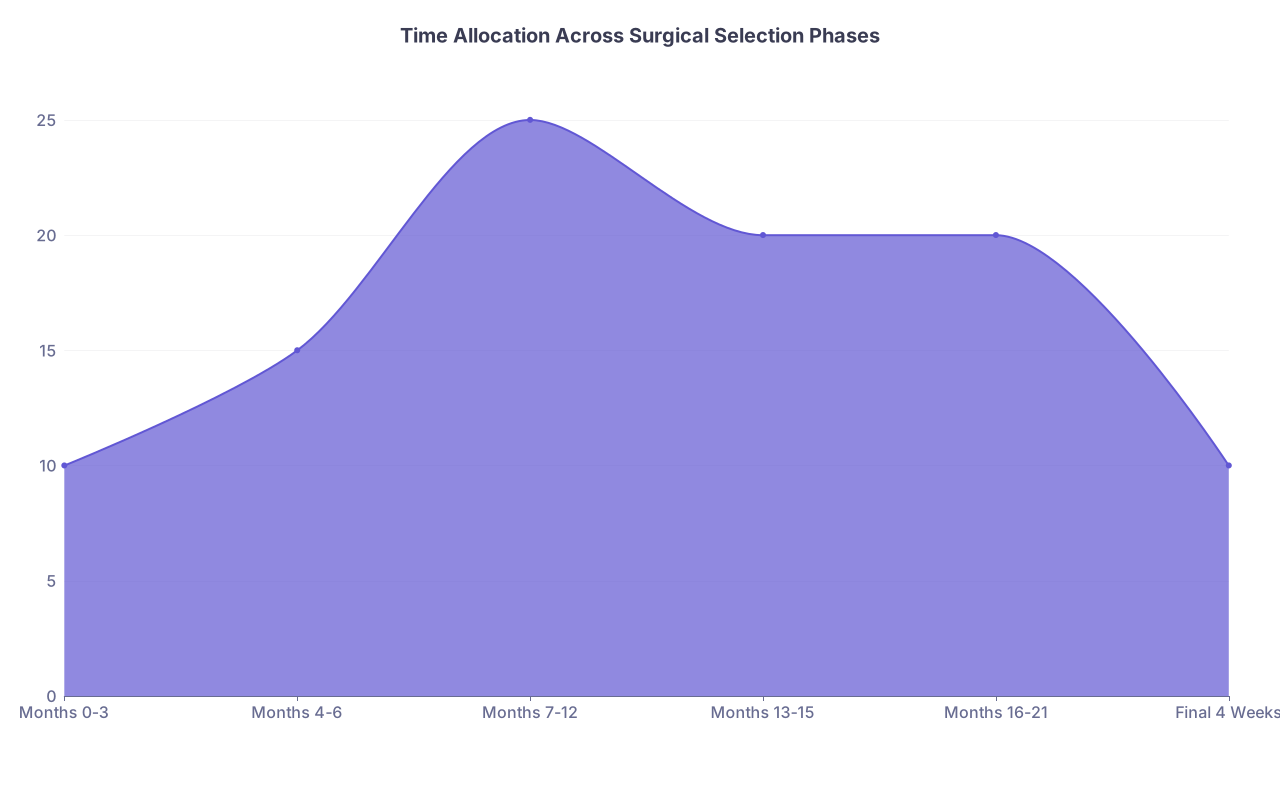
| Category | Value |
|---|---|
| Months 0-3 | 10 |
| Months 4-6 | 15 |
| Months 7-12 | 25 |
| Months 13-15 | 20 |
| Months 16-21 | 20 |
| Final 4 Weeks | 10 |
And the big process arc:
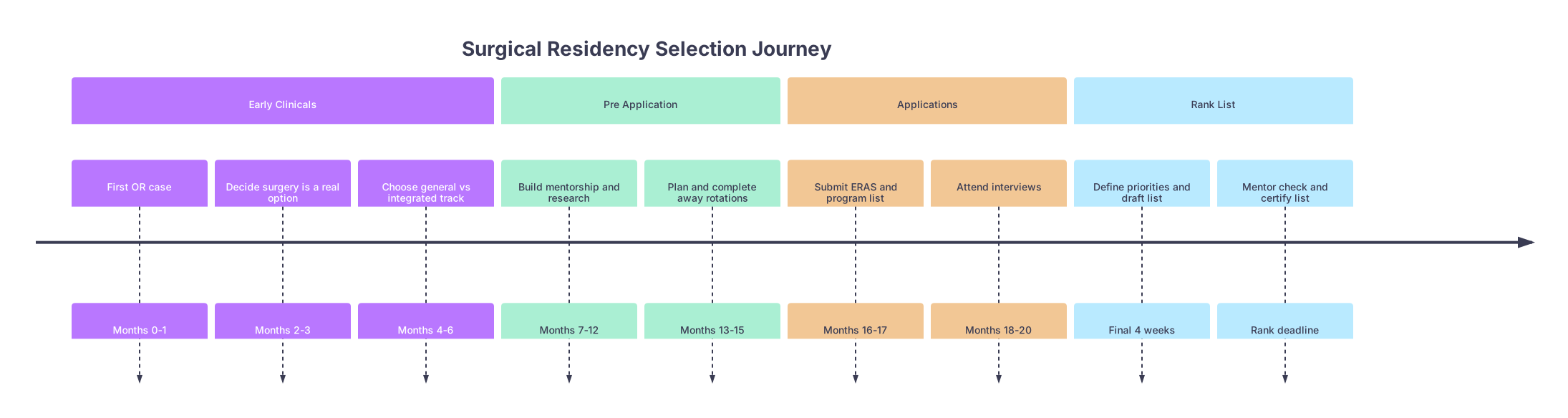
| Period | Event |
|---|---|
| Early Clinicals - First OR case | Months 0-1 |
| Early Clinicals - Decide surgery is a real option | Months 2-3 |
| Early Clinicals - Choose general vs integrated track | Months 4-6 |
| Pre Application - Build mentorship and research | Months 7-12 |
| Pre Application - Plan and complete away rotations | Months 13-15 |
| Applications - Submit ERAS and program list | Months 16-17 |
| Applications - Attend interviews | Months 18-20 |
| Rank List - Define priorities and draft list | Final 4 weeks |
| Rank List - Mentor check and certify list | Rank deadline |
Three things to walk away with
Decide in layers, not in a panic. First decide: surgery or not. Then general vs integrated. Then which programs. You don’t need all the answers in month one.
Use each phase to answer a specific question. Early rotations = “Do I like this life?” Away rotations = “Do they like me and do I like them?” Rank list month = “Where will I actually grow and not burn out?”
When in doubt, choose the place where you’ll become a competent, supported surgeon over the shiniest name. You can build a career from solid training and good mentorship. You cannot out-brand a miserable five to seven years.