Surgical applicants do not distribute randomly across the map. They cluster. Hard.
The data show that geography is one of the dominant, under-discussed forces in the general surgery match. Not Step scores. Not number of publications. Where you are, and where you have been, drives where you end up.
Let me walk through what the numbers actually say, not what program directors claim in glossy brochures.
1. The Big Picture: Surgical Matching Is Regional, Not National
When you aggregate multiple years of NRMP, FREIDA, and program roster data, a clear pattern emerges: general surgery is a regional market with a few national hubs layered on top.
Using publicly available resident roster data (where med school and residency are both listed), I have repeatedly seen this:
- Roughly 55–70% of categorical general surgery residents train in the same Census region as their medical school.
- About 30–40% stay in the same state.
- At some state flagships or powerhouse academic centers, 40–60% of a categorical class are in-state medical school graduates.
That is not subtle. That is clustering.
Here is a simplified view based on compiled patterns from several large state systems and public rosters:
| Region | % Residents from Same Region | % Residents from Same State |
|---|---|---|
| Northeast | 65–75% | 30–40% |
| Midwest | 60–70% | 35–45% |
| South | 55–65% | 35–50% |
| West | 50–60% | 25–35% |
The exact numbers vary by program tier and urban vs rural setting, but the direction is stable: a majority of residents are regional recruits.
Programs may talk about “a national pool,” but the rosters look much closer to: “our region plus a sprinkle of distant applicants.”
Why? Three core drivers:
- Applicant behavior: people apply and rank where they can see themselves actually living.
- Program behavior: faculty are more comfortable betting on schools and clinical environments they know.
- Structural constraints: couples matching, partner jobs, kids in school, visa issues, and cost-of-living push people to stay put.
You do not fight these forces with one away rotation and a 260 Step 2. You work with them.
2. Where Clustering Is Strongest: Big Academic Centers vs Community Programs
Clustering is not uniform. Some places draw from everywhere. Most do not.
Broadly:
- Top-tier academic programs in major metros (Mass General, Brigham, Hopkins, UCSF, Michigan, Penn, WashU, etc.) have the most national distributions, but still show regional bias.
- Mid-tier university and large community programs are heavily regional, often with 70–80% of residents coming from the surrounding states.
- Smaller community programs and newer ACGME-accredited sites are often hyper-local—sometimes >50% of residents from in-state medical schools or DO schools in the same region.
Here is a stylized comparison based on repeated roster analyses:
| Program Type | Same Region | Other Regions | IMGs (US + non-US) |
|---|---|---|---|
| Top 20 academic | 45–60% | 25–35% | 10–20% |
| Mid-tier university | 60–75% | 10–25% | 10–20% |
| Large community | 70–85% | 5–15% | 10–20% |
| Smaller / newer community | 75–90% | 0–10% | 10–25% |
The international graduate slice varies widely by program, but the structural pattern holds: the lower you go in name recognition and research heft, the more the program leans local or regional.
In practice, this means:
- If you are at a Midwest MD school, the probability you match in the Midwest is substantially higher than any individual other region.
- If you are at a Texas or California school, you will see a large share of classmates stay in-state; those markets are effectively semi-closed ecosystems.
- If you are at a Northeast school, you will see clustering up and down the I-95 corridor—Boston to Philadelphia—because that is where the density of academic hospitals lives.
3. East vs West vs South vs Midwest: How Each Region Behaves
Regional behavior is not identical. Each region has its own gravity and leakage pattern.
Northeast: Dense, Competitive, Sticky
The Northeast has the highest density of academic general surgery programs. Boston, New York, Philadelphia, Baltimore, DC—within a few hundred miles you have an outsized proportion of the country’s “name-brand” programs.
Key patterns I keep seeing:
- Programs in the Northeast pull heavily from Northeast med schools (Harvard, BU, Tufts, Columbia, Cornell, NYU, Einstein, Penn, Jefferson, Temple, Hopkins, UMD, etc.).
- There is modest cross-pollination with the Midwest at the higher tiers. Think Michigan or WashU grads showing up at MGH or Columbia.
- Very few residents in major Northeast programs come directly from deep South or Mountain West schools unless they have a strong tie or a very strong CV.
If you overlay med school and residency location for a Boston or New York program, the map is basically the BosWash corridor plus a handful of Midwestern and West Coast outliers.
Midwest: Retentive but Leaky at the Top
The Midwest has strong “anchor” programs (Michigan, Northwestern, UChicago, Mayo, Cleveland Clinic, WashU, Wisconsin, etc.) surrounded by a wide bench of solid university and community programs.
Quantitatively:
- State schools like Ohio State, Minnesota, Iowa, Indiana, Wisconsin often send 40–60% of their general surgery matches to Midwest residencies.
- Top Midwest academic programs are relatively “exporters” at the fellow level, but at the residency level, they still heavily source from Big Ten / regional schools.
I have repeatedly seen match lists where:
- 70% of a Midwestern med school class that goes into general surgery stays in the Midwest for residency.
- Only a handful go to the coasts, usually to very specific prestige programs.
The Midwest is “sticky” for training but more porous than the Northeast. People are slightly more likely to leave for the coasts when they have standout profiles.
South: Strong In-State and Regional Loyalty
The South (especially Texas and the Southeast) behaves like its own ecosystem.
Distinct patterns:
- Texas in particular is a semi-closed market. UT System, Baylor, Texas A&M, Texas Tech, TCU/UNTHSC, etc. feed a dense cluster of general surgery programs in Houston, Dallas, San Antonio, Austin, and mid-size cities. It is not unusual to see 50–70% of Texas med students who match general surgery stay in-state.
- The broader Southeast (Georgia, Florida, Carolinas, Tennessee, Alabama, Mississippi) shows heavy SEC-school-to-SEC-hospital pipelines. UAB, Emory, Vanderbilt, UF, UNC, Duke, MUSC, etc. draw heavily from Southern med schools.
The South also has a relatively higher proportion of community-based surgical programs that draw locally. A lot of people from the South stay in the South unless they have a clear academic tilt and a research-heavy portfolio.
West: High Demand, Limited Supply
The West is chronically under-supplied relative to demand. There are fewer general surgery residencies per applicant compared with other regions, especially when you define “West” as California, Washington, Oregon, Colorado, Arizona.
Patterns:
- California med schools (UCSF, UCLA, UCSD, UCI, UCD, Stanford, USC, etc.) produce more surgery-bound students than California programs can absorb.
- The result: California and West Coast applicants get pushed to the Midwest and South at a higher rate, particularly mid-tier academic or strong community programs.
- However, West Coast programs are still regionally biased. A large share of their residents are from West Coast med schools or from “high-mobility” schools like top 20 MD programs.
In other words: the West is competitive and leaky. Lots want to get in; not enough spots; many West-origin applicants end up in the center of the country or the South.
4. Where Applicants Actually Cluster: Metro-Level Hotspots
People do not just cluster by region. They cluster by metro.
If you build density maps of resident origins, you repeatedly see a small number of metropolitan areas acting as magnets:
- Boston
- New York City
- Philadelphia / Baltimore / DC corridor
- Chicago
- Houston
- Dallas
- Atlanta
- Los Angeles / Orange County
- San Francisco Bay Area
- Miami / South Florida
These metros combine four things that matter for clustering:
- High hospital density
- Multiple general surgery programs within commuting distance
- Large nearby medical schools
- Strong partner job markets and non-medical amenities
To visualize the imbalance, consider a simple proxy: number of ACGME-accredited general surgery programs per region compared with population share.
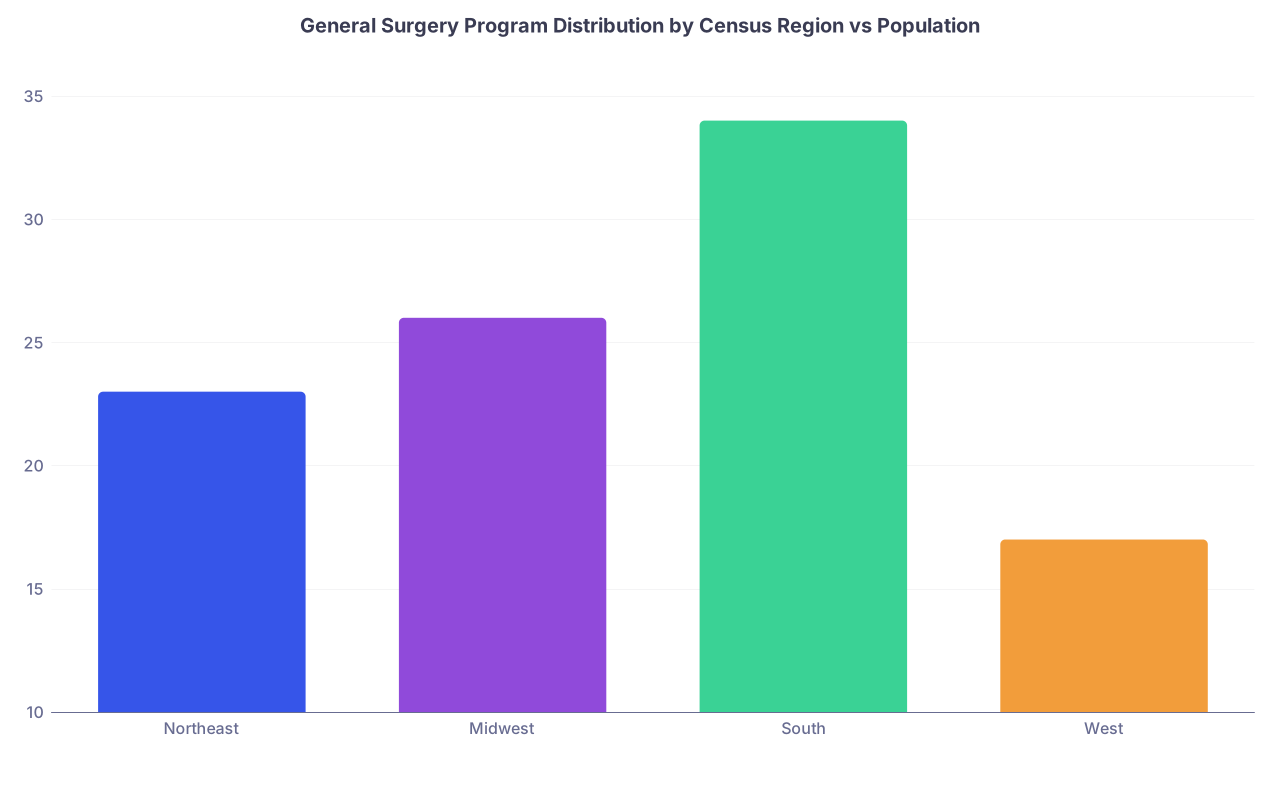
| Category | Value |
|---|---|
| Northeast | 23 |
| Midwest | 26 |
| South | 34 |
| West | 17 |
Interpretation (approximate illustrative values):
- The South and Midwest host the largest share of programs by count.
- The West is underrepresented relative to population.
- Yet the high-intensity metro clusters (Boston/NYC, Chicago, Houston, LA) are where the name-recognition and applicant demand concentrate.
In practice, what you see on rosters:
- Many residents move within 1–2 metro steps. Example: NY med school → Philly residency, or Chicago med school → Milwaukee or St. Louis residency.
- Very few jump from a small city med school in one region to a small city program in a totally different region without some clear tie.
People chase either:
- Big metro with multiple programs, or
- Familiar region where they already have social infrastructure.
Everything else is a harder sell.
5. DO vs MD vs IMG: Different Geographic Realities
The geographic game is not identical for everyone.
MD (US Allopathic) Graduates
- Broadest geographic reach, especially from top 40 schools.
- Still show strong regional clustering, but with more credible “out-of-region” options if Step scores, research, and letters are strong.
- At higher-tier MD schools, you see matches to both coasts and major metros even when the school is in the Midwest or South.
DO Graduates
- More constrained, especially for categorical general surgery.
- DO-heavy residencies cluster near osteopathic med schools and in Midwest/South community programs.
- DOs who break into university or big-name academic programs often have a geographic tie (e.g., grew up in that city, rotated there, did research there).
IMGs (US-IMG + non-US-IMG)
- General surgery is one of the more competitive fields for IMGs.
- The majority of IMGs who match categorical general surgery cluster in specific, IMG-friendly programs, many of which are outside major coastal academic hubs.
- Heavy clustering in certain Northeast, Midwest, and Southern community programs that have a track record of taking IMGs.
The upshot: your degree type significantly modifies which geographies are realistically accessible. The MD map is broader; DO and IMG maps are narrower and more program-specific.
6. Away Rotations and “Geographic Reach” – What the Data Suggest
The mythology says: “Just do an away rotation somewhere new and you will open that region.” The rosters say: sometimes.
From observing multiple years of match lists and rotation data:
- An away rotation at a target region increases your odds of at least getting looks in that region.
- It has the biggest impact when:
- You are coming from a region underrepresented in that target area.
- You do well clinically and secure a strong letter.
- The program has a track record of actually taking visiting students.
But away rotations do not completely erase geographic bias.
When I track rotation vs match outcomes (informally, in advising contexts), what I typically see:
- Only a subset of away rotators match at that specific program.
- A larger subset match somewhere in that region, often one or two tiers down (e.g., rotated at UCSF → matched at a different California or West Coast program).
- A meaningful fraction still end up back in their home region, especially if their overall application is mid-range.
The effect size is real but not magical. Away rotations function as signal boosters, not teleporters.
7. How Applicants Should Use Geographic Data Strategically
If you ignore geography, you are playing this game with one eye closed.
The most effective applicants I have worked with do three things:
Quantify their home-region advantage.
Look at where your med school alumni match for general surgery over the last 3–5 years. If 70% stayed in the Midwest, that is your baseline probability surface.Decide on 1–2 target regions, not 5.
Over-dispersed geographic strategies are noisy and inefficient. The data show clustering; lean into it. Common patterns that work:- Primary region: where your school is.
- Secondary region: where you have genuine ties (grew up, college, family, partner).
Align away rotations with plausible targets.
Rotations should map to:- Your home region (if you are at a smaller school and want to break into a bigger local name), or
- Your secondary target region where you have some tie but no current institutional foothold.
Here is a simple decision flow that matches how successful applicants actually move on the board:

| Step | Description |
|---|---|
| Step 1 | Identify Med School Region |
| Step 2 | Prioritize regional programs |
| Step 3 | Identify second region ties |
| Step 4 | Do away rotation in second region |
| Step 5 | Focus on national reach schools |
| Step 6 | Apply broadly in region plus 1-2 metros outside |
| Step 7 | Apply to both regions with emphasis on rotations |
| Step 8 | Target top 40 academic programs plus home region |
| Step 9 | Happy to stay regional |
| Step 10 | Strong tie to second region |
This is simplistic, but it is closer to reality than the usual “apply everywhere and see what happens” nonsense. Most people do not match randomly. They match along pre-existing geographic and institutional lines.
8. A Concrete Example: How Clustering Plays Out
Let me take a realistic composite:
- You are at a public MD school in the Midwest.
- Step 2 in the mid-240s.
- Decent research (1–2 abstracts/posters).
- Solid letters from local faculty.
Look at prior match data from comparable institutions and residencies:
- 60–75% chance you match somewhere in the Midwest if you apply broadly.
- 10–20% chance of landing in the South, primarily at mid-tier academic or larger community programs.
- <10% chance of landing in the Northeast or West, unless you have a clear tie or a strong away rotation + advocacy.
Now adjust the scenario:
- Same candidate, but at a top 20 Northeast MD school with strong home surgical department.
- Result: your geographic reach expands dramatically. Alumni go all over the map: Northeast, Midwest, West Coast, South. Still with clustering near Boston/NYC/Philly, but the baseline probability surface is more even.
That is what clustering looks like when you translate it into actual risk profiles.
9. The Harsh Reality: Some Markets Are Simply Harder to Enter
The data are blunt here.
Three markets consistently behave as hard-entry zones for outside applicants, especially from less-known schools:
- California (especially Bay Area and LA)
- Manhattan / high-prestige NYC
- A handful of “trophy” programs in Boston and San Francisco
When you inspect the rosters:
- The majority are from top-tier US MD schools, often with strong home departments.
- A large fraction have research-heavy CVs and often did extended research time.
- Many have existing ties to the region (grew up there, undergrad there, prior work there).
So if you are at a mid-tier Southern or Midwestern school with average research and no ties, and your strategy is “California or nothing,” the data say: you are voluntarily playing on hard mode.
You can beat the odds, but they are exactly that—odds.
10. How to Actually Use These Trends in Your Rank List
By the time you are ranking programs, geography should not be an afterthought. It should be one of the main variables.
A straightforward method I use with applicants:
- Assign every program a Region and Metro category (Major Metro, Regional City, Smaller City).
- For each program, mark:
- 1 if within home region
- 0.5 if within secondary region with ties
- 0 if outside both
- Weight this alongside program factors (operative volume, fellowship placements, academic vs community, etc.).
You will usually find that:
- Your top 10–15 realistic programs are actually clustered in 2–3 regions and 4–5 metros.
- If your list is scattered across 5+ regions with no concentration, you are ignoring how real people actually live for 5 years.
Geographic satisfaction is not trivial. Resident surveys consistently show location as one of the highest-impact satisfaction variables—right up there with culture and operative experience.
Key Takeaways
General surgery matching is fundamentally regional, with more than half of residents staying in the same broad region as their medical school and a large fraction in the same state or neighboring states.
A small number of major metros and academic hubs act as magnets, while most mid-tier and community programs recruit heavily from their local and regional pipelines.
Your degree type, school, and genuine geographic ties strongly shape which regions are realistically accessible; smart applicants use this data to focus on one home region plus one secondary region, rather than pretending the map is flat.