The mythology around “you need a 260 to match surgery” is statistically wrong. The data show something more nuanced—and more useful—if you actually look at Step score distributions instead of Reddit anecdotes.
Below I am going to walk through what the most recent match data tell us about Step 2 CK score distributions in competitive surgical fields: integrated plastic surgery, dermatology (often grouped with surgical subspecialties in competitiveness discussions), otolaryngology (ENT), neurosurgery, and orthopedic surgery. Step 1 is pass/fail now, so the game has shifted. Programs are sorting you by Step 2 CK far more aggressively than they admit publicly.
I am going to treat this like what it is: a filtering problem with quantifiable thresholds, not a vibe-based mystery.
1. The score landscape across surgical fields
Let me anchor with approximate numbers that reflect the recent trends post-pass/fail Step 1, using NRMP Charting Outcomes, individual specialty reports, and what program directors will tell you off the record at conferences.
These are estimated Step 2 CK distributions (US MD seniors, matched) for some of the most competitive “surgical-adjacent” fields. Think of these as reasonable ballpark ranges, not precise census values.
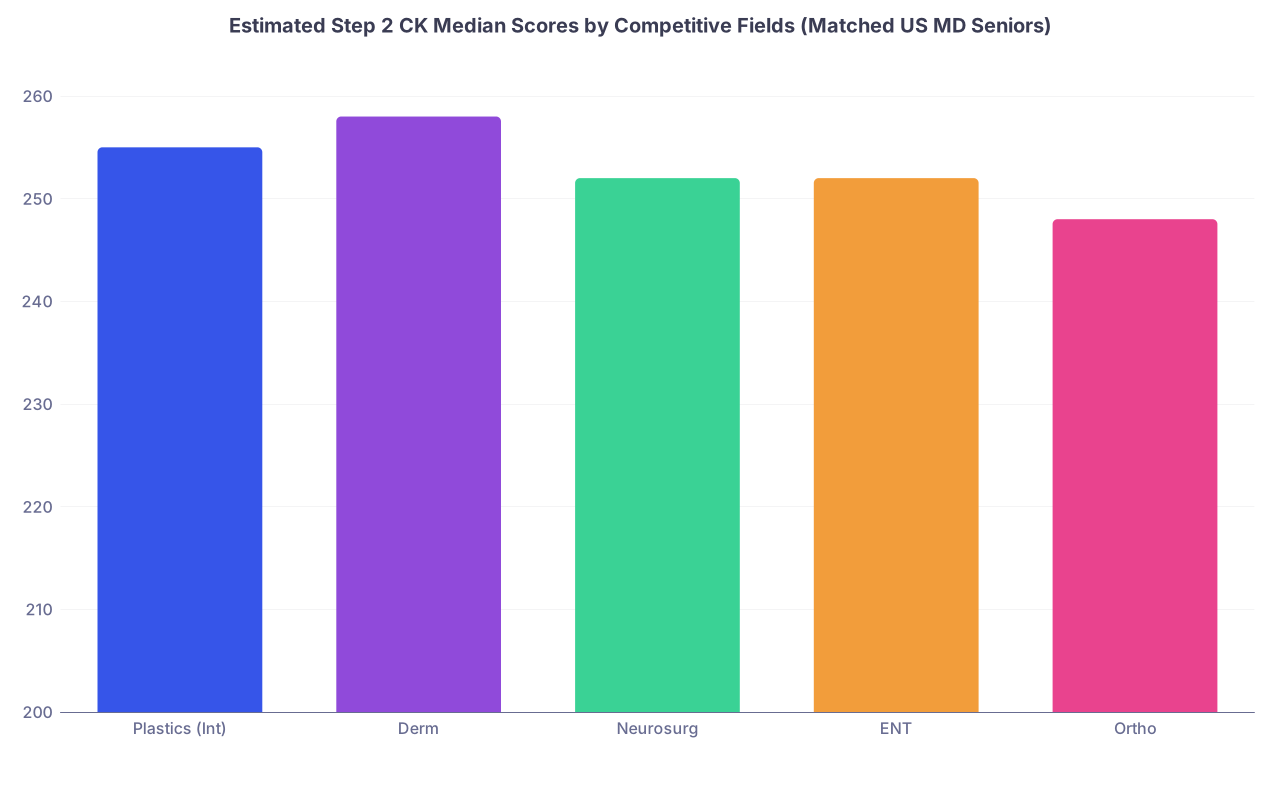
| Category | Value |
|---|---|
| Plastics (Int) | 255 |
| Derm | 258 |
| Neurosurg | 252 |
| ENT | 252 |
| Ortho | 248 |
Those medians already tell you the story:
- These specialties are not living in the 240s anymore
- A 250 is competitive but not “god-tier” for the very top programs
- The right mental model: you are fighting inside a relatively narrow band of 245–265, and distributions are skewed high
Now let’s break it down more precisely by distribution shape—because where the tails sit (10th/25th/75th/90th percentiles) matters more for your application strategy than the raw median.
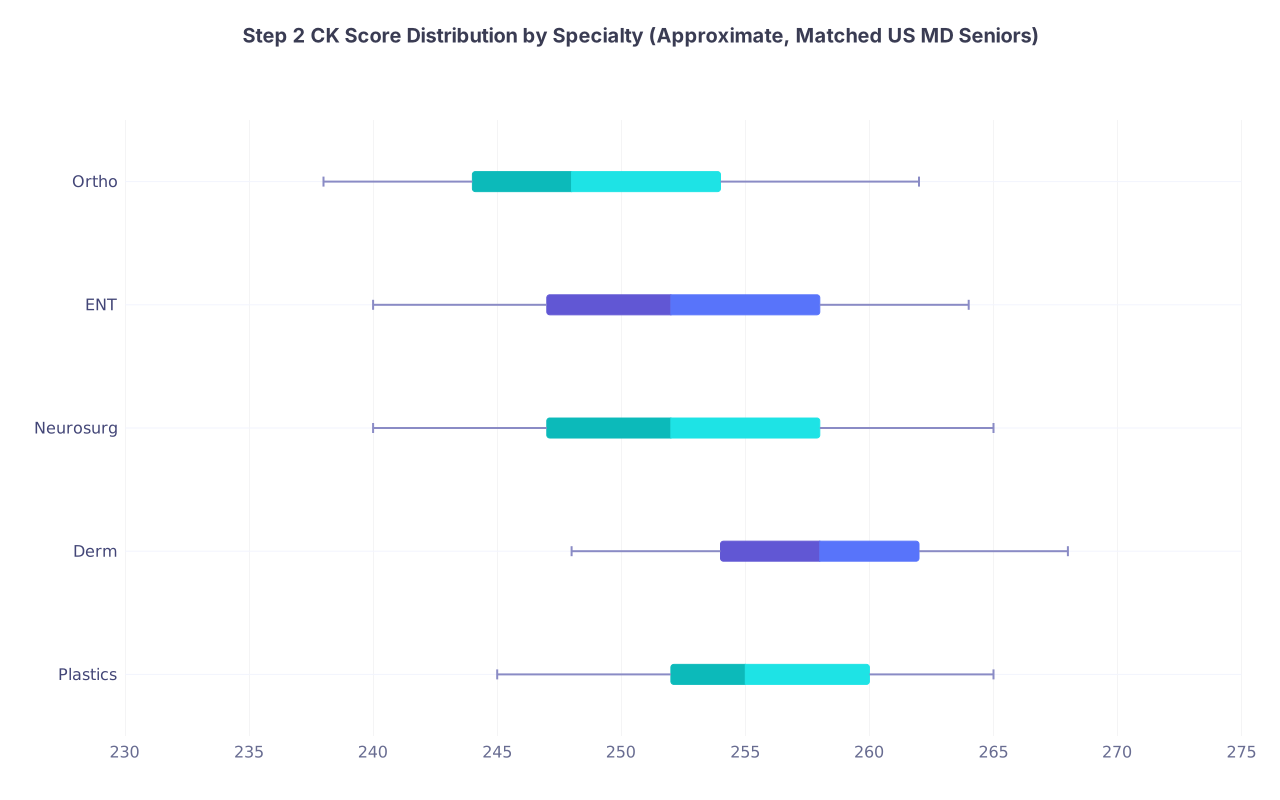
| Category | Min | Q1 | Median | Q3 | Max |
|---|---|---|---|---|---|
| Plastics | 245 | 252 | 255 | 260 | 265 |
| Derm | 248 | 254 | 258 | 262 | 268 |
| Neurosurg | 240 | 247 | 252 | 258 | 265 |
| ENT | 240 | 247 | 252 | 258 | 264 |
| Ortho | 238 | 244 | 248 | 254 | 262 |
What this shows, in plain language:
A 240 score puts you around:
- Below the 10th percentile in plastics and derm
- Very low end of neurosurg/ENT
- Still weak for ortho, but not dead if the rest of your file is strong
A 250 score puts you roughly:
- Around the median for ortho
- Slightly below median for ENT / neurosurg
- Below median but still clearly in play for plastics and derm
A 260 score:
- Above the 75th percentile for ortho and ENT
- Around or slightly above the 75th percentile even for plastics and derm
That is the hard statistical context. It is not “260 or bust.” But if you are below 245 and aiming at plastics, derm, or neurosurgery without a serious spike elsewhere (research, home program, connections), you are swimming against very strong current.
2. Step 1 (pass/fail) vs Step 2 CK: how filters actually work now
Programs used to deploy Step 1 as the first-pass screen. With Step 1 now pass/fail, that entire filtering logic has migrated to Step 2 CK. Many program directors say they are “more holistic now.” Then they hand their chiefs an Excel sheet with a Step 2 cut line at 245.
Here is how the current filter behavior looks in practice, based on conversations with PDs and chiefs plus applicant outcomes I have seen:
| Specialty | Soft Screen Line | Harder Cutoff Band | Comments |
|---|---|---|---|
| Plastics (Int) | 250 | 240–245 | Below 240 rarely reviewed |
| Dermatology | 252–255 | 245–248 | Heavy research may offset slightly |
| Neurosurgery | 245–248 | 235–240 | Home/aways can rescue borderline |
| ENT | 245 | 235–240 | Some community-heavy programs flex |
| Orthopedics | 240–245 | 230–235 | Wider spread; more Step flexibility |
“Soft screen line” = below this, your interview odds drop off quickly at most academic programs. Not zero, but sharply reduced.
The implications:
- Step 1 pass alone does not differentiate you
- Step 2 CK now carries more signal weight for:
- Initial ERAS sorting
- Who gets looked at by humans vs auto-filtered
- Which pile you land in on the PD’s desk (e.g., “strong,” “borderline,” “local interest”)
I have seen programs literally pull an ERAS export, sort by Step 2 CK descending, draw a red line at 245 or 250, and tell the coordinator, “Start inviting from the top, stop when we hit about 80 names.” That is the real process.
So if you are thinking strategically, you should treat Step 2 CK as the only nationally comparable hard metric you control at this point.
3. Field-by-field breakdown: what the score distributions actually mean for you
3.1 Integrated plastic surgery
Plastic surgery has one of the tightest, highest-scoring distributions in the match.
Approximate distribution for matched US MD seniors:
- 10th percentile: ~245
- 25th percentile: ~252
- Median: ~255
- 75th percentile: ~260
- 90th percentile: ~265
What the data say:
- Below 245: you are an outlier on the low side among matched applicants
- 245–250: in range, but you probably need strong compensators:
- 10+ pubs/abstracts/posters
- At least one dedicated research year, often two at top-10 programs
- Strong letters from known plastics faculty
- 250–260: “solid” zone. Programs will at least open your file everywhere, and the rest of your application will determine if you cross into serious contender territory
260: real asset. Not a golden ticket, but moves you toward automatic interview at many places if the rest of your file is not clearly weak
Key nuance: plastics seems unusually willing to trade off a few Step 2 points for research depth. I have seen 247–250 candidates match at strong programs with 20+ publications and big-name mentors, while 260+ with minimal research ended up with a weaker list.
3.2 Dermatology
Derm is often grouped with medicine subspecialties, but it behaves more like a “medical-surgical hybrid” in terms of competitiveness and selection behavior.
Approximate matched Step 2 CK distribution:
- 10th percentile: ~248
- 25th percentile: ~254
- Median: ~258
- 75th percentile: ~262
- 90th percentile: ~268
This is an absurdly top-heavy distribution. It tells you bluntly:
- A 240 score is essentially non-competitive at most academic derm programs unless you have a national reputation in research
- 245–250 can work with:
- Research year(s), especially in derm-focused labs
- Very strong letters from derm faculty at well-known institutions
- Significant networking / away rotations
Derm also has one of the strongest correlations between higher Step 2 and total number of interviews, based on internal program surveys I have seen: every ~5-point bump from 245 to 265 gains you several more interview invitations, on average, if your research baseline is similar.
3.3 Neurosurgery
Neurosurgery has a high median but slightly “wider” distribution compared with derm or plastics.
Approximate Step 2 CK distribution (matched US MD):
- 10th percentile: ~240
- 25th percentile: ~247
- Median: ~252
- 75th percentile: ~258
- 90th percentile: ~265
The programs that matter—major academic neurosurgery departments—are watching three numeric variables hard:
- Step 2 CK
- Number of neurosurgical publications / presentations
- Sub-I performance (subjective but often summarized as “top 10% of rotators,” which becomes a semi-quantitative internal rating)
I have seen successful matches to decent neurosurgery programs at 242–245 with:
- Strong home program support
- Multiple away rotations where faculty explicitly went to bat
- Concrete scholarly work (NS journal pubs, AANS/NREF-type abstracts)
But statistically, the lower you are below 250, the more your odds lean toward:
- Matching at smaller / less research-heavy programs
- Or failing to match on first attempt and then doing a research year, then reapplying
3.4 Otolaryngology (ENT)
ENT is in the same competitiveness tier as neurosurg and derm but with slightly more variability across programs.
Approximate Step 2 distribution:
- 10th percentile: ~240
- 25th percentile: ~247
- Median: ~252
- 75th percentile: ~258
- 90th percentile: ~264
Data pattern I have seen repeatedly:
- 250+ with decent research and no glaring red flags → interviews from a wide spread of programs, including mid- to high-tier academic
- 245–249 → interviews cluster more around your region, your home program, and any places where you rotated
- <245 → match is still possible, but now heavily dependent on:
- Home ENT program advocacy
- Performance on sub-Is
- Connections and visible interest (away rotations, conferences, directed emails)
ENT is also notorious for over-application, which amplifies the Step 2 signal; programs need some simple way to cut 600 applications down to 60–80 interviews. Step 2 is the cleanest lever.
3.5 Orthopedic surgery
Ortho has a slightly lower overall distribution but a larger number of total positions. That changes the calculus significantly.
Approximate matched Step 2 distribution:
- 10th percentile: ~238
- 25th percentile: ~244
- Median: ~248
- 75th percentile: ~254
- 90th percentile: ~262
The striking thing here is volume. There are simply more ortho spots than plastics/ENT/neurosurg, which means the distribution has more fat in the 238–248 range. I have seen:
240–245 applicants match consistently at strong community and some academic programs with:
- Solid letters (especially from big-name attendings)
- Reasonable amount of research (not necessarily a research year)
- Good performance on ortho sub-Is
250+ applicants can reasonably aim higher—mid- to upper-tier academic departments—if backed with strong evals
If you want to think in odds: being 1 SD above the ortho median (around 258–260) moves you into a category where your Step score will almost never be the reason you do not interview somewhere. At that point, everything else (fit, letters, research, personality) dominates.
4. How score distributions translate into match probabilities
People obsess over the score but ignore the probability curve. The transition from “almost no chance” to “very realistic” is not linear.
This is a stylized way to think about Step 2 CK vs approximate probability of matching in a highly competitive surgical field, assuming you are a US MD senior with reasonably typical research and no major red flags.
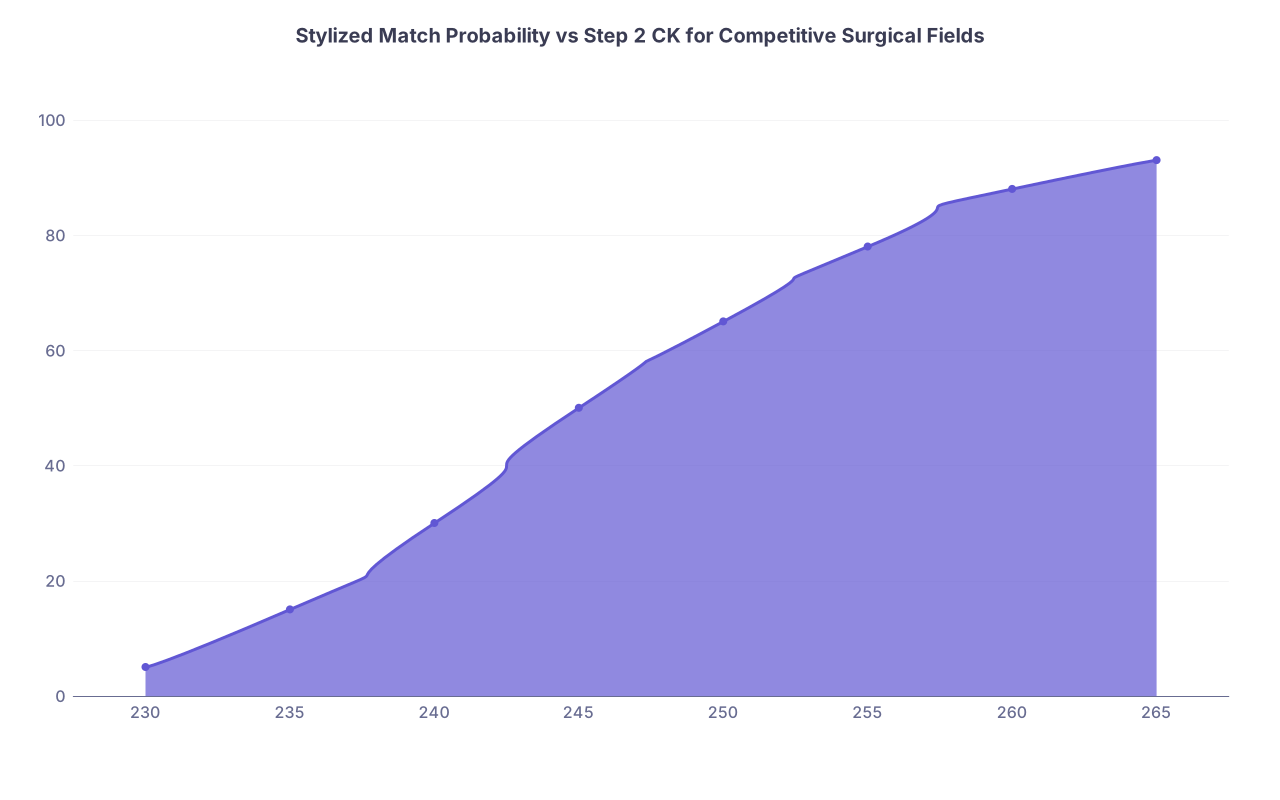
| Category | Value |
|---|---|
| 230 | 5 |
| 235 | 15 |
| 240 | 30 |
| 245 | 50 |
| 250 | 65 |
| 255 | 78 |
| 260 | 88 |
| 265 | 93 |
Read this as directional, not exact. But the shape is right:
- The big jump is 235 → 245. That is where you move from long-shot to “we have to take this applicant seriously.”
- 245 → 255 gains you a lot, but less per point than the jump from the 230s into the mid-240s.
- Above 260, you are mostly in diminishing-returns territory. A 268 is not “twice as good” as a 260 in PD eyes.
The corollary: if you are currently sitting on a 240–243 NBME average and are targeting derm/plastics/ENT, the marginal value of pushing that to 250+ is enormous. That ten-point swing can move you from 30–40% territory into 60–70%+ for match odds, assuming the rest of your file is not weak.
5. Strategy by score band: what the numbers say you should actually do
Let me be blunt. Here is how I would advise students based almost purely on their Step 2 CK number plus “average” other metrics.
5.1 Step 2 CK ≥260
You are above the 75th percentile for almost every surgical specialty.
- Strategy:
- Apply broadly but not insanely (you do not need 80+ programs)
- Target top academic centers aggressively; you are in the numeric window they expect
- Make sure your personal statement and letters are not obviously generic—at this level, weak qualitative signals hurt more
The risk here is complacency. I have seen a 263 plastics applicant with weak letters and no research get fewer interviews than a 252 with a research year and glowing recs.
5.2 Step 2 CK 250–259
You are in the “statistically comfortable” zone for all of these fields.
Plastics/derm:
- A 250 does not make you stand out on paper, but it gets you through initial filters
- Your competitiveness will be driven mainly by research volume and quality
ENT / neurosurg / ortho:
- You now have enough score to be competitive at a wide range of programs
- Focus your energy on:
- Targeted away rotations
- Strong performance on sub-Is (this is where a lot of rank list movement happens)
This is the zone where the distribution is dense. Many applicants cluster around 250–255. You differentiate by everything other than scores.
5.3 Step 2 CK 240–249
Now the distribution and specialty matter a lot.
Plastics / derm:
- Below 245: by the data, you are at or below the 10th percentile of matched applicants
- You need serious compensatory strengths:
- Dedicated research year(s) with multiple first-author papers
- Very strong institutional backing
ENT / neurosurg:
- 240–244: still below average; you will lean heavily on:
- Home department support
- Aways where faculty specifically advocate for you
- 245–249: borderline to average range; realistic if you apply broadly and have at least modest research
- 240–244: still below average; you will lean heavily on:
Ortho:
- 240–249: solidly within typical matched distribution
- Expect more interviews at community / hybrid programs, with some mid-tier academic possibilities
If you are in this band and still early (no Step 2 yet), the data say pushing up into ≥250 should be a top priority.
5.4 Step 2 CK <240
This is where hopeful thinking collides with distributions.
For plastics and derm, <240 almost always puts you below the 5–10th percentile of matched applicants, frankly bordering on non-viable without extreme outlier strengths (think: PhD, dozens of derm/plastics pubs, tightly networked mentor advocacy).
For neurosurg and ENT:
- 235–239: I have seen people match, but every single one had:
- Strong home department
- Excellent away rotations
- Some research signal
For ortho:
- 235–239: still possible, especially at community programs, osteopathic-heavy programs, or via couples match pulls
- <235: now you are fighting both the distribution and the volume problem (programs simply have too many higher-scoring applicants to consider)
In this band, the rational questions are:
- Do you pivot to a less numerically competitive field?
- Do you take a research year and aim for a major score improvement on second attempt (if Step 2 was early and below practice averages)?
- Do you target a slightly less competitive surgical field (general surgery, urology at some locations) rather than the absolute top tier?
I am not saying it is impossible. I am saying the odds curve is not kind.
6. What updated match data really changed
Two structural shifts after Step 1 went pass/fail and multiple cycles updated:
Step 2 distributions shifted upward.
Applicants know Step 2 is the new metric and study accordingly. That compresses competition around higher values. “250” is not the rare air it was a decade ago.Programs moved their implicit cutoffs.
Many PDs raised their auto-screen ranges by ~5 points. A place that used to start looking seriously at 235–240 now views 240–245 as the low end of the real applicant pool.Research became a stronger secondary discriminator.
At any given Step 2 band, research-heavy candidates are pulling more interviews than before. You see this especially in plastics and derm where the average number of abstracts/pubs/posters keeps creeping upward.
So if you are comparing your score to “my attending matched ortho with a 238 in 2011,” you are using obsolete baselines. The distributions have moved.
7. Bottom line for choosing a surgical residency based on your numbers
Strip away the noise. The data from recent match cycles in competitive surgical fields point to three core realities:
Step 2 CK is now the primary quantitative gatekeeper.
For plastics, derm, neurosurg, ENT, and ortho, your Step 2 score defines which tier of programs will meaningfully consider you. Not because PDs “care about numbers” philosophically, but because they are drowning in applications and need a fast first pass.The decisive ranges are narrow: 240–260.
Being at 255 vs 250 helps, but the real cliff is between the low 230s and mid-240s. If you can push yourself across that mid-240 threshold before you take Step 2, you dramatically change your statistical odds.Beyond the cutoff, differentiation shifts away from the score.
Once you are above a specialty’s approximate median, more points matter less than strong research, sub-I performance, letters, and fit. A 265 with weak clinical performance is a weaker applicant than a 252 with superlative evaluations and real scholarship.
So be honest with your numbers. Map your score into the real distributions for each field. Then either push Step 2 higher if you still can, or build the rest of your application to offset where you sit in that curve.