You are almost certainly misjudging how many surgical interviews you need to feel “safe.” Most applicants do. The data show that for surgery, the risk curve is steeper and more unforgiving than for most non-surgical fields, and small shifts in interview count can double or triple your odds of matching.
Let me be blunt: one or two extra interviews in a surgical specialty can be the difference between a 40 percent match chance and an 80 percent match chance. That is not hyperbole. That is what the NRMP data say when you stop hand-waving and actually look at the numbers.
This article walks through the numbers by major surgical specialty so you can stop guessing and start treating your interview count like what it actually is: a probability distribution problem.
The Core Rule: Interviews ≈ Probability
The National Resident Matching Program (NRMP) publishes “Charting Outcomes in the Match” and the “Program Director Survey.” Buried in there is the key graph you should care about: probability of matching vs. number of contiguous ranks. For practical purposes, in a typical surgical season, contiguous ranks ≈ number of interviews (minus a small number where you know you will not rank a program).
You are not matching to interviews. You are matching to the rank list those interviews create. But interviews are the rate-limiting step.
Across specialties, the data show three consistent patterns:
- Below ~5 ranks: catastrophic risk. Your chance of going unmatched is high in almost every surgical field.
- Around 8–10 ranks: the “knee” in the curve. Your match probability usually jumps from coin-flip territory into 70–85 percent.
- Around 12–15+ ranks: diminishing returns. Each additional interview still helps, but the marginal gain per interview is smaller.
The exact numbers differ for General Surgery vs Orthopedic Surgery vs Neurosurgery, and also differ for MD vs DO vs IMGs. But the shape is the same.
Let us quantify it.
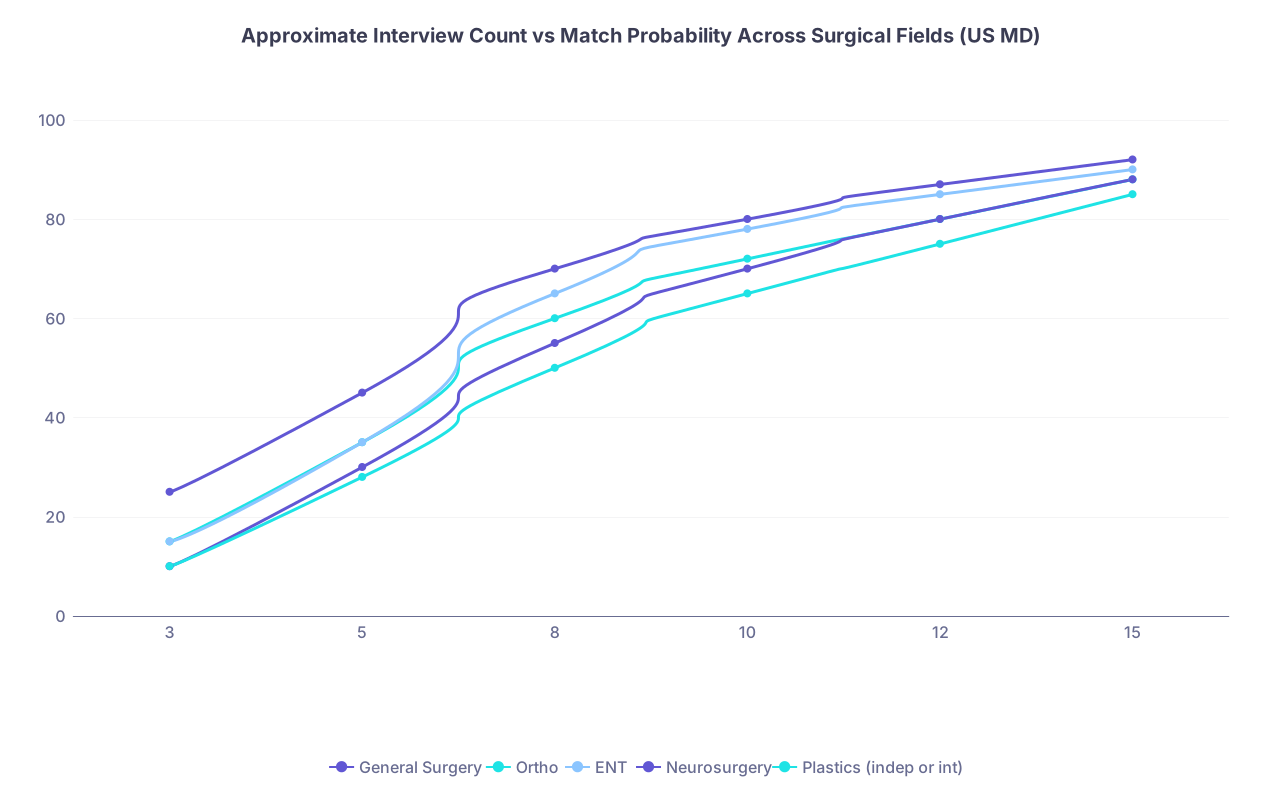
Big Picture: Interview Count vs Match Probability
| Category | General Surgery | Ortho | ENT | Neurosurgery | Plastics (indep or int) |
|---|---|---|---|---|---|
| 3 | 25 | 15 | 15 | 10 | 10 |
| 5 | 45 | 35 | 35 | 30 | 28 |
| 8 | 70 | 60 | 65 | 55 | 50 |
| 10 | 80 | 72 | 78 | 70 | 65 |
| 12 | 87 | 80 | 85 | 80 | 75 |
| 15 | 92 | 88 | 90 | 88 | 85 |
These are rounded, composite approximations from NRMP trends over multiple cycles, not exact one-year snapshots. Real life is noisier. Yet the ranking probability curves all tell the same story: the first 8–10 interviews are worth far more than interviews 16–20.
Now let us drill down by specialty.
General Surgery: The Workhorse Baseline
General Surgery is the backbone of surgical training and a good baseline for understanding how interviews convert to match probability, especially if you are a US MD.
For categorical General Surgery:
US MD seniors typically see:
- 0–4 ranks → roughly 20–40 percent chance of matching.
- 8–10 ranks → roughly 75–85 percent.
- 12–14+ ranks → 90 percent+.
DO and IMG applicants need more interviews on average to reach the same probability bands, because their per-program acceptance probability is lower.
| Applicant Type | 50–60% Match Chance | ~80% Match Chance | 90%+ Match Chance |
|---|---|---|---|
| US MD senior | 5–6 interviews | 8–10 interviews | 12–14 interviews |
| US DO senior | 7–8 interviews | 10–12 interviews | 14–16 interviews |
| US IMG | 8–10 interviews | 12–14 interviews | 16+ interviews |
Interpretation from a data analyst’s lens:
- If you are a US MD with fewer than 6–7 General Surgery interviews, you are playing a high-variance game. Historically, applicants in this band usually have <70 percent probability of matching.
- The “comfort” zone for most US MD applicants is 10–14 General Surgery interviews. Below that, anxiety is justified. Above that, the incremental benefit per interview drops but is still real.
- For DO/IMG, you need to treat 10 interviews as “moderate risk,” not safe. The data consistently show lower match rates at the same number of ranks.
I have seen applicants with 7 interviews in General Surgery tell themselves, “That is plenty, my advisors said 6+ is good.” Those advisors were quoting old, pre-competitive-era heuristics. The current numbers say otherwise.
Orthopedic Surgery: High-Stakes, High-Volume
Orthopedics is brutally competitive. The data consistently show:
- Lower match probability at each interview count compared with General Surgery.
- Strong effect of Step 2 scores, AOA, and home program / away rotations.
For US MD seniors in Orthopedics:
- Around 6–7 interviews: you are often still under 50–60 percent match probability.
- Around 10–11: now you are usually around 70–80 percent.
- Around 13–15: you start breaching that 85–90 percent comfort zone.
| Match Probability Target | Recommended Interview Count |
|---|---|
| 50–60% | 6–8 |
| ~75% | 9–10 |
| 80–90% | 11–14 |
| 90%+ | 14–16 |
For DOs and IMGs:
- The bar is significantly higher. Realistically, many DOs and especially IMGs aiming at Ortho should be targeting 15+ interviews to feel meaningfully safe, and many will not reach that volume.
From a numerical perspective, Orthopedics operates in a regime where fewer than ~9 interviews is very high risk. I have watched strong, Step-260+, AOA applicants with 7–8 Ortho interviews go unmatched because every single program had a deep bench of similarly strong applicants.
If you treat Orthopedics like General Surgery and assume 8 interviews is “fine,” you are misreading the risk curve.
ENT (Otolaryngology): Steep Drop-off Below ~8 Interviews
ENT is a classic small-field, high-competition specialty with a profile similar to Ortho: great lifestyle, high pay, limited spots. The NRMP and SF Match data over multiple years show:
- US MD seniors with:
- ≤4 ranks: often <30–40 percent match chance.
- 6–7 ranks: ~55–65 percent range.
- 9–10 ranks: ~75–85 percent.
- 12–14+: 90 percent+.
Key implication:
- The knee of the curve is around 8–10 interviews for ENT.
- Below that, the probability drops aggressively.
For DO and IMG applicants (who are rare in ENT but not nonexistent), you need to push higher—realistically 10–12 minimum to feel like the odds are not stacked against you.
This is what has actually happened with applicants I have seen: ENT applicants with 9–11 interviews are nervous but usually match. ENT applicants with 5–6 interviews are in a genuine coin-flip scenario.
Neurosurgery: Low N, High Volatility
Neurosurgery is weird statistically. Very small applicant and position numbers. Lots of applicants with extremely strong CVs. And programs that frequently have entrenched preferences for known entities (home students, research-year people, known collaborators).
Still, the basic pattern holds:
- Very few interviews (≤4–5) → large unmatched risk (>50 percent in many cycles).
- Around 7–8 → something like 60–70 percent.
- Around 10–12 → often pushing into 80 percent+ territory for US MDs.
- 13–15+: more like a 90+ percent scenario.
The main difference compared with General Surgery:
- Neurosurgery applicants are extraordinarily self-selected and skewed toward top statistics. That compresses the distribution. Your 250 Step 2 may not differentiate you as much. So the per-interview probability of success is lower.
Which means: you cannot treat a lower interview count as “fine” just because your numbers look amazing. The relative advantage shrinks in a high-signal cohort.
Viewed analytically: in a field where nearly everyone is in the right tail of the Step and research distributions, the key driver of match probability becomes volume (interview count) and network effects, not just your test scores.
Plastic Surgery: Integrated vs Independent
Plastic Surgery is another high-competition field that often gets misunderstood on the interview side.
Integrated Plastics (US MD seniors):
- Many matched applicants report ~12–18 interviews.
- The probability curve again shows something like:
- 5–6 interviews: high risk.
- 8–10: moderate, maybe 60–75 percent.
- 12–14: 80–90 percent.
15: usually >90 percent, assuming no major red flags.
Independent Plastics (after General Surgery, etc.):
- Smaller pool, different dynamics, but the same governing rule: fewer than ~8 interviews is dangerous, 10–12+ usually pushes you into safer territory.
If you are treating Plastics like a mid-tier competitive field where 6–7 interviews is comfortable, you are ignoring the data.
Comparing Surgical Specialties Side-by-Side
To see the relative competitiveness in a single snapshot, compare the approximate number of interviews needed for an ~80 percent match probability for US MD seniors.
| Specialty | Interviews for ~80% Match |
|---|---|
| General Surgery | 8–10 |
| Orthopedic Surgery | 11–13 |
| ENT | 9–11 |
| Neurosurgery | 10–12 |
| Plastic Surgery | 12–14 |
The relative ranking is obvious:
- Easiest (relatively): General Surgery
- Tougher: ENT
- Tougher still: Ortho, Neurosurgery, Plastics
If you like control, act on this: you cannot change the field’s competitiveness, but you can change your specialty strategy, dual-apply decisions, and how many interviews you accept or decline.
US MD vs DO vs IMG: Same Curve, Different Starting Point
Same number of interviews ≠ same probability across applicant types.
DO and IMG applicants often:
- Receive fewer interview offers.
- Have slightly lower per-program acceptance probability for each interview, due to structural biases and program preferences.
The NRMP data repeatedly show that at the same number of contiguous ranks, DO and IMG applicants have lower match rates than US MDs in competitive surgical fields.
From a data perspective, the line for DO/IMG is shifted down and to the right:
- Where a US MD feels reasonably safe at 10 interviews in General Surgery, a DO often needs 12–14 to be in the same probability band.
- Where a US MD Ortho applicant may feel 80 percent-safe at 12 interviews, a DO may need 14–16.
So the pragmatic rule:
- If you are DO or IMG, add 2–4 interviews to whatever threshold you hear quoted for US MDs in that specialty before you start using words like “comfortable” or “safe.”
How Interview Quality Modifies Interview Quantity
So far, I have treated all interviews as equal. They are not.
The rank list that matters is not just N programs, it is the distribution of program competitiveness and genuine mutual interest.
Three things skew the raw numbers:
Home program + strong away rotation programs
Historically, these have a much higher probability of ranking you high. A single “home” or “powerful away” interview can be worth 2–3 random mid-tier interviews in expected match probability.Ultra-competitive “reach” programs
An interview at a top-5 Neurosurgery or Plastics program is not the same as an interview at a newer community program. Your chance of landing high on their list is different. Counting them equally in your mind is naïve.Programs that you secretly will not rank
If you know a program is a “no” for geography, culture, or training style, do not fool yourself by counting it in your “safe interview” tally. It does not contribute to your actual rank length.
From a quantitative standpoint, you can think of each interview as having:
- An effective weight (higher if they know you, if you rotated there, or if your profile matches their historical picks).
- A real rank probability (zero if you will never rank them, low if they are out of your realistic range).
Experienced applicants subconsciously do this. You should do it explicitly.
The Risk Curve: Where It Gets Dangerous
| Category | Value |
|---|---|
| 2 | 80 |
| 4 | 60 |
| 6 | 45 |
| 8 | 30 |
| 10 | 20 |
| 12 | 12 |
| 14 | 8 |
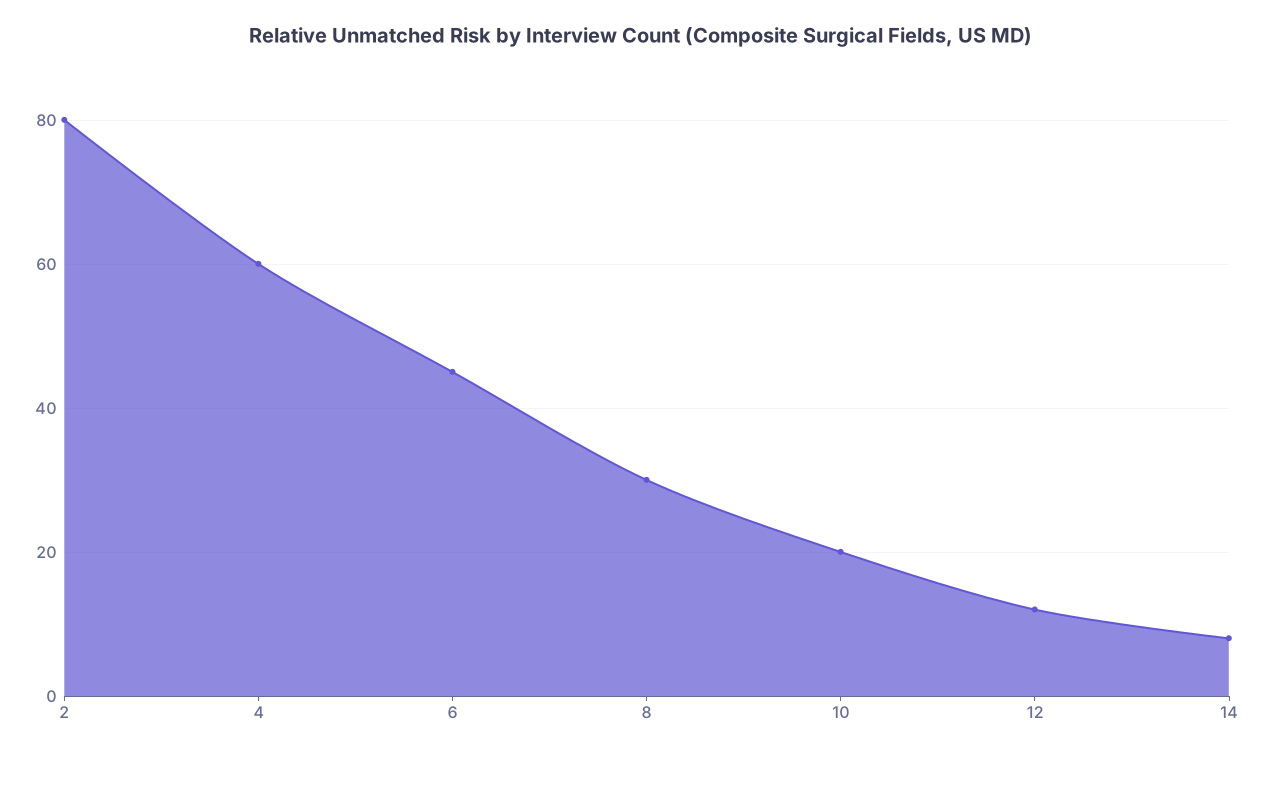
Interpreting this generic composite:
- At 2–4 interviews: your unmatched risk in most surgical specialties is alarmingly high (60–80 percent). You are in lottery territory.
- At 6–8 interviews: unmatched risk is still 30–45 percent in the more competitive fields.
- At 10–12: now you are down in the 12–20 percent band for US MDs in many surgical specialties.
- At 14+: the residual unmatched risk, if you actually rank all those programs, starts dropping below 10 percent.
This is why I become impatient when someone says, “I have 7 Ortho interviews, I heard the national average is about that, so I should be fine, right?” No. The mean is not the safety threshold. The risk curve is nonlinear.
How to Use These Numbers For Real Decisions
You are not doing this exercise to admire the graphs. You are doing it to answer four hard questions.
1. Should I dual-apply?
Run this honestly:
- Take your most realistic estimate for your final rank list length in your chosen surgical field.
- Use the banded estimates above:
- <6 ranks in a very competitive field (Ortho, ENT, Plastics, Neurosurg): high risk.
- 6–8 ranks: moderate/high risk.
- 8–10: moderate risk.
- 11–14: lower risk.
If, based on your school’s historical data and your CV, you project:
- <8 ranks in Ortho, ENT, Neurosurg, or Plastics → you should strongly consider dual-applying (e.g., General Surgery or a less competitive field).
- <6 ranks in General Surgery as a DO/IMG → dual-apply or broaden application scope.
2. How many interviews can I safely decline?
Short answer: fewer than you think.
In surgery, I usually treat these as rough do-not-go-below floors if you want to sleep at night:
- General Surgery (US MD): Do not decline down to fewer than 10 categorical interviews unless you are forced by absolute conflicts.
- Ortho / ENT / Neurosurg / Plastics (US MD): Try not to drop below 12–13 total unless you are 100 percent certain your “core” programs (home + away) are ranking you aggressively.
If you are DO or IMG, lower those floors at your own risk.
3. When should I panic and change strategy mid-season?
Look at your numbers by late November / early December.
- If you are sitting at:
- 3–4 total interviews in a very competitive surgical field.
- 5–6 in General Surgery as a DO/IMG.
Then you are in a danger zone numerically. That is when you:
- Take every possible late invite.
- Proactively reach out to prelim and backup options.
- Consider SOAP planning earlier than others.
Not because of vibes. Because of probabilities.
4. How much does one more interview matter late in the season?
The marginal value of an additional interview depends on where you are on the curve:
- Going from 3 → 4 interviews in Ortho: big delta, maybe 5–10 percent increase in match probability.
- Going from 11 → 12: smaller delta, maybe 2–3 percent.
- Going from 18 → 19: you are already in low single-digit marginal gain territory for most people.
So late in the game, if you currently have:
- ≤8 total interviews in a competitive surgical field → almost any credible additional interview is worth serious effort.
- ≥14 → you can be selective. The marginal gain may not justify high travel cost or schedule chaos.
One Last Reality Check: You Cannot Optimize Away All Risk
Data help you manage risk. They do not eliminate it.
You can:
- Hit 14 Neurosurgery interviews and still go unmatched.
- Match in Ortho with 5 interviews because one home program loved you.
Those are tails of the distribution. You do not build a strategy based on tails.
What you can do—and what almost no one does rigorously—is treat your interview count, by specialty and by applicant type, as a quantifiable risk profile instead of a vibe.
So here is the distilled version, if you remember nothing else:
- For General Surgery (US MD): Aim for 10–14 categorical interviews to feel reasonably safe. Fewer than 7–8 = real risk.
- For Ortho / ENT / Neurosurg / Plastics (US MD): Aim for 12–15+ interviews. Fewer than 8–9 = you are in a high-risk band.
- If you are DO or IMG: add 2–4 interviews to those targets to approximate similar safety.
With that framing, you can stop asking, “Is 7 interviews enough?” in the abstract and start asking the better question: “Given my specialty and background, where am I on the risk curve, and what do I need to do next to move up it?”
Because once you understand your numbers, the rest of the residency strategy—dual-apply plans, backup lists, how aggressively to chase late invites—stops being guesswork and starts looking like what it actually is: the next stage of a probabilistic game you are finally playing with your eyes open.
And once Match Day passes, and you are on the other side of this, the next dataset you will care about is very different: case volumes, fellowship placement rates, and board pass statistics by program. But that is a different analysis for a different phase of your journey.