You are a PGY‑2 on a general surgery rotation, scrubbed into yet another open cholecystectomy that should have been laparoscopic. Your phone buzzes in your locker with a text from a friend: “Our hand fellow just reduced a perilunate. Unreal. Plastics is where it’s at.”
Meanwhile, last week you were on ortho call and watched an attending pin two supracondylar humerus fractures and bail on a nasty mangled hand—“Call plastics.”
You like the intricacy of the hand. You like tendons, peripheral nerve, small joints. You also like the idea of fixing ankles, doing scopes, maybe a little arthroplasty. Or on the other side, facial fractures, microsurgery, breast reconstruction.
And the nagging question keeps circling:
If I want to be a hand surgeon, is orthopedics or plastics the better residency for hand exposure?
Let me break this down specifically, in the way programs actually function, not the fantasy version people throw around on Reddit.
1. The Fundamental Difference: What “Hand” Means in Each World
Before talking exposure, you need to accept one core idea: ortho and plastics approach the hand with different default priorities.
Orthopedic residents are trained primarily as musculoskeletal surgeons:
- Bone and joint stability
- Tendon mechanics
- Alignment, hardware, rehab plans
Plastic surgery residents are trained primarily as soft-tissue and reconstruction surgeons:
- Soft tissue coverage
- Nerve and vessel repair
- Microsurgery, flaps, cosmetic and functional restoration
Both operate on hands. But they do not walk into the room with the same mental model.
In practice, that plays out like this:
ORTHO RESIDENT CASE FOCUS (typical):
- Distal radius, scaphoid, metacarpal, phalanx fractures
- Tendon repairs with strong focus on biomechanics
- Wrist arthroscopy, ligamentous injuries (TFCC, SL/LT)
- Carpal instability, arthritis, small joint fusions
PLASTICS RESIDENT CASE FOCUS (typical):
- Flexor/extensor tendon lacs and secondary reconstructions
- Digital and nerve injuries, nerve grafts, nerve transfers
- Revascularizations, replantations (where available)
- Complex soft tissue coverage, local flaps, free flaps
- Congenital hand in some programs
Both will do carpal tunnel and trigger finger. That’s the bread-and-butter overlap. But the “advanced” side of the Venn diagram diverges quickly.
2. What Hand Exposure Actually Looks Like in Ortho Residency
Assume a standard 5‑year ACGME-accredited orthopedic surgery residency.
Rotation Time
Most ortho programs give:
- 2–4 months of formal hand rotation as a resident (often PGY‑3/4)
- Plus scattered elective time in hand during senior year if you choose it
- Plus call coverage where you pick up hand fractures, tendon lacs, etc.
In many places, hand is embedded in upper extremity or trauma service, so you get more exposure than the rotation names imply.
Typical structure:
- PGY‑2/3: First exposure to hand, lots of basics, ED reductions, pinning straightforward fractures.
- PGY‑4/5: Return as senior; now you lead cases, do more definitive fixation, attend clinic, and manage postop functional outcomes.
Case Mix and Volume
The key difference for ortho: numbers.
Most ortho residents graduate with very high volumes of:
- Distal radius fractures (volar plating, external fixation occasionally)
- Metacarpal and phalanx fractures (CRPP, ORIF, lag screws, plates)
- Carpal tunnel releases and trigger digit releases
- Joint arthrodesis/stabilization procedures (DIP/PIP fusions)
- Some wrist arthroscopy in stronger programs
You will see tendon repairs, but in many hospitals, tendon lacs are shared with plastics or EM stitches and refer. So tendon volume can be modest unless the hand attendings are ortho-based and aggressive.
Nerve work in ortho residencies tends to be limited:
- You might do digital nerve repairs.
- Proximal nerve work, grafting, or transfers are rarely owned by ortho residents pre-fellowship.
Complex soft tissue coverage is also less common:
- You will see flaps, but mostly pedicled options and simple local rearrangements.
- Free flaps with ortho micro are rare in the average general ortho program; those tend to be at big academic centers with ortho microsurgeons.
So what you leave with from ortho:
- Strong foundation in fracture management and mechanics of the hand and wrist
- Good exposure to compressive neuropathies (carpal/cubital) at the level of diagnosis and decompression
- Variable but often limited exposure to nerve/micro and advanced soft-tissue reconstructive problems
Where Ortho Hand Exposure Is Strongest
Ortho hand exposure is especially solid at:
- Programs with high-volume ortho hand faculty (e.g., Mayo Ortho, HSS, Rothman-affiliated programs, certain large academic centers).
- Trauma-heavy programs where ortho hand takes most hand trauma before plastics gets called.
- Places where hand is orthopedic-dominated culturally (common in community-heavy ortho programs).
You can usually see this in case logs and faculty lists. If a program has 3+ dedicated ortho hand attendings and no plastics hand presence, you know where the volume is going.
3. What Hand Exposure Looks Like in Plastics Residency
Now, flip to integrated or independent plastic surgery training (6 years integrated, or 3 years independent after general surgery).
Rotation Time
Typical plastics structure:
- 3–6 months explicitly labeled “hand” or “hand and upper extremity” during residency.
- Ongoing exposure to hand trauma while on general call (especially in community hospitals where plastics is “the” hand team).
- Electives in hand or micro in senior years if available.
In many integrated plastics programs, you will rotate on ortho hand or a combined hand service early, then again later as a senior with more autonomy.
Case Mix and Volume
Plastic surgery residents’ hand case mix is different. Less about plates and screws, more about tissue and microsurgery.
You will see a lot of:
- Flexor and extensor tendon repairs, including zone II, staged reconstructions, tendon grafting.
- Digital nerve repairs, nerve grafts, later neurolysis, occasionally nerve transfers depending on local expertise.
- Replantations and revascularizations at centers that still receive that volume.
- Soft tissue coverage around the hand and wrist: local flaps, reverse radial forearm, posterior interosseous flaps, thenar flaps, groin flaps in some older-school places.
- Scar contracture releases, syndactyly release, basic congenital hand where present.
You will still do osseous work:
- Phalanx and metacarpal fractures
- Some distal radius and carpal fractures depending on call patterns
- K‑wire fixation for many small bone injuries
But you usually will not do:
- Wrist arthroscopy at meaningful volume
- Complex carpal instability reconstructions
- Arthroplasty of small joints at depth (outside specific hand/micro heavy centers)
- Complex distal radius ORIF in the same volume as ortho folks
The other big piece: plastics hand sits at the interface of micro and extremity. So your hand exposure blends into:
- Free flaps for traumatic upper extremity defects
- Brachial plexus work and nerve recon (at select programs)
- Neuroma management and targeted muscle reinnervation (TMR)
If you are heading toward a micro-heavy hand practice (replants, free flaps, nerve), plastics training gives you a very direct runway.
4. Side‑by‑Side: Where Each Path Dominates
Let’s put this concretely. This is the part most students never get clearly spelled out.
| Domain | Ortho Residency (Typical) | Plastics Residency (Typical) |
|---|---|---|
| Fractures (volume) | Very high (DRF, metacarpal, phalanx) | Moderate |
| Tendon repairs | Moderate | High |
| Nerve repairs/grafts | Low–moderate | High |
| Wrist arthroscopy | Moderate–high (good programs) | Low |
| Soft tissue flaps | Low–moderate | High |
| Replantation/micro | Low (unless micro-heavy center) | Moderate–high (center-dependent) |
| Congenital hand | Low | Low–moderate (select programs) |
| Carpal tunnel/trigger | High | High |
Now, the chart version to hit your pattern recognition instinct:
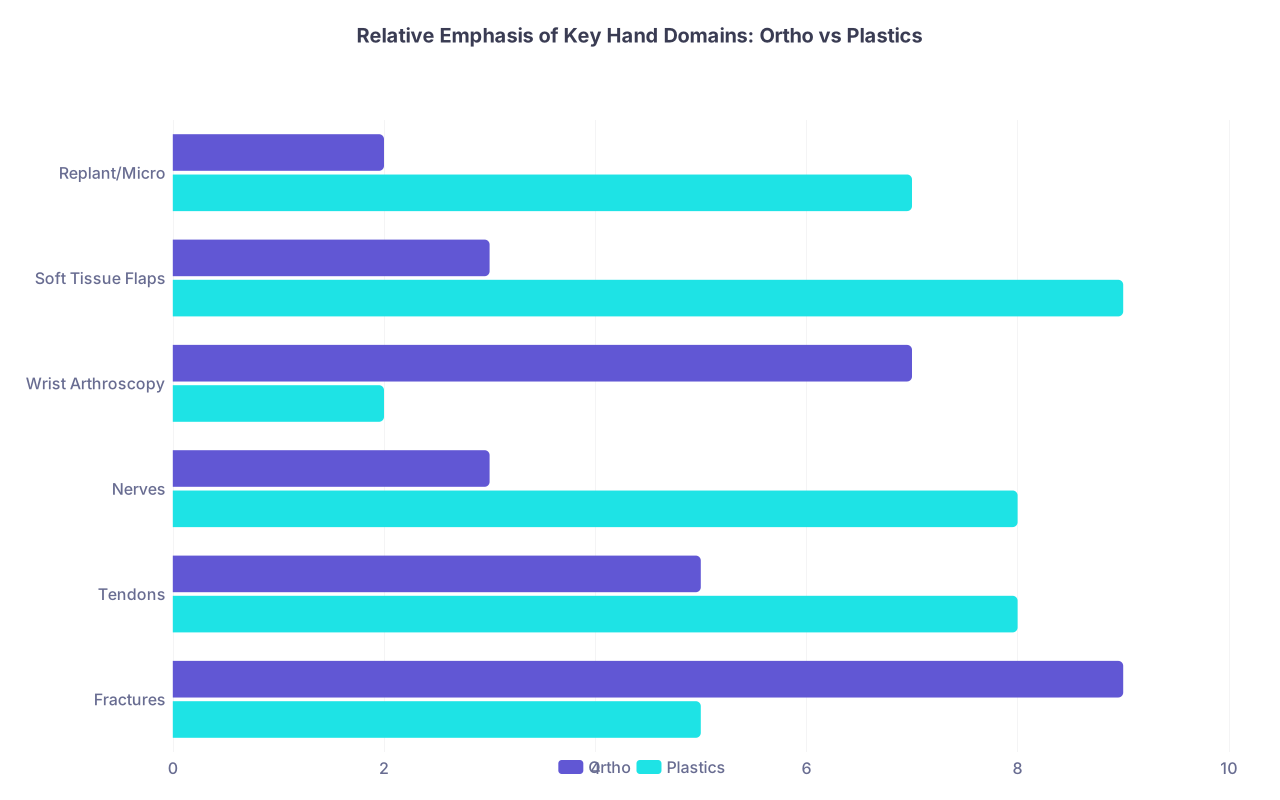
| Category | Ortho | Plastics |
|---|---|---|
| Fractures | 9 | 5 |
| Tendons | 5 | 8 |
| Nerves | 3 | 8 |
| Wrist Arthroscopy | 7 | 2 |
| Soft Tissue Flaps | 3 | 9 |
| Replant/Micro | 2 | 7 |
Is this exact? No. But directionally, it is how most graduates describe their experience.
5. How Hand Fellowship Fits In (And Why It Matters)
Here is the honest truth most people discover PGY‑4: if you want to be a true hand surgeon, you are almost certainly doing a hand fellowship regardless of whether you come from ortho or plastics.
The ACGME hand fellowships are dual-eligible:
- Ortho residents can match.
- Plastics residents can match.
- Some fellowships also take general surgery or neurosurgery, but that is rare.
What the fellowship directors care about:
- Your baseline technical skill
- Your understanding of musculoskeletal vs soft-tissue principles
- Your case logs and letters
- That you actually want to be a hand surgeon, not using fellowship as a placeholder
Fellowship then standardizes much of your skillset:
- Everyone learns fractures, tendon, nerve, micro, coverage, arthritis procedures.
- The ortho residents round out their soft tissue and nerve work.
- The plastics residents round out their bony work and carpal pathology.
So the decision is less “Where will I get to touch a hand?” and more:
- What do I want my non-hand surgical life to look like if I do not do hand?
- What kind of bigger-picture surgical brain do I want to bring to my eventual hand practice?
That last one people ignore, and they regret it.
6. Call, Trauma, and Who Actually Owns the Hand in Real Life
You should pay close attention to hospital call patterns. Because that is where residents actually gain comfort and decision-making competence.
Ortho-Dominant Hand Call
Hospitals where:
- Ortho gets all fractures and many tendon lacs first.
- Plastics comes in for complex soft tissue, replant, or when ortho declines.
As an ortho resident, you:
- Learn to handle bread-and-butter hand trauma from ED consult to OR.
- Reduce and fix fractures at 2 a.m., manage compartment syndromes.
- Occasionally call plastics for coverage or complex tendon/nerve issues.
As a plastics resident in this setup:
- You see hand trauma selectively—when it is nasty: mangled, coverage required, microsurgery.
- Volume of routine cases can be lower, but the complexity of what you see can be higher.
Plastics-Dominant Hand Call
Hospitals where:
- Plastics is “the hand service” that ED calls first.
- Ortho primarily handles big long bone trauma and elective joints.
As a plastics resident, you:
- Get slammed with hand lacs, tendon injuries, fingertip trauma, some fractures.
- Are the point person for both ED and floor consultations on upper extremity soft tissue and many fractures.
Ortho residents in these settings:
- Often see fewer hand cases independently.
- May lose fracture volume in the hand to plastics, particularly if attendings are plastics hand surgeons.
You can guess which system gives which resident better primary decision-making in hand trauma. It is not just about who does more cases; it is about who gets called first, at 3 a.m., with no one else immediately in the room.
7. Skillset After Residency (Before Fellowship): Ortho vs Plastics
Imagine you finish residency and, for some reason, do not do a hand fellowship. What kind of “hand surgeon” are you then?
Ortho Graduate Without Hand Fellowship
Typical comfort zone:
- Distal radius fractures, metacarpal and phalanx fractures.
- Carpal tunnel, trigger fingers.
- Some small joint fusion and simple wrist procedures.
- Simple tendon repairs and digital nerve repairs.
Weak spots:
- Complex soft tissue coverage, flaps.
- Replants, revascularization.
- Advanced nerve work (grafts, transfers).
- Congenital hand.
This person can be a perfectly competent community orthopedist doing a decent amount of hand. Lots of private ortho groups look exactly like this.
Plastics Graduate Without Hand Fellowship
Typical comfort zone:
- Tendon repairs, digital nerves, complex soft tissue work.
- Finger and some metacarpal fractures with K‑wires or simple ORIF.
- Coverage around the hand and wrist, scar revision, contracture release.
- Some replants, depending on program.
Weak spots:
- High-volume complex distal radius ORIF.
- Advanced arthroscopy, complex carpal instability reconstructions.
- Arthritis work at the level of total joint systematic management.
This person can be a very solid “hand and soft-tissue” plastics surgeon, especially in community settings where the bar is: fix injuries, restore coverage, decompress nerves, and know when to refer.
If your dream is “I want to be the person everyone calls for replants, nerve reconstruction, and crazy mangled hands,” plastics plus a hand/micro fellowship is often the cleaner route.
If your dream is “I want to run a practice where I do a mix of distal radius, carpal work, tendon, nerve, and maybe some shoulder/elbow,” ortho plus hand fellowship fits better.
8. Program‑Level Variability (The Giant Asterisk)
Here is where students get misled. They hear one story from a single resident and think it is universal.
Reality: there is massive program-level variability.
Examples I have seen firsthand:
A large Midwest academic ortho program where:
- Ortho hand owns almost all hand trauma.
- Plastics is mostly breast and general reconstruction.
- Ortho residents complete residency with huge hand fracture and carpal volumes and solid tendon/nerve exposure through hand attendings who like micro.
A coastal integrated plastics program where:
- Plastics runs a dedicated micro/hand service with replants.
- Ortho sends anything with soft tissue complexity to plastics.
- Plastics residents have absurd numbers of tendon and nerve cases, and enough fractures to be comfortable.
A shared-hand institution where:
- There is a combined hand call line with both ortho and plastics fellows.
- Residents from both services rotate on the hand service.
- Exposure is more equal, but faculty background shapes which residents are favored in clinic/OR.
So when you are comparing “hand exposure ortho vs plastics,” in real life you are comparing:
- Specific ortho Program A vs specific plastics Program B
Not Theoretical Ortho vs Theoretical Plastics.
You need concrete data:
- Who takes hand call? Which service is called first?
- How many dedicated hand attendings are on each side?
- Is there a hand fellowship there, and is it ortho-, plastics-, or dual-dominated?
- Can residents show you anonymized case logs for hand domains?
If residents dodge those questions or give you “oh yeah, you see a lot of hand,” assume nothing.
9. How to Decide: Matching Your Personality and Long‑Term Vision
Strip away the noise. Ask yourself three questions.
1. If I somehow do not match into hand fellowship, which core residency do I want to be in?
Ortho residency life vs plastics residency life is very different.
Ortho:
- Heavy trauma.
- A lot of sports, joints, spine, general fracture work.
- Culture is more “teams,” volume, aggressive clinic and OR.
- Lifestyle and job market after residency skew toward group practices, community and academic orthopedics.
Plastics:
- Mix of reconstruction and aesthetics.
- Microsurgery, breast, facial trauma, wounds.
- Culture often more “niche,” detail-oriented, image-conscious.
- Job market can include private cosmetic practices, reconstructive groups, academic microsurgery.
If all hand fellowships vanished tomorrow, which group of people and which day-to-day operative content would still make sense for you? That is your strongest compass.
2. What type of hand surgeon do I actually want to be?
Be specific, not aspirational fluff.
If you’re thinking:
- “I love biomechanics, arthritis, and complex wrist instability, and I also like shoulder and elbow.”
Ortho is better aligned.
If you’re thinking:
- “I’m obsessed with peripheral nerve, replant, soft tissue coverage, and microsurgery.”
Plastics gives you more relevant training en route.
If you’re thinking:
- “I want to be able to do both orthopedic and reconstructive complexity at a high level.”
Either path works, but you need:- A top hand fellowship.
- A program (ortho or plastics) with robust hand and micro exposure early.
3. Where can I get the strongest combined exposure: residency + fellowship?
Look one step ahead:
- Many top hand fellowships are historically ortho-dominated, but most now take plastics as well.
- Some micro-heavy, replant-heavy fellowships are more plastics-aligned.
- Some institutions strongly prefer to match their own residents into their hand fellowships.
You are not just choosing a core residency. You are choosing which network of hand mentors, fellowship directors, and alumni you want to be attached to.
10. Practical Steps for MS3/MS4 Trying to Decide
You need a concrete plan to evaluate programs, not just vibes from a visiting rotation.
Use Rotations Strategically
- Track how many hand cases you see in a week. Do not just remember “a few.”
- Note: who gets called for tendon lacs? Who fixes distal radius? Who does revascularizations?
- Ask upper-levels passing comments: “Do ortho or plastics see more hand here?” People will tell you bluntly at 1 a.m.
On a plastics rotation:
- Same thing: count the cases. How much of your OR time is hand versus breast, face, general recon?
- Ask: “If a mangled hand comes in, who is first call—plastics or ortho? Who does replants?”
- Watch who the ED pages, not just what residents say on tours.
Ask Targeted Questions on Interview Day
Do not ask, “How is your hand exposure?” That invites fluff.
Ask:
- “Who takes first call for hand trauma at your main hospital—ortho or plastics?”
- “How many months of dedicated hand do residents get, and in which years?”
- “Do residents operate with the hand fellows, or does the fellowship absorb the complex cases?”
- “Can a resident graduate here with enough hand to be comfortable doing community hand without a fellowship?”
You do not need a perfect answer. You need a real one.
Look at Real Case Logs When You Can
Some chiefs will show you (informally) their ACGME log categories:
- Distal radius ORIFs
- Metacarpal and phalanx cases
- Tendon repairs
- Nerve repairs/grafts
- Micro cases
If a so‑called “hand-heavy” program has residents with barely any nerve, tendon, or micro exposure—believe the numbers, not the marketing.
11. A Simple Mental Algorithm
If you like algorithms, here is one way to frame the decision about residency route, assuming hand is your main target:

| Step | Description |
|---|---|
| Step 1 | Want hand surgery career |
| Step 2 | Choose Ortho |
| Step 3 | Choose Plastics |
| Step 4 | Target ortho programs with strong hand volume |
| Step 5 | Reconsider specialty choice |
| Step 6 | Target plastics programs with hand and micro strength |
| Step 7 | Prefer bones and joints or soft tissue and micro |
| Step 8 | Happy doing general ortho if no hand fellowship |
| Step 9 | Happy doing broad plastics if no hand fellowship |
Crude, but surprisingly accurate for most people I have watched go through this.
12. One More Reality Check: The Hand Market
You also need to know what you are walking into.
- Dual‑trained hand surgeons (ortho or plastics) are in demand in many regions, but:
- Ortho hand surgeons often join large ortho groups, mix hand with general ortho or upper extremity, and focus on fracture/arthritis/sports‑adjacent work.
- Plastics hand surgeons often end up in academic centers, micro-heavy practices, or plastics groups where hand and nerve complement breast, facial, and other recon.
If your end vision is:
- “I want to join an ortho group and be ‘the hand person’ with some shoulder/elbow on the side.”
Ortho → Hand fellowship is the straightforward, structurally favored path.
If your end vision is:
- “I want a mixed reconstructive/micro practice where hand, brachial plexus, limb salvage, and maybe breast/other flaps coexist.”
Plastics → Hand/Micro fellowship often lines up better.
Neither is “better.” But each is clearly better suited to a specific life you might want.
Key Takeaways
Ortho residencies give you high-volume fracture and carpal pathology exposure with limited but real tendon/nerve work; plastics residencies give you dense tendon/nerve/soft-tissue and micro exposure with more modest bony work.
Hand fellowship is the great equalizer, but your core residency still shapes your mindset, your non-hand operative life, and your eventual practice environment.
You should not choose between ortho and plastics “for hand” in the abstract. You should choose the residency where:
- You would still be satisfied if you never did a hand fellowship.
- The program’s actual call patterns and case logs give you meaningful, not theoretical, hand exposure.