
The fantasy that you can treat orthopedic residency like a lifestyle job just because you have a spouse and kids is dangerous. Programs will not bend physics for you. But you absolutely can do ortho with a family—if you pick the right kind of program and get brutally honest about what you (and your partner) can tolerate.
This is not about “work‑life balance.” This is about whether your marriage survives PGY‑2, whether your kids still recognize you during trauma season, and whether you make it to graduation without burning out or blowing up your home life.
Here’s how to evaluate ortho programs specifically as a married parent, step by step.
Step 1: Accept What You’re Actually Signing Up For
You cannot evaluate programs realistically if you’re clinging to a false picture of orthopedic residency.
Typical reality for ortho (varies, but directionally right):
- 70–90 hour weeks are common at many places, especially PGY‑1 to PGY‑3
- Early mornings (in house 4:45–5:30 am for some trauma services)
- Late add‑on cases that blow up your evening plans
- Home call that is not actually “quiet” home call
- Weekend coverage that may be q2–q3 on busy rotations
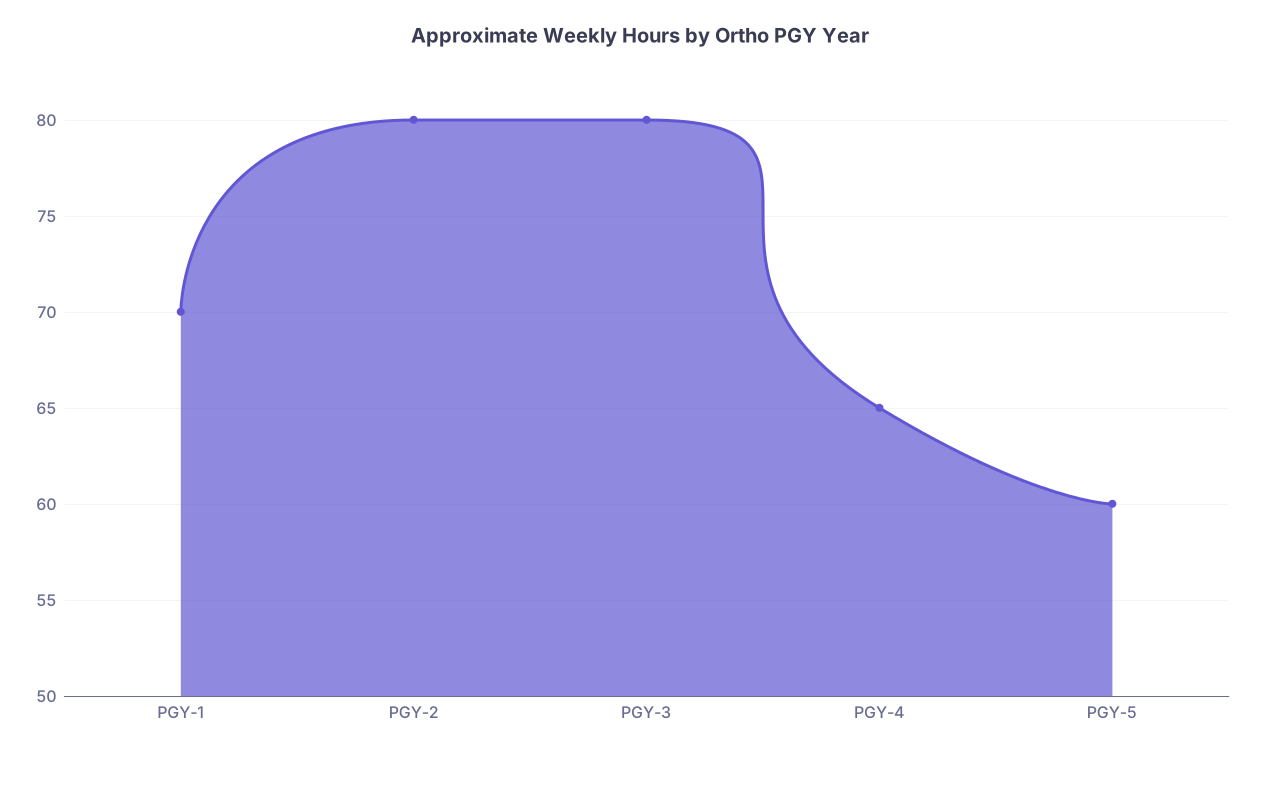
| Category | Value |
|---|---|
| PGY-1 | 70 |
| PGY-2 | 80 |
| PGY-3 | 80 |
| PGY-4 | 65 |
| PGY-5 | 60 |
If you’re married with kids, here’s the extra layer:
- Your partner is basically solo‑parenting a lot of the time.
- Childcare failures (sick kid, daycare closed, nanny quits) become emergencies.
- You’re not only tired at work; you’re expected to “show up” at home too.
So the question is not “Can I do ortho with a family?” The question is:
“Which programs make this barely sustainable versus impossible for our specific situation?”
To answer that, you need data, not vibes.
Step 2: Build Your Non‑Negotiable List (With Your Partner)
Do this before you even start comparing programs, or you’ll rationalize anything for a big‑name name.
Sit down with your spouse and answer:
What’s our realistic childcare plan?
- Family nearby or not?
- Can you afford a nanny, or are you dependent on daycare hours?
- Any kids with special needs, therapies, or frequent appointments?
What are our hard constraints? Examples:
- “We cannot do a program where both of us are commuting 45+ minutes.”
- “Daycare closes at 6 pm; we have no one else in town.”
- “Spouse works nights/weekends too; we need at least some predictability.”
What’s our minimum acceptable time together?
- One real day off together per week?
- At least 1–2 evenings where you’re reliably home before kids’ bedtime?
If you skip this and just “see how it goes,” you’re setting up for resentment.
Write the non‑negotiables down. Literally. Because you’re going to get dazzled on interview day and forget.
Step 3: Learn the Types of Ortho Programs (From a Family Lens)
Not all ortho programs are equally brutal in the same way. Some are terrible for a family because of time. Some because of culture. Some are survivable.
Here’s a general map:
| Program Type | Family-Friendliness (Typical) | Main Risk for Parents |
|---|---|---|
| High-powered academic | Low–Moderate | Hours + research |
| County/trauma heavy | Low | Chaos + call |
| Balanced academic/community | Moderate–High | Variable by site |
| Pure community | Moderate | Fewer residents |
| Military | Variable | Deployments/duty |
Quick rundown:
High-powered academic (big name, huge volume)
Think top 20 programs, big research footprint, level 1 trauma center.
- Pros: Good case volume, strong fellowship options, sometimes more residents to share call.
- Cons: Very high expectations, research on top of clinical work, culture may glorify staying late “for the team.”
Family filter: These programs can be doable for a family if the culture respects having a life and schedules are humane. Some absolutely do not.
County / trauma-heavy programs
- Pros: You graduate very comfortable with trauma, lots of autonomy.
- Cons: Nights are busy as hell, frequent late OR add‑ons, consults from everywhere.
Family filter: Rough for predictable family time. If your partner needs predictability, be extremely cautious.
Balanced academic/community mix
You rotate at a main academic site + community hospitals + maybe private sports/spine groups.
- Pros: Some rotations much lighter; shared workload; maybe more regular hours on certain blocks.
- Cons: Multiple sites mean multiple commutes; schedule uniformity varies.
Family filter: Often the sweet spot for married residents with kids if leadership is reasonable.
Pure community programs
- Pros: Often less research pressure, sometimes more elective ortho, potentially earlier finishes some days.
- Cons: Fewer residents mean more call; if volume is high, burden per resident spikes.
Family filter: You must look very carefully at call frequency and actual hours. Can be great, can be quietly awful.
Step 4: Decode Schedules Honestly (Not Just What They Tell You)
Every program will tell you they “comply with duty hours” and “are family friendly.” That phrase is basically meaningless unless you match it to their actual structure.
Here’s what you look for and what it really means.
1. Number of residents per year
More residents per year usually means:
- More ability to share call
- Slightly more flexibility for coverage around major life events
- Less q2 disaster trauma call
If a program has 2 residents per year and a massive trauma center, that’s a red flag for a parent unless there are advanced practice providers (PAs/NPs) doing a ton of floor work.
2. Call structure
You want precise answers here, not “it varies.”
Ask:
- “For PGY‑2 and PGY‑3, what’s the typical in‑house call frequency on trauma?”
- “Is call in‑house, home, or a mix? How often does home call actually make you come in?”
- “On average, post‑call, what time are residents usually going home—and do you actually get to leave?”
Programs that are survivable for parents usually:
- Have post‑call days that are truly protected
- Avoid chronic q2–q3 in‑house call outside of short stretches
- Do not have a culture of staying late post‑call “to help out”
3. Start and end times
You’re not asking whether they do 5 am rounds. Lots do. The real question:
- “What time do people actually leave on:
– A typical elective day?
– A busy trauma day?
– Clinic days?”
Watch for the shift in tone: “Well… it depends…” Translation: you’re there late. A lot.
Programs better for families typically:
- Have some rotations where you can reliably leave by 5–6 pm
- Have at least some predictability in scheduled OR days vs. clinic days
Step 5: Probe the Culture Without Getting the Scripted Answer
Culture matters more than the official schedule for married residents.
Two programs can have identical call schedules on paper, but in one, seniors will send you home early if your kid has a recital; in the other, they’ll mock you for asking.
Here’s how you test culture.
Questions for Residents (Not Faculty)
Ask these on interview dinners, Zoom socials, or in one‑on‑one chats:
- “Do you have any co‑residents who are married with kids? How are they doing?”
- “Has anyone had a baby during residency? How did the program handle leave and coverage?”
- “When someone has a family emergency, who actually covers? Is that seen as normal or resented?”
- “How often do you realistically get an entire day off that you can plan around?”
Then shut up and watch:
- Do they answer quickly and confidently? Or glance at each other and hesitate?
- Do they give a specific example? (“When John’s kid was hospitalized, we…”)
- Or something vague like “We’re super flexible here”?
If nobody in the program has kids, that’s data. It doesn’t mean it’s impossible, but it means you’ll be the one discovering the cracks.
Red flag phrases from residents
- “You just have to grind for five years and then you can live your life.”
- “People with families manage… somehow.”
- “We don’t really have time for that stuff, but it’s just residency.”
Programs where married residents are actually doing okay do not talk that way.
Step 6: Location and Commute Matter More Than You Think
A “great” program with a 45–60 minute commute each way can destroy a family with young kids.
You are not just losing 90–120 minutes per day. You’re losing the only hour when you might have seen your kids awake.
What you should do:
- Pull up Google Maps for each hospital site, at actual commuting hours (6 am / 4–6 pm).
- Ask residents which sites they rotate at and how often.
- If your spouse works, model both of your commutes against daycare/school locations.
A lot of people hand‑wave this with “we’ll figure it out.” That’s fine when you’re single. It’s reckless with a 2‑year‑old and a pregnant spouse.
Also: cost of living. Ortho residents get paid the same garbage salary everywhere. Nannies in big metro academic centers are extremely expensive. You may be fine with the hours but not fine with the fact that 40% of your take‑home pay is going to childcare.
Step 7: Ask the “Taboo” Questions Directly
You’re not a carefree 25‑year‑old picking a city for brunch spots. You’re optimizing a system for a household.
You are allowed to ask blunt questions. In fact, you should.
To program leadership or PD, you can say:
- “I’m married with two kids, and my spouse works full‑time. At your program, do you currently have residents in a similar situation? How has it worked for them?”
- “How do you approach schedule adjustments when residents have major family events—births, surgeries, serious illness?”
- “Can you walk me through how parental leave has been handled for residents in the past 2–3 years?”
Then ask the residents the same questions separately and compare stories.
If leadership brags about being family friendly but residents roll their eyes, believe the residents.
Step 8: Reality‑Check Your Own Bandwidth
This is the uncomfortable part. You have to be honest about yourself, not just the program.
Ask yourself:
- How do you function with chronic sleep deprivation?
- Do you get irritable when pulled in multiple directions? Your kids will test that. So will the trauma pager.
- Are you capable of missing events—birthdays, recitals, first steps—without resenting your choice every day?
Orthopedic surgery training is front‑loaded misery. If you’re thinking, “I’ll make up time later,” know that your children won’t stay little forever. You are choosing to miss things. That doesn’t make you a bad parent, but pretending you won’t miss much is delusional.
So when you evaluate programs, you’re not looking for “comfortable.” You’re looking for “misery level that our family can absorb without breaking.”
Step 9: Compare Programs With a Family-Specific Lens
When you’re down to a manageable list (say 5–10 serious options), I’d literally build a simple grid and score each program on the stuff that matters for your situation.
Example categories:
- Call burden for juniors
- Realistic end‑of‑day time on busiest services
- Presence of current residents with kids
- PD/leadership attitude toward family commitments
- Commute / number of sites
- Cost of living / childcare availability
- Spouse job opportunities nearby
- Support system (family, friends) within 1–2 hours
You don’t need some massive Excel model. But you should at least see, on one page, that “Program A has dreamy trauma training but would require my spouse to quit their job and be alone with kids in a city we can’t afford.”
That matters more than whether they send 3 people a year into sports fellowships.
Step 10: Signs a Program Is Actually Compatible With Married Residents
Here’s what I’ve seen in programs where married residents with kids were stressed—but not drowning.
You’ll see patterns like:
- At least 1–2 current residents per class have kids, and they look tired but not broken.
- Seniors and attendings tell stories like: “We shuffled call so he could be there for his kid’s surgery.”
- Residents talk openly about daycare pickup handoffs, sick‑kid days, and it sounds like a team problem, not an individual failure.
- PD acknowledges tradeoffs honestly: “You’ll miss some stuff. We can’t change the volume. But we will work with you on the big life events.”
And you’ll notice what’s missing:
- No bragging about being “the hardest program in the region.”
- No hero worship of residents who stay until midnight post‑call for no reason.
- No subtle contempt when you mention your kids or spouse.
If you visit or interview and you feel like you need to downplay your family to seem “serious,” run.
Step 11: What If All the Programs You Like Look Brutal?
Then you have a grown‑up decision to make. Three paths, all valid:
Do ortho anyway but tighten your life systems.
- Spouse goes part‑time or remote if possible.
- Invest in robust childcare (nanny + backup babysitter).
- Move closer to the hospital even if the area isn’t your dream spot.
- Accept that for 2–3 years, life is chaos.
Aim for less malignant programs even if they’re “less prestigious.”
- Mid‑tier academic or strong community programs where you won’t get crushed every single day.
- You can still get a solid fellowship with good letters and work ethic.
Reconsider specialty.
- This is the part people hate hearing. But yes, if every realistic option for ortho would destroy your family, you’re allowed to pick something else and be a present parent who does great work in another field.
What you do not do is blindly chase prestige, assume your marriage/partner/kids will “adjust,” and then act shocked when things fall apart.
Step 12: Use Interview Day Like a Recon Mission
Stop treating interview day like a performance. You’re interviewing them as aggressively as they’re interviewing you.
Practical moves:
- Try to talk to at least one resident who is married with kids. Ask them straight: “Would you choose this again with your family situation?”
- Ask, “On your worst rotation, what does a week look like—door to door, including commute?”
- Ask, “If you had a 3‑year‑old and a spouse who works full‑time, what would be the hardest part of this program?”
If they say “Everything would be fine,” they’re either lying, delusional, or not paying attention.
You’re not looking for “fine.” You’re looking for “possible with conscious sacrifice.”
Final Reality Check
Orthopedic surgery residency with a spouse and kids isn’t heroic. It’s just logistically and emotionally demanding. The programs that work for people like you are not the ones with the shiniest websites. They’re the ones where:
- Residents with kids are visible, not hidden.
- Leadership acknowledges that residents are humans with families.
- The culture values hard work without fetishizing self‑destruction.
Your job right now is not to impress people. Your job is to protect your future self—and your family—by choosing an environment they can survive.
So here’s your concrete next step:
Make a one‑page list today with three columns: “Non‑negotiables,” “Nice to have,” and “Deal‑breakers.” Then pull up the websites of your top 5 ortho programs and, based on what you already know, sort them into “Probably OK,” “High Risk,” and “Unknown.”
That becomes your roadmap for what to ask, who to talk to, and which programs you should probably stop romanticizing before they cost you more than they’re worth.