
The couples match into two surgical specialties is not romantic. It is a brutal logistics problem wearing a cute label.
If you and your partner both want surgery, you’re playing residency on hard mode. Not impossible. But you do not get to “just see how it goes.” You need a joint strategy, or the algorithm will chew you up.
Here is how to build that strategy like grown‑ups instead of starry‑eyed victims of the match.
1. Get Very Clear on What Game You’re Actually Playing
Couples matching into two surgical specialties (general + ortho, ENT + neurosurg, plastics + urology, etc.) is a different universe from:
- Med + non‑surgical
- Two primary care fields
- One super‑competitive + one flexible field
You’re trying to line up two limited commodities in the same geographic space, often in the same hospital, under a rigid algorithm that does not care about your relationship.
The harsh truths:
- Geography is a luxury, not a right.
- Prestige drops a few notches on the priority list if staying together is non‑negotiable.
- You probably need to apply to more programs than your solo classmates.
- The more competitive the pair (e.g., neurosurg + ortho, plastics + ENT), the less room you have to be picky.
If you don’t accept those four before ERAS opens, you will make stupid decisions later.
2. Start With a Hard Conversation, Not a Spreadsheet
Before you even think about “reach” vs “safety” programs, you and your partner need a brutally honest sit‑down. Not over text. No friends around. Just the two of you, phones away.
Answer these individually first, then compare:
What is more important to you, honestly:
- Matching into this specialty somewhere
- Or matching together, even if it means compromising on program or city?
Would you:
- Rather be together in a mid‑tier program in a B‑city
- Or apart with each of you at a strong program in an A‑city?
Are you okay with:
- Community programs?
- Unopposed smaller hospitals?
- Lower‑name academic centers?
- A long commute (different hospitals in the same metro)?
Who is in the more competitive specialty? Are they willing to:
- Apply broadly to include some less “fancy” places?
- Rank solid but non‑name‑brand programs high if it helps you stay together?
Write the answers down. Do not “assume we’re on the same page.” I’ve seen couples blow up over assumptions like:
- “I thought we agreed we’d never do long distance.”
- “I thought we prioritized my neurosurgery dream over geography.”
- “I didn’t realize you cared that much about being near your family.”
You need a clear, shared hierarchy of values:
- Together vs apart
- Specialty vs location vs program quality
- Academic vs community
- Region preferences (family, cost of living, etc.)
That hierarchy will drive every decision later.
3. Understand the Algorithm and What “Couples” Actually Means
Couples matching is not “we both match at the same hospital by default.” The algorithm pairs your rank lists. That’s it.
At a high level:
- You each make a rank list.
- You link them as a couple.
- Each line on your combined list is a pair: (Program A for you – Program B for them).
- The algorithm tries to place you in the highest pair of programs where you both can match simultaneously.
You can pair:
- Same hospital: (Mass Gen Gen Surg – Mass Gen Ortho)
- Same city, different hospitals: (NYU Gen Surg – HSS Ortho)
- Same region, different cities: (Duke Gen Surg – UNC Ortho)
- “One matches, one doesn’t” options if you’re willing to stomach that.
This is why your rank list as a couple can get very long—and why your strategy matters more than your vibes.
Here’s the big misconception:
Being a couple does not make a program more likely to rank both of you highly. Sometimes it does the opposite if they think you’re a package deal they cannot fully accommodate.
Your job is to make it as easy as possible for programs to say: “Yes, we’ll gladly take both.”
4. Map the Landscape for Your Two Specialties
Before you start listing programs, you need to know where overlapping opportunities even exist.
Step 1: Build two separate program lists
- You: every program in your specialty you’d reasonably consider.
- Partner: same thing for their specialty.
Step 2: Mark overlap categories
| Category | Description |
|---|---|
| Same Program | Same institution, both specialties |
| Same City | Different hospitals, same metro |
| Same Region | 1–2 hour drive apart |
| No Geographic Overlap | Completely different areas |
Now you have:
- “Gold” targets: same institution, both specialties present.
- “Silver” targets: same city, different hospitals.
- “Bronze” targets: drivable distance.
Step 3: Reality‑check competitiveness
Some pairings are naturally more doable:
- Gen surg + any surgical field → more overlap
- Ortho + ENT in medium cities → decent number of options
- Neurosurg + plastics in top 20 only → you’re asking for pain
You can even sketch this visually.
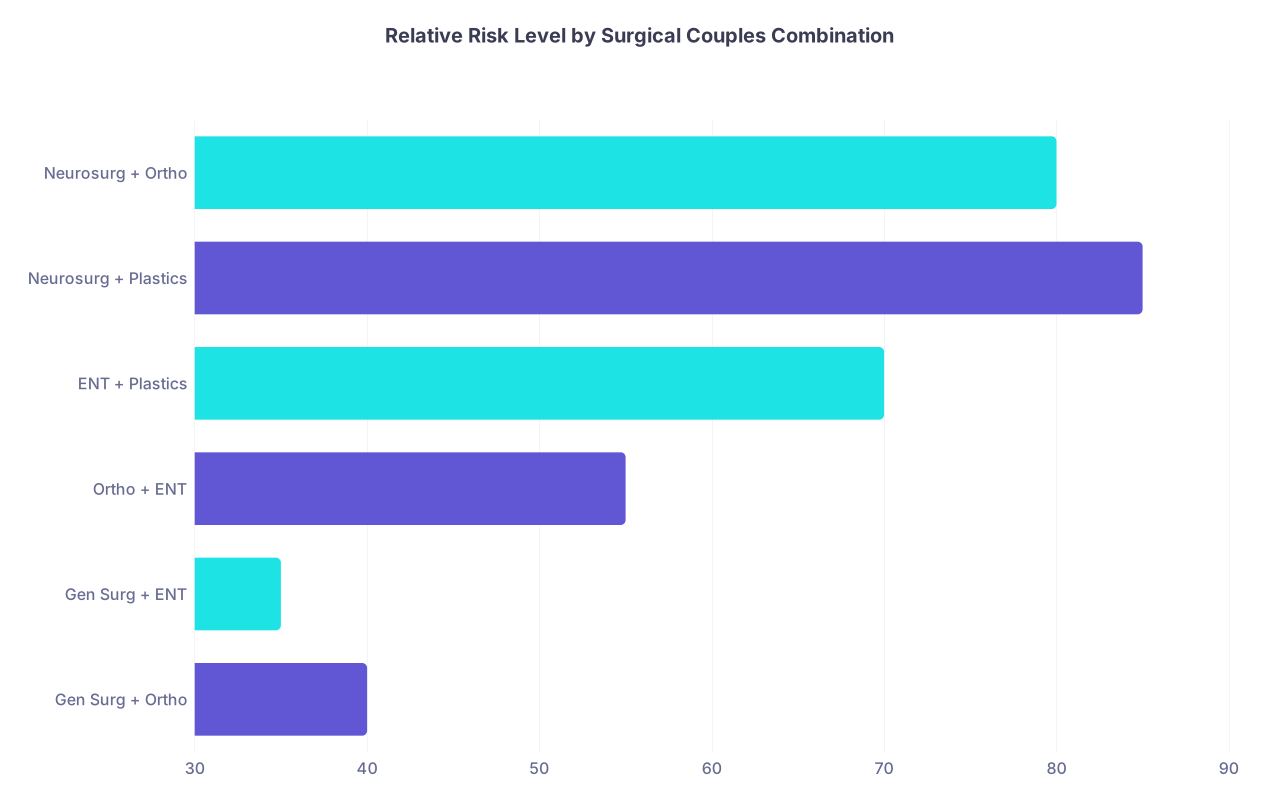
| Category | Value |
|---|---|
| Gen Surg + Ortho | 40 |
| Gen Surg + ENT | 35 |
| Ortho + ENT | 55 |
| ENT + Plastics | 70 |
| Neurosurg + Plastics | 85 |
| Neurosurg + Ortho | 80 |
(High value = more risk/complexity; this isn’t exact data, it’s how I’d think about it qualitatively.)
The more your combination skews to the right side (high risk), the more you need:
- Broader geographic spread
- More community or mid‑tier academic programs
- Earlier and more transparent communication with each other and with programs
5. Build an Application Strategy That’s Actually Joint
Do not apply like you’re both single and then hope it lines up at the end. If you’re couples matching into two surgical specialties, coordination starts before ERAS submission.
Application volume: yes, it will be high
Rough ballpark (not gospel, but reality‑based):
- Solo general surgery applicant: 40–60 programs
- Solo ortho / ENT / urology / plastics: 60–80+ programs
- Couples in two surgical fields:
- The more competitive partner probably stays at 70–90
- The less competitive partner often pushes up too (50–80), focused on overlap locations
If either of you is a borderline applicant (low Step 2, failed Step, weak letters), you pad more.
Targeting overlap programs on purpose
You’re looking for places with:
- Both specialties on site
- Enough volume/size that taking a couple isn’t disruptive
- Reputation for being reasonably humane (couples have better odds where leadership is flexible)
You:
- Star every program where both specialties exist
- Underline those in cities where there are multiple hospitals (so same‑city options exist even if same‑hospital doesn’t work out)
Pay attention to:
- Mid‑sized cities with several hospitals (e.g., St. Louis, Minneapolis, Pittsburgh, Cleveland)
- Major academic centers with lots of affiliated hospitals
These cities are often where couples land when they do not both match at the biggest “name” program but still want to live together.
6. Tell Programs You’re a Surgical Couple—But Do It Right
Couples who hide the fact until February are shooting themselves in the foot.
You want programs to:
- Know early you’re a couple
- Have time to talk internally across departments
- See you as a potential win‑win, not a problem
How to disclose:
- ERAS: Use the couples section properly. That’s the formal part.
- Personal statements: Brief mention in 1–2 sentences max, not your whole narrative.
- Interviews: Bring it up when they ask “What are you looking for in a program” or “Do you have any geographic priorities?”
- Post‑interview emails: A short, professional note can help.
Example email from you (gen surg) to a PD where partner is interviewing in ortho:
Dear Dr. Smith,
Thank you again for the opportunity to interview with your general surgery residency. I wanted to share that I am couples matching with my partner, Alex Doe, who has an upcoming interview with your orthopedic surgery program. We’re very interested in training in the same city, and your institution is high on our list given the strength of both departments.
Best regards,
[Your Name]
Short. Direct. Professional.
Do not:
- Beg: “Please rank us highly together, this is our dream to stay together.”
- Guilt‑trip: “We’ve been together for 7 years and it would be heartbreaking…”
- Overshare your rank intentions in November.
You want them thinking: “If we like each of them individually, this could be a nice bonus for our culture and our call schedule continuity.”
7. Interview Season: Coordinate Like You’re Planning a Military Operation
This is where couples implode if they’re sloppy.
You need:
- A shared calendar
- Clear travel rules
- Real‑time updates as invites roll in
Step 1: Shared calendar and color‑coding
Make a joint Google Calendar with:
- Your interviews (blue)
- Their interviews (red)
- Both in same city, clustered (green)
Prioritize clustering interviews in the same region/time window when possible—especially if you’re flying far (e.g., you both have West Coast programs).
Step 2: Watch for interview asymmetry
Common pattern: one partner gets 18 interviews; the other gets 8. Now what?
You must have a pre‑agreed plan:
- Are you willing to expand applications mid‑season for the weaker side?
- Will the stronger applicant aggressively pursue same‑city programs even if they’re slightly less “prestigious” to align better?
- Do you start emailing “we’re a couple” notes to programs on the weaker side where the stronger partner has an interview?
If one of you is clearly the more competitive specialty/applicant, that person must be willing to absorb more compromise and uncertainty. If they insist on only “top tier” while the other is struggling for interviews, the couple is at real risk.
8. Rank List Strategy: How to Build It Without Losing Your Minds
This is the part everyone panics over. It’s actually logical once you accept your priorities from that first hard conversation.
Your combined rank list is basically a list of ordered pairs: (Your Program – Partner’s Program).
You want tiers.
Tier 1: Dream together
These are:
- Same hospital, both specialties
- Or same city with programs both of you would be proud to attend
You list these combos first, roughly in the order of shared desirability. Sort by:
- Fit and training quality
- Geographic preference
- Culture you both liked
Tier 2: Good together
These are slightly less shiny:
- Mid‑tier academic + strong community in same city
- Two solid mid‑tiers in a city you can live with
- Or “same region, 1–2 hour drive” if you decided that’s acceptable
These are often your real safety net as a couple.
Tier 3: One happy, one okay—or apart?
Here’s the fork in the road.
Remember the question:
“What is more important—being together, or each of us matching into this specialty no matter what?”
If your answer was “Together above all,” then:
- You do not rank apart options higher than together options you’d realistically tolerate, even if you’d be at a fancier program apart.
If your answer was “Specialty first, then together if we can,” then:
- You may rank high‑prestige solo matches above low‑tier together options.
- You might include combined options where one matches and one doesn’t, if that’s something you’re willing to risk.
Put differently: your rank list is the moment where all that “we’re on the same page” talk gets tested.
Consider sketching your decision space visually.

| Step | Description |
|---|---|
| Step 1 | Start Rank List |
| Step 2 | Rank same hospital pairs first |
| Step 3 | Mix top solo programs higher |
| Step 4 | Add same city different hospital pairs |
| Step 5 | Add region pairs within 1-2 hour drive |
| Step 6 | Insert solo high priority programs |
| Step 7 | Add lower tier but acceptable pairs |
| Step 8 | Decide whether to include apart matches |
| Step 9 | Finalize couples list |
| Step 10 | Together Priority High |
| Step 11 | Enough overlap cities |
9. Contingencies and Worst‑Case Scenarios
You should not obsess over disaster scenarios—but you should have a Plan B if things go sideways.
Questions to answer before rank lists lock:
If one of us doesn’t match:
- Are we okay with the other starting residency while one SOAPs or takes a research year?
- Will the matched partner still rank aggressively or dial it back to maximize couple‑friendly options next cycle?
If we end up 1–2 hours apart:
- Are we willing to live in the middle and commute?
- Do we accept weekday distance and weekends together?
If one of us ends up in a program clearly stronger than the other:
- Are we both emotionally okay with that imbalance?
I’ve watched couples implode not because of distance, but because they never talked through the ego dynamics of one being at “Big Name University” and the other at “Regional Medical Center.”
Talk now. Don’t pretend it will magically feel fine later.
10. Tactics That Quietly Help Surgical Couples
A few practical moves that often make a difference:
Letters that mention you as a couple (carefully)
A mentor who knows both of you and casually notes, “I’ve worked with both applicants, and they’re a strong couple matching into complementary surgical fields” can make PDs more willing to coordinate.Targeted couples‑friendly programs
Some places historically like couples and have the size/flexibility to accommodate them—often large academic centers plus big community programs with multiple categorical spots per year. Ask recent grads; patterns exist.Late‑season communication
If in January you see strong overlap momentum in a specific city (multiple interviews for both of you across specialties), it’s reasonable to refocus your late energy (emails, signaling continued interest) there.Keep your egos on a leash
The person in the more competitive field has to accept this reality:
Their “dream program” may not be the best place for the relationship. Adults face that and decide consciously. Children pretend the conflict doesn’t exist.
FAQ (Exactly 3)
1. Should we always rank “together at weaker programs” above “apart at stronger programs”?
No. You should rank according to what you decided matters most in that initial conversation. Some couples genuinely prioritize each person securing their surgical specialty, even if they spend a few years apart. Others would rather be in mid‑tier programs together than at powerhouses apart. The mistake is not in either choice—the mistake is pretending you can have both if the numbers and geography say otherwise, and then building a fantasy rank list that ignores your own values.
2. Does being a surgical couple hurt us with programs?
It depends how you handle it. If you present as “we’re a single package, take both of us or none,” some places will quietly back away. If, instead, you come across as two strong independent applicants who also happen to be a couple, and you frame it as a potential asset (long‑term stability, mutual support, invested in the city), many programs are neutral or even mildly positive. Your job is to make it clear you each stand on your own merits and that your relationship is a bonus, not a demand.
3. How many interview invites do we need as a surgical couple to feel “safe”?
There is no magic number, but I start to relax a little when both partners are around 12+ interviews each, with at least 5–6 cities where there’s some form of overlap (same hospital or same metro area). If one of you is sitting at 15 and the other at 5 by late December, you’re not in “safe” territory yet; you’re in “we need to adjust expectations, expand lists, and communicate strategically” territory. More important than raw count is overlap: eight interviews in completely different regions means far less as a couple than six interviews where you share 3–4 cities.
If you’ve actually worked through all of this together—values, lists, emails, rank strategy—you’re already ahead of most surgical couples, who try to wing it and then blame the algorithm. With a deliberate joint plan, you will not control where you match, but you will control whether the result matches what you two decided matters most. And once you land somewhere, the next set of problems arrives: surviving two surgical residencies under the same roof. But that’s a story for another day.