
Most residents pick a program without being honest about one thing: whether they actually want to be an academic surgeon or a private practice surgeon. And it shows later.
If you’re choosing a surgical residency and you think you might want private practice, but you’re interviewing at a bunch of research-heavy powerhouses because “prestige,” you’re already setting yourself up for friction. Not necessarily failure—but friction.
Let me lay this out bluntly:
Your eventual job options, daily life, and income as a surgeon will be shaped heavily by the type of residency you pick—academic-leaning vs community-leaning—even if you match into the same specialty.
This is not a “what specialty should I choose” article. You’ve already decided (or mostly decided) on surgery. This is:
You want to plan for private practice vs academics. Here’s how to tailor your residency choices, rank list, and mindset accordingly.
Step 1: Be Honest About What You Actually Want
Do not start with “I want to keep all doors open.” That’s often code for “I haven’t thought about this carefully.” Doors do not magically remain open forever; they get heavier and more expensive to reopen.
So first, gut check.
If you’re leaning private practice surgery, you probably:
- Care a lot about operative autonomy and case volume.
- Visualize yourself in a community hospital, group, or multispecialty practice.
- Are less excited about writing papers, going to basic science labs, or living on NIH grants.
- Like the idea of higher earning potential and more control over your schedule eventually (not as a PGY-2, let’s be real).
- Want to be clinically excellent and efficient more than you want a long PubMed page.
If you’re leaning academic surgery, you probably:
- Actually like research. Not just “I did it for my CV.” You like the process, the questions, the talks.
- Want to teach residents and med students long-term.
- Like the idea of being “the” person for a niche (e.g., complex HPB, colorectal cancer outcomes, trauma systems).
- Care about titles: division chief, program director, vice chair, etc.
- Are okay with some income tradeoff for academic time, protected research, and institutional prestige.
If you’re somewhere in between? That’s fine. You don’t need a perfect answer. But you do need a leaning, because it will change how you analyze programs.
Step 2: Understand How Program Type Shapes Your Future
Here’s where people screw up. They talk about “good” vs “bad” programs instead of “aligned” vs “misaligned” programs.
Let’s define the basic buckets. Many programs are hybrids, but they still lean one way.
| Program Type | Main Orientation | Typical Hospital Setting |
|---|---|---|
| Big-name Academic | Academic | University / Tertiary Center |
| Academic-Community | Mixed | University + Community Sites |
| Large Community | Private Practice | Community System |
| Community with Fellowship Focus | Mixed | Community + Quaternary Partner |
| County / Safety Net | Private Practice | County / Public Hospital |
What academic-leaning programs give you
- Strong branding for fellowships and academic jobs
- Tons of research infrastructure, mentors, statisticians
- Subspecialty exposure at the cutting edge
- Grand rounds, conferences, visiting professors all the time
- Usually more fellows around (which can cut into resident case volume depending on culture)
These are great if you want:
- Competitive fellowships (surg onc, pediatric surgery, HPB, CT at big-name places)
- An academic career, K-award trajectory, leadership roles
- To network with people who sit on guideline committees and national boards
Less ideal if your true end goal is straight-to-private-practice general surgery in a midsize town. You can still do it, but you may feel like you’re constantly pushed toward “more training, more research, more niche.”
What community-leaning programs give you
- High operative volume, often earlier autonomy
- Bread-and-butter general surgery plus common subspecialty cases
- Attendings who themselves are private practice or hybrid surgeons
- Less research pressure; sometimes almost none
- A system and culture that mirror where you may actually end up working
These are gold if you want:
- To be ready on day one out of residency to manage a broad general surgery practice
- Comfort with efficiency, turnover, and real-world OR flow
- Connections to local/regional private groups, hospital systems
Less ideal if you’re aiming for a hardcore academic niche with R01-style research and full-time university work.
Step 3: Match Your Goal to the Right Program Features
Now let’s translate this into something practical: what to actually look for, ask, and prioritize on the interview trail and when building your rank list.
If you’re planning for private practice surgery
Your priority list should look something like this:
Case volume and autonomy
Not just raw numbers, but who is doing the key parts of the cases.Questions to ask:
- “What are average case logs for graduating chiefs in major categories?”
- “How often do seniors run rooms independently?”
- “Do fellows take a lot of the complex or index cases?”
Watch for:
- PGY-4/5s confidently saying, “I feel very ready to go straight into practice.”
- Residents doing common private practice procedures: hernias (open and lap), gallbladders, bowel resections, basic vascular access, ports, simple endocrine, bread-and-butter endoscopy.
Breadth of general surgery
You want wide exposure, not just narrow tertiary referrals.Community exposure
Ideal if you rotate at one or more community hospitals where the culture and flow feel like private practice.Ask:
- “What percentage of our time is at the main academic center vs community sites?”
- “Do residents work with private groups? How does that work?”
Graduate outcomes (this is huge and underused) You want proof. Not vibes.
Ask specifically:
- “In the last 5 years, how many chiefs have gone straight into private practice?”
- “Where are they working now?”
- “Do employers call you asking for your graduates?”
Programs that are used to placing people into private practice will rattle this off.
Lifestyle and culture
You’re not picking a spa. But some programs have a more “work hard, learn to be efficient, go home” vibe. Others have “stay late, write papers, be at journal club until 8 p.m.”Which one mirrors the surgeon you want to be? Answer that honestly.
If you’re planning for academic surgery
Your priority list flips.
Research infrastructure and expectations
You need to know:- Is there built-in research time (1–2 dedicated years vs none)?
- Are there strong clinical or basic science labs with funding?
- Do residents actually publish or just “have opportunities”?
Ask:
- “How many papers did last year’s chiefs graduate with on average?”
- “How many residents present at national meetings yearly?”
- “Is there a T32 or other formal research track?”
Fellowship placement record
This is your currency for academic careers in many surgical subspecialties.Ask:
- “Where have graduates matched for fellowships in the last 5–10 years?”
- “Are there internal fellowships here? How competitive is it to stay?”
Faculty who actually live the career you want
Look for:- Surgeon-scientists with grants.
- Clinical researchers running trials, outcomes studies.
- Residents with mentors who have time and interest to meet.
A program where the “academic” surgeon is just the one who does a few QI projects is not the same as a program with serious academic horsepower.
Protected time and institutional support
You will not magically do research on Q3 call.Ask:
- “Is research time protected, or do we still take call?”
- “Are there biostatisticians available?”
- “Do residents get help with IRB, grant writing, database access?”
Step 4: Where Hybrid Programs Fit In
A lot of residents end up here without realizing the pros and cons.
Academic-community hybrids and large community programs with fellowships can be excellent if:
- You’re still a bit unsure.
- You want strong clinical training and enough research to keep academic doors open.
- You might want a community-based academic job (think: busy clinical practice + residents, minimal lab time).
At these places, the trick is: you’ll get out what you actively chase. If you want academics, you’ll have to seek out mentors, projects, and national exposure. If you want private practice skills, you’ll have plenty of chances to operate.
Step 5: How Much Does Prestige Actually Matter?
Here’s the part nobody wants to say out loud.
Prestige absolutely matters—for some paths:
- Top academic HPB, CT, surg onc, peds surgery fellowships: a big-name residency helps.
- If you want to be a chair or major academic leader, brand and network matter.
But for private practice general surgery?
- A competent, well-trained graduate from a strong community program with huge case volume can be just as (or more) attractive to a hospital or group than someone from a fancy name who is less comfortable operating alone.
Private practice groups care about:
- Can you operate confidently and safely?
- Can you work with others without being a nightmare?
- Can you handle call and emergencies without panic?
I’ve seen chiefs from mid-tier community programs waltz into excellent group jobs because they were essentially mini-attendings by PGY-5.
Step 6: Specific Strategies While Applying and Ranking
Now let’s get tactical. You’re making a list. You’re trying not to screw up your next 5–7 years.
If you’re leaning private practice
On ERAS and interview day:
- Still apply broadly. Include some academic places. But aggressively include:
- Large community programs
- University-affiliated community programs
- County programs with heavy operative loads
During interviews:
- Ask openly: “How prepared are your graduates who go straight into practice?”
- Talk to the most “private practice–minded” senior residents you can find.
- Pay attention to whether residents seem like future group partners or future NIH PIs. That vibe is real.
On your rank list:
- Put high-volume, autonomy-heavy, graduate-into-practice-friendly programs above famous but ultra-subspecialized, research-obsessed places—if you are serious about private practice.
If you’re leaning academic
On ERAS and interviews:
- Target academic centers with national reputations in your likely subspecialty. Not just overall.
- Look hard at programs with:
- T32s or formal research tracks
- Built-in dedicated academic time
- Strong track record of competitive fellowships
During interviews:
- Ask program directors directly: “If I want an academic career in [X], how will this program support that?”
- Ask residents: “Who are the rising academic stars among the faculty?” If they struggle to name anyone, that’s data.
On your rank list:
- You can put some hybrid programs higher if they have a serious academic core. But do not kid yourself that a no-research, pure-service-heavy community program will easily launch you into peds surgery at CHOP.
Step 7: Pitfalls That Screw People 5–10 Years Later
A few common mistakes I see over and over.
Choosing prestige over fit
Matching at Big Famous University and then realizing:- You hate research.
- You’re drowned in service.
- Fellows take half the cases.
- The culture pushes everyone toward niche fellowships you do not want.
Choosing “easier” or less academic because research scares you—then changing your mind
You match at a super community-heavy place with essentially no research ecosystem. Midway through PGY-2, you discover you love clinical outcomes work and want an academic HPB fellowship. Now you’re climbing uphill.Ignoring graduate outcomes
This drives me crazy. Applicants obsess over resident happiness (which is good) and location (fine) but never ask:- “Where do your residents actually end up?”
Programs that proudly list their grads’ jobs on a slide or website usually have a narrative they’re proud of. If it’s vague or brushed off, be cautious.
Assuming you can always switch paths later easily
Can you go academic from a community program? Yes—if you grind.
Can you go private practice from an academic giant? Absolutely. Happens all the time.But both are harder if the culture, mentorship, and expectations are misaligned with your goal. Better to swim with the current if you can.
A Simple Decision Flow
Here’s a stripped-down thought process if you’re stuck:

| Step | Description |
|---|---|
| Step 1 | Start - Surgical Applicant |
| Step 2 | Target academic-heavy programs |
| Step 3 | Prioritize community and hybrid programs |
| Step 4 | Mix of academic and hybrid on rank list |
| Step 5 | Emphasize research track and fellowship record |
| Step 6 | Pick supportive academic culture over pure prestige |
| Step 7 | Choose hybrid programs with some research |
| Step 8 | Maximize operative volume and autonomy |
| Step 9 | Choose programs with both research and strong clinical training |
| Step 10 | Leaning academic career? |
| Step 11 | Leaning private practice? |
| Step 12 | Want competitive fellowship? |
| Step 13 | Want option for future academics? |
What This Looks Like in Real Life
Let me make this even more concrete.
You’re a fourth-year who likes general surgery, maybe bariatrics or bread-and-butter community work. You hate sitting at a computer analyzing datasets. You match better with the chiefs who talk about “running two rooms and being home for dinner sometimes” than the ones bragging about R01 grants.
On your list, you’ve got:
- MegaName University Hospital – 2 years mandatory research, 8 fellows, 1 community site
- State U + Community Consortium – mix of university and 2 community hospitals, optional research, 60–70% of grads into private practice, 30–40% into fellowships
- Large Community Residency – huge volume, excellent chief logs, almost everyone into private practice
If you rank them purely by prestige, you may end up spending 2 research years doing something you dislike, competing with fellows for cases, then fighting the program’s academic culture to go straight into community practice.
If you rank them by the surgeon you actually want to be, you might put the Consortium first, Community second, MegaName third. That is not “settling.” That is deliberate.
Reverse the example for someone gunning for academic thoracic or surg onc. For that person, MegaName with built-in research and big fellowship placements might belong on top.
Quick Visual: What Programs Actually Produce
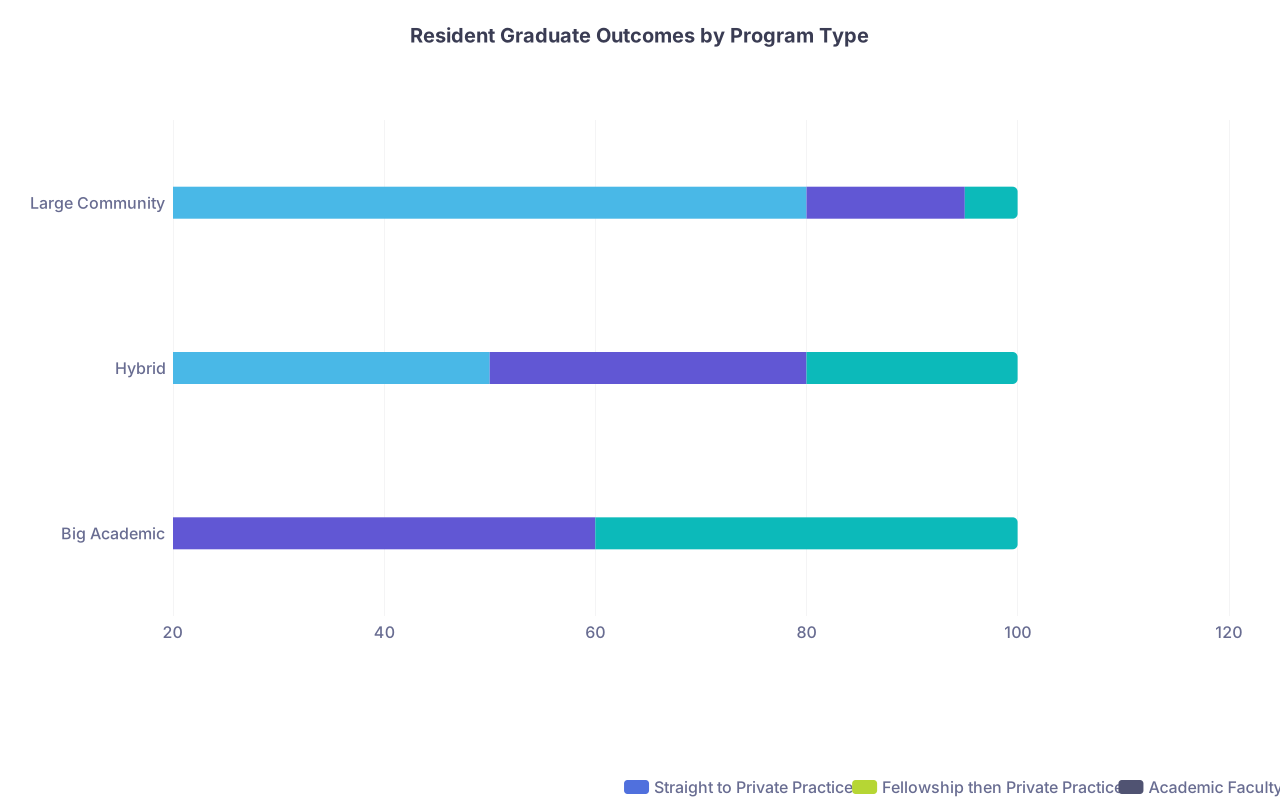
| Category | Straight to Private Practice | Fellowship then Private Practice | Academic Faculty |
|---|---|---|---|
| Big Academic | 20 | 40 | 40 |
| Hybrid | 50 | 30 | 20 |
| Large Community | 80 | 15 | 5 |
Numbers are illustrative, but the pattern is real at many places.
FAQs
1. If I’m 100% sure I want private practice general surgery, is it a mistake to go to a big academic program?
Not automatically, but it can be inefficient. You may end up:
- Spending time doing research you do not care about.
- Getting less early autonomy if fellows absorb complex cases.
- Feeling pressure to subspecialize when you really want broad general practice.
If the academic program still has outstanding clinical volume, strong mentorship, and a track record of grads going straight into practice, it can work very well. But if they openly say “basically everyone here does a fellowship and stays academic,” believe them. That might not be your scene.
2. Can I start in a community-heavy program and still end up in academic surgery?
Yes, but you need intention and hustle. That means:
- Finding any research mentors you can—often clinical or outcomes projects.
- Presenting at local and national meetings.
- Possibly doing an additional research year or fellowship with a strong academic component.
- Leveraging your clinical excellence (big case logs, strong letters) when applying to academic fellowships.
It’s harder if your program has no culture or support for scholarship. Not impossible. But you will be swimming upstream.
3. What if I genuinely have no idea yet—should I just pick the “most flexible” program?
If you’re truly undecided, aim for a hybrid program that:
- Has real, not fake, research opportunities.
- Still offers strong operative experience and autonomy.
- Sends some graduates into private practice and some into fellowships/academics.
- Has faculty who span the spectrum: hardcore academics, community-style workhorses, and hybrids.
That kind of environment lets you explore without closing either door early. But you still need to start paying attention by PGY-2 or PGY-3 so your choices (projects you take, mentors you pick, electives you choose) begin to line up with where you’re headed.
Key points to walk away with:
- Decide your leaning—private practice vs academic surgery—early enough that it can inform how you evaluate and rank programs.
- Judge programs by outcomes (where grads go), case volume/autonomy, and research ecosystem, not just by name.
- Align your residency environment with the surgeon you actually want to become, not the image you think impresses other people.