Only 41% of graduating US general surgery residents feel “independently comfortable” performing a robotic operation without staff help. Yet nearly 100% of large health systems advertise themselves as “robotic surgery centers of excellence.”
That gap is exactly what you are trying to navigate when you choose a residency.
Programs will all say the same things on interview day: “We do a lot of robotics,” “You will be console certified,” “Our residents are very involved.” None of that is measurable. None of it helps you rank Program A vs Program B.
So let me strip the marketing out of this and give you concrete, reproducible metrics you can use to compare robotic training between general surgery residencies.
We are talking about general surgery only. Not urology, not gyn, not ENT. Robotics in those worlds is a different animal.
1. The Core Question: Will You Graduate as a True Robotic Surgeon?
You are not trying to “see” a robot. You are trying to graduate as:
- Console‑competent
- Credential‑ready at your first job or fellowship
- Safe operating independently on day one
Everything we discuss will map back to that.
The problem: the ACGME case log system is still fundamentally laparoscopic/open–centric. Robotics is layered on top inconsistently. So you must create your own objective framework.
There are six major buckets of metrics that actually differentiate programs:
- Case volume and case mix at the console
- Structured curriculum and assessment
- Access to the robot and competition for cases
- Faculty culture and adopters vs dabblers
- Institutional and vendor infrastructure
- Outcomes after graduation (fellowship, first job)
If you cannot get clear answers in these domains, the program does not truly have mature robotic training, no matter how many glossy pictures they show you.
2. Hard Numbers First: Robotic Case Volume and Case Mix
If you remember nothing else from this article, remember this:
A resident who has driven the console for 150+ meaningful robotic general surgery cases with graded autonomy is in a very different universe from the one who has “touched” 30 hernia cases at the end of chief year.
You need numbers. Not vibes.
A. Ask for exact resident console volumes
Programs that truly care about robotic training can usually quote you specific numbers or at least a range from their recent graduates. You want console numbers, not just “robotic room presence”.
On interview day, ask very directly:
- “For your last 3 graduating classes, what was the median number of robotic console cases logged per resident in general surgery?”
- “What was the range? What did your highest and lowest graduates get?”
You are looking for something roughly like:
| Level | Robotic Console Cases | Interpretation |
|---|---|---|
| Weak | < 40 | Exposure only; not independent-ready |
| Adequate | 40–80 | Basic comfort; will need high-volume fellowship or job mentoring |
| Strong | 80–150 | Functionally competent; can start practicing and refine |
| Elite | > 150 | Very mature skill set for a graduating resident |
Numbers are not everything. But if a “robot-heavy” program cannot get their chiefs over 50 console cases, something is broken.
B. Separate “at the bedside” from “at the console”
Early in training, bedside experience (docking, troubleshooting, camera driving) matters. But programs will inflate this.
You must explicitly ask:
- “How are bedside vs console cases recorded or tracked?”
- “By end of PGY‑3, how many console cases do most residents have?”
If they give you a combined number without a breakdown, assume it is padded.
C. Case mix: what operations are you actually doing?
High volume means much less if 90% of those cases are short, low‑complexity hernias.
For robotic training that translates to real practice, you want diversity across:
- Foregut (hiatal hernia, fundoplication, Heller, paraesophageal)
- Colon (right, left, low anterior, sigmoid)
- Bariatric (sleeves, bypasses, revisions) if the institution does them
- Complex hernia/abdominal wall reconstruction
- Selected HPB or solid organ (e.g., adrenal, distal pancreatectomy) if available
On a visit, drill down:
- “For a typical chief, how are their 100–150 console cases distributed by operation type?”
- “Do mid‑level residents participate in colectomies and foregut, or is it all chiefs?”
You want at least:
- 20–30 robotic colorectal and/or foregut cases
- Some complex wall or bariatrics
- Repetition in a few core operation types, not just one‑offs
D. Compare across programs: build your own table
Create your own quick comparison while going through interviews.
| Program | Median Chief Console Cases | Breadth of Case Mix | Who Gets Priority? |
|---|---|---|---|
| Program A | ~40 | Mostly inguinal/ventral hernias | Fellows |
| Program B | ~110 | Foregut, colon, bariatric, hernia | Seniors & 4th years |
| Program C | ~70 | Foregut & hernia | Mixed, depends on attending |
Residency coordinators will not build this for you. You should.
3. Curriculum, Simulation, and Objective Assessment
Volume alone is not enough. Residents can do 120 cases and still be mediocre if nobody ever teaches them properly.
Strong programs treat robotics like a longitudinal curriculum, not a toy residents fight over.
A. Is there a formal robotic curriculum with milestones?
Look for:
- A defined PGY‑based pathway: PGY‑1/2 at bedside and sim, PGY‑3 transition, PGY‑4/5 primary console
- Clear requirements to graduate from bedside → supervised console → leading cases
Ask:
- “Is there a written robotic curriculum?”
- “What are the explicit milestones to go from bedside to primary console surgeon?”
- “Who decides when a resident is ‘ready’?”
If the answer is “Whenever the attending thinks they are ready,” that is code for: no structured process.
B. Simulation: mandatory, tracked, and meaningful?
Vendor consoles (da Vinci skills simulator, for example) and dry labs are only valuable if:
- Residents have protected access
- Performance is tracked across time
- Progress is tied to OR privileges
The better programs:
- Require completion of specific online modules and sim modules (e.g., camera targeting, energy dissection, suturing tasks)
- Track metrics such as economy of motion, collisions, time to completion, error rates
- Use these data to decide when a resident can start operating at the console
Good question to ask:
- “Do you have minimum simulation benchmarks residents must meet before they can be primary console surgeon?”
- “Are simulation results reviewed by a faculty lead, or is it self‑reported ‘I did the modules’?”
If it is purely self‑attested, assume it is not taken seriously.
C. Objective assessment tools: GEARS, OSATS, or home‑grown rubrics
There are validated tools like GEARS (Global Evaluative Assessment of Robotic Skills) that measure:
- Depth perception
- Bimanual dexterity
- Efficiency
- Force sensitivity
- Autonomy
If the program can tell you, “We use GEARS at 6‑month intervals and at the end of PGY‑3 and PGY‑5 to assess robotic skill,” that is a very good sign.
If you hear, “We just give them general evals in MedHub,” that is the usual vague feedback that does not translate to skill.
4. Access to the Robot: Who Actually Drives?
A surprisingly large number of hospitals have the robot primarily as an attending toy or a fellowship tool. Residents are in the room, but rarely in control.
You need to understand the politics of access.
A. Competition with other services and fellowships
The robot is a finite resource. You are competing with:
- Urology
- Gynecology
- Thoracic
- Surgical oncology
- MIS/bariatric fellowships
- Transplant or HPB in some centers
If there are 2 robots and 5 robotic-heavy services, someone will lose. Often, it is the general surgery resident.
On interview day, ask pointedly:
- “Do any of your general surgery rotations have MIS or surg onc fellows, and how is the robot time split between fellows and residents?”
- “Are residents routinely primary console on cases where a fellow is present?”
If the fellow always takes the console and you “assist from the bedside,” your robotic experience will be weak, regardless of institutional case volume.
B. Day‑to‑day scheduling control
Who controls the block time and robot assignments?
- If urology has dedicated robotic blocks 5 days a week and general surgery fights for leftover slots, you know the deal.
- If general surgery has locked‑in robotic blocks with dedicated attendings, that is much better.
You can ask the PD or chief residents:
- “Which services on your schedule are known as the ‘robotic months’ where you get the most hands‑on time at the console?”
- “Are there months where you get essentially zero robotic exposure?”
Look for programs where:
- Multiple core general surgery services run regular robotic lists
- Residents have predictable, not opportunistic, access
C. PGY‑level distribution
By the time you are a PGY‑3/4, you should be driving the robot, not just docking it.
Ask:
- “At what PGY level do residents usually start being the primary console surgeon for standard cases like cholecystectomy, inguinal hernia, or bariatric sleeve?”
- “Are there dedicated junior robotic rotations, or is access held until senior years?”
If most hands‑on console time is pushed to chief year only, you are compressing learning into a very short window.
5. Faculty Culture: Adopters, Dabblers, and Late‑Career Skeptics
The robot is not a religion, but some attendings treat it like one. That culture matters a lot.
A. Identify true robotic champions vs casual users
You want a critical mass of attendings who:
- Routinely do their core cases robotically
- Intentionally teach the robot to residents
- Are involved in QI, credentialing, or proctoring
During pre‑interview dinners and resident chats, listen for names:
- “If you want robotic experience, you need to be on Dr. X’s foregut service and Dr. Y’s colorectal service. They always let residents drive.”
- “Dr. Z does a lot of robotics but never gives up the console.”
That second scenario is common and toxic for your learning.
B. Attitudes toward robotics among faculty
If you hear variations of:
- “I still think lap is better; the robot is mostly for marketing.”
- “Our older surgeons are slowly starting to adopt it.”
Expect sluggish curriculum development and resident access.
Strong programs sound more like:
- “We treat the robot as a core tool in minimally invasive surgery, not a special add‑on.”
- “Our attendings agree that residents must demonstrate console competency by graduation.”
No program will say, “We are terrible at this,” but the undertone from residents is usually honest if you ask bluntly: “Do you feel actually prepared to run a robotic room as a chief?”
6. Infrastructure and Vendor Support: Sim, Training Pathways, and Credentialing
Robotics training is not just OR time. It is supported by a lot of infrastructure, and you can absolutely compare this between programs.
A. Simulation hardware and access
What you want to concretely know:
- Do they have a dedicated simulator (Xi/X or similar) accessible 24/7, or do residents “borrow” the clinical console?
- Is there a sign‑up system for sim time, and is it protected for residents?
- Does anyone actually track your sim usage and performance metrics?
If the sim hardware exists but sits locked in a closet “because no one has the password,” that is functionally useless.
B. Vendor pathways: resident certification/privileging
Most health systems work with vendors (e.g., Intuitive) to create a structured training and privileging pathway. Some offer:
- Resident‑specific foundational courses
- On‑site labs with porcine/cadaveric models
- Formal certificates of training that help with credentialing after graduation
Ask:
- “Are your residents enrolled in any vendor‑sponsored robotic training pathways? Do they get a completed certificate at the end?”
- “Have your graduates had any difficulty obtaining hospital robotic privileges at their first jobs?”
If the answer is “We do not track that,” they probably do not.
C. Number and generation of robots
It sounds obvious, but it is not: 1 robot for a 600‑bed hospital with busy urology, gyn, and multiple surgical fellowships is a nightmare for resident access.
Try to extract:
- Number of robotic platforms (Xi, X, older Si if still around)
- Allocation across campuses (main vs satellite)
- Average weekly robotic block days for general surgery attendings
You can get a rough feel for capacity with simple math:
If a program has:
- 3 robots total
- 2 robots at main hospital, 1 at community site
- 2 general surgery robotic blocks per day, 4 days/week
That is completely different from:
- 1 robot, 3 days/week, mostly used by urology
7. Outcomes After Graduation: What Happens to Their Chiefs?
Here is where most applicants never think to look, but it is one of the most powerful objective metrics: track what graduates actually do with robotics.
A. Fellowship placement in robotic‑heavy fields
Look specifically at:
- MIS/bariatric fellowships
- Colorectal fellowships
- HPB/surgical oncology fellowships with robotic focus
Ask:
- “In the last 5 years, how many residents have gone into MIS/bariatric or colorectal, and how did programs evaluate or comment on their robotic prep?”
- “Do your graduates seek additional robotic training in fellowship because they feel weak, or because they want high‑volume expertise?”
If multiple recent grads told the PD, “I had to do MIS fellowship just to get basic robotic comfort,” that is a red flag.
B. First jobs and credentialing
This is the metric almost nobody asks about, and it separates marketing from reality.
Ask the PD or APD:
- “For the last few graduates who went straight into practice, did they receive full robotic privileges in their first year out?”
- “Have any of your grads had to complete ‘remediation’ sums of sim time or proctored cases after joining a job because their residency robotic logs were considered thin?”
They may not have a number, but the reaction will tell you a lot.
8. Putting It All Together: A Practical Scoring Framework
You cannot rank programs perfectly, but you can avoid some landmines.
Here is a simple 25‑point framework I have seen people use effectively. You do not need to show it to anyone. Just score programs quietly after your interviews.
| Domain | Max Points | What You Are Looking For |
|---|---|---|
| Console volume | 8 | ≥80–100 cases median chief |
| Case mix | 4 | Foregut, colon, hernia, bariatric |
| Curriculum & sim | 4 | Formal, milestone-based, tracked |
| Access & competition | 4 | Residents > fellows; predictable blocks |
| Culture & faculty | 3 | Multiple true robotic champions |
| Graduate outcomes | 2 | Easy credentialing, strong MIS placements |
A rough interpretation:
- 20–25: True robotic training program. You will graduate viable.
- 14–19: Decent, but you may want robotic‑heavy fellowship if the job market you target is robot‑obsessed.
- <14: You will likely not be independently comfortable as a robotic surgeon on graduation, no matter what the brochure says.
You can sketch a quick bar chart in your own notes to compare programs.
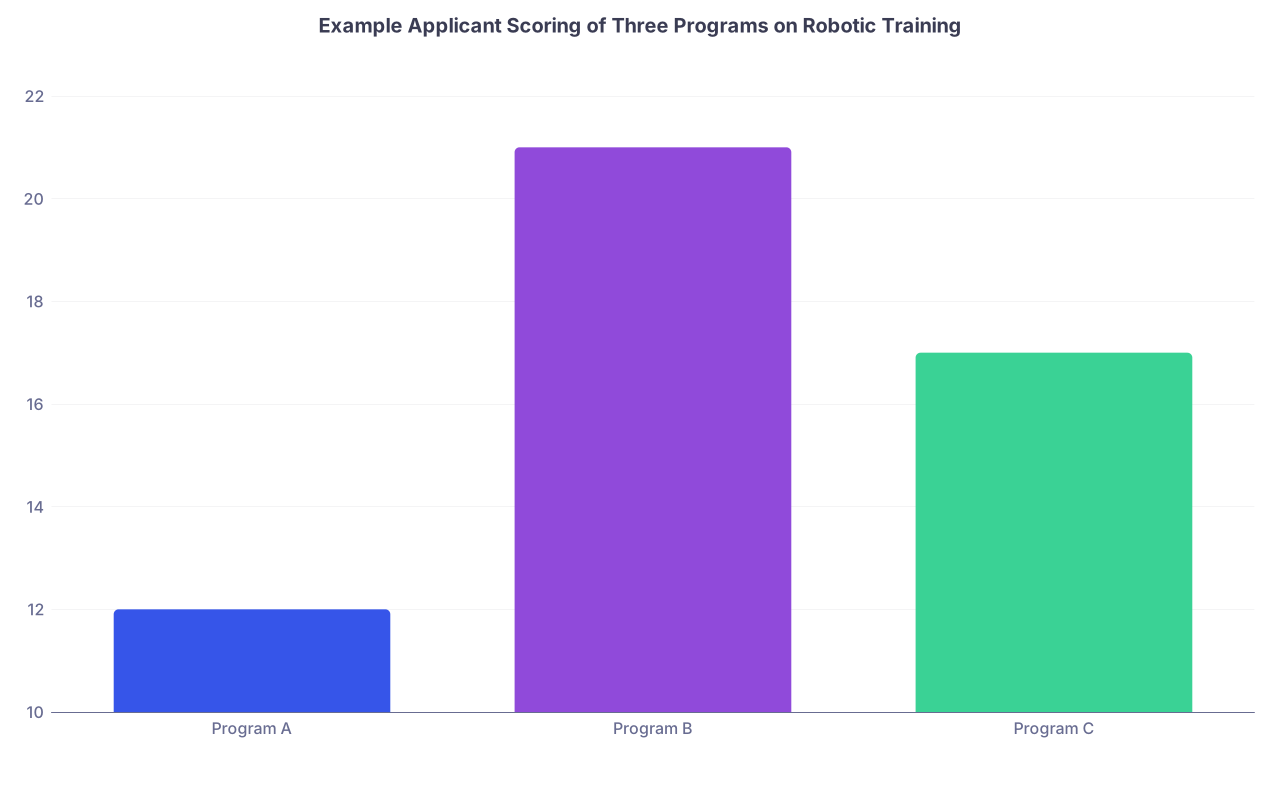
| Category | Value |
|---|---|
| Program A | 12 |
| Program B | 21 |
| Program C | 17 |
9. Red Flags and Green Flags You Will Actually Hear
Let me be even more concrete and translate all of this into the actual sentences you may hear on interview day.
Green flag phrases
When you hear these, your ears should perk up:
- “Every PGY‑3 must complete defined sim modules and a GEARS assessment before taking the console.”
- “Our last 3 graduating classes averaged 90, 110, and 105 robotic console cases respectively.”
- “Our MIS attendings are adamant that residents drive. We will stand at the bedside, but the resident operates.”
- “We have a dedicated PGY‑4 MIS/robotic rotation with 3–4 staffed robotic days per week.”
- “Our grads have not had trouble getting robotic privileges. Employers often comment they are ahead of peers.”
Red flag phrases
These are the warning sirens:
- “We are growing our robotics program.” (Translation: not there yet.)
- “Residents definitely see a lot of robotic cases.” (Seeing is not operating.)
- “The MIS fellows are usually on the robot, but residents help with docking and exposure.”
- “We just got our first Xi and are really excited to ramp up.” (You will be the experimental generation.)
- “Some attendings really like the robot, others never use it.” (Fragmented culture, patchy curriculum.)
Pay attention to how uncomfortable residents get when you push on these questions. Forced smiles and “uh, it depends” usually mean the reality is worse than the brochure.
10. How This Fits into Your Bigger Residency Choice
One more bit of honesty: robotics is one piece of your general surgery training. Not the only piece.
There are justified trade‑offs:
- A program with insane trauma and open vascular volume might be slightly weaker in robotics but still produce excellent surgeons.
- A community‑heavy program with a dominant community hospital might offer fantastic hands‑on robotic exposure but weaker complex HPB or transplant.
You have to decide:
- Do you want to practice in a market where robotics is essential (suburban systems, many private groups, bariatric and colorectal jobs)?
- Or are you targeting trauma‑heavy academic practice, global surgery, or a niche where robotics is truly secondary?
If you see yourself:
- Doing community MIS, hernia, bariatric, or colorectal
- Joining a large employed group where hospital administrators care about “robotic volumes”
- Competing in metropolitan markets where “robotic experience required” is written into job ads
…then robotic training should be a priority, not a luxury.
If you are aiming for transplant, trauma critical care, or a career that stays heavily open, you still want baseline robotic literacy—but you might tolerate a program that is merely “adequate” in robotics in exchange for outstanding experience elsewhere.
11. Concrete Questions to Bring on Interview Day
To close the loop, here is a short, ruthless list you can literally keep in your notebook.
Use them. Out loud.
- “What is the median number of robotic console cases for your last 3 graduating general surgery classes, broken down by resident?”
- “Of those, approximately how many are foregut/colon/bariatric vs basic hernia?”
- “Is there a written robotic curriculum with defined milestones for residents to move from bedside to console?”
- “Do residents have minimum sim requirements or GEARS scores before taking the console?”
- “On services with MIS or surg onc fellows, who usually gets the console—fellows or residents?”
- “What PGY level is typically primary console for standard robotic cases?”
- “Have any of your recent graduates had difficulty getting robotic privileges at their first job?”
The way programs answer—numbers, specifics, and your ability to verify those with residents—will tell you much more than any slide with a glossy picture of a robot.
To visualize how training should progress over residency, here is a simple flow.

| Step | Description |
|---|---|
| Step 1 | PGY1 - OR exposure and bedside |
| Step 2 | PGY2 - Bedside, docking, basic sim |
| Step 3 | PGY3 - Sim milestones, begin console on simple cases |
| Step 4 | PGY4 - Primary console on standard cases, graded autonomy |
| Step 5 | PGY5 - Lead complex cases, ready for independent practice |
You want a program that actually lives this progression, not one that hopes it will “just happen.”
With these metrics in hand, you are no longer at the mercy of vague marketing about “strong robotic exposure.” You can interrogate programs, compare them side‑by‑side, and decide where you will actually become a robotic surgeon rather than a spectator.
The next step, once you have filtered for programs that train you properly on the robot, is to integrate that with the rest of what makes a surgeon—open cases, critical care, mentorship, and real operative autonomy. That is the broader architecture of your training, and that is what you will tackle as you start building and tightening your final rank list.