Myth vs Reality: Do Prestigious Hospital Names Matter More Than Roles?
Does a one-month “observer” spot at Mass General beat six months as a hands-on sub-I at a no-name community hospital on your ERAS? That’s what a lot of IMGs are betting on. And a lot of them are dead wrong.
Let me be blunt: the obsession with brand-name hospitals is one of the most damaging myths in the IMG world. People will spend $8,000 they don’t have to sit in a corner of a fancy hospital, write “Harvard” in their CV, and then wonder why their interview list looks… underwhelming.
Let’s pull this apart using what actually matters in the residency match—especially for IMGs—and not what looks good on WhatsApp screenshots.
The Core Myth: “Big Name > Everything Else”
The dominant narrative in IMG circles goes like this:
If you can somehow get anything at a big-name place—Mayo, Cleveland Clinic, MGH, Hopkins, NYU—it automatically boosts your application, no matter what your actual role is. Shadowing, observership, unpaid “research internship” where you mostly do data entry—doesn’t matter. Brand name is king.
Reality: programs don’t rank “brand” in a vacuum. They rank evidence that you can do the job safely, work hard, and fit into a team. A famous hospital can help with that. Or it can be a meaningless line on your CV if what you did there was superficial.
The real hierarchy in clinical experience for IMGs is not:
Prestigious hospital > everything else
It’s closer to:
Hands-on, evaluative, recent U.S. clinical experience > everything else. With brand as a bonus, not the foundation.
What Programs Actually Look For (Not What People Brag About)
If you read NRMP program director surveys and talk to actual PDs instead of Telegram “gurus,” a pattern shows up. They care about things that predict how you’ll function as an intern, not how impressive your letterhead looks.
Most program directors ask themselves three basic questions about your clinical experience:
- Did this person actually touch patients and make decisions?
- Did someone I trust observe them closely enough to write a meaningful letter?
- How recent and relevant is this experience to what I need in my program?
The hospital name—yes, it matters a bit. But as a multiplier. Not as a replacement.
Here’s how different roles usually stack up in their minds, assuming similar timeframes:
| Experience Type | Typical Match Value for IMGs |
|---|---|
| U.S. Sub-internship/Acting Intern | Very High |
| U.S. Hands-on Elective | High |
| U.S. Community Hospital Hands-on | High |
| U.S. Observership with Strong LOR | Moderate |
| Pure Shadowing (no chart access) | Low |
| Remote/Tele rotations | Very Low |
Notice what’s missing: “Prestige” as its own category. Because it isn’t one.
Now let’s layer in brand name versus role with something a bit more structured.
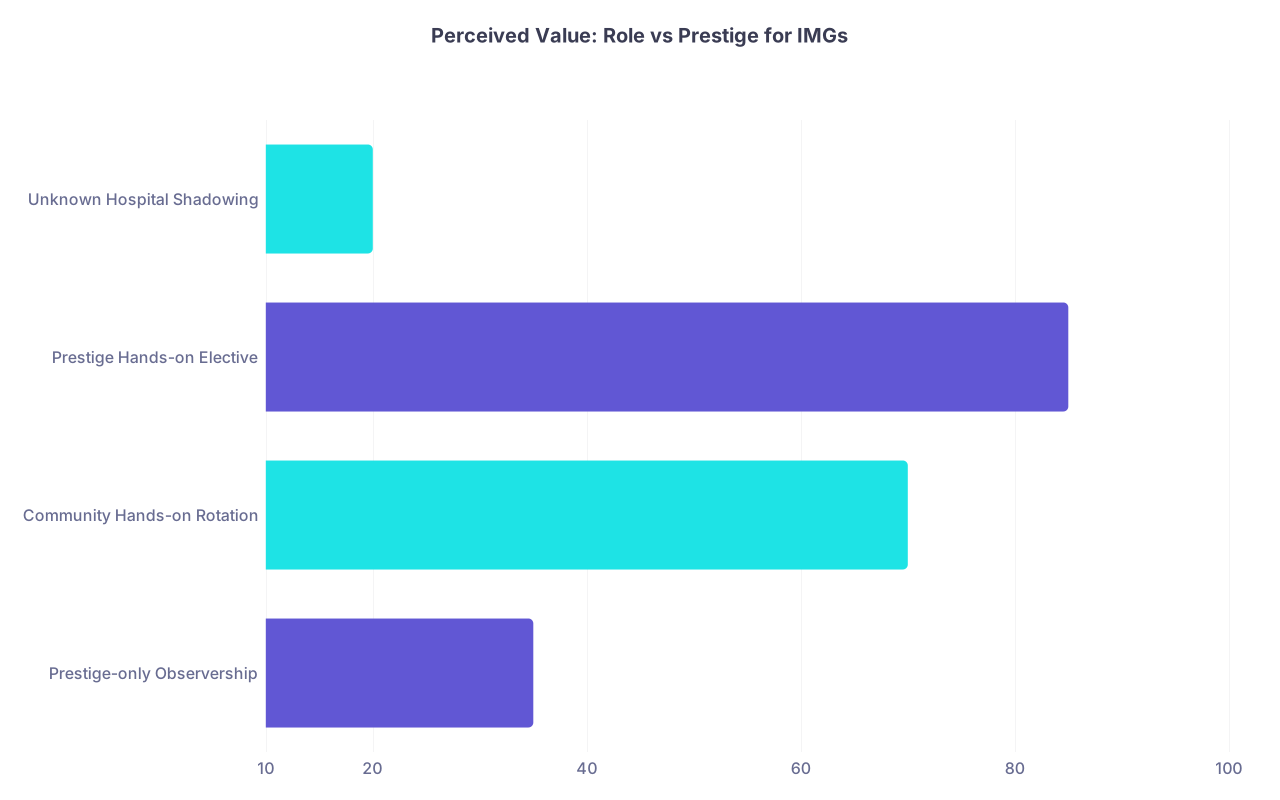
| Category | Value |
|---|---|
| Prestige-only Observership | 35 |
| Community Hands-on Rotation | 70 |
| Prestige Hands-on Elective | 85 |
| Unknown Hospital Shadowing | 20 |
These numbers aren’t from a randomized trial. They’re a reasonable synthesis of PD surveys, match data patterns, and real feedback: prestige plus hands-on = excellent. Prestige alone with weak role = overrated.
The Trap: Confusing Exposure With Evaluation
I’ve seen this dozens of times:
IMG goes to a top academic center for a month-long observership. No EMR access. No order writing. No notes. Zero responsibility. They follow the team, maybe present a patient or two. The attending barely remembers their name.
They leave with:
- One generic LOR: “Dr. X attended rounds and showed interest.”
- A line on CV: “Clinical Observer, Department of Medicine, Famous Hospital.”
- A sense that they’ve “made” their application.
Then comes interview season. Silence. Or interviews only at lower-tier community programs.
Why? Because exposure is not evaluation.
Residency programs care about:
- Who trusted you with actual patient care
- Who watched you long enough to know your work ethic
- Who is willing to vouch for you in concrete terms
An “observer” at a famous hospital that cannot be directly compared to a U.S. med student doesn’t carry the same weight as an acting internship where you’re writing notes, carrying a pager, getting grilled on rounds, and living the workload of an intern.
Most PDs would rather read: “This applicant functioned at the level of our MS4 sub-interns” from Dr. No-Name at County General than “This applicant observed our service and is very enthusiastic” from Dr. Big Name at an Ivy.
Because only one of those statements tells them you’re actually ready for July 1.
Data Clues: What Surveys and Match Numbers Suggest
There is no spreadsheet that says “Hopkins observership = +5% match chance.” Medicine doesn’t work that way. But we do have some clues.
NRMP Program Director Survey (Internal Medicine and others) repeatedly shows:
- “Audition electives” / “visiting rotations” at their institution are valued very highly.
- Letters from U.S. clinicians who have supervised you in a clinical context are critical.
- U.S. clinical experience is significantly more important for IMGs than for AMGs.
What you don’t see:
- “Name of hospital” as a separate high-priority factor
- “Prestige of observership site” as a top decision driver
You see “Type of clinical experience,” “Performance in that setting,” and “Letters of recommendation” dominating the list.
So if you force me to roughly weight the influence for an IMG’s clinical experience, it looks more like this:
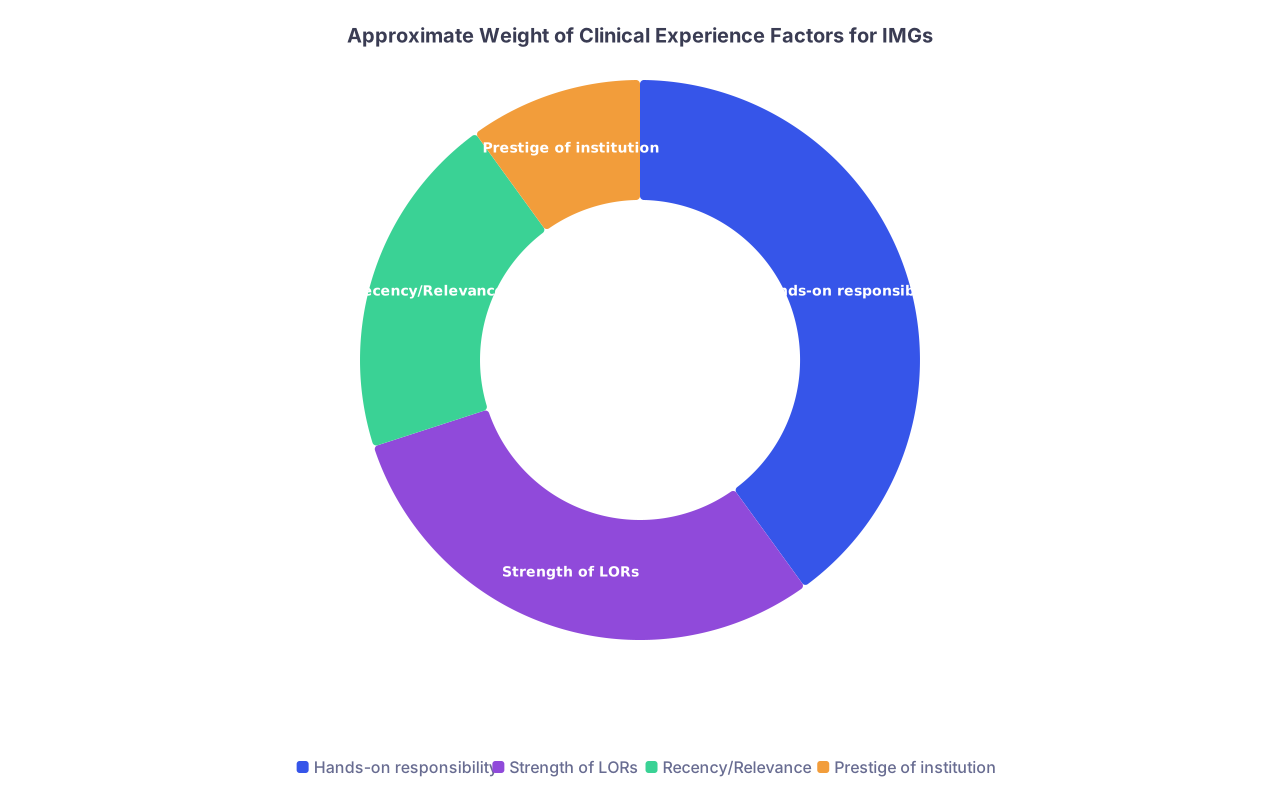
| Category | Value |
|---|---|
| Hands-on responsibility | 40 |
| Strength of LORs | 30 |
| Recency/Relevance | 20 |
| Prestige of institution | 10 |
Are those exact numbers? No. But they’re directionally consistent with what PDs say. Prestige is the smallest slice, not the core.
When Prestige Does Help (And When It’s Cosmetic)
Let’s be fair. Big-name hospitals are not useless. Far from it. They can help you—but only under certain conditions.
They help when:
- You have true, hands-on responsibilities there. Think: sub-I, acting intern, or equivalent.
- You are directly compared to U.S. med students and perform well.
- Your letter writer is known in the field and actually knows you well enough to write specifics.
- The specialty values academic pedigree heavily (e.g., certain competitive fields).
They’re mostly cosmetic when:
- You were basically a shadow—no EMR, no orders, no real accountability.
- Your letter is generic, templated, and could apply to 50 other observers.
- It’s your only U.S. experience and it doesn’t show you can function as an intern.
- You’re applying to bread-and-butter community programs that mostly care about reliability, not research pedigree.
I’d take a 4-week, high-intensity sub-I at a mid-tier community hospital with a sharp, detailed LOR over a 4-week observer spot at a “top 5” name any day, if my goal is increasing your match probability.
And yes, I’ve seen candidates with two “elite” observerships and zero solid hands-on rotations get crushed by people with ugly-sounding but meaningful community hospital experiences.
The IMG-Specific Angle: Why Role Matters Even More for You
If you’re an AMG, everyone already knows your baseline context. LCME school. Standardized clerkships. MS3 evaluations. For IMGs, none of that is assumed. PDs don’t always know how to interpret your home country rotations.
So they look at your U.S. clinical experience as the main calibration tool.
They’re asking:
- Can this person adapt to our system?
- Will they drown in July?
- Can they present concisely, write reasonable notes, follow up on tasks?
You don’t prove any of that by standing at the back of the room on rounds at a famous hospital. You prove it by:
- Pre-rounding
- Presenting
- Writing notes that actually go in the chart
- Calling consults
- Following up labs
- Getting called out when you miss something
That doesn’t require a fancy name. It requires a role that’s as close to an intern as possible.
Here’s the uncomfortable truth: IMGs often overcompensate with “brands” because they can’t easily get real roles at those same institutions. So they settle for observer badges at top places, instead of pushing hard for hands-on experiences where they’ll actually be tested and trusted.
It feels safer. It looks shinier. It’s also less powerful on ERAS.
How to Choose: Big Name Observership vs Smaller Hands-On Role
Let’s make this tangible. Imagine you have two options for a 4-week block:
Option A: Observership at “Northwestern University Hospital,” no EMR access, you follow the team, maybe give a presentation. Letter will be short and generic.
Option B: Acting-intern equivalent at “Riverside Community Hospital,” full EMR access, you write daily notes, manage cross-cover under supervision, and the attending promises to “go to bat” for strong trainees in letters.
If you care about actual match chances (not ego), Option B wins almost every time.
Here’s how these typically compare across dimensions that matter:
| Factor | Prestige Observership | Community Hands-on Rotation |
|---|---|---|
| EMR/Order Writing | Rare | Common |
| Real Responsibility | Low | High |
| Quality of LOR Potential | Often Generic | Often Specific |
| Comparison to US Students | Rare | Common |
| PDs’ Trust in Performance | Limited | Higher |
If you can get: Prestige + Hands-on in one place? Great. That’s gold. But if you’re forced to choose, don’t sacrifice role for logo.
Where Prestige Backfires
There’s another subtle problem: expectations.
Some PDs see a CV with three “big” institutions and no real roles, and it sends the opposite message you think. It can read like:
- “This person chases logos but hasn’t done an honest, gritty, workload-heavy month.”
- “They seem more interested in brand than in being where patients actually live.”
Programs that grind—busy community internal medicine, safety-net hospitals—want evidence that you’re not just here for the name. That you’ll show up on a random Tuesday night in February when three admissions roll in and the system is glitching.
Sometimes, a no-BS letter from a midwestern community attending like:
“We treated her exactly like our own MS4 sub-interns. She carried 6–8 patients, stayed late when needed, and I would be happy to have her as an intern.”
…carries far more punch than a “big” letter that never once says how many patients you carried, whether you wrote notes, or if you were even allowed to place one order.
How to Actually Think About Clinical Experience as an IMG
Strip away the noise and you’re left with a simple framework.
Whenever you’re offered a clinical experience, ask three questions:
Will I have real, documented responsibilities?
If the answer is “you’ll just observe,” downgrade it. Hard.Can this lead to a strong, detailed letter comparing me to U.S. students or interns?
If the attending never meets you properly or has 20 other observers, don’t expect much.Is the experience recent and relevant to the specialty I’m applying for?
A hands-on psychiatry month from three years ago matters less for this year’s IM application than a fresh internal medicine sub-I.
If a big-name hospital fits those criteria, fantastic. If it doesn’t, don’t delude yourself into thinking its logo will rescue a weak role.
Here’s a rough mental ranking that actually tracks with what PDs care about:
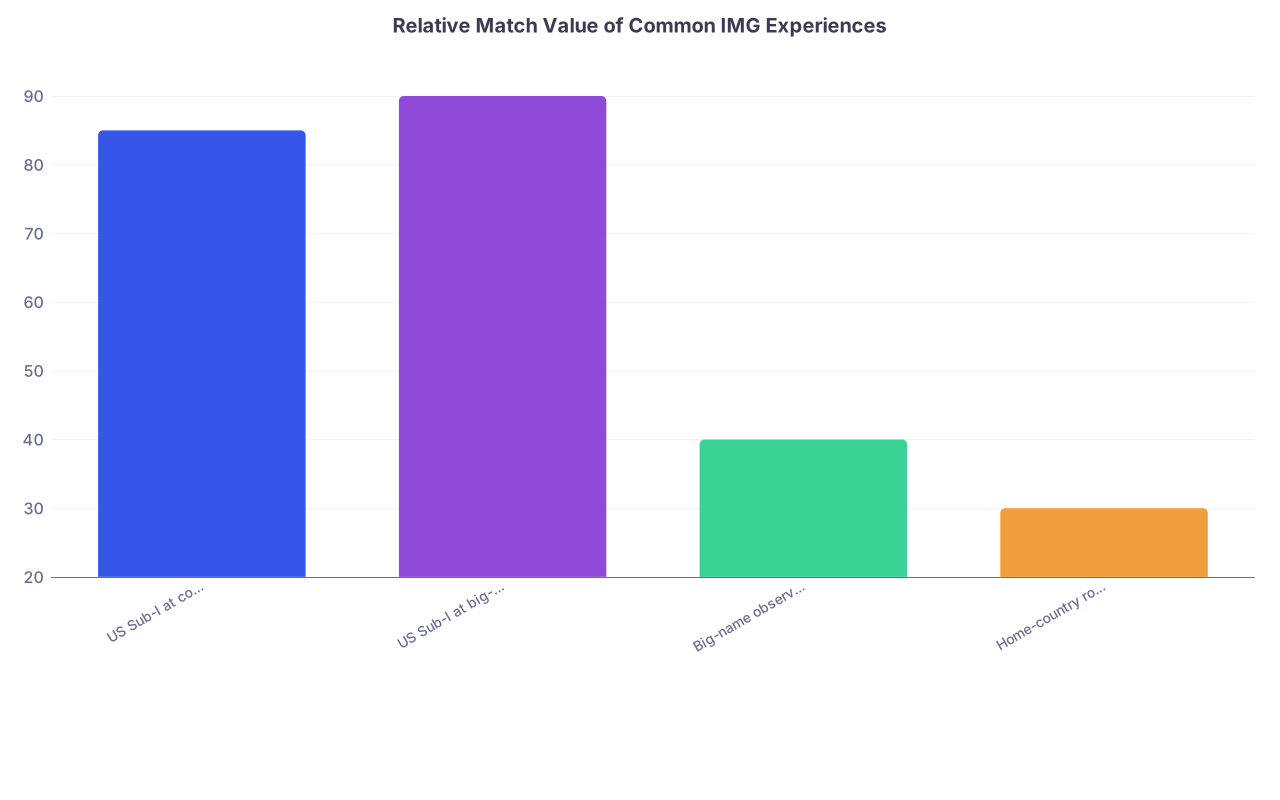
| Category | Value |
|---|---|
| US Sub-I at community program | 85 |
| US Sub-I at big-name center | 90 |
| Big-name observership | 40 |
| Home-country rotations only | 30 |
Again: not gospel numbers. But the pattern holds—sub-I > observership. Role > logo.
Final Reality Check
So, do prestigious hospital names matter more than roles?
No. Prestige is a mild amplifier at best. Your role—what you actually did, how you were evaluated, and what someone can truthfully write about you—matters far more.
Remember these:
- Hands-on, evaluative U.S. clinical experience beats passive observerships, even at big-name hospitals.
- Strong, specific letters based on real responsibility are worth more than a famous logo with a generic LOR.
- Prestige helps only when stacked on top of real work. It never substitutes for it.