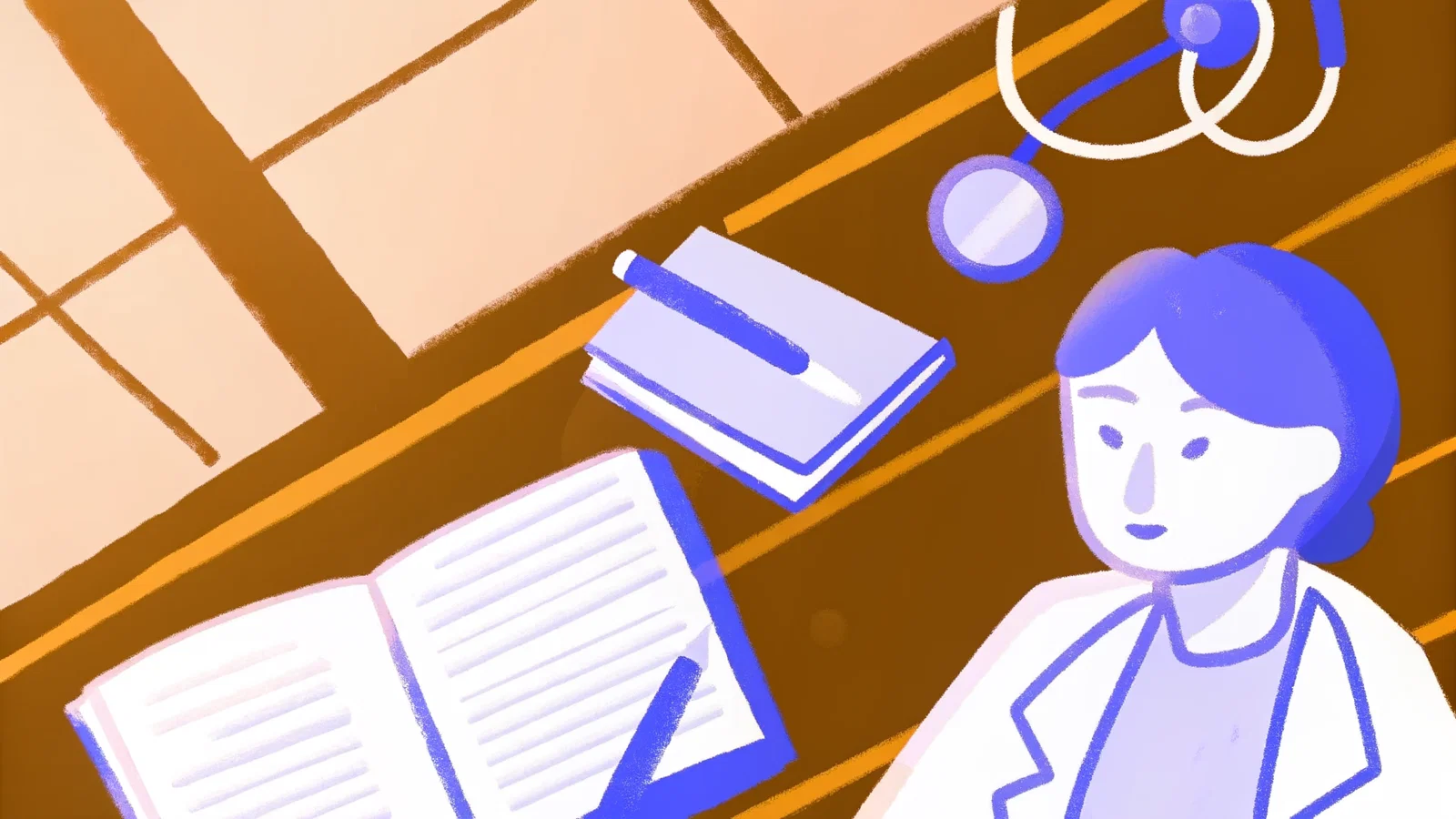
You're standing outside room 814 with your pen already uncapped like that's somehow going to save you. The intern finishes presenting. The attending nods. Then the head turn happens. Toward you. Not casually either. Deliberately. And suddenly the hallway feels too quiet, your tongue forgets how to work, and every millisecond of silence feels like evidence that you do not belong in medical school.
"What are the causes of an anion gap metabolic acidosis?" "What's the next step?" "Why that antibiotic?" "What nerve runs there?" "What complication are we trying to prevent?"
And then you realize the awful truth: this attending doesn't really teach with mini-lectures or friendly setup questions. They teach by asking. Constantly. Every interaction is a pop quiz wearing a stethoscope.
If that's your rotation right now, I need to say this first because this is the part anxious people never believe: a pop-question-heavy rotation does not automatically mean you're doing badly. It feels high-stakes because it's public, fast, and impossible to fully control. That's exactly why it gets under your skin. But the format itself is not proof that the attending is disappointed in you, targeting you, or building a case against your evaluation. Sometimes it's just how they were trained. Sometimes it's how they think. Sometimes, frankly, it's a lazy teaching style dressed up as rigor. But it still isn't a verdict.
What they're usually testing is not whether you've memorized every page of Harrison's by 5:30 a.m. They're looking at whether you prepared for your patients, whether you can reason through a problem safely, whether you're paying attention, and whether you can stay composed when put on the spot. That matters. A lot more than random trivia perfection.
This article is for surviving that kind of rotation without spiraling into the kind of 1 a.m. doom loop where you replay one bad answer like it's career-ending footage. You do not need to become a medical Jeopardy champion overnight. You need a system. A way to prepare, answer, recover, and protect both your grade and your sanity.
The Moment You Realize Every Question Is a Pop Question
The first few days are usually the worst because you haven't figured out the attending's pattern yet. So every question feels like a trap. You start scanning their face for clues. Are they curious? Annoyed? Setting you up to fail in front of everyone? The uncertainty is half the misery.
And let's be honest: this style feels brutal because medicine already attracts people who are absurdly good at tying self-worth to performance. Then someone asks you a question in a cramped patient room while three residents and a nurse are listening, and your brain goes straight to the darkest possible interpretation. If I miss this, I look lazy. If I pause too long, I look stupid. If I answer wrong, I tank the eval. That's the soundtrack.
But here's the reality I wish more students heard plainly: one awkward silence is not a professionalism issue. One wrong answer is not a grade funeral. Even freezing does not automatically translate to "unprepared." It often translates to "human being under pressure." Attendings know that, even the annoying ones.
What this setup actually tests is broader than recall. Can you follow the patient story? Did you review the obvious problems? Can you build a differential, prioritize danger, and choose a safe next step? Can you admit uncertainty without collapsing into panic or bluffing your way into nonsense? That's the real exam. Not whether you can recite every cause of eosinophilia before coffee.
Why Pop-Question Rotations Feel So Brutal
The psychology here is ugly but predictable. Uncertainty makes people anxious. Public performance makes people more anxious. Add hierarchy and evaluation, and your brain starts acting like a raccoon in a dumpster fire. You're not weak for reacting badly to that. It's a very normal stress response.
The part students miss is the hidden message behind a lot of attending questions. Most aren't actually asking, "Do you know the exact fact I know?" They're asking, "How do you approach a problem when you're not handed the answer?" That's why a structured, safe response often lands better than a frantic fact-dump.
I've seen students hurt themselves by assuming every question is all-or-nothing. It isn't. The attending asks, "Why is this patient hypoxic?" and the student thinks, I must instantly produce the single perfect diagnosis. No. Start with the obvious. "Given the fever, new oxygen requirement, and focal crackles, pneumonia is high on my differential. I'd also think about pulmonary edema and PE depending on the rest of the picture." That sounds like someone thinking. Which is what they want.
And yes, let's address the 2 a.m. fear directly: "If I freeze, will they think I'm unprepared? Will this tank my grade?" Usually, no. Repeatedly looking disengaged, careless, or defensive can hurt you. One rough answer usually doesn't. Attendings evaluate patterns. If you know your patients, show improvement, and don't become weirdly combative when corrected, you're fine more often than your anxiety admits.
They're usually looking for four things: structure, honesty, safe reasoning, and willingness to be taught. Not swagger. Not fake confidence. Definitely not wild guessing dressed up as certainty. That impresses nobody.

How to Prepare Without Studying Yourself into Exhaustion
This is where anxious students usually make things worse. You go home after a rough day and try to study literally everything that could ever be asked on that service. It feels responsible. It is not. It's panic disguised as work.
You need a survival strategy, not a fantasy plan. Focus on common presentations, core management steps, and high-yield differentials. If you're on internal medicine, know chest pain, dyspnea, fever, altered mental status, AKI, hyponatremia, GI bleed, CHF, COPD, pneumonia, sepsis. If you're on surgery, know postop fever, ileus, bowel obstruction, wound infection, fluid management, pain control, common complications. Start with what you are actually seeing, not obscure zebras.
Your best daily routine is boring. Good. Boring works. Before rounds, review each of your patients by problem list. Have a one-liner ready. Know why they're here, what changed overnight, the main labs, the current plan, and one likely teaching point tied to their diagnosis. Ask yourself, "If I were the attending, what would I ask about this patient?" That question alone saves people.
Use a simple framework when answering. Define the problem. Give the differential. Choose the next step. Say why. That's enough most of the time. For example: "This looks like hypotonic hyponatremia in a patient with heart failure. My differential includes hypervolemic hyponatremia from CHF, medication effect, and less likely SIADH based on volume status. I'd start by confirming serum osmolality and urine studies, while reassessing volume and medications." Clean. Safe. Organized.
And when you don't know, don't melt down. Have language ready. Script it if you need to. "I'm not sure, but my first thought is..." works. "I'd like to reason through it aloud" works. "I don't know the exact answer, but my approach would be..." works. Calm honesty sounds far better than desperate guessing.
How to Answer When You Freeze Mid-Question
Freezing feels dramatic from the inside, but it's often less visible than you think. Usually it looks like a student taking a beat. That's survivable. The key is not letting one beat turn into a full panic spiral.
Start with your body because your brain is unreliable when adrenaline spikes. Exhale slowly. One breath. Then repeat or reframe the question: "You're asking about the likely causes of her postoperative tachycardia?" That buys you two or three seconds and shows engagement instead of panic. Tiny trick. Weirdly effective.
Then think out loud, but don't ramble like you're trying to fill dead air with words before anyone notices you're scared. Keep it anchored to the patient. "For this patient, I'd worry first about pain, hypovolemia, infection, or PE depending on the timeline and oxygenation." Short beats. Relevant data. Forward motion. If you can give a clean top three and a next step, you are doing better than you think.
If you answer wrong, recover like an adult. Not with ten apologies. Not with a speech. Just: "Got it." Or, "That makes sense." Or, "Thank you, I was thinking too narrowly." Then move on. Students often turn a small miss into a spectacle by groveling. Don't do that. It makes everyone uncomfortable and draws more attention to the mistake.
And the fear of looking stupid? Brutal, but manageable. One imperfect answer rarely ruins a rotation. What does make things worse is spiraling in public: overexplaining, arguing, guessing after you've been corrected, or getting visibly defensive. Being wrong is normal. Being hard to teach is a problem.
How to Protect Your Grade and Your Sanity
If you want to quietly help your evaluation, do the unglamorous things well. Show up on time. Know your patients. Follow through on tasks. Volunteer when it's useful, not performative. Ask smart, targeted questions. Accept feedback without acting wounded. These behaviors are gold, and students underestimate them because they're less dramatic than nailing a pimp question about the coagulation cascade.
Consistency beats brilliance. Every time. Attendings remember the student who was reliable, prepared, and noticeably more polished by week three. They do not sit around cherishing one magical answer you gave about renal tubular acidosis. They remember whether working with you felt easy or exhausting.
You also need rules for protecting your head. Debrief with classmates if that helps, but don't turn it into a mutual panic club where everyone compares obscure questions like hostages trading trauma stories. Set a hard stop on post-round rumination. Ten minutes to review what you missed and look it up. Then stop. Replaying every question on your walk home, in the shower, while brushing your teeth, and while trying to sleep is not studying. It's self-torment.
I'm firm on this because I've seen what happens when students don't rein it in. They start overpreparing in all the wrong ways, sleeping less, getting more anxious, freezing more often, and then using that as proof they're failing. It's a stupid cycle. Break it early.
So here's the reminder I wish someone had drilled into all of us sooner: surviving a pop-question rotation is not about sounding brilliant all day. It's about being steady. Coachable. Safe. Prepared enough for the common stuff. Honest about the rest. Fear will tell you every question is a referendum on your future. It's not. Most of the time, it's just rounds. Hard rounds, yes. But still rounds. You can survive that.