

Last week a hospitalist pulled me aside in the work room. She’d just switched into neurology fellowship after years in IM and whispered, “I think I screwed myself… does any of my old CME even count now? Or am I about to get audited and lose my license?” She laughed, but it was the panicky, I‑might‑actually-cry laugh we both know too well.
If you’re here, I’m guessing you’ve got a similar knot in your stomach. You changed specialties—maybe officially, maybe you’re in the transition—and now you’re staring at piles of “irrelevant” CME, wondering if it all just turned into confetti.
Let me cut through the noise: your old CME is usually not worthless. But there are some traps, and they’re exactly the kind of bureaucratic, technical traps that keep anxious people like us up at night.
Let’s unpack this like someone who really doesn’t want a surprise email from the board.
First: Are You Worried About License, Hospital, or Board Certification?
This is the first place people mix everything together and then spiral.
You’ve got at least three different “masters” that care about CME:
- Your state medical board (for your medical license)
- Your specialty board (for board certification / MOC / CPD)
- Your employer or hospital medical staff office (for privileges / credentialing)
Each of them treats your old specialty CME a little differently.
| Entity | Cares About Relevance? | Typical Requirement Style |
|---|---|---|
| State Medical Board | A little | Total hours + some topic rules |
| Specialty Board (ABMS) | A lot | Specialty-specific + structured activities |
| Hospital / Employer | Moderate | License + some focused / risk CME |
So when you’re asking “does my old CME count,” you actually have to ask three slightly different, equally annoying questions:
- Does it count for my license?
- Does it count for my new board?
- Does it keep my job/privileges safe?
Let’s go one by one.
State License: Is My Old CME Useless Now?
This is the one people catastrophize about: “What if the state audits me and says my ICU sepsis CME doesn’t count now that I’m doing derm?”
Breathe. States are usually the least picky about specialty match.
Most state medical boards care about:
- Total number of CME hours (e.g., 50 hours / 2 years, 100 hours / 2 years, etc.)
- Certain mandatory topics (opioids, ethics, pain management, implicit bias, child abuse reporting, etc.)
They do not usually say, “You must have X hours in your current specialty.”
So that cardiology CME you did three years ago as an IM hospitalist? If it was AMA PRA Category 1 Credit™ or the state-accepted equivalent, it almost always still counts toward your total CME hours for license renewal—even if you’re now going into psych, derm, or PM&R.
Where people get burned is here:
- They forget that some states require live or interactive CME (not all online on-demand).
- They miss the weird mandated topics (“2 hours opioid”, “1 hour ethics”, “1 hour human trafficking”).
- They assume their board’s rules = their state’s rules. Different beasts.
So your old specialty CME is rarely “wasted” for your license. It becomes generic “bucket filler” for total hours. The content relevance usually matters more to you than to the state.
Worst-case scenario for license?
You get audited, they see 60 hours of valid Category 1 CME, but none in the opioid prescribing category they require; you have to scramble to complete a specific course, maybe face a fine or warning. Not “lose your license tomorrow,” but a very miserable few months.
The fix: go to your state board website, pull the exact CME rule set (not a blog summary, the actual regulation), and see:
- Do they specify topics?
- Do they say anything about specialty-specific CME? (Most don’t.)
You’ll almost always find your old CME absolutely still counts for something.
Specialty Board: This Is Where Things Get Messy
This is the part that makes your brain go, “I knew it—this is where I’m screwed.”
Let’s say you:
- Did IM residency
- Were ABIM certified
- Logged IM‑relevant CME and MOC points for years
- Then you switch to radiology or anesthesia or psych
Two questions pop up:
- Does my old IM CME count for my new specialty board?
- Does it still matter for the old board if I want to keep that certification alive?
1. For the new board
If you’re still in training for the new specialty (residency or fellowship), your initial certification requirements usually don’t depend heavily on your prior CME. They care about:
- Completing an ACGME-accredited residency/fellowship in the new specialty
- Passing the initial board exam
- Maybe a few professionalism/ethics/ABMS-type modules
Your old cardiology, nephrology, or ICU CME usually does not “count toward” initial certification in a new field. It’s just background knowledge.
Once you’re certified in the new specialty, then the specifics of that board’s MOC / CME program kick in. That’s when they’ll want:
- A certain number of specialty-specific CME hours over X years
- Certain types of activities (SA-CME, self-assessment, performance improvement, etc.)
Here’s the harsh part:
Most specialty boards expect the majority of CME logged for their MOC program to be related to that specialty. They’re not thrilled if a neuro board-certified doc is turning in 90% dermatology CME.
Will they reject all “out-of-specialty” CME automatically? No, not usually. But they could:
- Limit how many “general” CME credits count
- Require that certain “core” activities be their own modules (e.g., ABIM, ABA, ABP, etc.)
So yes, a lot of your old CME from your prior specialty probably won’t be meaningful for MOC in the new specialty. It might still pad total CME hours, but it likely won’t satisfy the more specific “participation in XYZ modules” rules.
Worst-case scenario:
You assume your old IM CME will keep you on track for your new radiology MOC. Three years later, you log in and realize you’re way behind on specialty-specific self-assessment and practice improvement. Now you’re doing a year’s worth of work in three panicked months.
2. For your old board
Do you even want to keep that certification?
If yes, your old IM CME massively still counts—because it matches that certification. You can absolutely be double-boarded and keep satisfying both IM and, say, allergy, as long as you:
- Follow each board’s MOC process
- Log enough specialty-appropriate CME for each
Your switch doesn’t delete your old CME’s value for the original field.
But if you’re mentally “done” with the old specialty and drop that board certification, then yeah, its MOC-aligned CME loses most of its formal value. It becomes generic professional development and maybe helps for state license, but that’s it.
Hospital / Employer: Are They Going to Freak Out?
Here’s another anxiety trigger: “My hospital requires specialty-relevant CME for privileging. If I show them all my old specialty CME, do I look incompetent?”
Most hospitals care about two broad questions:
- Are you licensed and in good standing?
- Are you maintaining competence in what you’re credentialed to do here?
So if you:
- Used to be a general surgeon
- Switched to wound care / hyperbaric medicine
- Or moved from adult EM to pediatric EM
- Or left hospitalist work to be an outpatient primary care doc
What they want to see, usually, is that your recent CME aligns with what you’re actually doing clinically.
Your old CME isn’t “bad” or incriminating. It’s just… historical.
But more and more hospitals will specify something like:
- “X hours of CME relevant to your clinical privileges in the last 2 years”
- “Documented CME in moderate sedation, ACLS, stroke care, etc.”
So in the context of privileging, the last 1–2 years matter a lot more than what you were doing five years ago in fellowship.
If your worry is:
“I spent the last three years doing tons of ICU/hospitalist CME and now I’m going into outpatient psych—did I waste all that?”
Realistically:
- For state license: it still counts for total hours
- For hospital privileging in psych: probably not useful going forward, but not harmful
- For specialty board in psych: largely irrelevant
So yes, if you’ve truly turned the page, some of that old specialty CME is now primarily just part of your professional history.
But it doesn’t erase your future. It just means the next 1–3 years you’ll want to be deliberately heavy on your new specialty when you pick CME.
“I Switched During Residency / Fellowship—Now What?”
This is its own special kind of anxiety.
Scenarios I’ve seen:
- You did 2 years of categorical IM, then switched into anesthesiology
- You started in neurosurgery, burned out, moved to radiology
- You began in OB/GYN, then transferred into family medicine
You’re staring at all the CME from your first specialty—grand rounds, conferences, journal clubs, online modules—and wondering if it’s all sunk cost.
Here’s the unglamorous truth:
- Most CME you “earn” during residency is more about fulfilling program requirements than building a personal CME portfolio.
- When you fully finish the new residency and become board-eligible/certified, that board cares almost entirely about what happens after you’re certified, not what you did as a struggling PGY‑2 in a different field.
Residency-phase CME is rarely where people get audited or punished. What actually bites people is:
- Post-residency years where they stop tracking anything
- Sloppy record-keeping when they move states or change jobs
- Assuming someone else (GME office, hospital) is tracking it forever
So if you changed specialties during training, your old CME is basically:
- Fine for your state license eventually
- Not critical for your new board’s initial certification
- Basically invisible to most employers who only care about your last 2–3 years once you’re an attending
It’s not wasted. It just lives in the background instead of the spotlight.
How to Stop Obsessing and Make Your Old CME Work For You
You can’t go back and retroactively make your ICU or surgery CME magically become derm or psych. But you can do damage control and future‑proof yourself.
Here’s the practical, not-perfect-but-realistic path:
Inventory what you actually have
Log into every CME provider you’ve used (UpToDate, specialty societies, Medscape, CME conferences, etc.). Download transcripts. Save them in one boring but essential folder.Separate in your head: total hours vs. relevance
- Total hours → mostly for state license
- Specialty relevance → mostly for boards and privileging
Check three rule sets personally
Don’t rely on what “someone said in the call room” or a half-baked blog.- Your state medical board CME requirements
- Your new specialty board’s CME/MOC rules
- Your hospital/clinic’s privileging bylaws (ask medical staff office)
Plan the next 2–3 years CME like you’re correcting course
If your last few years were 90% old specialty, deliberately swing hard the other direction:- Prioritize conferences, online modules, and journal CME in your new specialty
- Look for your new specialty society’s official MOC/SA-CME offerings
- Pick CME you can report cleanly to your new board
When in doubt, email the board/hospital
Yes, it’s terrifying to email ABIM, ABR, ABA, etc., or your medical staff office. But they’d rather answer a boring question early than deal with a panicked crisis before a renewal deadline. Ask something like:- “I recently transitioned from X to Y. Do my prior CME credits in X count toward any current cycle requirements, or should I assume only future, Y‑focused CME will satisfy MOC?”
Get it in writing and save it. Future you will be grateful.
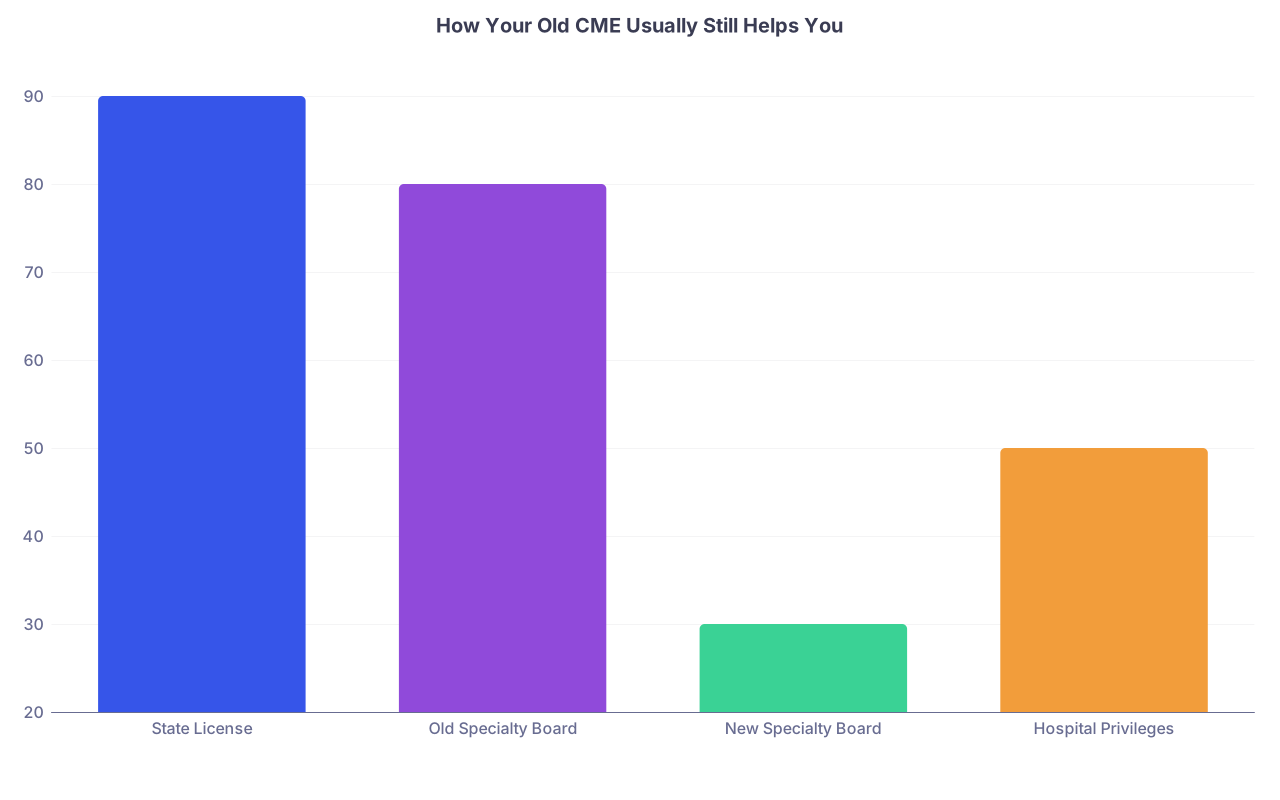
| Category | Value |
|---|---|
| State License | 90 |
| Old Specialty Board | 80 |
| New Specialty Board | 30 |
| Hospital Privileges | 50 |
(Percentages are rough “how often it still matters,” not exact stats—but that’s the hierarchy I keep seeing.)
The One Thing You’re Probably Overlooking
Everyone fixates on “does my ICU CME count now that I’m doing derm?”
But here’s the quiet reality: what often matters more than the exact topic is that you can prove it—clean, organized, defensible.
I’ve seen people sail through audits with mediocre-but-documented CME. I’ve also seen excellent doctors with tons of actual education get grilled because they can’t produce certificates or logs.
So yes, worry a bit about relevance.
But worry more about documentation.
If you can say, “Here are my last 5 years of CME transcripts, by provider, with dates, credit types, and topics,” most bureaucracies back off quick.

| Step | Description |
|---|---|
| Step 1 | Switched Specialty |
| Step 2 | Check State Board Rules |
| Step 3 | Check New Board MOC |
| Step 4 | Check Hospital Bylaws |
| Step 5 | Old CME usually counts for total hours |
| Step 6 | Old CME rarely counts for specialty MOC |
| Step 7 | Need recent CME in new clinical area |
| Step 8 | Focus future CME on new specialty |
| Step 9 | Concern |
Bottom Line: Did You Waste All That Old CME?
No. But you might have overestimated how “transferable” it would be.
Real talk:
- For license: your old CME almost always still helps.
- For your new specialty board: expect to start fresh in spirit, if not literally.
- For privileges: they care much more about what you do from now on.
So no, you didn’t “ruin” your CME record by changing specialties. You just changed the rulebook mid‑game. Annoying? Definitely. Fatal? No.
You get to reorient, be intentional for the next few years, and build a CME trail that actually matches who you are as a clinician now—not who you were five years ago panicking through a different residency.
Years from now, you won’t be replaying whether that 2019 sepsis webinar counted for anything in derm. You’ll remember that you changed direction, didn’t have all the answers, and figured out how to keep going anyway.


