
You stepped away.
Maybe you took a sabbatical after burning out on call. Maybe you went on parental leave and it turned into a longer break than planned. Maybe you followed a spouse’s job overseas. Or you just needed to stop for a year before you broke.
Now you’re looking at your licenses, hospital privileges, and CME requirements and thinking: “Did I just blow everything up?”
Here is the reality: a leave or sabbatical does not have to wreck your CME status, licensure, or board certification. But it will if you treat it as an afterthought.
Let’s walk through exactly what to do if you’re on leave now or planning one, so you do not return to a pile of regulatory landmines.
Step 1: Get Clear on Who Actually Cares About Your CME
You do not have “one” CME obligation. You have several overlapping ones, all with their own clocks and rules.
These are the main players:
| Entity | Typical Cycle | Jurisdiction |
|---|---|---|
| State medical board | 1–3 years | State/province level |
| Specialty board (MOC) | 5–10 years | National |
| Hospital/health system | 1–2 years | Local/Institutional |
| Payer/insurance panel | 1–3 years | Plan-specific |
| DEA / special permits | 1–3 years | Federal/regional |
Before you worry about “CME in general,” you need a list.
Today, list out every place your name and license are tied:
- All state/provincial licenses (yes, including that random moonlighting state)
- Specialty boards (ABIM, ABFM, RCPSC, etc.)
- Hospitals and surgery centers where you have privileges
- Major payers where you’re credentialed (Medicare, big commercial plans)
- Federal/other registrations (DEA, buprenorphine, etc., if applicable)
Then, for each one, find:
- Renewal date(s)
- CME requirement (total hours and any subcategories: ethics, opioid, patient safety, etc.)
- Whether they have any explicit policy on leave of absence / sabbatical / part-time practice
If you cannot find a policy online, you email or call. Do not assume a break automatically buys you leniency. Often it does not—unless you ask, in writing, before problems arise.
Step 2: Decide Your Status During Leave – Active, Inactive, Or Surrender?
This is where people accidentally hurt themselves.
You have three general options when you step away:
- Keep everything active and keep doing CME
- Move some things to inactive / retired / non-practicing
- Completely surrender something (this is usually the worst default)
Let’s be blunt.
If you think there is a reasonable chance you’ll be back within 1–3 years, you almost always want to either:
- Keep your main license(s) active and do the minimum CME, or
- Move to a board’s “clinically inactive” or “retired” track if they offer one that preserves status.
What you typically do not want to do casually:
Let things lapse and assume “I’ll just fix it later.”
Reactivation is often more painful than maintaining minimal compliance: reentry plans, supervised practice, extra CME, explanation letters to credentialing committees. I’ve watched people lose 6–12 months trying to claw their way back.
Step 3: Talk to Your State Boards Before You Go Dark
State boards are where most physicians get burned, because they assume boards “will understand.” Boards do not “understand.” They enforce rules.
Here is the play if you’re planning a leave:
Pull your state board CME rules.
Look specifically for language on:
- Exemptions for illness, disability, or hardship
- Exemptions or modifications for military deployment
- Grace periods or deferrals
- Pro-rated CME for partial renewal cycles
Email the board (not just call) something like:
I am a currently active licensee (License #_____). I will be on a leave of absence from clinical practice from [date] to [date] for [brief reason if you’re comfortable—“medical”, “family”, or “academic” is enough].
My renewal is due on [date]. I’d like clarification on CME expectations during this period and whether there are options for:
• Exemption or reduction based on temporary non-practice, or
• A deferral or extension of the CME deadline.Could you please advise in writing what is required to maintain my license in good standing during this leave?
Then save that response in three places. If someone questions your CME a year later, you have board guidance in writing.
If you are already on leave and behind: still email. Ask what remediation they require. Do not just cram random CME and hope it flies.
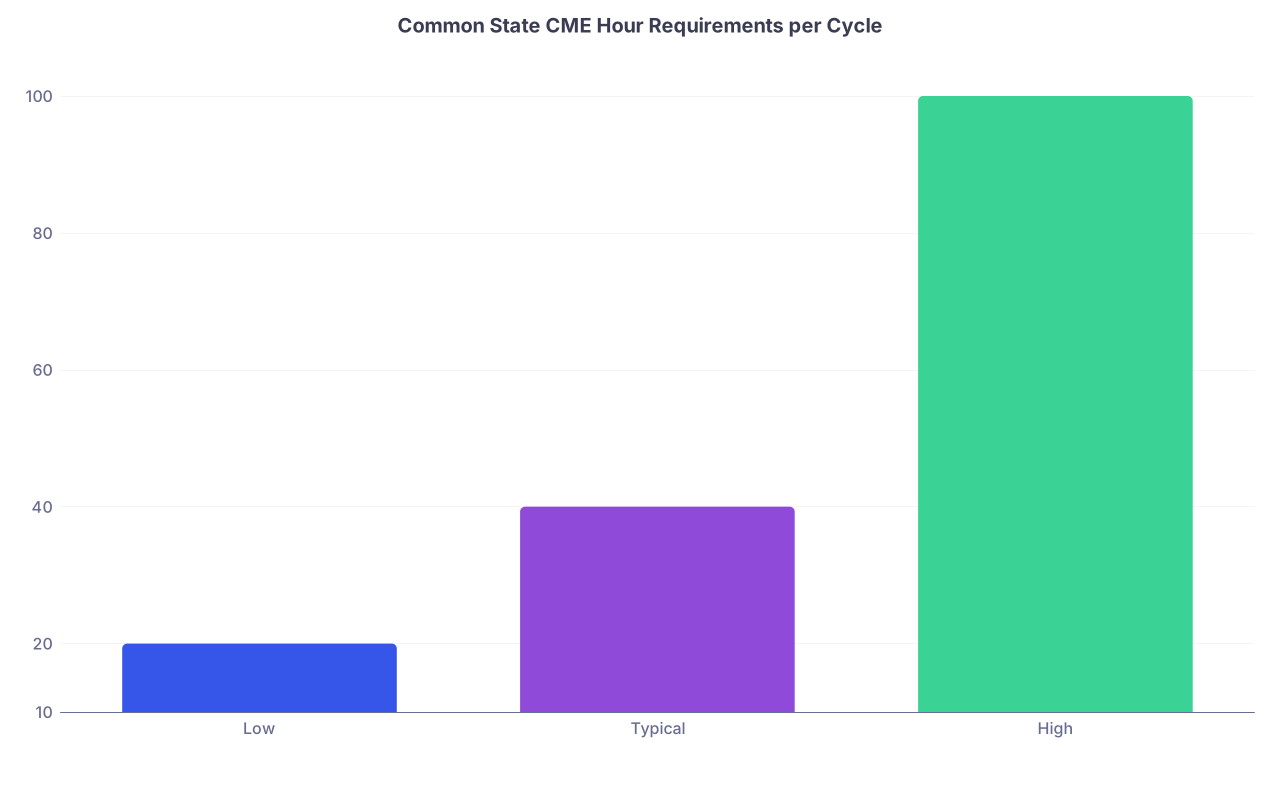
| Category | Value |
|---|---|
| Low | 20 |
| Typical | 40 |
| High | 100 |
Step 4: Protect Board Certification (MOC) While You’re Out
Boards have gotten more complicated with their “continuous certification” games. The trap is missing a few MOC years and discovering you are now “Not Certified” on public lookup.
Action plan:
Log into your board portal (ABIM, ABP, RCPSC, etc.).
Look at:
- Your certification expiration date
- Any yearly/biannual “points” or “Lifelong Learning” requirements
- Any upcoming secure exam windows or assessment deadlines
Find if they have formal policies on:
- Medical leave / parental leave
- Part-time practice
- Practice interruption or sabbatical
Most boards will not automatically stop your requirements. Some will allow:
- Reduced requirements per year
- Deadline extensions
- Temporary “clinically inactive” status that preserves certification but flags it as such
You want to ask for accommodations early, especially if an exam or big milestone is coming up during your leave.
Again, email, not just phone. Something like:
I am currently board certified in [specialty], ID [#]. I will be taking a leave from clinical practice from [date] to [date].
I would like to maintain my certification. Could you advise:
• Whether standard MOC participation continues to be required during this period, and
• Whether there are options for extension, accommodation, or inactive status that preserve certification while I am not clinically active?
If the leave is due to serious illness, disability, or a protected event (pregnancy/childbirth, major caregiver duties), say so explicitly. Boards are more flexible when they understand the context; they’re less flexible with “I just didn’t get around to it.”
Step 5: Handle Hospital Privileges Intentionally, Not Passively
Leaving privileges to “expire” looks sloppy to medical staff offices. The story they see: physician who cannot get paperwork in on time, or who disappears without explanation. That follows you later.
If you are on staff now and taking leave:
- Tell the Medical Staff Office in writing that you’re taking a leave
- Ask what status options exist:
- Leave of absence
- Inactive-while-on-leave
- Courtesy or adjunct status
- Resignation with option to reapply
Some hospitals have explicit rules: if you are on LOA for more than X months, they may require a reappointment process, proctored cases, or re-credentialing on your return.
Ask now:
- What happens to my privileges if I am away > 6 or 12 months?
- Will I need a re-entry plan, proctoring, or additional CME to return?
- Is there an “educational leave” or “sabbatical” category?
Then match your CME approach to what they expect. Some hospitals require:
- X hours of CME specific to your specialty every 2 years
- Proof of CME completion as a condition of reappointment after LOA
- Focused CME if you’re changing scope on return (e.g., dropping procedures)
You do not want to be finishing 25 hours of core CME in the week before your reappointment file goes to committee. Happens all the time. Looks bad.
Step 6: If You’re Already Behind on CME – Triage and Fix
Let’s say you’re mid-sabbatical, renewal is coming, and you’ve done almost zero CME. You did not plan. It’s ok; you fix it now, not 2 weeks before renewal.
Triage plan:
Figure out your hardest requirement first.
That’s usually:- State with the earliest license renewal
- Board with a fixed MOC/assessment deadline
List the specific buckets:
- Total hours (e.g., 50 hours / 2 years)
- Category 1 vs 2
- Mandated topics (opioid prescribing, ethics, domestic violence, implicit bias, etc.)
Ask two questions:
- How many hours do I actually need to be compliant?
- By what date?
Then pick CME platforms that can efficiently hit multiple targets.
Example: You need 40 total hours, including:
- 2 hours opioid prescribing
- 3 hours ethics
- 1 hour human trafficking
Do not collect random 1-hour talks from 10 different sites. Use one or two major CME vendors that let you filter by category and state requirements.
You want:
- On-demand, self-paced courses (because you’re on leave, you might not have institutional access)
- Broad topic coverage
- Ability to generate consolidated transcripts with date/time and credit type
And then you treat CME like a temporary part-time job until you’re out of the hole.
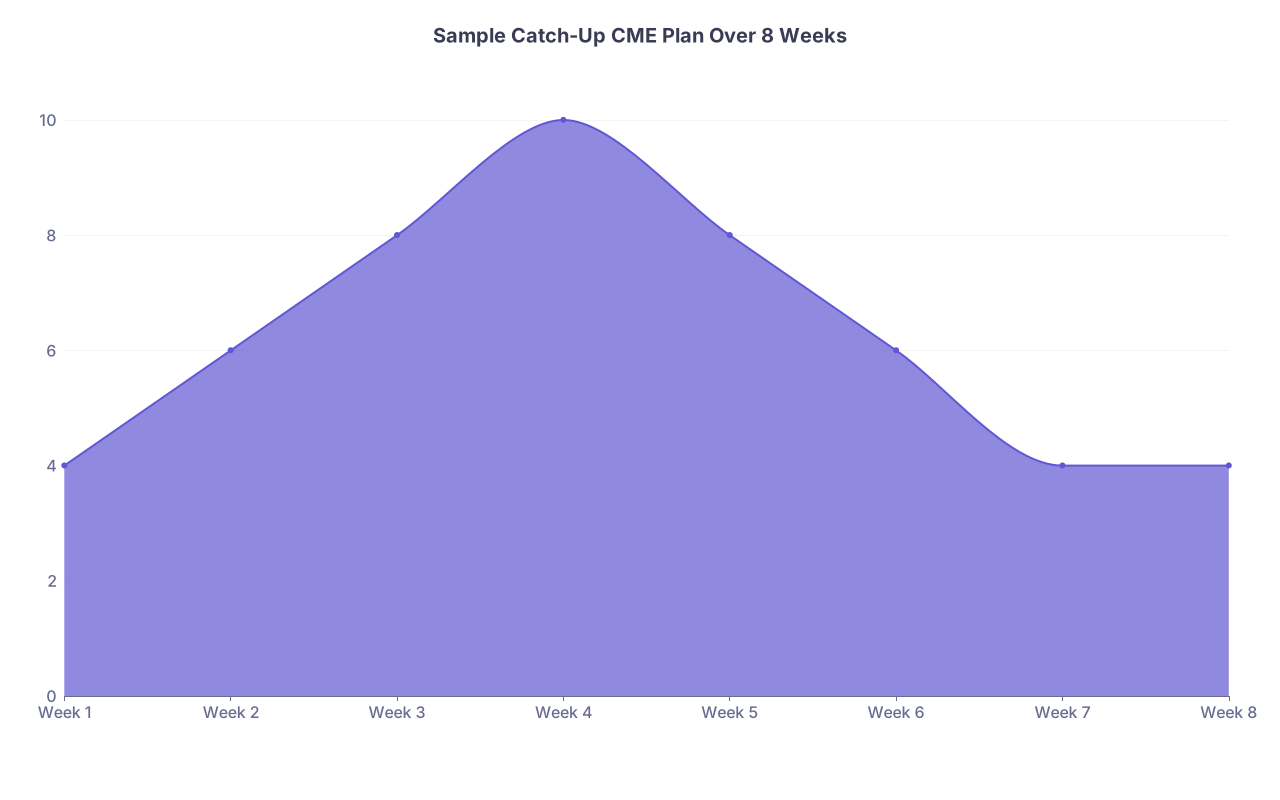
| Category | Value |
|---|---|
| Week 1 | 4 |
| Week 2 | 6 |
| Week 3 | 8 |
| Week 4 | 10 |
| Week 5 | 8 |
| Week 6 | 6 |
| Week 7 | 4 |
| Week 8 | 4 |
Step 7: Track Everything Like You’ll Be Audited Tomorrow
Most people on leave lose track of CME because they think, “I’m not seeing patients, no one will ask.” Then three years later, an email arrives: “You have been selected for CME audit.”
During sabbatical/LOA, set up a minimal system:
- One dedicated folder in cloud storage (Google Drive, OneDrive, Dropbox—pick one)
- Inside it:
- “CME Certificates”
- “Licensing / Board Emails”
- “Renewal Confirmations”
Whenever you:
- Complete CME → immediately save certificate as PDF with date and title in the filename
- Get an email from a board or hospital about your status → save it as PDF
- Submit a renewal → download and save payment/renewal confirmation
This is not about being “organized for its own sake.” It is so that if a board questions something 4 years from now, you can pull proof in 2 minutes instead of spending 2 days in email archaeology.
Step 8: Specific Situations – What To Do
Long-Term International Move (Spouse Job, Mission Work, etc.)
You’re out of the country for 2–5 years and not clinically active in your home jurisdiction.
Your options:
- Keep one primary license active with minimal CME:
- Usually your original home state or the state you’re most likely to return to
- Meet the minimum CME for that board only
- Move extra/unneeded licenses to inactive or let them lapse intentionally (with documentation)
For boards:
- Ask about “out of practice” thresholds. Many boards consider >2 years out of active practice as requiring some re-entry plan. If you know you’ll be out that long, document the start and end of your non-practicing period and keep doing some CME relevant to your specialty, even if not formally required. It helps with re-entry later.
Burnout / Medical Leave Where You Can Barely Function
Pushing heavy CME when you’re barely keeping yourself together is counterproductive.
But you cannot ignore all requirements either.
What to do:
- Contact your state board and specialty board explaining that you are on medical leave and ask specifically for:
- Temporary CME deferral
- Reduced requirements
- Extension of deadlines
Some will grant formal hardship waivers or extra time. Get these in writing.
Then, as you stabilize, aim for:
- Short on-demand CME (15–30 minutes) on low-cognitive-load topics
- A slow, steady accumulation rather than marathons
- One or two mandated-topic modules (opioids, ethics) done early so they are not hanging over you
Step 9: Coming Back from Leave – Presenting Your CME Story
When you return, every credentialing committee and some boards will essentially ask the same thing: “Were you safe and compliant while you were gone, and are you safe to practice now?”
Your CME history is part of that answer.
If you did what I’m describing:
- You maintained at least one license in good standing
- You stayed current with at least core CME
- You have state/board emails clarifying any modified expectations
Then, your reentry narrative is simple:
I took a [12]-month sabbatical for [reason, in non-private detail].
During that time I maintained my primary license in [State], kept up with my CME, and remained in good standing with my specialty board.
I’m attaching my CME transcript for that period and correspondence from the board regarding my status.
If you did not do this and you’re sorting it out late, then:
- Fix the CME deficits first
- Get written confirmation from boards that you are back in compliance
- Be prepared with a short, direct explanation in credentials committees:
“I was on a leave, misunderstood the CME requirements, subsequently completed [X] hours including [mandated topics] and received confirmation from [Board] that my requirements are now met.”
It is better to own it and present corrective action than pretend it never happened.
FAQ (Exactly 5 Questions)
1. I’m on unpaid parental leave for 6 months. Do I still need to do CME?
Probably yes, if your license renews during or shortly after that period. Most boards don’t auto-waive CME for parental leave, though some will allow extensions or partial exemptions if you ask. Check your state board’s policy and email them. For a short leave within a 1–2 year CME cycle, the simplest path is usually: keep the license active and do your required CME gradually during the cycle.
2. My license already lapsed while I was on sabbatical. How bad is that?
Annoying, not necessarily fatal—if you address it before you try to practice again. Expect to need: additional CME, a reactivation or reapplication process, and possibly a formal explanation. Contact the board now, ask specifically what is required to reinstate, and start completing any CME they request. Do not see patients until you have written confirmation that your license is active again.
3. Can I claim CME from before my leave to satisfy requirements during/after it?
CME almost always must fall within a defined cycle (e.g., the previous 24–36 months). You cannot usually “prepay” CME for future cycles beyond what the rules allow. That said, many boards accept any CME done within the cycle, regardless of whether you were on leave during that period or not. So if you front-loaded CME before leave and it falls within the current renewal window, it typically counts.
4. I’m moving to a new state after a 2-year break. How much CME do I need for a new license?
Varies by state. Some require a fixed number of recent CME hours (e.g., 50 in the last 2 years) or specific topic modules. Others focus more on verifying prior licensure and board certification. Practically, if you know you’re coming back after 2+ years out, aim to have at least a solid block of recent, specialty-relevant CME (20–50 hours) plus any mandated topics (opioids, ethics) done before you apply. Check the new state’s website for “initial licensure CME requirements” and fill gaps proactively.
5. I know I won’t practice again. Should I still bother with CME?
If you are 100% sure you’re done with clinical practice forever, you can absolutely stop chasing CME. But make a clean decision. Either:
- Keep one license and maintain minimal CME for a few years while you see how you feel, or
- Intentionally let licenses and board certification lapse/convert to retired status and stop doing CME.
What you want to avoid is a half-decision where things expire “by accident” and you later decide you want back in; reentry from cold stop is much more painful.
Open your calendar right now and find the next license or board renewal date. Then write down, in one line, how many CME hours you still need for that cycle. That single number is your target. Once you see it clearly, you can build everything else around it.