

The belief that residents do not need to think about CME yet is flat-out wrong. It is one of the quieter myths in medical training—but it costs people money, time, and sometimes their first year of independent practice.
Let me be blunt: by the time many residents “start caring” about CME, they’re already behind.
The Myth: “CME Is for Attendings, Not Residents”
You’ve heard the script.
“Don’t worry about CME until you’re done with residency.” “Your program handles all the education you need.” “Focus on boards now; CME comes later.”
I’ve heard this from senior residents on night float, from attendings in the workroom, even from a PD who should’ve known better. It sounds reasonable because, yes, residency is technically structured, supervised education. You’re not maintaining a license yet in most states. You’re not paying MOC dues. You’re barely keeping up with notes and sleep.
So people assume CME is irrelevant.
Here’s what the data and the real-world logistics actually show:
- Many states now tie initial licensure to CME-like requirements or structured education that overlaps heavily with accredited CME.
- Board certification and MOC/CC (Maintenance of Certification / Continuing Certification) start their clocks earlier than you think, often in your PGY-3–PGY-4 year.
- Hospitals and employers expect you to hit the ground running on ethics, opioid prescribing, child abuse, implicit bias, documentation, and risk management the day you start as an attending—topics you can knock out with CME while still a resident, often for free.
- The best time to learn how CME works—and to build the habits and infrastructure you’ll need for 30+ years—is not when you’re already drowning as a new attending.
Residents who treat CME as “someone else’s future problem” end up scrambling, overpaying, or worse—risking licensure and credentialing delays.
What CME Really Is (And Why Residency Isn’t Truly a Bubble)
CME is not just some abstract “education good, boredom bad” thing. It’s a regulated system that ties together:
- State medical licenses
- DEA registration in some states (like opioid prescribing CME)
- Hospital credentialing and privileging
- Board certification maintenance
- Malpractice risk mitigation
Residency feels like a protected bubble away from all that. It isn’t.
Your residency program is accredited (ACGME in the U.S.), and you have structured didactics, grand rounds, M&M, journal clubs. Many residents assume all of that “counts as CME someday.” Often it can. But only if:
- It’s formally accredited (ACCME or equivalent)
- It’s tracked properly
- You know where the records live
Plenty of residents come out of training with three to seven years of potential CME activity that was never captured. That’s like working full time and not getting paid because you never set up direct deposit.
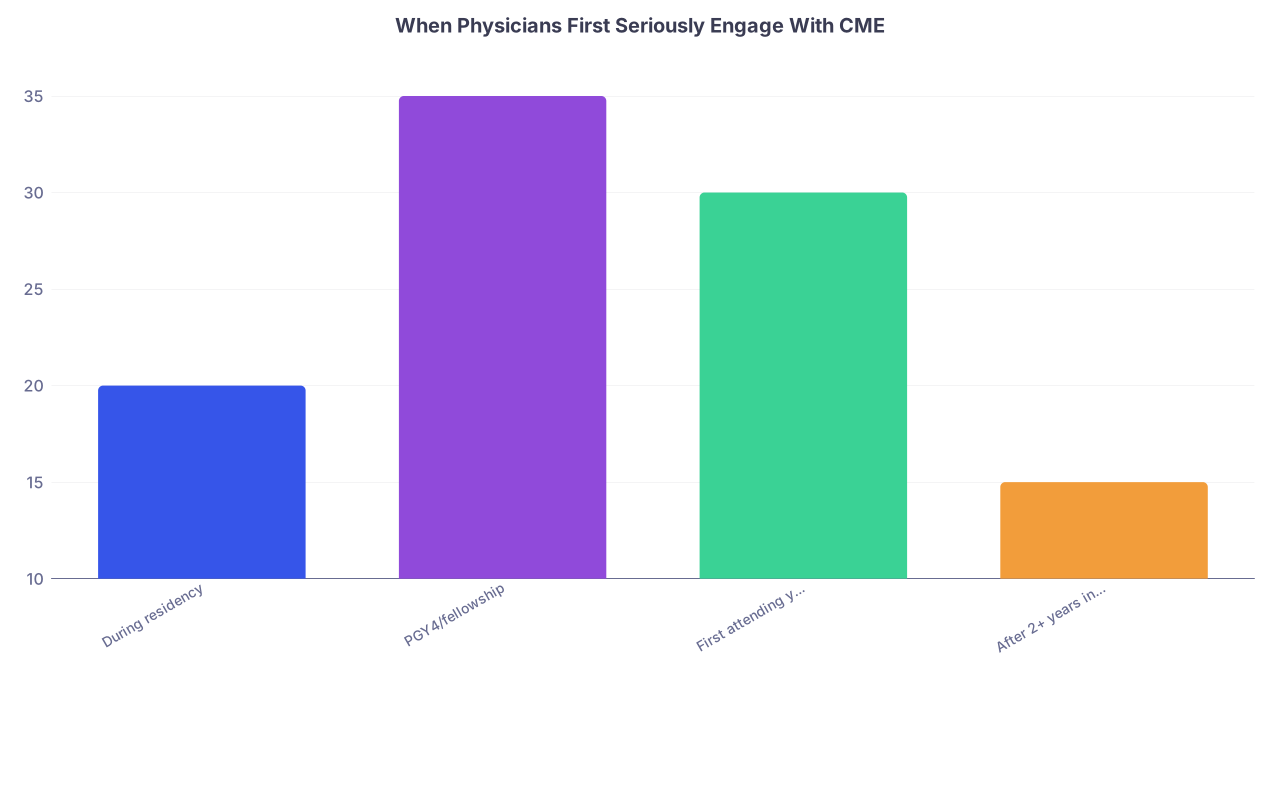
| Category | Value |
|---|---|
| During residency | 20 |
| PGY4/fellowship | 35 |
| First attending year | 30 |
| After 2+ years in practice | 15 |
The informal reality, from survey data and physician organizations, is that most doctors do not seriously look at CME logistics until the first or even second year of practice. And then they discover:
- Their state license requires 25–50 CME hours per cycle
- Some states require specific topics (opioids, pain management, cultural competency, abuse reporting, domestic violence, etc.)
- Their board is demanding a mix of CME, self-assessment modules, and sometimes quality-improvement projects
- Hospitals/insurers are asking for proof of CME for credentialing and discounts
Meanwhile, all those years of residency education that could have counted toward some of this? Gone, because nobody bothered to track it.
Licensure, Boards, and the CME Clock: It Starts Earlier Than You Think
You cannot talk about CME without talking about timelines. The myth that “CME is for later” lives or dies on when clocks actually start.
Let’s pin that down.
1. State Licensure
Most U.S. states require CME for license renewal, not initial licensure. That part is technically true.
But here’s the catch:
A lot of you get your first unrestricted license in your final year of residency or fellowship so you can moonlight or function more independently. Depending on the state, that license renewal will hit 2–3 years later—which is often still during fellowship or early attendinghood.
And some states explicitly require training in opioids, pain management, or specific public health topics before you prescribe or renew.
So no, you’re not safely in a “no CME, no problem” phase through all of residency.
| State | Hours Per Renewal | Special Topic Requirement |
|---|---|---|
| California | 50 / 2 years | Pain management / opioids |
| Texas | 24 / 2 years | Ethics, professional responsibility |
| Florida | 40 / 2 years | Domestic violence, HIV, prescribing |
| New York | Varied | Infection control, child abuse |
Now imagine you’re a new attending in Florida who never thought about CME in residency. Renewal comes up, and you suddenly need to find topic-specific courses while also learning your new job, EMR, billing, and practice politics.
Easy way to make your life harder for no reason.
2. Board Certification and MOC
Boards are not identical, but there’s a pattern:
- Initial cert often has time-limited status (e.g., 7–10 years)
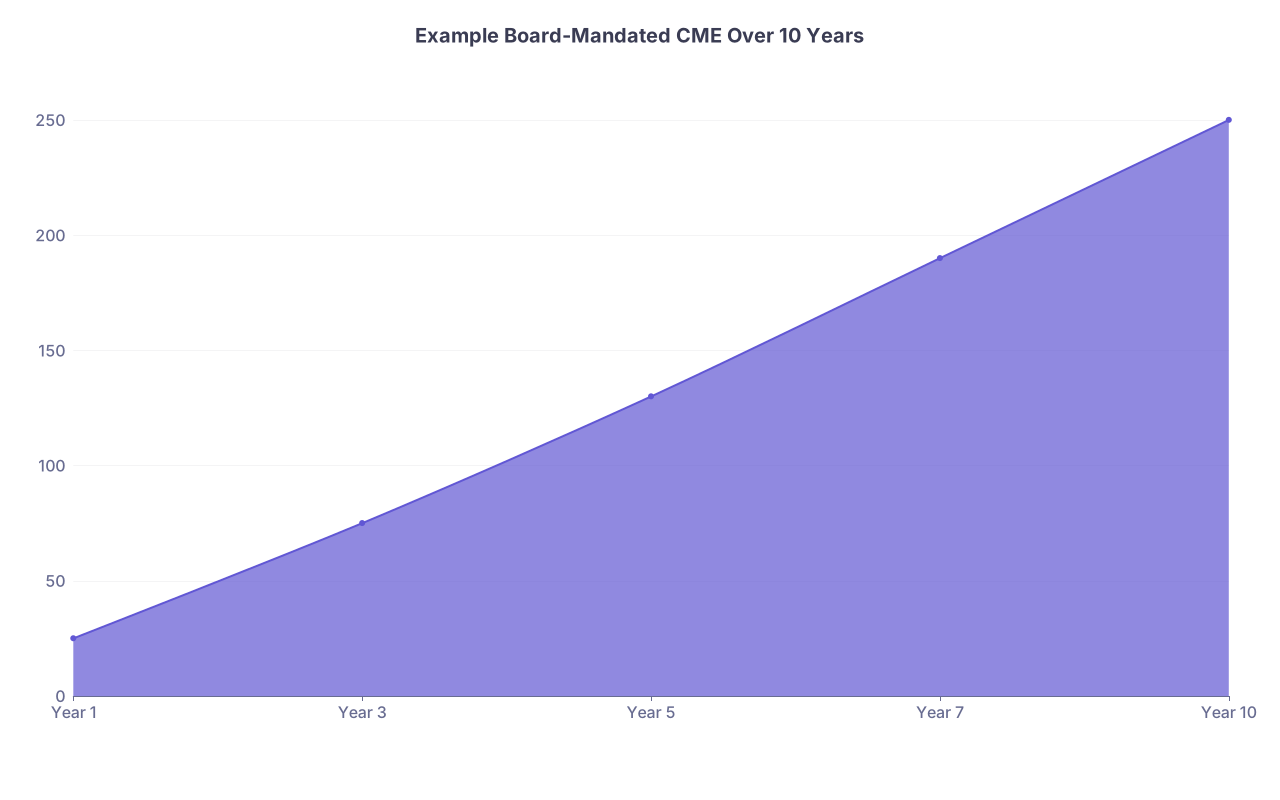
- MOC/CC programs layer in ongoing CME and assessment activities (e.g., 250 CME credits over 10 years, with a subset being “MOC Part II” or “SA-CME”)
- Some boards are shifting toward more frequent, lower-stakes longitudinal assessments that are effectively tethered to your CME choices
Many specialties encourage or allow residents to start engaging with board-aligned CME modules during PGY-3 or fellowship. That’s not just marketing. It’s an opportunity to double-dip:
- Board exam prep
- CME credit
- MOC credit once you’re certified
Residents who treat CME as off-limits until they’re attendings lose that leverage.
| Category | Value |
|---|---|
| Year 1 | 25 |
| Year 3 | 75 |
| Year 5 | 130 |
| Year 7 | 190 |
| Year 10 | 250 |
That cumulative curve is why starting to think about CME structure in residency is not overkill; it’s rational self-defense.
Money, Time, and the CME Trap New Attendings Fall Into
There’s a financial side nobody warns residents about because residents “don’t need CME yet.” Then they graduate and find out what CME really costs.
Typical pattern I’ve seen:
- Resident finishes training with no idea how CME works
- Starts first job, gets minimal CME stipend ($2k–$3k)
- Needs: board review, licensure-required courses, risk-management CME, maybe a major conference
- Panic-buys expensive CME bundles, rush courses, or high-end board review packages
- Burns through CME money with poor strategy, overpays out of pocket, or both
A little awareness during residency prevents a lot of this.
Residents have hidden advantages:
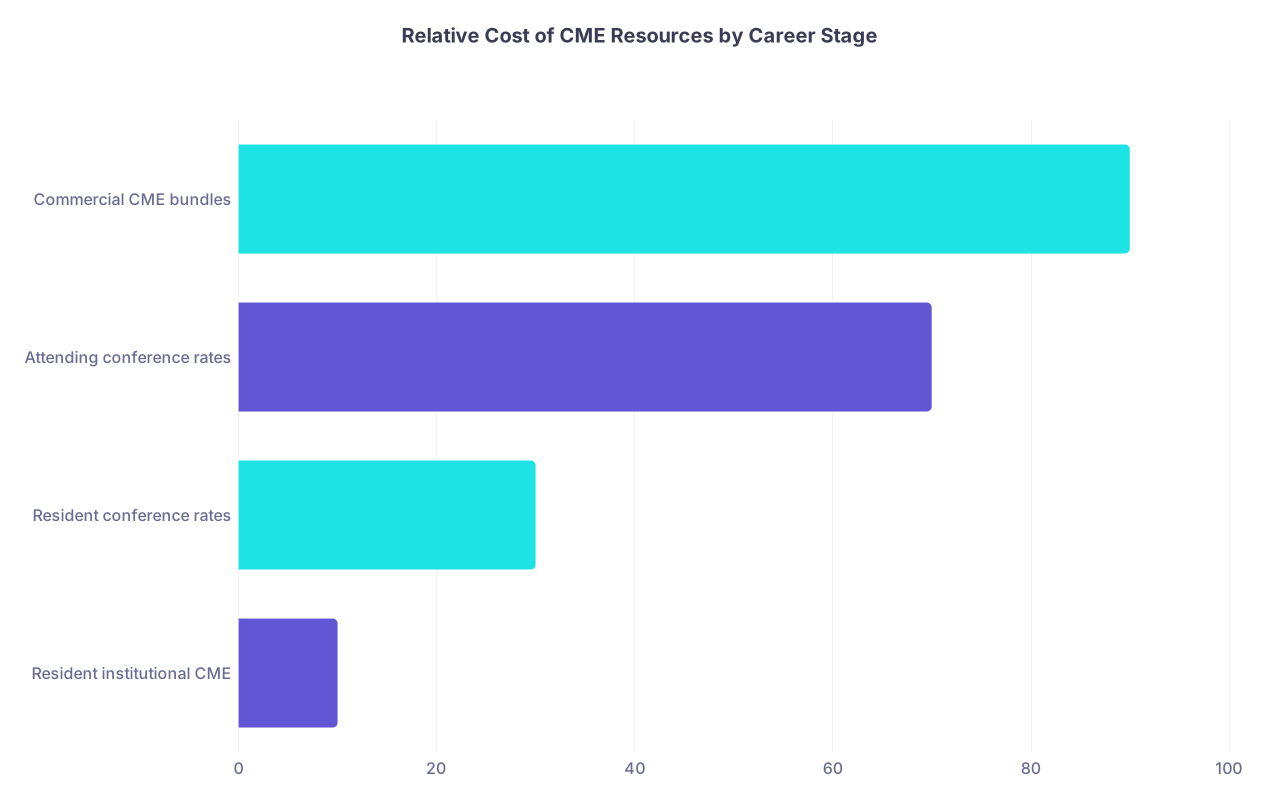
- Free or heavily discounted access to institutional CME, grand rounds, and online modules
- Resident rates for national meetings that attendings would kill for
- Access to academic libraries with free CME journal and point-of-care subscriptions
If you start tracking and choosing wisely as a PGY-2 or PGY-3, you step into attending life with:
- A working understanding of ACCME-accredited CME
- Familiarity with your specialty society’s CME ecosystem
- A sense of which formats work best for you (live courses vs. online modules vs. question banks)
That’s not abstract. It’s dollars and hours you’re not going to waste later.
| Category | Value |
|---|---|
| Resident institutional CME | 10 |
| Resident conference rates | 30 |
| Attending conference rates | 70 |
| Commercial CME bundles | 90 |
Residents sometimes pay almost nothing for opportunities attendings pay thousands for.
Concrete Ways CME Already Touches Residents
You might still be thinking: “Fine, but what does any of this have to do with my day-to-day as a resident?”
Let me walk through actual, real-world intersections I’ve watched residents miss.
Opioid / Controlled Substance Training
States like Massachusetts, Pennsylvania, and others require opioid-related CME to prescribe or renew. If you plan to practice in one of these states, you can take those modules while in residency—many hospitals already offer them for staff.Mandatory Abuse and Public Health Modules
Child abuse recognition, domestic violence, implicit bias, infection control—these are required in multiple states. Most teaching hospitals have CME-bearing trainings that qualify. Residents do them anyway. They just never document them as CME.Risk Management and Documentation
Your future malpractice carrier may give premium discounts if you complete certain risk-management CME. Quite a bit of that education already lives in your quality-improvement meetings, chart review sessions, and morbidity and mortality conferences—again, if it’s accredited and tracked.Academic Career Plans
Thinking about academic medicine? Your promotion committee one day will look at educational activities, including CME teaching roles and participation. Understanding CME structure early makes it a tool, not just a box-check.International or Cross-State Mobility
Some residents plan to move states post-residency or consider locums. Those transitions absolutely involve license applications and CME attestations. If you begin that process with organized CME records, the paperwork drops from painful to mildly annoying.
What Thinking About CME in Residency Should Actually Look Like
I’m not saying you should be hoarding certificates in PGY-1 like some anxious hobbyist. But “thinking about CME” as a resident does mean a few very specific, very manageable things.
First, locate the infrastructure. Figure out:
- How your institution runs CME
- Where records live (often an internal portal or a third-party CME tracker)
- Who in GME or medical staff office actually understands this system
Then start doing three simple things:
Collect What You Already Do
Any grand rounds, journal club, case conference, tumor board, QI presentation that’s accredited? Make sure your participation gets logged under your actual NPI / name in a way you can export later.Map Your Likely Target State and Specialty
If you know you’re probably practicing in, say, New York as a pediatrician, go read NY’s license CME requirements and the ped board’s MOC conditions once. Fifteen minutes. Circle obvious overlaps with what you’re already getting in residency. You will immediately see opportunities to double-count effort.Test-Drive Different CME Formats
Try one self-paced online course, one in-person conference (if possible), and one journal-based activity before you graduate. Figure out what keeps you awake vs. what lets you learn efficiently. This matters when you’re trying to meet a 50-hour requirement between night shifts or clinic days.
None of this adds real time. It’s shifting from “mindless compliance” to “deliberate tracking and selective engagement.”

| Step | Description |
|---|---|
| Step 1 | Resident Year 1 |
| Step 2 | Find institutional CME office |
| Step 3 | Create CME account and profile |
| Step 4 | Ensure conferences log credit |
| Step 5 | Review state and board requirements |
| Step 6 | Choose CME that overlaps with needs |
| Step 7 | Export transcript before graduation |
That flow? That is what “thinking about CME in residency” looks like. Not obsessing. Just not being oblivious.

The Hidden Upside: CME as a Career Lever, Not Just a Requirement
Here’s the part almost no one tells residents: CME isn’t only a regulatory headache. Used well, it’s one of the rare levers you control in how your career evolves.
As an attending, your day-to-day learning will tilt toward whatever hits your inbox or whatever pharma-sponsored lunch shows up on Tuesday. That is not a strategy.
Residents who get wise to CME early tend to do something different:
- They pick CME that aligns with where they want to be in 5 years, not just what’s convenient next week.
- They leverage CME to explore niche skills—ultrasound, addiction medicine, palliative care, informatics, leadership—before committing to a full extra fellowship.
- They use high-yield CME content for actual practice change, not just to appease a licensure board.
If you think CME is something you start reacting to after graduation, you’ll treat it like an annoyance. If you realize during residency that this is essentially a funded, structured mechanism for you to retool and reorient your career every few years, you’ll use it strategically.
And that difference compounds over decades.

The Core Myth, Broken
So let’s put a stake through this myth.
Residents absolutely should not blow off their actual training to obsess over CME minutiae. But the idea that “you don’t need to think about CME yet” is false on three levels:
Factually: Your future licensure, board maintenance, and even some first-year requirements can be softened—sometimes fulfilled—by work you do during residency if you pay mild attention now.
Financially: You have access to discounted or free accredited education as a resident that you will pay real money for later. Ignoring that is just bad arithmetic.
Strategically: CME is one of the few long-term levers you control over your own development. Learning how it works before you’re an overwhelmed new attending is not optional if you care about career design.
You do not need another anxiety source in residency. But you also do not need a nasty surprise at your first license renewal or MOC deadline.
Three things to walk away with:
- Treat residency education as potential CME; figure out how to get it tracked and exported.
- Spend a single hour this year reading your likely state and board CME requirements and spotting overlaps.
- Use your resident years to experiment with CME formats and topics so you enter attending life with a system, not confusion.
Ignore the myth. The earlier you start thinking intelligently about CME, the less you’ll resent it—and the more you’ll actually get out of it.


