

It’s late. You’re both on the couch, your ERAS opened in one tab, spreadsheets in another, your partner scrolling through program websites like they contain some hidden code you’re missing. You’re technically “excited” about couples matching, but what you’re actually feeling is:
“Are programs going to judge us for this? Are they going to think we’re high-maintenance? Should we… just not talk about it?”
You’re picturing some PD rolling their eyes at your joint application. Or screening you out because “couples are complicated.” Or worse: liking you but not your partner and tossing both of you aside because of the match link.
That’s the anxiety talking. But it’s loud.
Let’s get into the real stuff: what programs actually think about couples match, where relationships can hurt (and where they actually help), and whether you should be “low-key” about it or own it.
What Programs Really Think About Couples Match (vs What We Fear)
Here’s the nightmare script running in your head:
- “They’ll think we’re not serious about their program, only about each other.”
- “They’ll assume we’ll cause drama or demand special treatment.”
- “They’ll think we’ll leave if one of us is unhappy.”
- “They’ll just see us as a logistical headache they don’t want to deal with.”
Some places? Sure. I’ve heard faculty say stuff like:
- “Couples match is a puzzle piece headache.”
- “We try to help them, but we’re not bending over backwards.”
But here’s the part that gets left out:
- Programs see couples every year. This is not rare or shocking to them.
- Most PDs don’t hate couples. They hate surprises and unclear priorities.
- Being in the couples match by itself isn’t the problem. Being vague, disorganized, or unrealistic is.
You know what actually bothers programs?
- The couple who pretends they’re flexible but then demands to be in the same program last minute.
- The pair who overestimates their competitiveness and ranks only elite combos, then blames the system.
- The applicant who never mentions they’re couples matching and expects silent telepathy from programs.
So no, the relationship itself isn’t the red flag. The way you handle it can be.
Should You Downplay The Relationship? The Real Trade-Offs
Let me answer the core question directly:
If you’re formally couples matching in NRMP, you already cannot “downplay it” in any real way. Programs will see that you’re in the couples match.
What you’re actually asking is:
“Should we avoid talking about our relationship and our need to be in the same area, so they don’t see us as difficult?”
And here’s my honest answer:
Downplaying your relationship usually hurts you more than it helps.
Why?
Because programs already know you’re couples matching once rank lists hit their system, and often earlier if you tell them proactively. What they don’t know—unless you tell them—is:
- How flexible you are geographically
- Whether you’re open to different hospitals in the same city
- Whether you’d consider nearby cities
- Whether your careers or your relationship comes first if there’s a trade-off
When you hide all of that, they have to guess. And programs are risk-averse. When they have to guess, they don’t assume in your favor.
The only “benefit” of downplaying? You have a fantasy that they’ll rank you like a single applicant without thinking about the logistics. But the match algorithm and couples mechanics don’t work like that. You and your partner are linked whether you talk about it or not.
When Talking About Your Relationship Helps (And How To Do It Without Sounding Needy)
You don’t need to turn every interview into “The Story of Us.” But there are smart, strategic ways to acknowledge you’re couples matching that actually make you look thoughtful—not clingy.
1. In Your Application / Personal Statements
You don’t have to write a “we” essay. In fact, I’d avoid it unless you’re applying to something that really values the narrative (like FM/psych with shared mission).
But you can:
- Briefly mention couples match in an “adversity” or “growth” section: learning to balance dual careers, managing long-distance, coordinating schedules.
- Indicate geographic preferences without sounding like you’re issuing demands.
Example: “Because my partner is also applying in [specialty/region], we’re particularly interested in programs in [Region X, City Y].”
That’s not needy. That’s transparent.

2. During Interviews
Programs almost always ask: “Do you have any geographic considerations?” or “What matters to you in where you train?”
This is your cue to be honest, but measured:
Bad:
“We have to be at the same program or we’ll be really upset.”
Better:
“My partner is also applying in [specialty]. We’re in the couples match and hoping to end up in the same city or nearby area. We’ve cast a wide net and are looking at several cities that work for both of us.”
That sounds realistic. Flexible. Adult.
If they ask directly: “Are you applying as a couple?” just say yes. Short, direct. Then pivot to why their program attracts you as an individual.
3. In Update Emails / Letters of Interest
If there is a program or city that works especially well for both of you, it’s okay—smart even—to say:
- “My partner is also interviewing in [City] for [specialty]. Ending up in the same area is very important to us, and your program is one of our top choices.”
Programs like signals. They don’t like vague “you’re one of my favorites” spam. But a clear “you fit our couples plan” signal can help them justify ranking you higher if they have room.
But What If They Judge Us? The Worst-Case Scenarios (And How Likely They Are)
Let’s walk through the actual nightmare fuel one by one.
Fear #1: “They’ll think we care more about each other than residency.”
Some programs will wonder about that if you oversell the relationship and under-sell your actual interest in training. If all they remember from your interview is “my partner my partner my partner,” yeah, they’ll be wary.
But if you:
- Talk concretely about what you like in their program (curriculum, patient pop, fellowship paths, etc.)
- Show independent motivation and interests
- Mention couples match as one constraint, not your entire personality
…then you come across like an adult with a life, not a risk.
Fear #2: “If they like me but not my partner, they’ll drop me.”
Reality: the match algorithm doesn’t work like that emotionally. Programs submit their rank list of you based on you. They submit their rank list of your partner based on your partner.
The algorithm then tries to find the best combination that satisfies both lists and your joint couples list. The program isn’t usually sitting there going, “Well we can’t have A without B, so lower A.” They just rank.
The real danger isn’t that they judge your relationship. It’s that:
- You both rank unrealistically “bundled” combinations (same hospital only, same highly competitive programs only).
- One partner is significantly weaker statistically and drags down the combined outcome because the pair’s options shrink.
That’s not judgment. That’s math.
Fear #3: “They’ll think we’ll leave if one of us is miserable.”
Some PDs worry about retention. That’s true. But they also know this:
- Single residents leave.
- Couples without formal couples match still maneuver jobs.
- Life happens—illness, family, partners, kids.
You can defuse this if it comes up (or if you sense it):
“I know couples match can sometimes seem risky from a program side. We’ve had a lot of frank conversations about this. We both understand residency is intense and we’re committed to supporting each other while fully committing to our respective programs.”
That’s it. You don’t need a TED Talk.
Strategic Transparency: How Much To Share, With Whom, And When
You don’t have to blast “WE ARE COUPLES MATCHING” in neon everywhere. But being entirely low-key and secretive usually backfires. Here’s a reasonable middle ground.
| Where | What You Can Safely Share |
|---|---|
| ERAS Application | Brief geographic note, mention couples match if relevant |
| Personal Statement | Optional 1–2 lines on partner if it adds context, not the focus |
| Interview (asked directly) | Yes, you’re couples matching; your general geographic plan |
| Thank-you / Interest Emails | Clarify partner’s specialty/region, stress flexibility |
Who should know you’re couples matching?
- Your advisors. Otherwise they’ll give you single-applicant advice that doesn’t fit.
- Program coordinators / PDs at places where both of you interview in the same city—because they might actually coordinate behind the scenes more than you think.
- Mentors who can advocate for you as a pair in certain institutions.
You don’t need to turn it into a brand identity, but hiding it completely is shooting yourself in the foot.
When Downplaying Might Make Sense (Very Specific Edge Cases)
There are only a few situations where I’d say: “Okay, be more subtle.”
You’re not officially couples matching, but “hoping” to end up together.
- Then don’t oversell. Programs can’t do much with vague wishes. Focus on your own candidacy and use geography signals carefully.
Your relationship is very new / unstable and you’re not even sure about sacrificing options for it.
- Then absolutely don’t build your whole narrative around the relationship. You’ll resent that if things change.
Your partner is in a non-match field (industry, research, etc.) and their location is more flexible than yours.
- In that case, you can frame it as: “My partner is hoping to join me in [Region], but my main priority is strong training in [specialty].”
In these situations, you’re not really “downplaying” the relationship. You’re aligning what you tell programs with the actual reality of your priorities.
Concrete Things You Should Not Do
Just to be blunt about it, here’s where applicants shoot themselves (and their relationships) in the foot:
- Writing a joint couple-y personal statement where your individual identity disappears.
- Telling every program “You’re our top choice” without actually coordinating as a couple. Programs talk. This blows up.
- Refusing to consider nearby-but-not-identical hospitals in the same metro. You’re not Beyoncé.
- Asking programs to “promise” things they can’t ethically promise (“If we rank you high will you rank us high?” etc.)
- Ghosting communication about couples match and then emailing post-interview in a panic: “Actually we MUST be in the same program, can you pair us?”
Programs don’t hate couples. They hate chaos. Don’t be chaos.
What To Tell Yourself When The Anxiety Gets Loud
You’re scared that your relationship—the one thing that’s kept you semi-sane in med school—is going to be used against you. That if you’re honest about needing to be near this person, you’ll look weak or unserious.
Here’s the counterpoint I want you to really hear:
- Lots of residents are in relationships. Many PDs themselves had partners in training. They get it.
- Being clear about your constraints lets the right programs help you.
- The match algorithm is already binding you together; your “downplaying” isn’t going to hack that system. It only limits your ability to advocate for yourselves.
It’s not “unprofessional” to care about your relationship. It’s human. And pretending you don’t care just makes you anxious and vague, which reads worse than just… being upfront.

Quick Reality Check: Signals You’re Probably Overthinking It
If any of these sound like you, you’re not alone, but you are spiraling:
- Rewriting an email for the 10th time to remove one reference to your partner “in case it scares them off.”
- Considering not couples matching and just “hoping the algorithm is kind” because you don’t want to be a burden.
- Avoiding telling your advisors you’re couples matching because you don’t want them to think you’re being “difficult.”
- Wanting to hide a 5+ year relationship that literally shaped your entire geographic preference, just to seem more hardcore.
These are anxiety moves, not strategy moves.
The strategic move is: coordinated lists, realistic combinations, flexible metro areas, and honest-but-not-dramatic communication with programs.
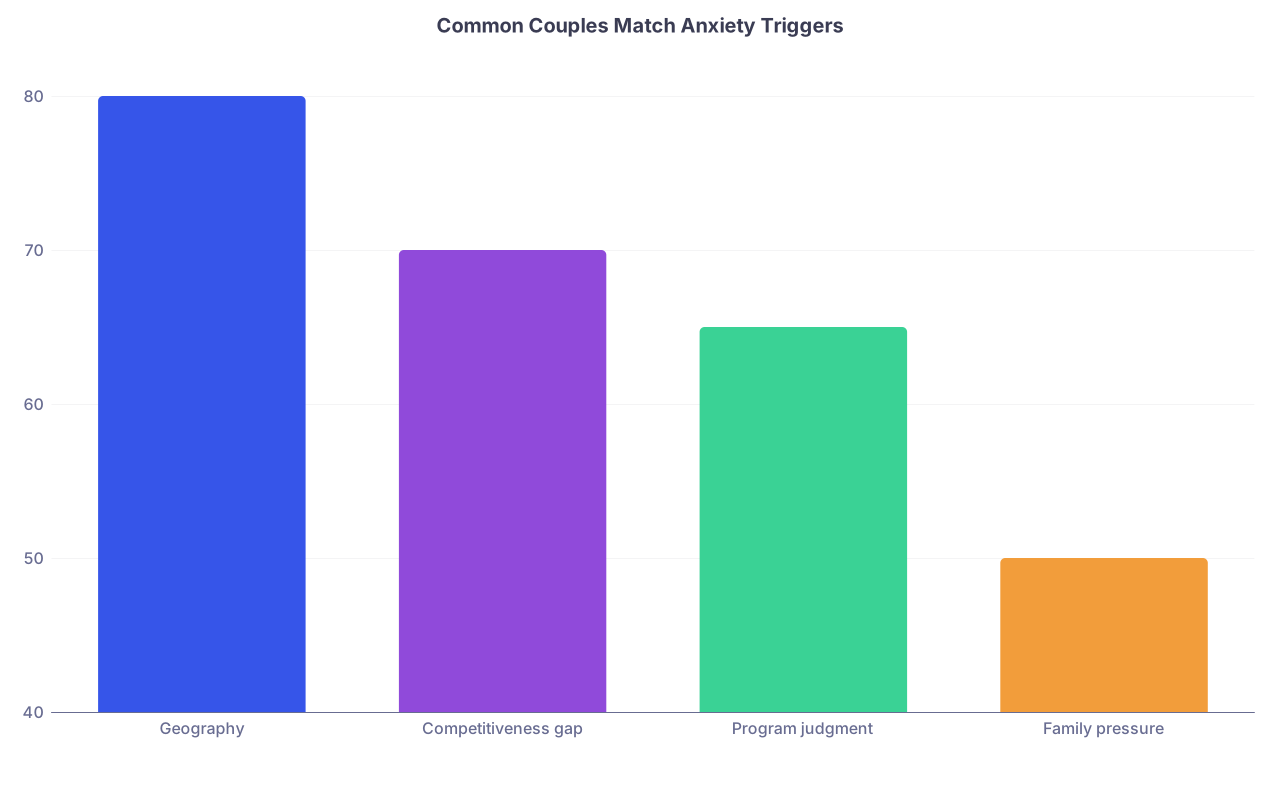
| Category | Value |
|---|---|
| Geography | 80 |
| Competitiveness gap | 70 |
| Program judgment | 65 |
| Family pressure | 50 |
How Programs Actually Use Couples Info (Behind The Curtain)
Little secret: some programs genuinely like landing couples. Not because they’re romantic, but because stable support systems reduce burnout and attrition.
I’ve seen:
- Coordinators quietly arranging interview days to align for both partners.
- PDs emailing each other across departments: “I like my candidate; you like yours; let’s try to make this work.”
- Rank meetings where someone says, “They’re couples matching with our IM program, and IM wants them—bump them up a bit if we can.”
You won’t see any of this. It doesn’t show up in your portal. But it happens.
Does every program go this far? No. Some barely think about it. Some don’t care at all. But you at least give the ones who do care something to work with when you’re honest and specific.

| Step | Description |
|---|---|
| Step 1 | You & Partner |
| Step 2 | Advisors |
| Step 3 | Program Coordinators |
| Step 4 | Application Strategy |
| Step 5 | Interview Scheduling |
| Step 6 | Thank-you / Interest Emails |
| Step 7 | PD Awareness of Couple |
| Step 8 | Potential Rank List Coordination |
FAQ (Exactly 4 Questions)
1. Should we explicitly say “We’re in the couples match” in interviews?
Yes, if it comes up naturally (geography, future plans, “anything else we should know?”). You don’t need to lead with it, but hiding it like a secret usually does more harm than good. Keep it short and pair it with reassurance about your individual commitment to training.
2. Is it a bad idea to mention my partner in my personal statement?
It’s fine to mention your partner briefly if it’s relevant to your story (e.g., long-distance during clerkships, shared service work) and not the main character of the essay. The statement should still be predominantly about you, your growth, and your motivation. If it starts reading like a relationship blog, you’ve gone too far.
3. Will weaker stats from one partner sink the other in the couples match?
They can limit your combined options, yes. That’s not about judgment; it’s pure algorithm mechanics. The stronger partner might have to be realistic and accept programs they’d be “overqualified” for if they want to stay together. That’s a hard conversation, but it’s better had early than pretending you can both match at the same ultra-competitive place.
4. If a program asks where we’ll rank them, can we say they’re our “top choice as a couple”?
Only if it’s actually true, and you and your partner have explicitly agreed on that. Lying about rank intentions is a fast way to burn bridges, and programs talk. It’s safer to say: “You’re one of our top choices, and your program fits very well with our couples match plans in this region,” unless you’re 100% ready to back up a “number one” statement.
Key points to hold onto:
- Programs don’t automatically judge you for couples matching; they judge unclear, chaotic, or unrealistic behavior.
- Downplaying your relationship usually just removes the chance for programs to help you—it doesn’t magically un-link your applications.
- Be honest, be specific, be realistic. You don’t need to turn your relationship into a marketing campaign, but you don’t need to hide it like a liability either.


