

The most common mistake couples make in the Match is pretending they have the same priorities when they do not.
You do not fix that with more talking. You fix it with structure. A clear decision algorithm that forces trade‑offs into the open, converts vague preferences into numbers, and gives you a way to disagree without blowing up the relationship or sabotaging both careers.
This is that algorithm.
1. Start With the Only Question That Actually Matters
Before you look at a single program website, you and your partner answer one hard question:
“If it comes down to it, are we willing to:
A) Split for training, or
B) Compromise individually to stay together?”
No hedging. You pick A or B.
- If you choose A (we might split): your algorithm must explicitly include a “worst‑case distance” plan and two semi‑independent rank lists.
- If you choose B (we stay together no matter what): your algorithm must hard‑prioritize geographic overlap and accept that one or both of you may take a hit on program “fit” or prestige.
Everything else—academic vs community, research vs lifestyle, proximity to family—is downstream of this call. I have watched couples spend 40 hours debating research tracks and never actually admit they disagree on whether living apart for 3 years is acceptable.
Do not skip this.
2. Define What “Academic” vs “Community” Really Means For You
Most people throw around “academic” and “community” like they are binary. They are not. Programs land on a spectrum, and each of you probably means something different by those words.
Break it down into components. Then you can score them.
At minimum, define these domains for each partner:
- Research intensity
- Fellowship pipeline
- Clinical volume and autonomy
- Lifestyle and call
- Name recognition / prestige
- Location & support system
- Program culture
Here is a quick comparison frame you can adapt:
| Domain | More Academic-Leaning | More Community-Leaning |
|---|---|---|
| Research | Protected time, >20% faculty funded | Minimal, QI projects only |
| Fellowship Match | Strong pipelines to competitive | Solid for core but fewer niche options |
| Clinical Volume | Complex, tertiary referrals | Bread-and-butter, high throughput |
| Lifestyle | Often heavier call, more expectations | Often better hours, more flexibility |
| Prestige | Name recognition, big university | Local/regional reputation |
| Location | Often urban, higher COL | Variable, often suburban/smaller cities |
| Culture | More hierarchy, more subspecialized | Tighter team, more generalist mindset |
Now, sit down separately and write your Top 3 non‑negotiables. Not 10. Three.
Examples:
- “I must be in a place with strong cardiology fellowship placement.”
- “I will not do a program with q3 24‑hour calls.”
- “I need to be within 1 hour of a major airport because of family.”
Then compare. Highlight:
- Overlaps (easy wins)
- Conflicts (where academic vs community tension is real)
This is the raw material for the algorithm.
3. Build a Shared Scoring System (This Is Non‑Optional)
If you try to “vibe” your way through couples ranking with words like “feels right” and “seems solid,” you are asking for conflict and last‑minute panic.
You need a scoring rubric. Simple. Brutal. Repeatable.
Here is the structure that works:
3.1 Set Your Weighted Categories
For each partner, create 5–7 categories and assign weights that sum to 100.
Example for Partner A (more academically oriented):
- Research & scholarly support – 25
- Fellowship placement – 25
- Clinical training quality – 20
- Location & lifestyle – 15
- Program culture – 15
Example for Partner B (more community/lifestyle oriented):
- Lifestyle & schedule – 30
- Location & support system – 25
- Clinical volume/autonomy – 20
- Program culture – 15
- Fellowship / career options – 10
You can tweak, but keep it under 7 categories or it becomes noise.
3.2 Create a 1–5 Scale You Both Use the Same Way
Define what 1, 3, and 5 mean specifically for each category.
Example – Fellowship placement (Internal Medicine):
- 5 – Consistently places >50% into competitive fellowships, multiple recent matches in my top 2 subspecialties.
- 3 – Regularly places some residents into fellowships, including 1–2 in my field every 1–2 years.
- 1 – Rare or no recent placements into my desired fellowship.
Lifestyle (Family Medicine, community-leaning partner):
- 5 – Predictable schedule, no 24‑hour call, strong outpatient emphasis, residents happy with work‑life balance.
- 3 – Busy but manageable schedule, some weekends, limited overnight shifts.
- 1 – Heavy inpatient / call, residents clearly exhausted or cynical.
You will have to do some work here: reading websites, talking to residents, checking fellowship match lists.
But once the scale is defined, scoring gets faster.
3.3 Score Each Program Individually First
This is where couples screw up: they try to fill in a shared spreadsheet at the same time. That just invites immediate negotiation and pressure.
Do this instead:
- Each of you independently score each program 1–5 in your own sheet.
- Multiply score × weight for each category to get a weighted score.
- Sum to a Personal Program Score (PPS) for each program (0–500 if you use 5 categories × max 100 total weight).
Then you create a Couple Composite Score (CCS).
Formula I recommend:
- Normalize each partner’s PPS to a 0–100 scale.
- CCS = (Partner A normalized PPS × 0.5) + (Partner B normalized PPS × 0.5), by default.
You can adjust those 0.5 / 0.5 weights if one partner has much more constrained options (e.g., one is applying to neurosurgery, the other to psychiatry). But forcing it to 70/30 or 60/40 should be an explicit, conscious conversation.
4. Merge Your Scores: The Actual Decision Algorithm
Now you have numbers. Here is how you turn them into a rank list without torching the relationship.
Step 1: Define Red‑Line Cutoffs
Some programs are non‑starters for one of you. That must be clear.
You set:
- Absolute cutoffs (e.g., PPS < 55/100 = do not rank)
- Category red lines (e.g., any program with lifestyle score = 1 for Partner B is excluded, regardless of composite score)
This is where academic vs community tension shows up. Example:
- Partner A wants an academic powerhouse that looks like:
- Research: 5
- Fellowship: 5
- Lifestyle: 1
- Partner B’s red line: “No 1s for lifestyle.”
Result: That program is dead. You do not “sneak it in at the bottom.” A red line is a red line.
If you are not willing to enforce cutoffs, then stop pretending they exist.
Step 2: Generate a Joint Program List by City / Region
Couples Match is not about individual programs. It is about location pairs.
You create:
- A list of all cities / regions where you both have at least one viable program above cutoff.
- For each city, list:
- Partner A’s viable programs + PPS
- Partner B’s viable programs + PPS
- The best possible CCS combination in that city (highest A+B composite pairing).
Now you can see real trade‑offs. Example:
- City X:
- A has Academic U (90/100), Community X (75/100)
- B has Community Y (88/100), Small Academic Z (65/100)
- Best pair: (A: Academic U, B: Community Y) – CCS: 89
- City Y:
- A has Academic Big Name (96/100)
- B has Only Program (70/100)
- Best pair – CCS: 83
- City Z:
- A has Middle Tier U (82/100)
- B has Lifestyle Dream (94/100)
- Best pair – CCS: 88
Now the argument is not “academic vs community in the abstract.” It is:
- “Are we willing to prioritize A’s 96/100 academic dream if it pulls B down to 70/100, versus choosing City X where both are high 80s?”
That is a specific, solvable question.
Step 3: Rank Cities by Best Possible Pair Score
For each city or region, keep the single best pair for now. Rank cities by that CCS.
This gives you a City Priority List.
You will adjust it for:
- Family constraints
- Cost of living
- Visa issues
- Geographic deal breakers (e.g., “not willing to live in the deep South / rural Midwest,” etc.)
But you start with the numbers. Then you talk.
5. Decide How Much “Academic Hit” You Are Willing to Take for Location
This is the core tension you asked about: aligning academic vs community priorities.
You solve it by setting explicit tolerance thresholds.
5.1 Academic Partner: Define Your Floor
If you are the academically driven one, you answer:
- “What is the minimum PPS I am willing to accept to stay with my partner in the same city?”
Maybe for you:
- PPS ≥ 80 – “Feels like a great fit”
- 70–79 – “Good, not perfect, acceptable”
- 60–69 – “Only if it keeps us together in a top‑tier city”
- < 60 – “Not acceptable, even for co-location”
Write this down. Then enforce it.
5.2 Community/Lifestyle Partner: Define Your Ceiling for Misery
If you are the lifestyle / community‑oriented one, you answer:
- “What is the maximum sacrifice on lifestyle I am willing to make for my partner’s academic goals?”
Maybe:
- Lifestyle score 4–5 – “Required for me to be happy long‑term”
- 3 – “OK if location and partner’s program are strong”
- 2 – “Only if there is absolutely no other way to match together in a safe city”
- 1 – “No”
Again: write it down. Programs that fail these thresholds for either of you are dropped.
You will be tempted to “keep them just in case.” That is how couples end up matched to cities neither of them actually wanted.
6. Translate City Priorities Into Actual Rank Pairs
Now you have:
- A City Priority List
- For each city, a set of viable programs for each partner, with scores
Next step: you build rank pairs in NRMP format.
6.1 Rank the Top City Combinations First
For your top city (highest CCS):
- List out every plausible program pair (A program × B program) that you both would accept.
- Sort those pairs by sum of each partner’s normalized PPS or by whichever partner has tighter constraints, depending on your initial 50/50 vs 60/40 agreement.
That becomes:
- City 1: Best pair
- City 1: Second-best pair
- City 1: Third-best pair
...
Then move to City 2, and do the same.
Yes, it is tedious. Yes, this is how adult decisions look.
6.2 Do Not Overinflate Long‑Shot Academic Dreams
If Partner A has a 2% shot at Mega Academic University and Partner B would have to go to a low‑tier program they dislike in that city, that combination does not belong in your top 5 just because the name is shiny.
Match algorithms care about rank order, not dreams. If your realistic outcomes in that city are poor for one of you, it can absolutely be ranked below a city where both have solid, realistic matches.
6.3 Integrate “Split” Scenarios Only If You Chose Option A
If back in Section 1 you said, “We are willing to split if needed,” then:
- After exhausting your acceptable together‑in‑same‑city combinations, you can add:
- “A in City 1, B in City 2” type pairs
- Ranked below any same‑city combinations you truly prefer
But be rigorous:
- Define a maximum distance you are willing to tolerate (e.g., under 4‑hour drive, easy nonstop flight).
- Define minimum program quality thresholds that still apply.
Do not smuggle in “we will split across the country” by sneaking New York / California pairs at the bottom. If that is not realistically acceptable, do not rank it.
7. Keep This Entire Process From Destroying Your Relationship
The algorithm solves the logic. It does not handle the emotions. You need rules for that.
7.1 Use a Structured Meeting Schedule
Do not let Match talk infect every weeknight.
Set:
- 1–2 “Match meetings” per week, 60–90 minutes.
- Agenda:
- Review any new info (interview impressions, resident feedback).
- Update scores where needed.
- Review 1–2 specific decisions (not everything).
- Confirm any rank order changes.
Outside those times, Match talk is off-limits unless it is logistics.
This protects the relationship from becoming entirely about spreadsheets.
7.2 Use Tie‑Break Rules Up Front
When your CCS for two cities is within, say, 2 points, you will just fight if you do not have a tie‑breaker.
Common tie‑breakers:
- Closer to family or key support.
- Lower cost of living.
- Better options for any children (schools, stability).
- Better visa sponsorship situation.
Pick 2–3 tie‑break factors now. Apply them consistently.
7.3 Do a “Regret Check” Before Finalizing
One week before the rank list certification deadline:
- Each of you privately writes down:
- “If we matched at Rank #1, would I feel content?”
- “At what rank would I start to feel genuine regret for myself?”
- Then you talk through answers. If someone is already dreading the likely outcome, your weights or cutoffs are off.
Your goal is shared, moderate satisfaction, not maximizing outcome for one partner and telling the other to “be a team player.”
8. Example: Academic vs Community Couple Walkthrough
Let me walk you through a real‑world style scenario.
- Partner A: Applying Internal Medicine, wants cards fellowship, prefers academic.
- Partner B: Applying Pediatrics, strongly lifestyle‑oriented, open to community programs.
They define:
Partner A weights:
- Fellowship prospects – 30
- Research opportunities – 20
- Clinical complexity – 20
- Location – 15
- Culture – 15
Partner B weights:
- Lifestyle – 30
- Location – 25
- Culture – 20
- Clinical training – 15
- Fellowship potential – 10
They agree:
- We will not do long‑distance (Chose Option B).
- Partner A minimum acceptable PPS = 70/100.
- Partner B lifestyle minimum = 3/5.
They look at three cities:
City Alpha (big academic center)
- A: Academic Med Center – 95 PPS
- B: Children’s Hospital (academic, busy) – 72 PPS, lifestyle score = 2
Fails B’s red line → City Alpha dropped entirely.
City Beta (mixed)
- A: University‑affiliated IM – 88 PPS
- B: Community Peds with academic affiliation – 90 PPS, lifestyle = 4
Passes all thresholds, CCS high → City Beta becomes top priority.
City Gamma (smaller, more community)
- A: Community IM with some fellowship connections – 78 PPS
- B: Community Peds, very lifestyle friendly – 96 PPS
CCS slightly below City Beta, but both are clearly satisfied → City Gamma is #2.
Academic Partner A might emotionally want City Alpha. But by previously agreeing on B’s lifestyle floor, the decision is already made. No need to relitigate it 10 times.
This is the point. The algorithm protects you from last‑minute emotional flips and prestige blinders.
9. Track Everything in One Clean System
You do not need elaborate software. You need discipline.
Minimum setup:
- A shared spreadsheet (Google Sheets works well).
- Tabs:
- Partner A Scoring – program rows, category scores, PPS.
- Partner B Scoring – same.
- City Summary – cities, best pairs, CCS, notes.
- Draft Rank List – NRMP pairings by order.
Use conditional formatting:
- Red for anything below cutoff.
- Bold for programs strongly preferred.
And document:
- Date of last change to major decisions.
- Comments after each interview while it is fresh.
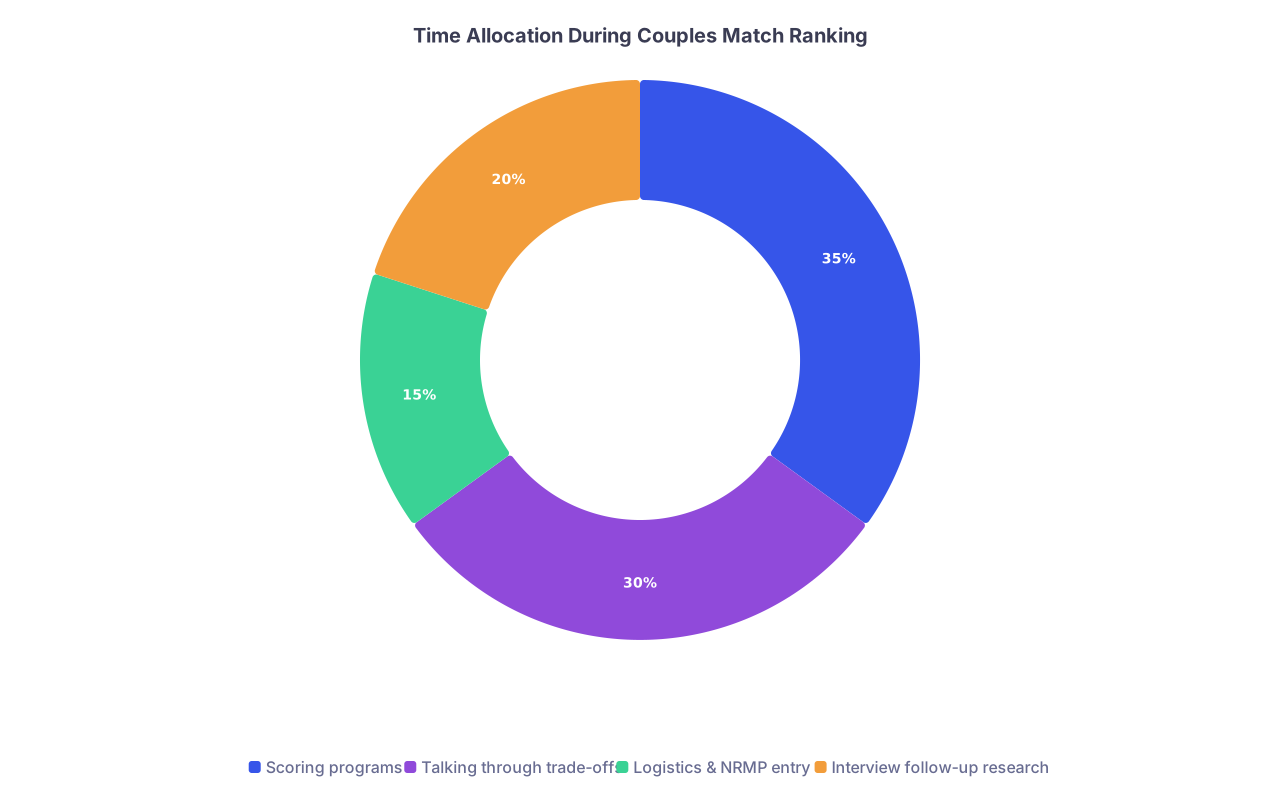
Here is how your time should roughly break down during ranking season:
| Category | Value |
|---|---|
| Scoring programs | 35 |
| Talking through trade-offs | 30 |
| Logistics & NRMP entry | 15 |
| Interview follow-up research | 20 |
If “talking through trade‑offs” creeps to 60–70% and scoring drops, you are back to vibes over structure. Pull it back.
10. Visualize Your Process So You Stop Spinning
Sometimes a picture helps cut through the anxiety. Here is a simple flow of the decision algorithm you are actually running:

| Step | Description |
|---|---|
| Step 1 | Decide Split vs Stay Together Priority |
| Step 2 | Define Individual Non-Negotiables |
| Step 3 | Create Weighted Scoring Rubrics |
| Step 4 | Score Programs Individually |
| Step 5 | Apply Cutoffs and Red Lines |
| Step 6 | Group Programs by City/Region |
| Step 7 | Calculate Best Pair per City |
| Step 8 | Rank Cities by Composite Score |
| Step 9 | Generate NRMP Rank Pairs by City Priority |
| Step 10 | Apply Tie-break Rules and Regret Check |
| Step 11 | Certify Final Rank List |
Print that. Tape it on the wall. If you are arguing about a program but have not done whatever box you are in yet, stop and go do the upstream step.
11. Academic vs Community: How Much Does It Actually Matter?
One last reality check.
People massively overestimate the difference between a solid academic program and a strong community program, and massively underestimate:
- How much they will care about their day‑to‑day life.
- How burnout and resentment can poison a relationship when one partner “sacrifices too much.”
Academic pedigree matters most when:
- You want a hyper‑competitive fellowship (e.g., derm, ENT, IR, some surgical subspecialties).
- You are aiming for a heavily research‑oriented or national leadership career.
Community strength and lifestyle matter more when:
- You value being a high‑functioning clinician with sustainable hours.
- You care about starting a family, mental health, location stability.
If one of you is strongly academic and the other is not, your job is not to drag one person toward the other’s ideals. Your job is to build a map where:
- The academic partner stays above their career floor.
- The community/lifestyle partner stays above their personal happiness floor.
- The relationship does not get treated as a secondary variable.
The algorithm I laid out does exactly that—if you are honest with your inputs.
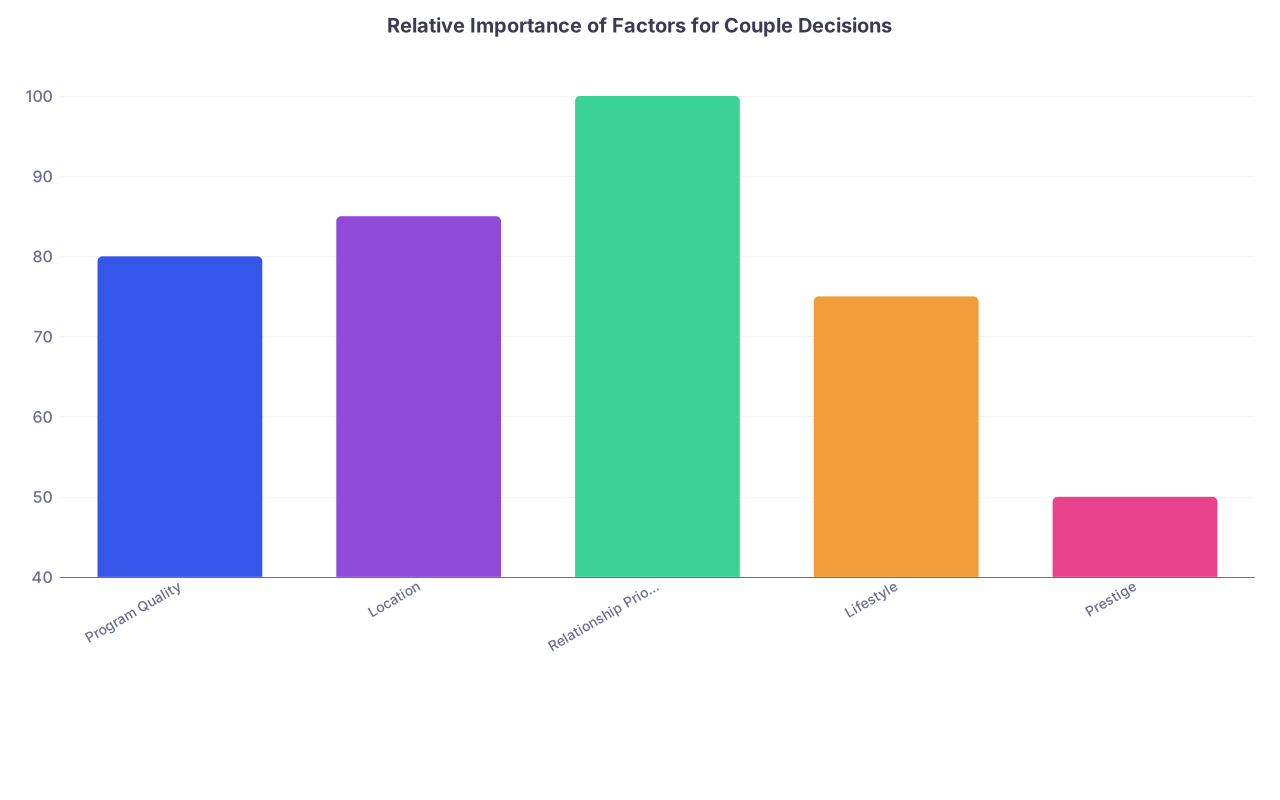
| Category | Value |
|---|---|
| Program Quality | 80 |
| Location | 85 |
| Relationship Priority | 100 |
| Lifestyle | 75 |
| Prestige | 50 |
Interpretation is straightforward:
- Relationship priority has to sit at 100 if you are couples matching.
- Prestige should not be driving this bus.


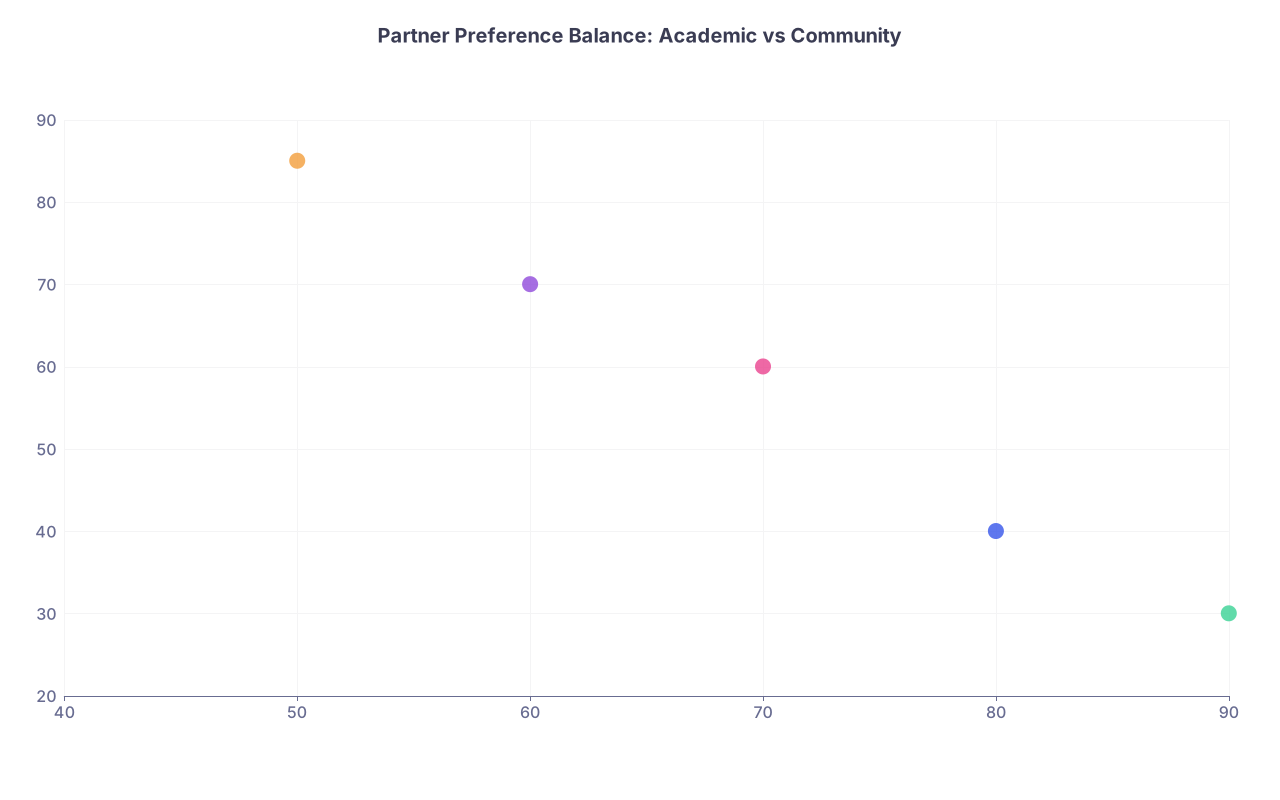
| Category | Value |
|---|---|
| Couple 1 | 80,40 |
| Couple 2 | 60,70 |
| Couple 3 | 90,30 |
| Couple 4 | 50,85 |
| Couple 5 | 70,60 |


