
The Couples Match does not care about your ring. It cares about your plan.
If you’re engaged but not married, you’re in a gray zone that schools and programs often handle clumsily. Some coordinators assume "engaged" means casual. Others assume you’re married in everything but name. If you leave this vague, people will fill the gaps with their own assumptions. Which is exactly what you cannot afford in a high‑stakes Match.
Here’s how to handle it like an adult, not a deer in the headlights.
1. Get One Thing Straight: Your Status Is “Couples Match Partner,” Not “Fiancé(e)”
The biggest mistake I see: people think the key label is "engaged."
Wrong. For the purposes of residency, the key label is: “participating in the NRMP Couples Match together.”
Your ring status is secondary. Your matching status is primary.
So when you present yourselves, lead with:
- You are a defined unit for the purposes of the Match.
- You have a shared geographic plan.
- You have a realistic understanding of tie‑breakers and sacrifices.
Your engagement is context, not the headline.
If an interviewer or PD asks about your status, the answer is:
“We’re engaged and we’re Couples Matching together through NRMP this cycle. We’ve built a shared rank list strategy focused on [region/type of program] so we can be in the same city.”
Notice the order:
- Engaged = your relationship status
- Couples Matching = your application status
- Basic overview of your plan
You’re signaling: “We’ve thought this through. We are not vaguely ‘hoping’ to end up together. We’re structurally binding our outcomes.”
2. Where To State Your Engagement (And How Explicit To Be)
Let’s break this down by every place your status can reasonably appear.
ERAS / App Materials
There is no formal “engaged” box. So you use the tools you have:
ERAS Demographics / Personal Info:
There’s typically no “engaged” category. Do not try to force it into “married” or “single” if that feels dishonest. You can leave it as single/unmarried. Your application strategy will clarify the rest.Personal Statement (yours):
Only mention the engagement if:- It directly supports your geographic preference, maturity, or continuity story, and
- You can do it in 1–2 sentences, not a whole romance saga.
Example:
“My fiancé and I are Couples Matching this cycle and are committed to training in the Midwest long term, where both our families and professional mentors are based.”
That’s it. No proposal story. No “we met in anatomy lab” paragraph.
Personal Statement (partner’s):
Mirror the same factual, calm tone:“I’m participating in the Couples Match with my fiancé, who is applying to Internal Medicine programs in [region]. We hope to establish our careers together in this area.”
Notice you’re naming:
- The fact of Couples Match
- The specialty
- The region
- The long‑term intention
Experience Entries (ERAS):
Do not wedge your relationship into Activities. Your engagement is not an “Extracurricular Activity” or “Leadership Role.”Supplemental Application / Geographic Preferences:
This is where being engaged matters. You can explicitly say:“My fiancé and I are Couples Matching this cycle and are seeking positions in the Northeast to be close to our support system and long‑term career goals.”
Or, if there’s a dual‑city acceptable plan:
“We are primarily targeting [City A] and [City B] because both cities offer compatible programs in our specialties and are driving distance apart.”
You’re telling programs: this is not random. There’s logic.
3. How To Talk About It In Interviews Without Sounding Naive or Desperate
Program directors are not actually worried that you’re engaged. They’re worried about:
- Whether your Couples Match will pull you away if they rank you highly
- Whether you’ve thought through worst‑case scenarios
- Whether you’re going to blow up your year with drama if things go south
So you need a clean, rehearsed way to present this.
Baseline Script
When it comes up (and it will), aim for:
“Yes, my fiancé and I are Couples Matching. I’m applying in [your specialty], they’re applying in [partner’s specialty], and we’ve built a rank list strategy that keeps us in [region(s)] where there are multiple strong programs in both specialties. We’ve talked through realistic outcomes and we’re both comfortable prioritizing staying together geographically.”
That last sentence matters. It tells them: “We understand trade‑offs.”

If They Ask: “What If You Don’t Match Together?”
Don’t flinch. You should have a grown‑up answer ready.
Something like:
“We’ve built a rank list that maximizes our chances of matching in the same city, including a wide range of programs. We also have a contingency plan if we do not match together—prioritizing at least being within driving distance, and considering the SOAP or reapplying if absolutely necessary. We’re realistic about the risks, but we’ve approached it thoughtfully.”
Key points you’re conveying:
- You know you’re not invincible.
- You have a reasonably mature plan.
- You’re not assuming a fairy‑tale outcome.
If They Ask: “Why Not Just Get Married Before Match?”
This question is nosy, but it does get asked. Don’t over‑explain.
“We chose a timeline that works for our families and our own values, but for the purposes of the Match, we’re fully committed and binding our outcomes together through the Couples Match.”
Short. Firm. No apology.
4. How To Coordinate With Your Partner So Your Story Doesn’t Sound Sloppy
Programs will sometimes interview both of you at the same place. Sometimes in different departments. Sometimes the same day, sometimes weeks apart.
If your narratives don’t align, they notice.
You and your partner need to align on:
- Primary region(s) you say you’re targeting
- Whether you’re willing to do long‑distance if necessary
- How you describe the seriousness of your relationship
- Whether you’re “absolutely staying together” vs “prefer to”
Do this before interview season:
Sit down with a spreadsheet of programs.
Group them by city/region.
Decide:
- Tier 1: Must be together, will rank aggressively even if program prestige is slightly lower.
- Tier 2: Preferred together, but would consider some distance if career fit is excellent.
- Tier 3: True fallback situations.
Agree on language. Literally write down 1–2 sentences each of you will use in interviews.
Do not improvise this on Zoom at 7:30 am in front of a PD.
5. Emailing Programs About Being Engaged & Couples Matching: What’s Appropriate
Programs do not want love letters. But they do want clear logistical information that affects ranking decisions.
When It Makes Sense To Email
- One of you got an interview, the other did not, and this is a critical geographic program for your pair.
- You want to let a program know you’re highly interested because your partner is also interviewing there / in that city.
- You received an interview at different times and want to ensure they know you’re a couple.
Sample Email Template (From You To Your Program)
Subject: Couples Match Update – [Your Name], [Specialty] Applicant
Dear Dr. [PD Last Name] and Residency Selection Committee,
I hope you’re well. I wanted to briefly share that I am participating in the NRMP Couples Match this cycle with my fiancé, [Partner Name], who is applying in [Partner Specialty].
[If applicable:] [Partner Name] has also applied to [Institution Name] in [Partner Department] and is very interested in the program.
We are highly interested in training in [City/Region] together and believe that [Institution Name] would be an excellent fit for both of us.
Thank you for your consideration,
[Your Name]
AAMC ID: [ID]
Short. Factual. No begging.
When Not To Email
- To overshare about your engagement story
- To demand dual interviews as a condition
- To repeatedly “check in” with the same program about whether they’ve interviewed your partner yet
Once, maybe twice if there’s a clear new fact. Not every week.
6. Ranking Strategy: Being Engaged Changes How Aggressive You Can Be
This is where people sabotage themselves without realizing it.
Being engaged but not married doesn’t change the NRMP algorithm. But it absolutely changes your risk tolerance as a couple.
You two need to decide: What’s worse?
- Matching your dream program but ending up across the country, or
- Matching a solid but not flashy program in the same city and staying together
Different couples answer this differently. But you have to answer it.
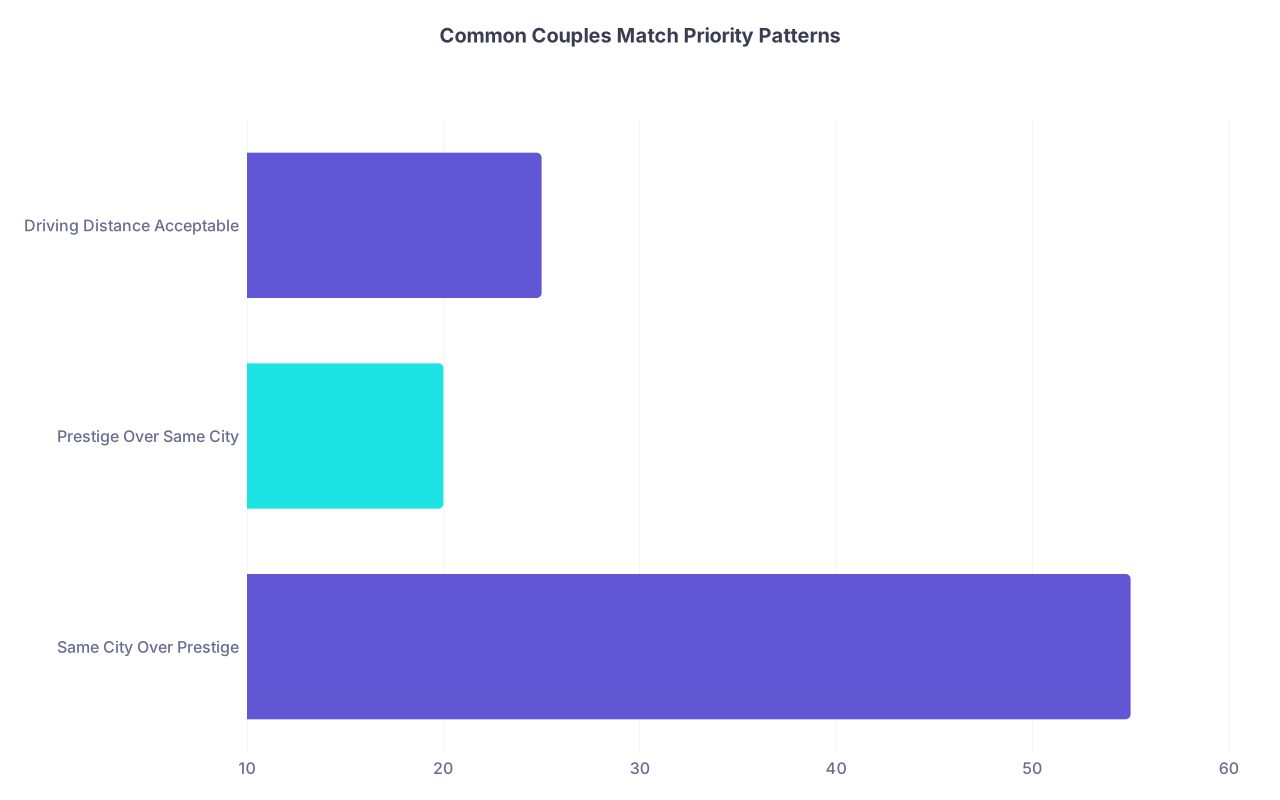
| Category | Value |
|---|---|
| Same City Over Prestige | 55 |
| Prestige Over Same City | 20 |
| Driving Distance Acceptable | 25 |
Here’s a common sense ranking structure for engaged couples:
- Top rows: Same‑city pairs where both programs are reasonably good fits (not necessarily both “reach” programs; one may be more of a safety).
- Middle rows: Same‑region or driving distance pairs (e.g., one in Philly, one in NYC).
- Lower rows: One strong, one weaker program in same city if you prioritize being together.
- Bottom (or not at all): Scattered single matches with no geographic overlap—only if one of you is genuinely willing to do distance.
Do not lie to yourselves here. If you’re going to be miserable separated, don’t build a rank list that makes that likely.
7. Special Situations: Visa Issues, Non‑Med Partner, or Different Cycles
Now, a few tricky edge cases that come up a lot.
Case 1: One Of You Is IMG / Needs Visa Sponsorship
Programs worry that:
- Visa issues will blow up the pair
- One partner won’t match due to visa limitations
You address it directly:
“We’re aware my fiancé requires visa sponsorship. We’ve strategically applied to programs with a history of sponsoring [visa type], and we’ve limited our geographic scope to regions with multiple such programs to keep our Couples Match realistic.”
If you pretend this isn’t a big deal, they assume you haven’t looked at reality.
Case 2: Your Partner Isn’t In Medicine (No NRMP Account)
Then you’re not in the NRMP “Couples Match” formally. You’re in a real‑life couple, but algorithmically you’re solo.
In that case, “engaged” still matters for your geographic explanation, but you cannot say you’re “Couples Matching.”
You phrase it like this:
“My fiancé works in [field] and has significant flexibility, but our goal is to be in [region] long term. I’ve targeted my applications to cities where there are strong opportunities in both my specialty and their field.”
You still use your engagement as a reason for focused geography, just without misusing the NRMP term.
Case 3: You’re Off-Cycle From Each Other
One of you is applying this year, the other next year. Engagement then becomes part of a two‑stage planning story.
Your script:
“I’m applying this cycle, and my fiancé will be applying next year in [specialty]. We’re aiming for me to match in [region] with a strong set of programs in their field so they can target the same area next year.”
Again: framed as planning, not drama.
8. The Emotional Side: Presenting as Mature, Not Fragile
Programs don’t want to step into a soap opera. Engaged couples sometimes accidentally project drama just by the way they talk:
Red flags in how you talk:
- “We have to match together or it will be a disaster.”
- “We’re only ranking places that take both of us.”
- “We’re just trusting it’ll all work out.”
Instead, anchor your language around:
- Commitment
- Flexibility
- Strategy
Something like:
“We’re committed to being in the same city, and we’ve built a broad enough list to make that likely while still maintaining good fits for us both.”
It sounds boring. That’s the point. Boring is exactly what a PD wants from your personal life: stable, low‑risk, quietly competent.
9. Quick Comparison: Married vs Engaged vs Dating in the Couples Match
Just so you know how programs quietly sort you, here’s the rough mental bucket they use.
| Status | How Programs Often Interpret It | Practical Impact |
|---|---|---|
| Married | High commitment, likely to stay together, often prioritized as a unit | PDs more confident building ranks assuming you’ll act as a stable pair |
| Engaged | Serious, but “life happens”; they may probe your planning more | You must demonstrate you’ve thought through scenarios and geography |
| Long-term dating | Variable; some stable, some not; programs may be skeptical | You need extra clarity and stability in how you talk about the future |
Is that fair? Not always. But pretending it isn’t happening does you no favors. You counteract the bias by sounding more prepared than the average engaged couple.
10. Exactly How To Phrase Your Status Everywhere
If you just want the copy‑paste version, here you go.
Personal Statement (1–2 lines):
“My fiancé and I are participating in the NRMP Couples Match, with a shared goal of building our careers in [region]. We’ve focused our applications on institutions that offer strong training for both [your specialty] and [partner’s specialty].”Interview Response (general):
“We’re engaged and Couples Matching this cycle. I’m applying in [your specialty], they’re applying in [partner specialty]. We’ve built a realistic rank list prioritizing [region/cities] where there are multiple strong options in both fields so we can train in the same city.”Email to PD (single short paragraph):
“I wanted to share that I am participating in the NRMP Couples Match with my fiancé, [Name], who is applying in [specialty]. We’re strongly interested in [Institution/City] as a place to train together and build our careers.”When pressed on risk:
“We understand Couples Matching carries risk. We’ve cast a reasonably wide net geographically and built contingency plans, but our strong preference and primary goal is to train in the same city.”
You’ll notice none of this sounds clingy. Or naive. It sounds like two people who love each other and can also read a PDF about the Match algorithm.
Open a blank document right now and write exactly 3 sentences you’ll use to describe your status as an engaged couple in: your personal statement, your interviews, and a PD email. Say them out loud once. If you sound like you’re hoping for a fairy tale instead of executing a plan, rewrite them.


