

What do you do when your partner needs a heavy research program… and you just want to be a solid clinician in a decent city?
Let me guess your situation.
You’re applying for a “regular” residency track. Your partner is going for a physician-scientist track (PST) / research track / ABIM research pathway / T32-heavy program. You both want to Couples Match. And suddenly you’re realizing:
- The programs that worship R01s may not care that you’re an amazing clinician.
- The programs with great clinical training for you may have zero protected time for your partner.
- Your lists have to be tied together in NRMP… and one bad decision can tank both careers.
You’re not wrong to be stressed. Couples Matching with one partner on a physician-scientist track is harder than two standard applicants. But it’s navigable if you’re brutally realistic and strategic.
Here’s how to handle it, step by step.
Step 1: Get painfully clear on what your partner’s track actually is
There’s “I like research,” and then there’s “I’m signing up for an ABIM research pathway with 3 years of post-doc baked in.” These are not the same thing.
Different “physician-scientist” setups your partner might be dealing with:
- Formal PST programs (e.g., Internal Medicine-PST, Neuro-PST, Peds research track)
- ABIM research pathway (shortened clinical training, extended research years)
- T32 or institutional research tracks bundled with residency
- “We say we’re researchy” standard categorical programs with some protected time but no real structure
You need to know exactly which of these they’re targeting. Because that directly affects:
- Which cities are even viable
- How many overlapping programs exist
- How flexible your partner can realistically be
Ask your partner bluntly:
- Are you applying ONLY to formal PST/research tracks, or are you also applying to standard categorical spots as backup?
- Are you willing to do research after residency instead of during, if needed?
- Would you rather:
- Be at your dream PST without me, or
- Be at a good-but-not-elite research program with me?
If they can’t answer that, stop everything and make them answer it. Without that clarity, you can’t build a rational Couples Match strategy.
Step 2: Map your overlap like it’s a logistics problem (because it is)
You cannot “vibe” your way through a Couples Match with a physician-scientist partner. You need a map.
Create a simple spreadsheet with at least these columns:
- City
- Institution
- Your specialty – programs you’ll apply to
- Their specialty – PST programs + standard programs they’ll apply to
- Whether the institution has:
- A formal PST in their field
- Any track record of research mentorship in their area
Then do this:
- List all PST programs they’re seriously considering.
- For each city/institution, list all programs you could reasonably apply to (even if not dream).
- Count the overlap cities vs. “orphan” PST programs in random places where you’d have garbage options or none.
You’ll likely find three types of cities:
Ideal hubs – Strong PST for them + multiple realistic options for you
(Think: Boston, NYC, Philly, Chicago, Houston, SF Bay, etc. depending on specialty.)Partner-heavy, you-scarce – Great PST, but you’d be stuck at a weak program or commuting.
(Single academic center towns with limited other hospitals.)You-heavy, partner-scarce – Several good options for your specialty, but no real PST or weak research infrastructure.
Your strategy will heavily favor category #1. Category #2 or #3 can still appear on the list, but low. Do not lie to yourselves that a city with one PST and one low-tier community program for you is somehow “balanced.”
To visualize where the realistic overlap is, you can even think of your “viable cities” like this:
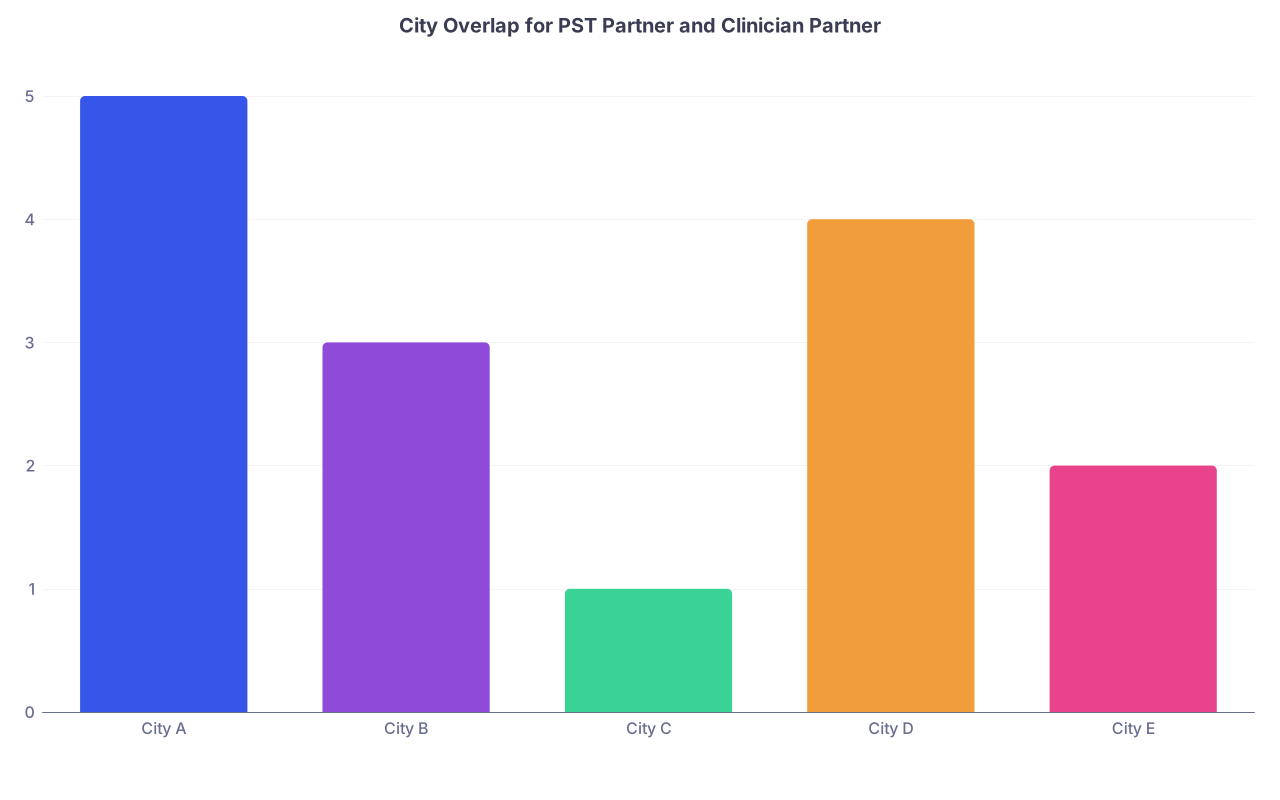
| Category | Value |
|---|---|
| City A | 5 |
| City B | 3 |
| City C | 1 |
| City D | 4 |
| City E | 2 |
You’re not trying to be perfect. You’re trying to make sure your actual rank list isn’t fantasyland.
Step 3: Decide which of you is the “limiting reagent”
In most PST couples, one partner’s options are structurally narrower. It’s almost always the physician-scientist, but not always.
Brutal but necessary question:
Whose training needs are harder to meet?
- PST partner: needs a strong research environment, real mentorship in their niche, some protected time, possibly ABIM research pathway.
- You: need solid clinical volume, decent reputation, not a malignant mess, and ideally in a city you won’t hate for 3–7 years.
Here’s how I’d frame it:
- If your partner is MD/PhD, has serious publications, and truly wants an academic research career, then the PST needs win. Wasting that at a no-research residency is dumb.
- If your partner “likes research” but could still be happy as a clinician-educator, and you’re entering an ultra-competitive specialty with narrow geographic spread, your clinical match may carry more weight.
Don’t pretend you’re equal if you’re not. Say out loud:
“For this Couples Match, we are prioritizing _______’s constraints first, as long as the other person isn’t in a dangerous or career-killing program.”
That doesn’t mean one of you is more important as a human. It means someone’s constraints are non-negotiable.
Step 4: Build a joint application strategy, not two parallel ones
Most couples screw this up. They each build their own list, then duct-tape them together at the end. That’s how you get chaos.
Your planning order should be:
Identify core cities/institutions that:
- Have a PST for them
- Have at least 2–3 programs for you (even if one is “meh”)
Aim for depth in those hubs, not wide scatter everywhere.
Example: In Boston, you apply to 4–5 programs, they apply to 2–3.
In some random city with one PST, you may not apply at all if you’d be stuck.Use non-PST but research-strong categorical programs as backup for them in the same cities where you have good options.
You’re trying to create clusters, not single points. A city where you have 3 possible pairings is safer than a city where there’s exactly one program-program pairing that works.
An oversimplified pairing logic looks like this:

| Step | Description |
|---|---|
| Step 1 | Identify PST hubs |
| Step 2 | List your programs in same cities |
| Step 3 | Prioritize city highly |
| Step 4 | Use as low-tier backup |
| Step 5 | Apply broadly within hub |
| Step 6 | >= 2 options for you? |
Think in pairings from day one. Not after interview season.
Step 5: Be strategic and blunt in communications with programs
You need to understand something: PST programs are usually more plugged in, politically, than standard categorical programs. The PD of a PST track often knows the categorical PDs in the same department extremely well. Sometimes they’re literally the same person.
That’s leverage—for both of you.
Here’s how to use it without being annoying:
For your PST partner:
- They should email PST programs (after interview invites, or after interviews) saying something like:
“I’m Couples Matching with my partner who is applying to [specialty]. We’re very interested in [Institution] because it offers strong research mentorship in [field] and robust clinical training in both of our specialties. Are there other programs here that my partner should be aware of?”
For you:
- If you’re interviewing at the same institution (different department), you say:
“My partner is applying to the [Physician-Scientist / Research] track in [department]. We’re Couples Matching and your institution is one of the few that supports both of our career paths.”
Programs like committed couples who want to be there together. They also like physician-scientists. If there’s any chance your partner’s PST status helps get you a second look—or vice versa—you want that in play.
Just don’t do this:
- Do not send “we will rank you #1” emails to 6 programs. You’re not subtle; they can tell.
- Do not threaten: “If you don’t rank us as a couple, we won’t rank you.” That’s childish.
You are giving them context, not ultimatums.
Step 6: Ranking: how to stack the list without blowing up both careers
This is where couples ruin things. They either:
- Sacrifice one person entirely (“I’ll just match anywhere as long as your PST happens”), or
- Over-prioritize being in the same city and both end up undertrained and miserable.
You need structure.
Think of creating tiers of pairings:
Tier 1 – Both happy, both careers supported
- Strong PST for them
- Good to excellent clinical program for you
- City you can both live in without resenting each other
Tier 2 – One person slightly compromised, but still okay career-wise
- Great PST for them, acceptable but not ideal program for you
OR - Excellent program for you, solid but not elite research for them
- Great PST for them, acceptable but not ideal program for you
Tier 3 – One career clearly compromised, but safe and not career-ending
- Should be low on your list, but still present in case the alternative is not matching
Absolute NOs – Combinations where:
- One of you would be in a malignant program
- One of you would have no realistic path to your career goals
- One is clinically unsafe (work hour violations, abusive culture)
These NOs should not appear anywhere on the rank list, even as desperation backups.
You might find it helpful to sketch this mentally like a grid:
| Tier | Partner A (PST) Program Type | Partner B (Clinical) Program Type | Priority |
|---|---|---|---|
| 1 | Top PST, strong mentorship | University or strong academic | Highest |
| 2 | Solid research categorical | Mid-tier academic or strong community | Medium |
| 3 | Generic categorical, light research | Mid-tier community, decent training | Low |
Then, inside NRMP, you translate those tiers into ordered pairs, not parallel single lists. If you’ve never looked at the NRMP Couples Match example lists before, do that early. It’s easy to mess up the logic.
Key principle:
Do not put a “Tier 3” pairing above a “Tier 1” pairing just because it’s in a sexier city.
You’ll be there for 3–7 years. Instagrammable brunch does not compensate for trash training.
Step 7: Have the “what if we don’t match together?” conversation early
Most couples avoid this until two days before rank lists are due. Then someone panics and makes a terrible decision.
Do this now:
Answer these questions together:
Which is worse:
- You both matching in the same city, but one of you at a seriously suboptimal program, or
- You matching in different cities at strong programs?
If you do end up geographically apart:
- Are you willing to do long-distance during residency?
- For how many years before one of you would try to transfer?
Would either of you:
- Consider SOAPing into something together if one of you goes unmatched?
- Prefer that the unmatched partner re-applies next year instead?
I’ve watched couples blow up over this because one assumed, “We’d never do long-distance” while the other assumed, “We’d never tank our careers to avoid long-distance.”
Say the unsentimental version out loud.
Often, with a PST partner, this is the reality:
- Their research trajectory can be derailed permanently by landing in a weak environment.
- Your clinical trajectory, while important, may be more “portable” post-residency.
Sometimes the right answer for a year or two is long-distance, then a transfer or job change. Not fun. But less destructive than two people in bad programs.
Step 8: Protect your relationship while making ruthless decisions
This process will tempt you to keep score:
- “You’re getting your dream research environment; I’m settling.”
- “You’re making me move away from my family.”
- “Your career is apparently more important than mine.”
If every discussion is framed as “who’s sacrificing more,” you’re done.
Instead, focus the conversation on shared goals:
- “We want both of us to have viable careers we’re proud of.”
- “We want to maximize the number of years we actually live in the same place.”
- “We do not want to spend 3–7 years in programs we hate just to avoid being apart for 1–2.”
Separate two things:
- Feelings: It’s valid to feel jealous, resentful, or scared. Say that plainly.
- Decisions: Those should be made like two adults planning a joint life, not like tallying sacrifices.
If you’re stuck, involve a neutral third party: mentor, PD, or advisor who actually understands both PST and your specialty. Not your parents. Not your random classmate who just wants to stay in LA.
Step 9: For the PST partner – don’t overplay your hand
One more thing specifically for the physician-scientist partner:
You’re used to being the “shiny” applicant. MD/PhD, first-author Nature paper, big-name PI. It’s easy to unconsciously treat the Couples Match as “you + trailing spouse.”
Do not do that.
You cannot drag your partner into a city where they have exactly one weak program and then pretend it’s “our decision” because the R01 density is high.
You also should not:
- Only apply to ivory-tower PSTs in coastal cities and then panic when hubs don’t line up.
- Refuse to consider strong research environments that aren’t formally labeled as PST but functionally give you everything you need.
The right posture is:
“My research career matters deeply. So does my partner’s training and our relationship. I’m going to aim high but be flexible on structure (PST vs categorical) as long as the environment is strong.”
You’re not choosing between being a scientist and having a life. You’re choosing how rigid you’ll be about branding.
Step 10: Keep the long game in view
Residency is not the final destination. Especially for physician-scientists.
Reality:
- PST + research track matter most if your partner is gunning for a serious R01-funded career.
- Many people end up getting their real research chops during fellowship or post-doc, even if residency was “normal academic.”
- Your first job location, not your residency city, is where you’ll likely build your long-term adult life.
So you anchor to this:
- Does their program give them a plausibly strong launchpad for serious research (network, mentorship, infrastructure)?
- Does your program train you well enough that you match into a solid fellowship or get the job you want?
- Do you as a couple survive residency without torching your relationship or burning out completely?
Not:
“Did we impress our classmates with where we matched?”
Final thoughts – what to actually remember
If you skimmed everything, here’s what matters:
- Treat the Couples Match with a PST partner as a logistics and priorities problem, not an emotional journey. Map your overlap, identify who has the tighter constraints, and build from there.
- Think in pairings and tiers, not individual programs. Tier 1: both careers supported. Tier 2: one slightly compromised but okay. Tier 3: last-resort but not harmful. Delete any pairing that is truly career-killing or abusive.
- Have the ugly conversations early: “What if we don’t match together?” “Whose constraints are non-negotiable?” Decide that as a team, then rank accordingly.
You’re not trying to make this perfect. You’re trying to make it survivable, fair, and good enough that both of you walk out of residency with careers—and a relationship—still intact.


