

The biggest fights I see in couples match aren’t about distance. They’re about, “I love this program” vs. “I really don’t want to train there.”
You’re not the first couple to hit this wall, and you won’t be the last. There is a way through it that doesn’t involve either person quietly resenting the other for years.
Let me walk you through it step by step.
Step 1: Translate “I love/I hate this program” into specifics
“I love this place” and “I hate this place” are useless sentences for decision-making. They’re emotional summaries. You can’t build a rank list on that.
You have to translate those feelings into concrete reasons.
Do this separately first. No cross-talk. Each person writes:
- 3–5 reasons they like the program
- 3–5 reasons they dislike or worry about the program
- How strongly they feel (e.g., 1–10 scale)
Then compare.
You’ll often find you’re not fighting about the same thing. Example I’ve actually heard:
- Partner A (IM applicant): “I love it. Strong fellowship placements, super supportive PD, resident wellness doesn’t sound fake for once.”
- Partner B (EM applicant): “I hate it. The ED felt chaotic and under-resourced, and every resident I talked to looked exhausted.”
You’re not disagreeing about whether the same program is “good.” You’re each reacting to very different realities: your own specialty experience, your own priorities.
Once you name the specifics, you can do real work: you can weigh, compare, and negotiate around concrete issues instead of vague “vibes.”
Step 2: Map out how much is actually at stake
Not every disagreement is a hill to die on. Some are mild preferences dressed up in dramatic language because you’re stressed and exhausted.
You need a quick way to see what’s a true deal-breaker vs “I’d prefer not.”
For each of you, categorize the program:
- Green: I’d be happy training here.
- Yellow: I’d tolerate it, but it’s not my first choice.
- Red: I genuinely don’t want to spend 3–7 years here unless there’s no other workable option.
Then gut-check: How many reds, yellows, and greens does each of you have overall?
This gives you context:
- If one partner has only one true green and the other partner just “kind of disliked” it? That’s a real conversation.
- If one partner has it as a mild yellow and the other has it as a deep red? That probably shouldn’t be ranked high.
You can keep this visual with a simple table.
| Partner | Rating | Meaning |
|---|---|---|
| A | Green | Really wants to be there |
| B | Red | Strongly prefers not there |
You want to avoid building a rank list full of “one person is thrilled, the other is silently miserable.” That’s how couples match stories turn into divorce lawyer stories.
Step 3: Decide your shared priorities before you argue specifics
Most couples do this backwards. They debate Program X vs Program Y before deciding what the actual shared goal is.
You need one clear hierarchy for the two of you as a unit. Not 30 mini-arguments.
Sit down and answer this, bluntly:
- Is the top priority matching in the same city, same institution, or just within X miles?
- Are there any absolute geography constraints? (Family care, visas, kids’ schooling, etc.)
- For each of you separately:
- What’s the minimum you need from a program to feel okay (case volume, fellowship chances, culture)?
- What’s the agreement if those minimums collide? Whose constraints are tighter or more time-sensitive?
For example, you might agree:
- Priority 1: Both in the same metro area
- Priority 2: Neither person in a program they rate as “red” unless it’s literally that or unmatched
- Priority 3: Try to optimize for the more competitive specialty first (because options are fewer), as long as the other’s program is at least “yellow”
Write this down. Reference it when you fight later. It stops you from changing your rules mid-argument to “win.”
Step 4: Understand your power imbalance (yes, there probably is one)
This is the part couples skip because it’s uncomfortable.
Some people in a couple flat-out have more leverage in the match:
- More competitive specialty
- Stronger application (scores, letters, research)
- Programs explicitly recruiting them
- Visa limitations
- One partner re-applying after a prior unmatched year
If one partner is a competitive ortho applicant with a PD basically courting them and the other is a solid FM applicant with more geographic flexibility, pretending you have identical leverage is fantasy. You don’t.
Here’s the healthy way to handle that:
- Name it out loud: “Realistically, ortho is harder to place, and this program is one of your strongest options.”
- Then consciously decide how much weight that gets. Maybe it means: We’re willing to rank a city higher that’s suboptimal for the FM partner because it’s one of the few strong ortho fits.
What you don’t do is weaponize it: “Well, my specialty is harder so we go where I want.” That’s lazy and corrosive.
You use that leverage reality to guide reasonable compromise, not to declare a winner.
Step 5: Create program “tiers” together and place this conflict program honestly
Now you zoom out from “this one program we’re fighting about” and look at your whole landscape.
Make tiers together. Something like:
- Tier 1: Both partners green, same institution or very close
- Tier 2: One green, one yellow but acceptable, good logistics
- Tier 3: One green, one yellow, tougher logistics (commute, different cities in same region)
- Tier 4: One green, one red – only if needed to avoid unmatched
- Tier 5: Safety nets / scramble strategy
Now ask: Which tier does this specific program you’re fighting about actually belong in?
If it’s truly:
- One partner green
- Other partner red
- And you have any Tier 1 or solid Tier 2 options
It probably shouldn’t be near the top. It becomes a fallback, not a flagship.
But if your sheet looks like:
- Very few Tier 1 options
- This controversial program is realistically your strongest “match in same city with solid training” option
Then it might land higher, but with eyes open: “We’re both accepting this might be great for one and only okay for the other.”
Use the program-specific fight to refine your tiers, not blow them up.
Step 6: Use a structured tie-breaker conversation, not an emotional brawl
When you and your partner emotionally lock in on opposite sides, raw conversation alone usually goes in circles.
Use something structured. Here’s a simple approach that works:
- Each partner gets 10–15 uninterrupted minutes to explain their view of the program
- Why they love/dislike it
- Their top 3 reasons
- What outcomes they’re afraid of if you do or don’t go there
- The listening partner can only ask clarifying questions, not rebut.
- After both speak, each has to summarize the other’s position fairly:
- “So you’re worried that if we go there, you’ll be stuck in a weak program that hurts your fellowship chances and you’ll resent me.”
- Then, together answer: “Under what conditions would this program become acceptable/unacceptable for us?”
You might land on something like:
- “We’ll rank it high only if we don’t have any Tier 1 programs where we’re both green.”
- Or “We’ll rank it mid-list as a backup city, but not top 3.”
The goal isn’t to make you both “love” the program. The goal is to place it in a spot on the list that matches how big the downside risk actually is for both of you.
Step 7: Decide ahead of time how much each person can “pull rank” once
In real life, in high-stakes couples decisions, someone sometimes uses a “veto” or a “this one’s really important to me” card.
That’s not inherently toxic. It turns toxic when:
- It’s unspoken,
- It’s used three different times,
- Or it’s attached to guilt instead of clarity.
My recommendation:
- Each person gets one strong preference card for the whole rank list process.
- You both agree you’ll only use it if:
- The issue is core to your training or well-being, and
- You can state clearly what you’re asking and why.
Example:
- “I want to use my one card to say I don’t want to be in Program X. The culture and burnout I saw there genuinely scare me.”
- Or: “I want to use my one card to push City Y up the list. My mom’s health is fragile, and being a 1-hour flight away instead of 5 makes a huge difference.”
The other person can still say no. This isn’t dictatorship. But naming “this is my one big card” raises the seriousness and usually shifts the discussion in a more respectful way.
Use this sparingly. And don’t pretend every disagreement qualifies.
Step 8: Get outside eyes when you’re stuck
If you’re truly gridlocked, the worst thing you can do is keep having the same fight just the two of you.
Bring in a neutral but informed third party:
- An advisor who understands both your specialties
- A trusted upper-year who couples matched
- A mentor who’s blunt, not just “supportive”
What they can help with:
- Reality-checking your impressions of the program (is it really as bad/good as you think?)
- Highlighting things you’re underestimating (call schedules, fellowship rates, city cost of living)
- Suggesting creative ranking strategies (e.g., pairing each of you with different nearby programs, not just same hospital)
Sometimes just hearing, “Listen, that program is fine but not the hill to die on,” from someone who’s been around the block resets the temperature fast.
Step 9: Remember: you’re not just choosing a program, you’re choosing a life
One partner’s dream program is not automatically the right answer for the couple.
Ask some bigger questions:
- Will this city/program support the relationship (not just the careers)?
- If one of you ends up less happy professionally, do you both feel confident you can talk about that without “you dragged me here” becoming the subtext of every argument?
- Are you sacrificing long-term stability for short-term ego? (Some of the most miserable PGY-2s I’ve met are in “prestige” places they bullied their partner into ranking high.)
Residency is hard enough when both people like where they landed. If one of you starts out resentful, you’re playing on hard mode.
If the choice is between:
- One partner ecstatic, one quietly miserable
vs.
- Both of you “this is good, not perfect, but workable,”
Pick the second. Every time. Long-term, it wins.
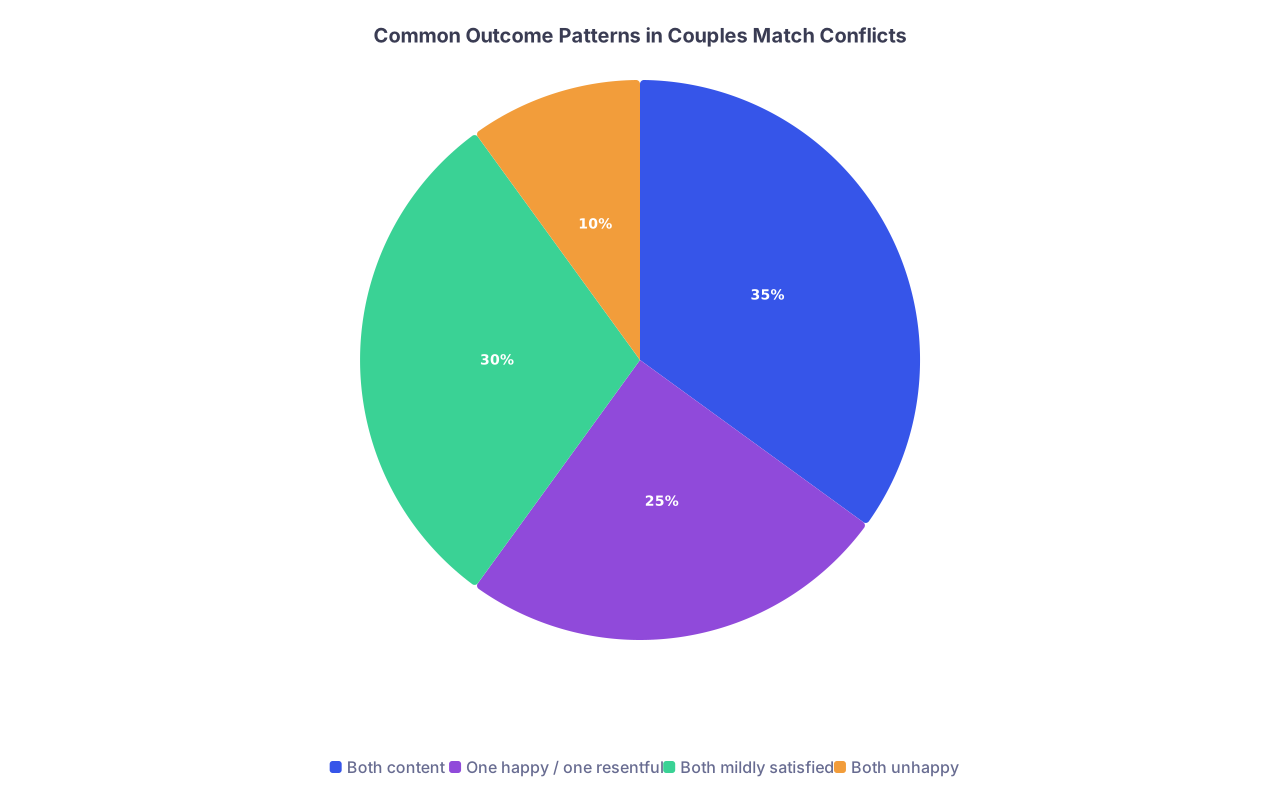
| Category | Value |
|---|---|
| Both content | 35 |
| One happy / one resentful | 25 |
| Both mildly satisfied | 30 |
| Both unhappy | 10 |
Step 10: Lock the list, then stop re-litigating it
Once you’ve:
- Defined your shared priorities
- Mapped your tiers
- Placed the controversial program intentionally
- Sanity-checked with someone you trust
You submit the list. And then you’re done.
No more:
- “Should we have ranked it higher?” at 2 am
- “If we don’t match in X it’s your fault”
- Endless rehashing of old arguments
You agree: “We made the best decision we could with the information and constraints we had. We own it together.”
If things go sideways and someone’s less happy, that’s a conversation for PGY-1, not retroactively for the couple’s match list. You adjust, you support each other, you plan your next move. You don’t rewrite history.

| Step | Description |
|---|---|
| Step 1 | Identify Program Conflict |
| Step 2 | Clarify Specific Likes/Dislikes |
| Step 3 | Define Shared Priorities |
| Step 4 | Assess Power Imbalance |
| Step 5 | Create Tiers & Place Program |
| Step 6 | Use One-Card Preference or Seek Mentor Input |
| Step 7 | Finalize Rank Position |
| Step 8 | Submit List & Stop Re-Litigating |
| Step 9 | Still Gridlocked? |

Quick Example: How one couple actually handled this
I worked with a couple where:
- Partner A: OB/GYN, strong candidate, loved a big-name East Coast program
- Partner B: Psych, felt that same program was malignant and hated the city
Their process:
- They admitted: OB was more constrained; that program was a clear top-3 for OB.
- They rated it:
- OB: Green, 9/10 enthusiasm
- Psych: Red, 3/10 — largely due to culture concerns and distance from family
- They created tiers and realized they had two other cities where:
- OB had slightly less prestigious but still strong programs
- Psych had excellent programs and better lifestyle
- Psych partner used their “one big card” to block the malignant-feeling place. OB reluctantly agreed because the other options were still strong.
- They ranked:
- Tier 1: Two cities where both were green or green/yellow with strong programs
- That big-name East Coast program ended up lower down as a last-resort city where both could technically train but neither really wanted
They matched in their top tier city, both in solid programs. OB didn’t get the exact “dream name,” but avoided four years of partner resentment. Three years later, OB still got a fantastic fellowship. Psych is happy. Relationship intact.
That’s the goal.

FAQ: Handling “I love it” vs “I hate it” in the Couples Match

1. What if one of us says a program is a “hard no” and the other says it’s their dream?
Then you’re at a true conflict, not a mild preference difference. First, verify: is the “hard no” about fixable things (neighborhood, inaccurate info) or non-negotiables (toxic culture, dangerous city for your identity, etc.)? If it’s truly non-negotiable, that program shouldn’t be near the top of the list. You then prioritize finding cities/institutions where you’re both at least “yellow.” A relationship where one person is miserable to fuel the other’s ego/program name is a bad trade.
2. Should the more competitive specialty automatically get priority in these situations?
No, “automatically” is the wrong word. The more competitive specialty does have fewer viable options, so their flexibility is lower. That’s real and needs to be considered. But that doesn’t give them blanket authority. You still weigh both people’s minimum needs. A fair stance is: “We’ll prioritize not burning your limited strong options, as long as my program isn’t below my acceptable floor.”
3. How high should we rank a program one of us loves and the other just mildly dislikes?
That’s a classic Tier 2 situation. If one is green and the other is genuinely yellow (not secretly red), it’s totally reasonable to rank it fairly high, especially if logistics are good and city fit is decent. Just don’t put it above options where you’re both green unless there’s a strong reason (unique training opportunity, major family/geography reason).
4. What if we only discover this disagreement after we submitted ERAS and visited the program?
That’s normal. You only really know how you feel after interviews. You still have full control over your rank list. Use the process I outlined now: clarify specifics, define shared priorities, tier your programs, and then place this one accordingly. ERAS applications don’t dictate your rank order; your rank list does.
5. How do we avoid resenting each other later if one person “gives in”?
You don’t “give in” in a healthy couples match. You both make a joint decision you deliberately own together. That means: you’ve talked about the tradeoffs, you’ve both said out loud “I can live with this,” and once the list is in, you stop using “I compromised for you” as emotional leverage. If you find yourself thinking that often, that’s a sign you ranked something against your true red line and need to address the relationship dynamic, not just the program.
Key points: Translate “love/hate” into specifics, define shared priorities as a couple, and place controversial programs in your rank list relative to your tiers, not your emotions in the moment. And remember: you’re not just matching into programs—you’re building a life neither of you has to resent later.


