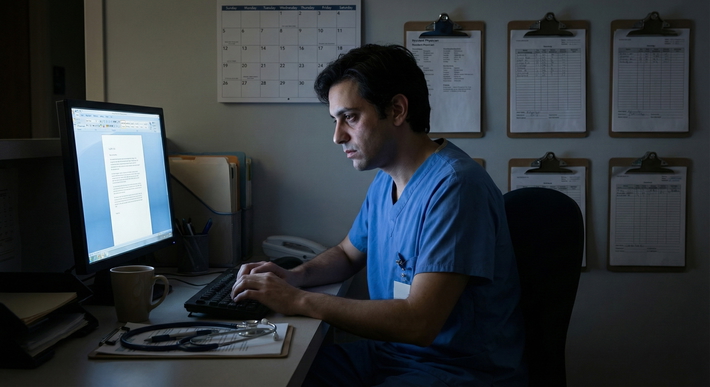
It’s 7:30 p.m. the night before your away rotation starts. You’ve combed through the visiting student website. Nothing. No page on disability services, no mention in the orientation packet, no line in the confirmation email. You emailed the generic student coordinator two weeks ago and got “We’ll look into it.” Then silence.
Tomorrow you’re supposed to show up at 6 a.m. on a surgical service where you know you’ll need some kind of accommodation—maybe extra time for notes because of ADHD, a stool for standing cases because of POTS, a captioning setup for didactics because you’re hard of hearing. And this place looks like it’s never even thought about visiting students with disabilities.
Here’s how to handle that. Step by step, without tanking your evaluation or your health.
1. First 24 Hours: Stop Hoping It’ll Magically Resolve
You’ve probably already tried the “polite email and wait” approach. It didn’t work. At an away site with no clear disability process, you have to assume:
- They don’t have a streamlined visiting-student disability pathway.
- Nobody feels responsible for fixing that gap.
- If you don’t drive the process, it will not happen.
So the mindset shift is this: your job is not to convince them your disability is “real.” Your job is to force the system to pick a responsible adult and pin the issue to them.
Day 0 (Night Before) – Triage
If you’re reading this the night before you start and nothing is set up, prioritize:
- What is absolutely critical to your safety or basic functioning tomorrow?
- What is important but can wait a few days?
- What would be nice but optional for this month?
Examples:
- Critical: stool in the OR if you can’t safely stand for 6 hours, ability to sit during rounds if you’re at fall risk, ability to use glucose meter in front of patients if you’re a Type 1 diabetic.
- Important: extra time for notes, flexible post-call departure, structured communication instead of being yelled at in the OR.
- Optional: preferred call night patterns, ideal clinic rooms, prime parking spot close to the entrance (for some people this moves to “important” or “critical”).
Write this list down. You’ll use it when you talk to people.
2. Map the Power Structure: Who Can Actually Do Something?
Most away sites are chaotic. People will shrug and say “That’s not really my area.” You need to find the nodes that actually make things move.
At a minimum, there are five levels that matter for a visiting student with a disability:
| Role | Why They Matter |
|---|---|
| Clerkship/Rotation Coordinator | Handles schedules, logistics, knows who has authority |
| Clerkship/Rotation Director | Can adjust expectations, grading, and requirements |
| GME Office | Knows institutional policies, sometimes runs accommodations for trainees |
| Disability/Accessibility Office | Formal ADA process and documentation |
| Home School Dean/Student Affairs | Backup advocate and pressure point |
Your sequence usually looks like this:
- Rotation coordinator (email/phone).
- Clerkship/rotation director (email then face-to-face).
- GME/Disability office (parallel path).
- Home school (if things start stalling or turning hostile).
If it’s 5:45 a.m. on Day 1, you don’t have time for the perfect chain of command. You start where you are.
3. Day 1 Script: What to Say and What Not to Say
Before You Walk In
Decide your disclosure level. You do not owe your attending your diagnosis. But you do need to communicate functional limitations.
Think in this format:
- “I have a documented disability through my home institution.”
- “For patient safety and my own health, I need the following specific adjustments.”
- “These are standard accommodations I already use successfully at my home institution.”
That’s it. No long medical backstory. No apologizing for existing.
At Check-in / Orientation
If there’s a group orientation, you don’t raise this in front of everyone. After the main session, you find the coordinator.
Something like:
“I want to flag something that should’ve been done before I arrived. I’m a visiting student with a documented disability at my home school. I need some standard accommodations to function safely on service. I haven’t been connected with your disability or student affairs office yet. Who is the right person at this institution for disability accommodations for visiting students? I need to talk to them today.”
If they say “We don’t have that,” your answer:
“Somebody here handles ADA issues for trainees. Whether it’s GME, student affairs, or HR, I’m happy to contact them directly—can you point me to that office or manager?”
Then you email them on the spot.
4. Running a Parallel Process: Formal + Informal
You need two tracks at once:
- Formal – documentation, official accommodations, ADA-compliant adjustments.
- Informal – day-to-day workarounds with attendings, residents, and staff.
They don’t replace each other. You need both.
Formal Track: Lock It Down in Writing
Same-day email to:
- Clerkship coordinator
- Clerkship/rotation director
- Whatever “disability,” “student affairs,” or “GME” contact you can find on the website
- CC your home school’s disability office and/or dean of students
Subject: “Time-Sensitive: Visiting Student Disability Accommodations”
Body (short, sharp, not emotional):
I am a visiting fourth-year medical student from [Home School], where I am registered with our disability office and receive approved accommodations.
I start the [Service] rotation today. I attempted to arrange accommodations before arrival but have not yet connected with the appropriate office at [Host Institution].
For patient safety and to meet the essential requirements of this rotation, I need the following standard accommodations that are already in place at my home institution:
- [e.g., Ability to sit during prolonged procedures/rounds due to documented mobility/orthostatic condition]
- [e.g., Access to written handoffs instead of exclusively verbal, due to documented hearing impairment]
- [e.g., Slightly extended time to complete documentation with stable patient load, due to documented learning disability]
Could you please:
- Confirm who at [Host Institution] handles disability accommodations for visiting students, and
- Arrange a brief meeting today or tomorrow so we can align expectations and ensure a safe and compliant learning environment.
I am happy to have our disability office send documentation directly to the appropriate contact.
Thank you for your help with this time-sensitive issue.
Best,
[Name, AAMC ID, Contact Info]
You send it. You keep seeing patients while it slowly makes its way through the bureaucracy.
Informal Track: Protect the Day While the System Catches Up
Now you’re on the ward or in the OR. You can’t wait for institutional perfection. You need real-time adjustments.
You don’t say, “I have X diagnosis.” You say, “I work best when…”
Examples:
Mobility / endurance:
“I’m managing a condition where long periods of standing can cause sudden dizziness. I’m safe as long as I can sit intermittently. Is there a stool I can use in the OR and a spot to sit during long rounds?”
ADHD / learning difference:
“I absorb information much better when I can write things down immediately and see things in writing. Could I get patient lists in advance or at the start of rounds, and I’ll make sure I’m fully prepared?”
Hearing impairment:
“I have a documented hearing difference. I hear best when I can see the speaker and when key instructions are also written. If you give critical instructions quickly in the OR, I may ask you to repeat them once or confirm them in writing so I don’t miss anything.”
You’re not asking for favors. You’re describing how to keep you safe and effective.
5. When the Institution Has No Process (or Pretends They Don’t)
This is where people get stuck. You ask about disability services, and you get:
- “We don’t really do that for visiting students.”
- “We’ve never had anyone ask that before.”
- “We don’t have a system in place.”
Translation: “We’re ignorant and unprepared, and we’re hoping you give up.”
Do not accept “we don’t have a process” as an answer. ADA obligations don’t vanish because they forgot to set up a form.
Your response:
“I understand there may not be a set process for visiting students yet. I’m still covered by disability law while I’m training here. So we need an interim solution. At minimum, we can parallel my existing home school accommodations while your office decides on a formal mechanism.”
Then you give them a starting point:
- “At my home institution, this is handled by our disability office with input from student affairs.”
- “They have a letter with my approved accommodations they can send. Could your office accept that as a basis to mirror accommodations for this month?”
Loop your home school in. They’ve done this before. Let them push.
6. Dealing With Resident and Attending Reactions
This is the part everyone is actually afraid of: retaliation, subtle or not-so-subtle.
Reality Check
I’ve seen all of this:
- The attending who says, “If you can’t stand for a 10-hour case, maybe surgery isn’t for you.”
- The resident who “forgets” to get you a stool and rolls their eyes when you sit.
- The awkward silence when you say you need captions for didactics.
You’re not crazy to worry about this. But you still don’t sacrifice your health to protect their comfort.
How to Set the Tone Early
When you talk to the attending on Day 1 or 2, keep it simple:
“I want to make you aware that I’m a visiting student with a documented disability. I’ve worked out accommodations with my home institution that allow me to meet all the essential requirements of the rotation safely. I’ve contacted your administration to mirror those here. In the meantime, the key things that keep me functional are: [two bullet points max, said out loud]. I don’t expect grading leniency—just the ability to do the work safely.”
That last line matters: “I don’t expect grading leniency.” It flips the script from “this person wants an easier ride” to “this person wants to do the real job without collapsing.”
7. When You Hit Actual Pushback or Hostility
If someone says something clearly inappropriate or blocks accommodations, you escalate. Immediately. Not three weeks later.
Red flags that require escalation:
- “We don’t provide accommodations to visiting students.”
- “We can’t adjust the rotation; everyone has to do it the same.”
- “You don’t look disabled.”
- “Maybe you should consider another specialty if you can’t handle this.”
At that point, this is not just a “kindness” issue. It’s a legal and policy problem.
Escalation Ladder
You go up the ladder until someone acts:
- Clerkship/rotation director
- Department Vice Chair for Education
- GME office / institutional ADA coordinator
- Your home school dean of student affairs
- If needed: visiting student office / AAMC VSLO complaint channels
You keep emails factual:
“On [date], during [context], Dr. [Name] stated [quote or close paraphrase] after I disclosed that I was a visiting student with a documented disability and requested standard accommodations.
I am concerned this reflects a misunderstanding of disability obligations for visiting trainees and may create a hostile learning environment. I would like to work collaboratively on a solution that allows me to meet the essential requirements of the rotation safely, consistent with my documented accommodations at my home institution.”
You’re not here to win a moral debate. You’re here to create a paper trail and force the system to fix itself.
8. Protecting Your Evaluation and Match Prospects
Yes, the fear is real: “If I push this, they’ll tank my eval and I’ll never match here.”
Here’s the hard truth: a program that punishes you for needing basic accommodations is not a program you want to match at. Full stop.
But there are tactical ways to minimize collateral damage.
Make It Boringly Professional
You don’t argue in the hallway. You don’t vent in group texts that can get screenshotted. You:
- Show up on time.
- Work hard within your actual limits.
- Document everything (dates, names, what was said, what was refused).
- Keep your home school looped in so you’re not alone.
If you end up needing to explain a mediocre eval later, you’d rather be the person who calmly requested reasonable accommodations and got stonewalled than the person who just “underperformed.”
If Things Are Going South
If by Week 2 you can see the writing on the wall—no accommodations, passive-aggressive comments, your health deteriorating—have a direct conversation with your home dean:
- “Is it in my best interest to finish this rotation?”
- “If I withdraw, how do we document that this was due to failure to accommodate, not my performance?”
- “What can we put in my MSPE or a letter of support if questions arise?”
Sometimes the right move is to cut your losses and leave. You are a human being with one body, not cannon fodder for an away that doesn’t deserve you.
9. Future Rotations: How to Avoid This Mess Again
You can’t fully control other institutions, but you can make future aways less chaotic.
Before You Apply
Check:
- Does the visiting student website have:
- A disability services link?
- An explicit statement that visiting students can access accommodations?
If the answer’s no across the board, that’s data. You can still apply—but go in eyes open.
Before You Accept
Send a targeted email:
“Before I finalize my acceptance, I need to confirm that visiting students with documented disabilities can receive accommodations parallel to those provided at their home institution. Who would I work with at your institution to set that up?”
If they dodge or delay even at this stage, that’s your preview.
Timeline That Actually Works
Use a rough timeline like this:
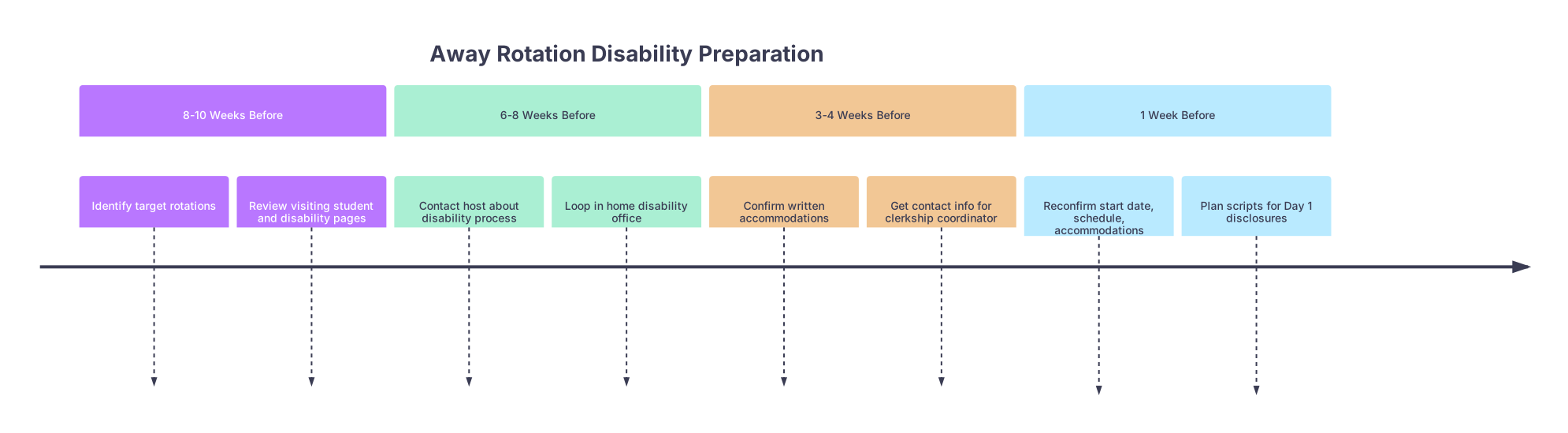
That structure alone prevents a lot of “night-before panic” situations.
10. Quick Reference: What’s Reasonable vs. Unreasonable
Programs like to hide “we just don’t want to bother” under “that’s not reasonable.” Let’s be clear.
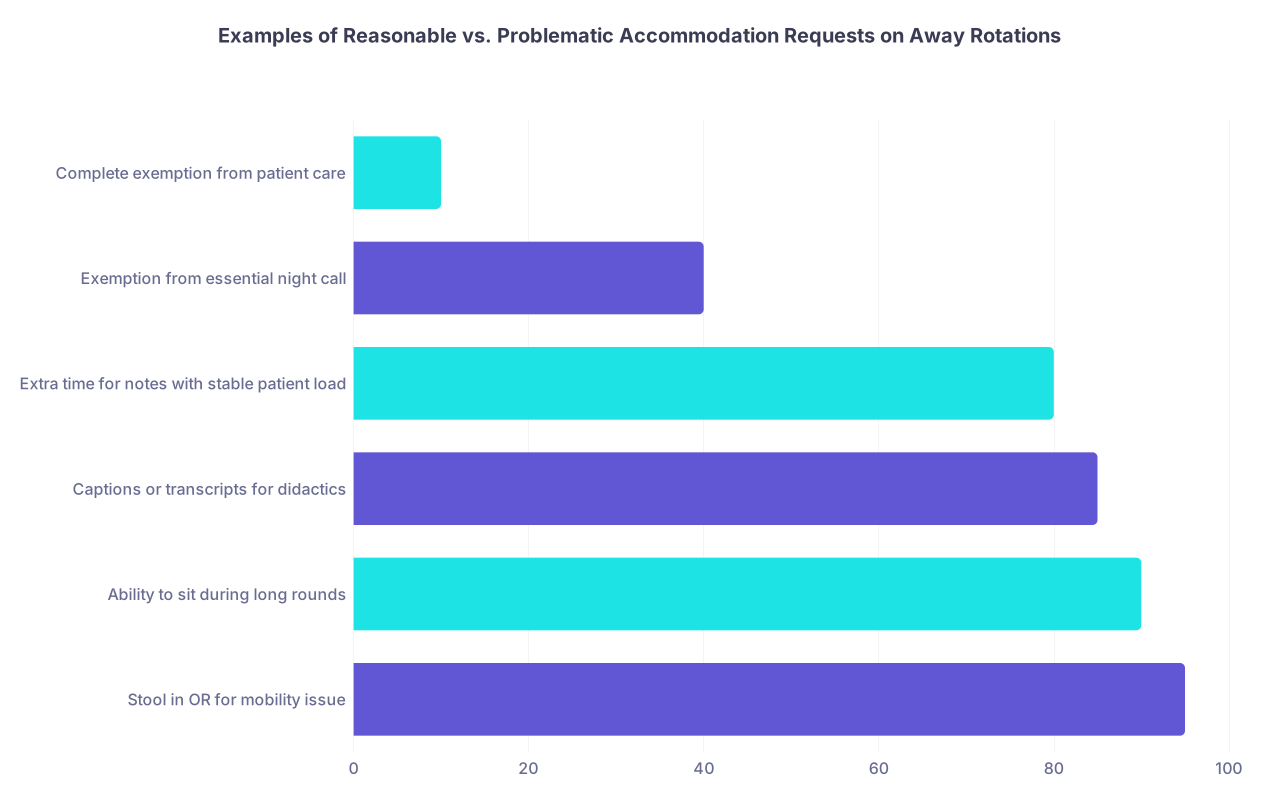
| Category | Value |
|---|---|
| Stool in OR for mobility issue | 95 |
| Ability to sit during long rounds | 90 |
| Captions or transcripts for didactics | 85 |
| Extra time for notes with stable patient load | 80 |
| Exemption from essential night call | 40 |
| Complete exemption from patient care | 10 |
The first four are usually reasonable. The last two get tricky because they can clash with “essential functions” of the rotation or specialty. The exact line is fuzzy and depends on the institution and specialty, but don’t let them pretend “stool in OR” is some outrageous request. It isn’t.
11. Mental Bandwidth: Taking Care of Yourself While You Fight This
Fighting for accommodations on top of being on an away is exhausting. You’re not weak if this drains you; it drains everyone.
What helps:
- Decide in advance what you will not sacrifice: sleep minimum, medical therapy you won’t skip, physical limits you won’t cross.
- Keep one person at your home school updated—dean, counselor, disability officer—so someone knows what you’re carrying.
- Have a short, honest answer ready for friends and family: “This rotation isn’t set up for disability accommodations, so I’m doing clinical work and also fighting that in the background. It’s a lot. I might be slower to respond but I’m okay.”
You are allowed to play the long game. Match is one day; your body and mind have to last much, much longer.
12. If You Decide to Report or Push for Structural Change
Some of you are thinking bigger: “I’m getting through this rotation, but I also want to make sure the next disabled visiting student isn’t left hanging.”
Good. That’s how systems change.
Options after (or during) your rotation:
- Anonymous feedback through VSLO or the host’s visiting student evaluation.
- A formal complaint to the host’s disability office, student affairs, or GME.
- A detailed, factual memo from your home school dean to the host institution summarizing what went wrong and suggesting a formal process for visiting student accommodations.
Keep it clinical and specific. Dates, requests, responses, outcomes. No long venting paragraphs—those make it easier to dismiss you as “emotional” rather than “correct.”