

It’s August. You’ve got ERAS open on one screen, Reddit on the other, and a half-finished Excel sheet titled “MD vs DO Programs – Final???” saved in your documents. Your classmates are bragging about applying to 120 programs “just to be safe.” Your advisor says, “Be strategic.” Your brain hears, “Apply everywhere.”
You tell yourself you’re “dual applying” smartly—MD and DO internal medicine, maybe family, maybe prelim medicine “as backup.” But under the surface, you’re about to make the exact mistakes that sink a lot of DO applicants: scattered lists, wrong mix of MD vs DO, no realistic filters, and a fantasy that more applications automatically equals more interviews.
Let me be blunt: dual applying can save your Match… or quietly kill it. I’ve watched DO students with solid stats get half the interviews they should, not because they were weak applicants, but because their MD/DO program strategy was a mess.
You’re here so you don’t become that story. Good. Let’s go through the ways DOs mismanage MD vs DO program lists—and how to avoid burning time, money, and your shot at matching.
Mistake #1: Treating MD and DO Programs Like One Giant Pile
The first disaster: you build one big list of “internal medicine” or “surgery” programs and just start clicking boxes. MD, DO, academic, community—it all blurs into one.
That’s how you end up applying to:
- MD programs that basically never interview DOs
- DO programs that don’t fit your profile at all
- A random mix that doesn’t reflect your actual competitiveness
Dual applying doesn’t mean “throw everything together.” MD and DO programs live in different ecosystems for DO students.
Here’s the ugly reality:
- A solid DO applicant might be average or even below average at many MD academic programs.
- The same applicant might be very competitive at well-regarded DO programs.
- Some MD programs genuinely like DOs and match them often.
- Others have zero DOs on their roster and aren’t starting with you.
If you ignore that and treat them the same, you’ll waste thousands of dollars and dilute your chances.
You should have, at minimum, three distinct lists in your head (or, better, in a spreadsheet):
- MD programs that routinely take DOs
- MD programs that almost never touch DOs
- DO programs (your true base)
If you skip this separation and just “dual apply” blindly, you’re already in trouble.
Mistake #2: Ignoring DO Friendliness Data and Hoping for a Miracle
I see this constantly: DO students heavily applying to big-name university MD programs with zero DOs in their last several classes.
Hope is not a strategy. Data is.
You should be checking:
- Program websites – resident lists with “DO” vs “MD”
- FREIDA / program PDFs – many list DO percentages
- Prior match lists from your school – where DOs like you have succeeded
- Reddit/SDN threads only to confirm patterns, not to drive your whole strategy
If a program has 30+ residents and not a single DO, you are almost certainly wasting an application there unless:
- You rotated there,
- You have a strong personal connection,
- Or your metrics are so far above their average that you’re an outlier (and be honest—most people are not).
Here’s a simple rule:
| DO Presence in Current Residents | How to Treat the Program |
|---|---|
| 0 DOs in last 3 classes | Avoid unless special tie |
| 1–2 DOs total | Extreme reach |
| 10–30% DOs | Reasonable to target |
| 30%+ DOs | High-yield for DOs |
Stop ignoring this and thinking, “Well, someone has to be first.” No. They don’t. And it probably will not be you.
Mistake #3: Building the List Around Prestige Instead of Match Probability
Another common disaster: you build your MD list from the top down.
You start with:
- Big-name university programs
- Famous locations (NYC, Boston, LA, Chicago)
- “Top 50” lists you found online
Then you sprinkle in some DO programs and tell yourself, “See? I’m balanced.”
You’re not. You’re prestige-chasing.
What you should be doing is the opposite: build your list from the bottom up based on your actual risk tolerance. That means:
- First: enough true safety options
- Then: solid target programs
- Only then: limited reach and fantasy picks
Instead, most DOs reverse it:
- 40% reach
- 40% mid-reach
- 20% safety (if that)
And then they’re surprised when they get 6 interviews and spend the winter panicking.
For dual applying, a healthier breakdown for most DOs might look like this:
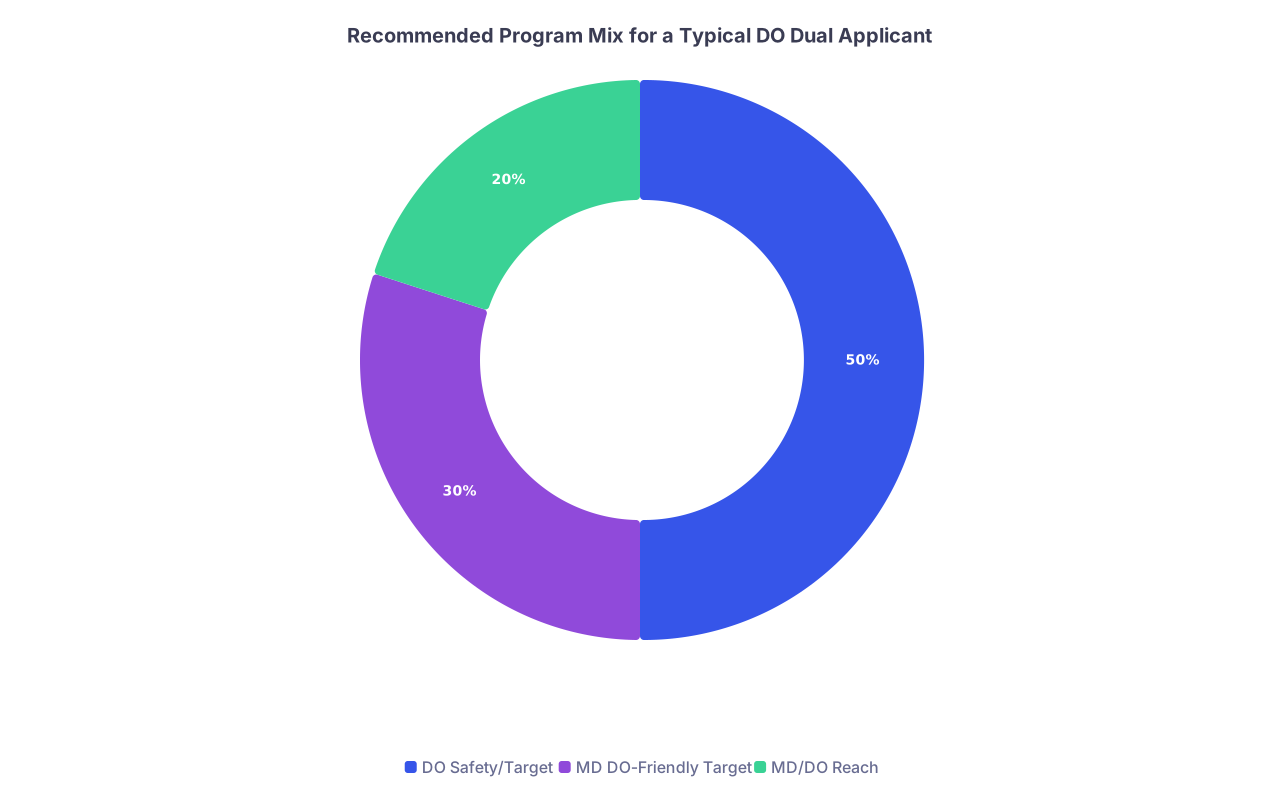
| Category | Value |
|---|---|
| DO Safety/Target | 50 |
| MD DO-Friendly Target | 30 |
| MD/DO Reach | 20 |
If you’re applying to a competitive specialty (or you have red flags, mediocre scores, or limited geographic flexibility), that DO safety/target share needs to go up, not down.
If your spreadsheet is 70% university MD programs, you’re not dual applying. You’re gambling.
Mistake #4: Not Matching Your Program List to Your Actual Profile
I’ve seen this pattern way too many times:
- Step 2 CK: 227
- No home residency program
- One mediocre research poster
- Applying IM with a list full of “top” MD university programs and only a handful of DOs
And they swear they’re being “realistic.”
You must align your MD vs DO list with:
- Your scores (COMLEX and USMLE if taken)
- Your class rank or relative performance
- Your research (especially for competitive or academic-heavy fields)
- Your geography (are you flexible or locked to one region?)
- Your clinical grades and letters (honors vs passes, home vs away rotation strength)
If your stats are mid-range or shaky, your DO list should be built first, then you carefully add MD programs where DOs with similar profiles have matched.
If you’re a rockstar DO—high Step 2 (250+), strong research, glowing letters, successful away rotations—you can shift more weight to DO-friendly MD programs. Notice I said DO-friendly. Not just “places I’d like to live.”
Here’s an example of how misalignment looks vs what it should look like for a mid-range DO IM applicant:
| Type | Misaligned Applicant List | Better-Aligned Applicant List |
|---|---|---|
| DO Community | 5–7 programs | 15–20 programs |
| DO University-Affiliated | 3–5 programs | 10–15 programs |
| MD DO-Friendly Community | 8–10 programs | 10–15 programs |
| MD Big-Name University | 15–20 programs | 3–5 max (true reaches) |
If your current spreadsheet looks more like the left column, you’re walking straight into trouble.
Mistake #5: Overapplying to MD and Underapplying to DO
This one is brutal. DO students who are scared of “matching only DO” and overcorrect by heavily favoring MD applications.
So they end up with:
- 60+ MD programs
- 10–15 DO programs
- Weak DO coverage in the very specialties where DO training is strong
That’s how people end up unmatched, then shocked, because “I applied to 75 programs!”
Here’s the problem: raw number of programs is irrelevant if they are the wrong programs for you.
Most DO applicants should flip that default bias:
- More DO programs than MD
- Especially in competitive or moderately competitive specialties
- With MD spots targeted like a sniper, not sprayed like buckshot
For many mainstream specialties (IM, FM, Psych, Peds), where DOs consistently match well, a sane, relatively safe range for an average DO might look roughly like:
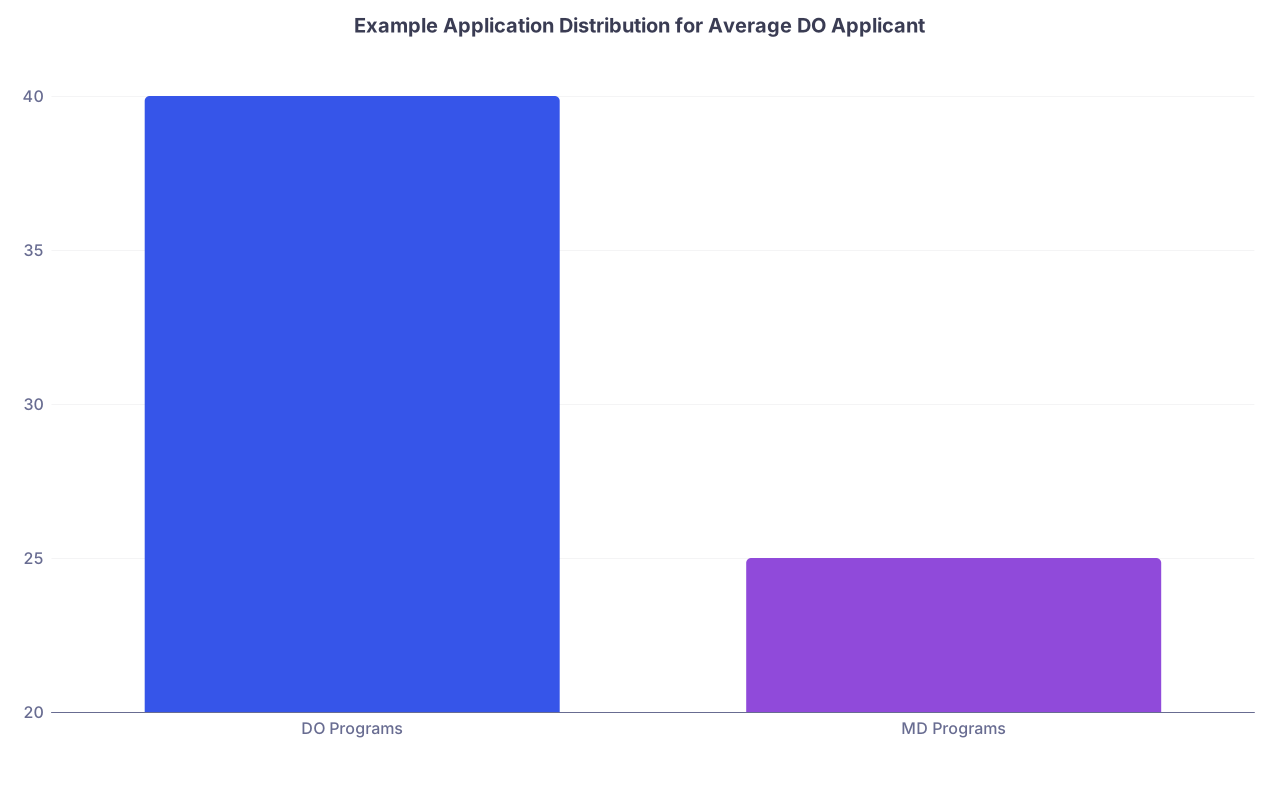
| Category | Value |
|---|---|
| DO Programs | 40 |
| MD Programs | 25 |
This is just a conceptual example, not a commandment. But if your ratio is reversed—25 DO, 40 MD—ask yourself honestly: are you planning to match, or are you chasing an MD logo?
Because the Match algorithm doesn’t care how you spell “doctor” on Instagram. It cares whether someone ranks you.
Mistake #6: Applying MD Only in Cities You Want, DO Only as Afterthoughts
Another trap: geographic fantasy.
You tell yourself:
“I’ll apply MD in the cities I want—NYC, Boston, San Diego—and DO programs in random places as backup.”
Then you act surprised when:
- Those MD programs are flooded with 260+ US MDs and Ivy research monsters
- DO programs in your dream regions barely see your application or get little attention from you
Here’s the twist people forget: there are excellent DO programs in good locations. And there are MD programs in undesirable locations that are much more realistic for you as a DO.
When you build your list around lifestyle/location first and only sprinkle DO programs in “wherever,” you’re doing exactly what unmatched DOs did the year before you.
A better approach:
- For each region you like, identify both MD and DO programs that have taken DOs.
- In cities you really want, do not rely solely on MD programs. There may be strong DO options nearby you’re ignoring because of letters on the logo.
- Use DO programs aggressively to anchor your desired geographies, not just as leftovers in places you’d never actually live.
If you only use DO programs as your “I guess I’ll go anywhere” option, don’t be shocked if “anywhere” is where you end up—or nowhere at all.
Mistake #7: Not Accounting for the COMLEX / USMLE Problem
A classic source of list mismanagement: not thinking through how programs view your testing portfolio.
Scenarios I see DOs mishandle:
COMLEX only, no USMLE
Then they apply broadly to MD programs that clearly state “USMLE required” or heavily prefer it. Many of those apps are DOA.Low Step 1 or Step 2 with okay COMLEX
They apply as if the USMLE never happened. Programs see the number. You can’t wish it away.Great USMLE, mediocre COMLEX
They don’t lean into the MD side enough, despite having what many PDs actually filter on.
You must build your list with these realities:
- MD programs are still USMLE-first. Many don’t know how to interpret COMLEX well.
- DO programs generally understand COMLEX and are more forgiving without USMLE.
- A weak USMLE often hurts more than a weaker COMLEX alone would have.
So if you:
- Did not take USMLE: you must be DO-heavy and very selective about MD programs that openly accept COMLEX-only and have prior DOs.
- Have weak USMLE scores: lean more into DO programs and MD programs that clearly have a track record with DOs/COMLEX.
- Have strong USMLE: you should not under-apply to DO-friendly MD programs.
Ignoring this and building one blended list “because I did fine overall” is denial. Programs filter by score type and cutoffs. Your list has to respect that.
Mistake #8: No Real Filters Beyond “Heard It’s Good”
This might be the laziest but most common error: building your list off vibes.
- Someone on Reddit said Program X is “chill”
- A classmate’s cousin matched at Y
- You saw Z on a “Top 25” list and liked their website photos
So you throw them all on the list.
You do not systematically consider:
- How many DOs do they have?
- How many residents total (tiny vs huge program)?
- Their board pass rates and alumni placement
- Whether they prefer high USMLE over COMLEX
- Whether they’re malignant or resident-supportive
- Whether they’ve recently merged, lost accreditation issues, or had major turnover
The result? Your list is full of:
- Low-yield MDs with no DOs
- Weak DO programs with poor outcomes
- Random scatter that reflects more hearsay than actual strategy
You need non-negotiable filters. For example:
- “I will not apply to MD programs with zero DOs in the last 3 years.”
- “I will not apply to programs with consistently poor board pass rates.”
- “I will prioritize DO and MD programs in regions where DOs from my school have already matched.”
Yes, this takes time. But not doing it is how you join the “I applied to 120 programs and got 4 interviews” club.
Here’s a straightforward flow that should be happening in your head (or on paper) before you add a program to your list:

| Step | Description |
|---|---|
| Step 1 | Find Program |
| Step 2 | Reject Program |
| Step 3 | Maybe List or Reject |
| Step 4 | Add to Target List |
| Step 5 | Has DOs in last 3 classes? |
| Step 6 | Accepts COMLEX or DOs clearly? |
| Step 7 | Aligns with my scores & geography? |
If you’re not at least subconsciously doing something like that, you’re guessing.
Mistake #9: Applying to Another Specialty “Just in Case” Without a Real Plan
Dual applying across MD and DO is already complex. Then some people add a second specialty on top of that “for safety.”
Example disaster setup:
- Primary goal: Ortho MD & DO
- Backup: IM MD & DO
- Result: Four lists, no clear prioritization, half-baked personal statement(s), confused letters, and programs sensing you’re not committed.
Or: Psych primary, FM backup. Or EM primary, IM backup. You get the idea.
The issue is not having a backup. The issue is sloppy execution:
- Using generic personal statements that sound nonspecific to either specialty
- Getting letters that don’t support the backup field
- Failing to build enough DO backups in the backup specialty
- Not trimming MD reach programs in the primary field to free up apps for realistic options in the backup
If you’re going to dual apply specialties as a DO, then dual apply MD vs DO on top of that, you need to be even more disciplined with:
- Which specialty gets more MD vs DO slots
- Where your letters are strongest
- Which field you would actually rank higher if accepted to both
If you’re just “sprinkling in” another specialty MD list without fully adding DO backups in the same field, that’s not strategy. That’s panic disguised as planning.
Mistake #10: Not Tracking and Adjusting in Real Time
Final big one: you treat your list as fixed.
You finalize 90–100 programs in September, send everything, and then just sit and watch your email like it’s a lottery ticket. Zero mid-course correction.
Then October hits. Interviews start trickling in. You notice:
- MD interviews: almost none
- DO interviews: some, but not as many as your peers
- Or all your invites are from one region / program type
And you do… nothing. Because you “already applied.”
You should absolutely be monitoring patterns and ready to:
- Apply to more DO programs in October if interview volume is low
- Expand geographically beyond your comfort zone on the DO side
- Realize fast that the MD portion of your list isn’t hitting and stop mentally relying on it
Too many DO students cling to the fantasy that the MD invites are “just coming later” and don’t correct course with additional DO programs until it’s too late.
If by mid-October you’re getting:
- 0–1 MD invites
- < 4–5 total for core specialties
You should be immediately reassessing and adding DO programs strategically where possible.
You won’t perfectly salvage a bad list in October. But you can absolutely prevent a disaster from getting worse.
Your Next Step (Do This Today)
Do not just nod and move on. Open your spreadsheet right now—or create one if you’ve been winging it.
Create four columns:
- Program Name
- Type (MD or DO)
- DO Presence (None / 1–2 / 10–30% / 30%+)
- Category (Safety / Target / Reach)
Then pick 10 MD programs and 10 DO programs from your current list and fill those columns in.
Now ask yourself:
- How many MD entries are actually DO-friendly?
- How many DO “safety/target” programs do you truly have?
- Is your list prestige-heavy and safety-light?
If the answers worry you, good. Fixing that now is exactly how you avoid becoming another “I applied everywhere and still didn’t match” story.


