

It is mid-July of your PGY-2 year. You just finished a run of nights, your Step 3 date is looming, the ABIM (or equivalent board) exam window is blinking at you from an email, and your co-resident just asked, “Hey, did you submit your ERAS fellowship application yet?”
You open your calendar.
Board prep. Fellowship personal statement. LORs. Research abstract revisions. ICU rotation.
Everything collides in the same 6–9 month window. And if you treat each as a separate crisis instead of a coordinated plan, you are going to suffer more than you need to—and your results will show it.
Let me break this down specifically: the residents who handle this phase well are not necessarily smarter. They sequence tasks correctly, protect high-yield study time, and leverage board prep to help their fellowship application, not compete with it.
This is how you do that.
1. Know the Timeline You Are Actually Living In
Most residents underestimate one thing: how compressed the “board + fellowship” window really is.
Let us anchor this on a common scenario: Internal Medicine resident aiming for cardiology, GI, heme/onc, pulm/crit, etc.
Here is the rough combined timeline many of you are in:
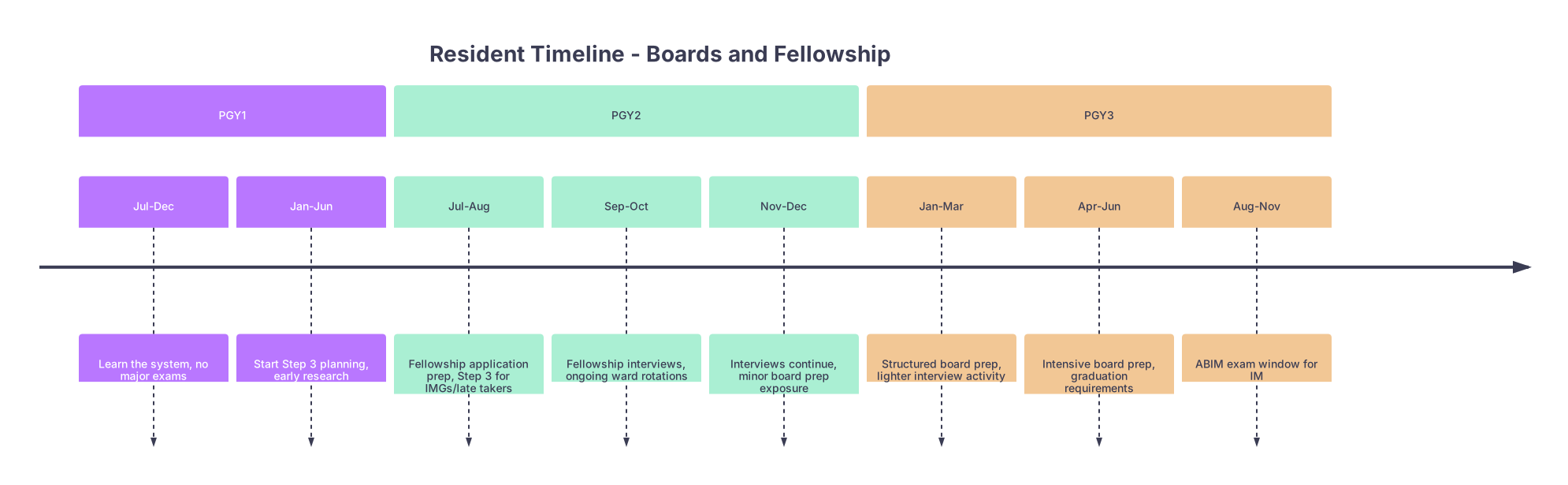
| Period | Event |
|---|---|
| PGY1 - Jul-Dec | Learn the system, no major exams |
| PGY1 - Jan-Jun | Start Step 3 planning, early research |
| PGY2 - Jul-Aug | Fellowship application prep, Step 3 for IMGs/late takers |
| PGY2 - Sep-Oct | Fellowship interviews, ongoing ward rotations |
| PGY2 - Nov-Dec | Interviews continue, minor board prep exposure |
| PGY3 - Jan-Mar | Structured board prep, lighter interview activity |
| PGY3 - Apr-Jun | Intensive board prep, graduation requirements |
| PGY3 - Aug-Nov | ABIM exam window for IM |
For most U.S. IM residents:
- Fellowship ERAS opens: mid/late June of PGY-2
- Application due / programs start reviewing: July
- Interviews: roughly August–November PGY-3 (with variation)
- ABIM Certification Exam (for IM) is late summer / early fall of PGY-3 or just after graduation
Other specialties have similar collisions:
- Pediatrics: boards late spring / early summer after PGY-3, fellowships applied for in PGY-2
- General surgery: ABSITE every year, written boards after residency; fellowships (MIS, surg onc, trauma/critical care) applications start PGY-4
So your “integration problem” has three overlapping curves:
- USMLE / COMLEX final step (for some, this is still pending in early residency).
- In-training exams (ITE/ABSITE) and then specialty boards.
- Fellowship application build-up and interview season.
The residents who drown treat these as independent fires.
The residents who do well map them as one continuous academic project.
2. Decide: What Actually Comes First For You?
You cannot “prioritize everything.” That phrase is nonsense.
You need explicit rank ordering across three domains:
- Passing your boards on the first attempt
- Matching into an appropriate fellowship (not just any, and not just the “highest prestige” name)
- Maintaining functional sanity / basic life maintenance (non-trivial, but this is not a wellness lecture)
Here is my blunt take:
- A failed board exam is a career-level problem.
- A weaker fellowship placement is an ego problem or a delay problem, but your career can recover.
- Burnout and mental collapse are real, but the most immediate hard stop is still failing your boards.
That does not mean you blow off fellowship. It means your planning must guarantee a baseline of safe board performance first, then maximize fellowship competitiveness around that constraint.
To make this concrete, I look at three inputs:
| Factor | High-Risk Scenario | Low-Risk Scenario |
|---|---|---|
| Prior standardized scores | Borderline Step 1/2, low ITE | Historically strong scores |
| Current clinical load | Heavy ICU/Night float blocks | Elective-heavy or research |
| Fellowship competitiveness | Cards/GI/DERM-type bottlenecks | Less saturated fellowships |
If you are:
- Borderline on ITEs + targeting GI or cards + on a brutal schedule → board prep becomes non-negotiable priority #1, and you compensate on the strategy of your application, not number of hours.
- Historically strong test taker + applying to a less competitive niche fellowship → you can push harder on research output and application polish while keeping board prep steady but not obsessive.
The worst error I see: strong applicant for a competitive fellowship who has mediocre ITEs but spends 80% of “academic time” polishing a 5th draft of the personal statement while ignoring structured QBank work. They match. Then fail boards. And suddenly they are fighting for remediation and explaining a failure to every credentialing committee for the next decade.
Do not be that story.
3. Build a Year-Long Integration Plan, Not Two Siloed Plans
You need one integrated schedule that explicitly includes:
- Clinical rotation intensity
- Board preparation phases
- Fellowship preparation milestones
Think in quarters, not weeks. Weekly lists are where people get lost; quarterly structure is where you win.
Quarter by quarter (IM example, aspiring fellow)
Assume you are an IM resident planning on a traditional subspecialty.
PGY-2, Q1 (July–September)
- Main academic tasks:
- Fellowship ERAS submission (June/July)
- Targeted research output (last-minute abstract / poster polishing, if needed)
- Light board prep: maybe 10–15 questions a day, 5 days a week
- Reality:
- This is fellowship application season. You will not do deep board prep here. Accept that.
- Smart move:
- Use ITE-style questions or board-style questions aligned with your current rotations.
- Use the question bank to reinforce clinical performance and interview talking points: “On cards consults, I noticed I was weak on valvular disease, so I focused on X…”
PGY-2, Q2 (October–December)
- Interviews are ramping up or about to begin, depending on specialty.
- You continue:
- Consistent, low-intensity board questions (aim for 200–300 questions per month).
- Maintain a “knowledge journal” that helps both boards and interviews (more on that later).
- Goal:
- Do not lose your test-taking muscles.
- Start building systematic review habits, but do not expect high volume yet.
PGY-2, Q3–Q4 (January–June)
- Application: largely done (maybe some late interviews, thank-you notes, rank list decisions).
- This is your first serious board-prep ramp.
- If the exam is after graduation:
- Work toward 30–40 questions/day, 5 days per week during lighter blocks.
- Use ITE feedback: anything red or yellow becomes deliberate study.
PGY-3 pre-boards (July–Exam)
- This is the final push:
- QBank completion to 80–100%
- Dedicated review of weak sections
- Simulated exams on off days (depending on your call schedule)
Where does fellowship live in the middle of this? In the early half of PGY-2. That is it.
So you design a study plan where board prep is not “on hold” but throttled down during that quarter, and then deliberately ramped after the heaviest fellowship tasks are over.
4. Make Board Prep Work For Your Application
Here is where most residents miss a huge opportunity. They act like board prep and fellowship prep are competing tasks. Often they are aligned.
Fellowship interview days are not just vibes and “tell me about yourself.” You will get:
- Clinical scenario questions
- Prior management decision questions
- Variants of “Talk through how you think about X” that map directly to board-tested frameworks
If you study right, your question bank strategy becomes your interview prep.
How to do that:
Use a single, running document for “high-yield frameworks.”
Example: You are doing nephrology questions. Each time you hit a good explanation, you pull out:- Hyponatremia approach
- AKI: pre-renal vs ATN vs obstruction
Turn them into 5–10 line structured frameworks. That same document is gold when an interviewer says, “Tell me how you approach hyponatremia on the wards.”
Tag content in your notes by:
- “Boards-heavy” (objective, pattern-based)
- “Interview-friendly” (frameworks, controversies, areas where you can sound thoughtful)
Use tough board questions as stories in interviews.
Example:
“I realized during board prep and on night float that I was inconsistently approaching syncope. So I built myself a checklist around EKG, structural heart disease, and prodromal symptoms. That changed how I staffed these with my attending and I saw fewer over-admissions / under-admissions.”
You are showing:
- Self-awareness
- Growth
- Clinical reasoning aligned with high-level exam standards
All from work you needed to do anyway.
5. Use Fellowship Pressures to Sharpen Your Board Prep
The integration works in the other direction too.
Fellowship applications force you to answer three questions:
- Why this subspecialty?
- What is your career plan?
- What are your strengths and weaknesses?
If you are honest when you write your personal statement and discuss your interests with mentors, you get a clearer target for what you must not be weak on for boards.
Example:
- You are applying for cardiology and your weakest ITE sections are EKG and heart failure.
- It is incongruent—borderline embarrassing—to tell programs you want to be a cardiologist but your certification breakdown later shows cardiology as a bottom decile section.
So your personal statement is not just fluff. It is a contract of sorts. If you write:
- “I am particularly drawn to heart failure management and complex hemodynamics…”
Then your board prep better include:
- Every heart failure guideline algorithm
- Practice reading pressure tracings, valvular path murmurs, advanced HF therapy indications
You let your stated fellowship interest discipline your board prep priorities.
Same for heme/onc:
- If you are “interested in malignant hematology” but consistently skip the obscure leukemia questions because they are annoying, your narrative falls apart.
- Your application focus should push you to own at least your niche section of the blueprint.
6. Different Strategies Based on Risk Category
Let me be even more concrete. Here is how I would advise different archetypes.
| Archetype | Testing History | Fellowship Target | Strategy Emphasis |
|---|---|---|---|
| The Borderline Tester | Low ITEs, avg Steps | Competitive (GI/cards) | Boards first, smart app |
| The Test-Savvy Star | Strong scores | Hyper-competitive | Aggressive research + polish |
| The Late Bloomer | Improving ITEs | Moderately competitive | Balanced, with tight schedule |
| The Burned-Out PGY-3 | Inconsistent prep | Any reasonable match | Protect energy, ruthlessly focus |
1. The Borderline Tester
- Non-negotiable:
- First pass on boards.
- Plan:
- During fellowship application season:
- Slim down application work. No perfectionism on personal statement. One or two strong mentors edit it, done.
- Apply strategically: mix of reach and solid mid-tier programs where your home PD’s call will matter.
- Board prep:
- Decide on one main QBank and stick to it.
- Lock 45–60 minutes 5 days/week, even during ICU. Non-negotiable. That might be only 15–20 questions/day, but consistently.
- During fellowship application season:
- Mental rule:
- If something has to slide, it is a marginal abstract, not board review or sleep.
2. The Test-Savvy Star
- Strong ITEs, high Steps, maybe research-heavy already.
- Risk: You coast on boards because “I have always done fine” while obsessing over matching the #1 program.
- Plan:
- Board prep:
- You do not need 2 full QBanks. You need:
- One QBank done well. Review every explanation.
- A few timed, full-length practice blocks toward the end.
- You do not need 2 full QBanks. You need:
- Fellowship:
- Put your extra energy into:
- Targeted networking (email faculty at target programs, present at their conferences when possible).
- Manuscript completion.
- Highly tailored personal statements for a small tier of top-choice programs.
- Put your extra energy into:
- Board prep:
3. The Late Bloomer
- ITEs climbing, you finally learned how to study in residency.
- You can actually use board prep as your success story.
- Plan:
- Document your improvement:
- “ITE PGY-1 40th percentile, PGY-2 60th, PGY-3 80th percentile, driven by deliberate practice.”
- Make this part of your narrative:
- Shows growth, coachability, and resilience.
- Boards:
- You are at risk of over-studying. Set a ceiling, not just a floor, on daily questions so you do not fry yourself.
- Document your improvement:
4. The Burned-Out PGY-3
- Already fried from residency, maybe a rough personal year as well.
- You are tempted to defer boards or throw a half-hearted application together.
- Plan:
- Decide very consciously:
- This may be the year to prioritize mental health and a solid board performance, and pursue fellowship after a hospitalist year.
- That is not failure. It is strategic retreat. And it often leads to a stronger, more mature fellowship match later.
- Decide very consciously:
7. Concrete Weekly Structures That Actually Work
People love vague advice. Let me give you something you can implement next Monday.
During peak fellowship application build (June–August PGY-2)
Goal: Keep board muscles active without expecting major gains.
Sample week:
- 3 days:
- 20–25 board questions each (timed, mixed internal medicine), ~45 minutes.
- 1 half-day protected (if you can negotiate it with your PD) for:
- Personal statement draft or revision
- Updating CV and ERAS
- Emailing letter writers with organized packets
Evenings once or twice a week:
- 60–90 minutes:
- Fellowship work only—no QBank. That may be:
- Reading around your research project
- Drafting a research paragraph for your personal statement
- Listing faculty at priority programs you want to talk about on interview day
- Fellowship work only—no QBank. That may be:
During interview-heavy months (Sept–Nov PGY-3 for many)
Goal: Prevent backsliding while traveling and post-call.
Sample:
- On non-interview days:
- 20–30 questions/day, untimed if fatigued but with active review.
- On interview days:
- No QBank. But:
- Read through your “framework” document in 20-minute chunks (refresh your reasoning patterns).
- No QBank. But:
- On travel days:
- Simple review:
- Flashcards (if you use them)
- Brief notes on your phone from previous weeks of board prep
- Simple review:
The trick is that you never let weeks go blank. Volume can drop; zero is unacceptable.
8. Communication With PDs and Mentors: Get Them on the Same Page
One underused strategy: explicitly telling your program director and mentors how you are balancing boards and fellowship, and asking for specific support.
Most residents do this:
- “I am busy with fellowship stuff and also studying for boards.”
Vague, unfocused.
What you should do:
- “I am aiming to finish 60% of my board QBank by March and 100% by June, while submitting a solid but not elaborate fellowship application this July. To protect that, I am hoping to use my elective block in February as my heaviest study period. Could we avoid adding extra clinic sessions there?”
You are more likely to get what you ask for when it sounds like a plan, not a complaint.
Mentors can also:
- Help you pick which research project to push across the finish line. You do not need five half-baked posters; you need one complete story that fits your future subspecialty and does not cannibalize board prep time.
- Review your personal statement once, carefully, instead of seven rounds of “revisions” that are mostly stylistic.
9. Tactical Study Methods That Serve Both Goals
Let us go even more granular.
Use block-based studying tied to rotations
On cardiology rotation:
- 50% of your questions: cardiology only.
- 50%: mixed.
- Take notes in a shared “Boards + Fellowship” notebook, with headers like:
- “AFib stroke risk / anticoag algorithm”
- “HF guideline-directed medical therapy stepwise”
On ICU:
- Focus QBank on:
- Shock states
- Ventilator management
- Sepsis and related pearls
- Those cases are prime interview ammo for critical care or pulmonary-critical care fellowship.
Use QBank data to target mini-reading blocks
Instead of reading 50-page chapters, let the QBank tell you where to zoom in:
- If your performance dashboard screams “renal”:
- Spend 30–45 minutes 3 times that week reading a reliable board review text or primary guideline on AKI, CKD staging, and electrolyte abnormalities.
- Translate that to 1–2 talking points you can use on interviews. For example:
- “I did a deep dive on ambulatory management of CKD progression and started making structured follow-up checklists for our clinic patients.”
Same work. Two outputs.
10. When Things Go Off the Rails
You will not follow your beautiful plan perfectly. Nobody does.
You need failure protocols.
Missed 2–3 weeks of board prep during a brutal rotation?
- Do not “make up” the questions numerically. That leads to cram sessions with poor retention.
- Instead:
- Restart at realistic daily volume.
- Extend your finish date for QBank completion.
- If necessary, drop a low-yield project: a non-critical poster, a minor elective, a side teaching project.
Fellowship interviews are consuming more time than expected?
- Decide triage rules in advance:
- You might:
- Decline low-priority interview offers (yes, really) if traveling will devastate your schedule and you already have enough mid/high-tier interviews.
- Use:
- Back-to-back interview days geographically aligned whenever possible.
- You might:
You bomb a practice exam close to boards?
- Temporarily shift 1–2 weeks into “board priority mode”:
- Reduce extra shifts if possible (swap or negotiate).
- Pause all optional academic extras.
- Increase daily QBank volume and active review.
- You will not fix years of weak foundations in 10 days, but you can close dangerous gaps.
11. The Long View: How This Phase Affects Your Future Self
Most residents treat “boards + fellowship applications” as a one-time acute chaos. It is not.
The way you integrate them now sets patterns for:
- How you handle recertification exams later
- How you manage competing academic and clinical priorities in fellowship
- How you juggle promotion packets, QI projects, and MOC in attending life
If you learn:
- To protect your core test-prep time
- To set realistic, not fantasy, productivity targets
- To align your studying with your public professional narrative
You are not just surviving residency. You are installing a system you will reuse.
12. A Sample Integrated 6-Month Snapshot
Let me show you what this actually looks like in a compact view. Imagine you are PGY-2, January to June, planning cards fellowship and ABIM after graduation:
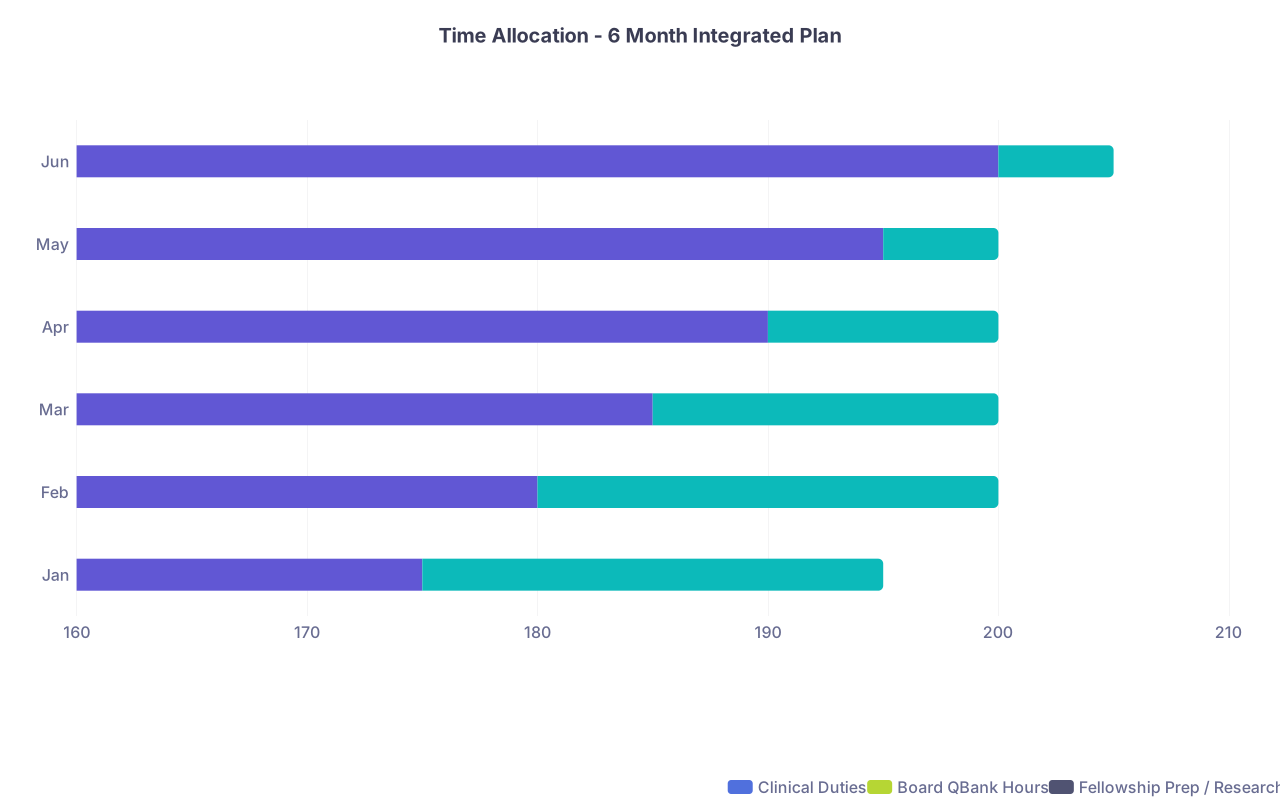
| Category | Clinical Duties | Board QBank Hours | Fellowship Prep / Research |
|---|---|---|---|
| Jan | 160 | 15 | 20 |
| Feb | 160 | 20 | 20 |
| Mar | 160 | 25 | 15 |
| Apr | 160 | 30 | 10 |
| May | 160 | 35 | 5 |
| Jun | 160 | 40 | 5 |
You can see the logic:
- Clinical duties stay basically fixed (residency is residency).
- Board prep volume rises gradually as you approach graduation.
- Fellowship-related work tapers down as the core application and major outputs are already done.
Your reality will differ in numbers. But the direction should look like this, not the reverse.
13. Last Tactical Details That Make Disproportionate Difference
A few small things I have seen repeatedly separate the “barely hanging on” from the “quietly in control” residents:
Single source of truth
- One master calendar for:
- Exam dates
- ERAS deadlines
- Interview travel
- Research submission dates
- Not scattered on sticky notes, random texts, and your memory.
- One master calendar for:
Batching “application energy”
- Do not touch your personal statement every night for 30 minutes; that is a slow bleed.
- Instead:
- Two or three 2–3 hour blocks across a couple of weeks for drafting and revisions. Then stop.
Limiting input noise
- Every co-resident will have an opinion on:
- Which QBank is “the best”
- Whether you “need” two board review courses
- How many interviews you “must” attend
- Pick your approach based on one or two trusted upper levels / attendings and then commit. Constantly changing strategy midstream is a bigger risk than picking a slightly suboptimal resource.
- Every co-resident will have an opinion on:
Sleep protection near big events
- The week before your board exam:
- Fellowship stuff is done. No interviews. Minimal research.
- The week before a cluster of high-stakes fellowship interviews:
- Slightly lighter QBank volume. Focus on review and rest so you can actually sound like yourself in front of PDs.
- The week before your board exam:
With these pieces in place, you are not juggling “board prep” over here and “fellowship applications” over there. You are running one integrated professional development project that happens to have two big outputs: a passing board score and a strong fellowship match.
Handle this season well, and you will exit residency with more than just a certification and a position. You will leave with a blueprint for how to manage complex academic and career demands for the next 30 years.
You have solved the first big integration problem. Next comes fellowship itself—learning to balance service, scholarship, and early attending-level expectations. But that is a story for another stretch of call nights.


