

The default advice that “you should go straight through to fellowship” is lazy and often wrong.
If you’re asking whether a gap year between residency and fellowship is worth it, it means you’re already seeing cracks in that one-size-fits-all narrative. Good. Let’s sort this out like an adult, not like a spreadsheet.
I’m going to walk you through when a gap year helps, when it quietly wrecks momentum, and exactly how to decide based on your situation—not your co-resident’s, not your program director’s, yours.
First, the blunt truth: programs don’t love gap years—but they don’t hate them either
Most fellowship program directors think in two simple categories:
- “Straight-through, no red flags”
- “Deviation from the standard path – explain yourself”
A gap year drops you into category 2. That’s not fatal. It just means they will absolutely ask:
Why did you take time off, and did you use it like an adult or drift like a tourist?
If your answer is coherent and productive (“I did a one-year research fellowship in interventional cardiology and got 2 manuscripts and solid letters”), you’re fine. If it’s fuzzy (“I kinda needed a break and did some locums and traveled”), now they’re wondering about motivation, discipline, and whether you’ll grind when fellowship gets miserable at 2 a.m.
Let’s anchor this with what fellowship programs actually care about.
| Priority for PDs | Effect of a Well-Planned Gap Year | Effect of a Random Gap Year |
|---|---|---|
| Commitment to specialty | Strengthens | Weakens or neutral |
| Recent clinical activity | Neutral/positive | Often negative |
| Research productivity | Strong positive | Usually none |
| Letters from known faculty | Strong positive | Often weaker |
| Maturity/professionalism | Can strengthen | Questionable |
So the real question isn’t “Is a gap year bad?” It’s:
Will a gap year make you a clearly better fellowship candidate and human… or just delay the inevitable?
The 7 situations where a gap year actually makes sense
If you don’t clearly fall into one of these buckets, you probably shouldn’t take one.
1. Your application is currently noncompetitive for your target fellowship
You want GI, cards, derm, ortho, heme/onc at a big-name place. But your file looks like this:
- Mediocre in-training exam scores
- Thin or no research in the field
- Vague letters (“hard-working resident, pleasure to work with”)
- No real niche or story
If you push your ERAS submit now, you’re basically hoping for a miracle.
In this case, a structured gap year can be decisive. I mean things like:
- One-year clinical/research fellowship (e.g., research year in advanced endoscopy, HF cardiology, transplant ID)
- Dedicated research year with a productive PI in your specialty
- Quality improvement / outcomes research role with clear deliverables and protected time
Done well, that year can give you:
(See also: How Many Fellowship Programs Should I Realistically Apply To? for guidance.)
- 2–5 abstracts, maybe a couple of publications
- A letter from a well-known name in your fellowship field
- A much sharper narrative: “I tested this field full-time and doubled down”
If you’re significantly behind competitively, a gap year is often the most rational move—if you treat it like a job, not a breather.
2. You’re burned out enough that continuing straight might break you
Not “I’m tired, residency is hard.” Everyone’s tired.
I’m talking:
- You dread coming to work every single day
- You’ve lost interest in almost everything outside of Netflix and sleep
- You’re snapping at nurses and co-residents and you barely recognize yourself
- You’re thinking, “If fellowship is worse than this, I’m not sure I’ll make it”
If that’s you, forcing yourself straight into a high-intensity fellowship can backfire. People do quit. People do crack. And then you have bigger problems than explaining a gap year.
A well-planned gap year here looks like:
- A reasonable clinical job (e.g., hospitalist or outpatient work) with:
- Predictable schedule
- No 28-hour calls
- Colleagues who are not constant chaos
- Actual recovery: therapy, sleep, exercise, seeing your family again
- Time to re-engage with why you’re doing this at all
Important nuance:
If you use this year to just grind as a hospitalist doing 20 shifts a month, you’ve swapped one treadmill for another. That’s not recovery. It’s avoidance with a paycheck.
3. You’re not actually sure you want that fellowship
Plenty of residents say they want cards/GI/crit care because:
- That’s what the stars in their program do
- They liked a rotation… once
- It sounds prestigious, and they don’t know what else they’d do
Then they get to PGY-3 and secretly wonder: “Do I really want 3 more years of training? Nights in an ICU at 40? Or do I just need a stable job?”
If you’re not at least 80% sure you want that specialty, pressing pause is often smart.
What a gap year does here:
- Lets you work as a hospitalist/hybrid and see what general practice feels like
- Gives you the headspace to attend specialty conferences, shadow in that field, or do part-time work related to it
- Forces you to notice: do you miss that field or feel relieved without it?
I’ve seen residents talk themselves into heme/onc because “I should” and end up fairly miserable, then stuck. A year to sort your head out is cheaper than a misaligned fellowship.
4. You need to move or fix your geography/life situation
You’re in New York, your partner’s locked to California. Or you have aging parents who actually need you around. A gap year can help you:
- Move to the target region
- Work clinically there
- Build relationships and get letters in that area’s programs
- Show programs: “I actually live here and I’m staying”
That matters. PDs prefer people who look like they’ll stick around and not bolt after training.
5. You want a year of heavy research to pivot specialties or go academic
Some examples where a gap year is almost standard:
- Switching direction within a broad field (e.g., gen peds → peds cardiology or peds heme/onc)
- Aiming for very academic fellowships in competitive places
- Coming from a lower-resourced residency where research was almost impossible
If you can land a real research year:
- Clear mentor
- Clear project plan
- Expectation of abstracts/papers, not just “we’ll see”
That’s high-yield. Programs love a candidate who shows they can produce scholarship in their intended field.
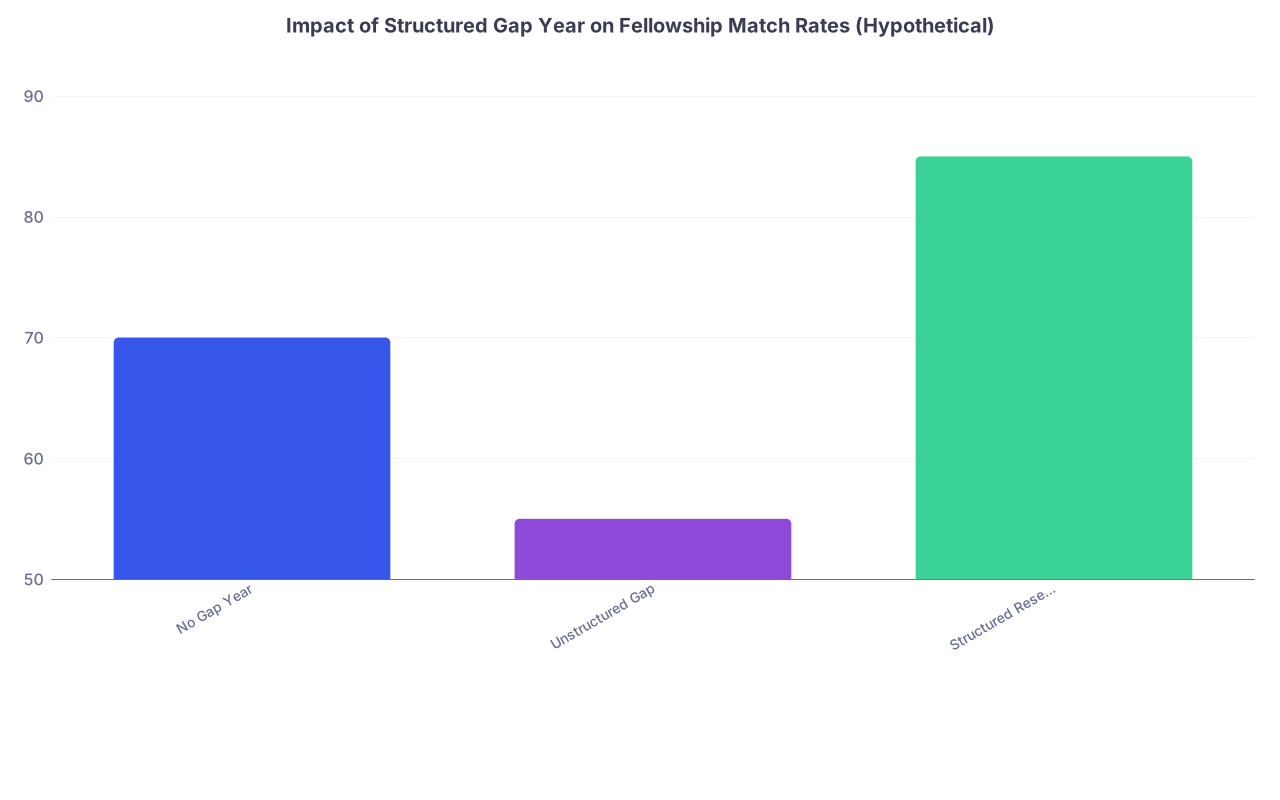
| Category | Value |
|---|---|
| No Gap Year | 70 |
| Unstructured Gap | 55 |
| Structured Research Year | 85 |
6. You need money—now—and fellowship pay won’t cut it
Sometimes it’s brutally simple:
- You’ve got six figures of high-interest debt
- You have kids or dependents to support
- Fellowship salary won’t cover what real life now costs you
Working 1–2 years as a hospitalist or nocturnist can:
- Drop your loan burden
- Let you build an emergency fund
- Take financial panic off the table
Caveat: If you do this, stay connected to your target field:
- Go to conferences
- Do some per diem in a relevant unit/clinic if possible
- Keep one or two academic mentors alive and updated
- Maybe do small QI or chart-review projects
Giant red flag: a 2–3 year gap with no meaningful tie to your fellowship specialty. That’s when PDs start thinking, “Has this person de-skilled? Are they really still interested?”
7. You had life happen: illness, family crisis, pregnancy, immigration, etc.
These are legitimate reasons:
- You got sick
- A close family member needed major care
- Maternity/paternity with a realistic desire not to start fellowship with a newborn and zero leave
- Visa/immigration constraints
Programs aren’t heartless. They just want to see:
- You’re back to full function
- You used the time as constructively as possible
- You can explain the gap cleanly without sounding defensive
Situations where a gap year is usually a bad idea
Let’s call out the bad reasons. If this sounds like you, reconsider.
“Everyone else seems to be taking a gap year, so I figured I would too.”
No. You’re not “everyone.” That’s how people wake up 3 years later regretting inertia.“I’m hoping a gap will magically make me want this fellowship.”
If you’re already lukewarm on the field, absence doesn’t always make the heart grow fonder. Sometimes it just makes you drift.“I want to travel and chill for a year.”
Great for you as a human. Terrible explanation at an interview if that’s the only thing you did. You can still travel—but wrap it in something structured and defensible.“I hate my residency program; I just need to get out.”
Leaving a bad environment can be smart. But if you don't address the underlying burnout, perfectionism, or lack of boundaries, you’ll just carry it into your next program.
How programs evaluate your gap year (what you’ll be judged on)
Think like a PD for a second. You’re looking at two files:
- Applicant A: straight-through, good scores, one paper, solid letters
- Applicant B: took a year after residency
They will ask 4 questions about B:
Is the reason for the gap reasonable and clearly explained?
Example good answer: “I took a structured one-year research position in advanced heart failure to strengthen my foundation in clinical research and confirm my commitment to cardiology. During that time, I…”
Example bad answer: “I was just exhausted and wanted time off.”Did they stay clinically sharp?
- If your gap was mostly research → did you moonlight, do per diem, or maintain some clinical exposure?
- If your gap was mostly clinical (e.g., hospitalist) → can you speak to cases and decision-making like a current, engaged physician?
Did they produce something tangible?
PDs love concrete outcomes:- Publications
- Abstracts/posters
- QI projects implemented
- Teaching roles or curriculum work
- Leadership responsibilities
Does this year clearly make them a better fellowship fit?
If the connection between what you did and the fellowship you want is obvious, that’s ideal.
A simple decision framework: Should you take a gap year?
Use this like a checklist. If you’re mostly “yes” in one column, that’s your answer.
| Question | If Mostly YES → Gap Year Helps | If Mostly NO → Go Straight |
|---|---|---|
| Is your current app clearly weak for your target field? | Yes | No |
| Are you near real burnout, not just tired? | Yes | No |
| Are you unsure you even want this fellowship? | Yes | No |
| Do you have a specific, structured plan for the year? | Yes | No |
| Will you maintain some tie to your target specialty? | Yes | No |
If your “structured plan” is vague, stop. Don’t submit your resignation letter yet.
How to structure a high-yield gap year (so it helps, not hurts)
Let me be concrete. A strong gap year usually has these elements:
Clear primary role
- 0.8–1.0 FTE research with defined projects
- Or 0.6–1.0 FTE clinical work in a reasonable job
Anchor mentor or supervisor
Someone whose name and letter will matter for your fellowship field. You should literally be able to say: “I’m planning X, Y, Z with Dr. Smith in advanced pulmonary hypertension.”Deliverables and timeline
Not “I’ll see what comes up,” but:- “We’re aiming for 2 abstracts at ATS and a manuscript submission by March.”
- “I’m taking a lead role in a sepsis QI project with defined metrics.”
Ongoing engagement with your desired fellowship specialty
- Attend one major society meeting (e.g., ACC, ACG, ASCO)
- Go to grand rounds or case conferences
- Shadow or do some shifts in that specialty environment if possible
Personal life/mental health plan
You don’t need a manifesto. But know how you’re going to:- Sleep like a normal human again
- Move your body
- See the people you care about
- Maybe talk to a therapist if residency wrecked you
Common fears residents have about gap years (and what’s real vs noise)
“I’ll forget everything if I don’t go straight through.”
If you do zero clinical work for a year, you’ll be rusty. But most gap years aren’t like that. A few clinic sessions a week or some hospitalist shifts keep you sharp enough. Fellowship will re-teach a lot anyway.
“Programs will think I’m weak or not committed.”
They’ll think that if your story is weak or your year is useless. If your gap clearly advanced your skills, research, or personal stability, many PDs quietly respect that more than the resident who white-knuckled it straight through and looks half-broken.
“I’ll lose momentum and never go back.”
That depends entirely on you. Some people taste a full attending paycheck and never come back. Others feel the pull of their dream field grow stronger with time. If you’re genuinely ambivalent, that’s not a gap-year problem—that’s you not actually wanting more training.
How to explain your gap year in applications and interviews
You need a tight, boringly clear script. Something like:
Reason
“I took a dedicated year after residency to focus on [research in X / clinical experience in Y / family responsibilities].”What you did
“During that time, I [worked as a hospitalist at Z / completed a research fellowship with Dr. X] and was involved in [A, B, C].”Outcome
“From this, I gained [stronger research foundation in X / more confidence managing complex patients / clarity that I want to pursue Z fellowship].”Tie back to fellowship
“This experience confirmed my commitment to [fellowship field] and prepared me to contribute meaningfully from day one.”
Keep it under 90 seconds. Say it until you don’t sound defensive.
Quick reality check: what your future self actually cares about
Two, five, ten years from now, almost nobody will care if you did fellowship the very next July or a year later. What will matter:
- Are you in a specialty you actually like?
- Are you burned out beyond repair or functional?
- Do you have the skills and CV you need for the job you want (academic, private, hybrid)?
- Can you look back and say, “That decision made me better,” not just “That decision was faster”?
If a gap year clearly moves you closer to those answers being yes, it’s probably worth it. If it’s just delaying a choice you’re scared to make, it’s not.

| Step | Description |
|---|---|
| Step 1 | PGY 2-3 Resident |
| Step 2 | Consider gap year to explore or work |
| Step 3 | Apply straight through |
| Step 4 | Structured gap year for research or experience |
| Step 5 | Plan gap year with mentor and goals |
| Step 6 | Delay gap year idea and clarify plan |
| Step 7 | Know I want fellowship now |
| Step 8 | Application competitive for target field |
| Step 9 | Have structured plan |
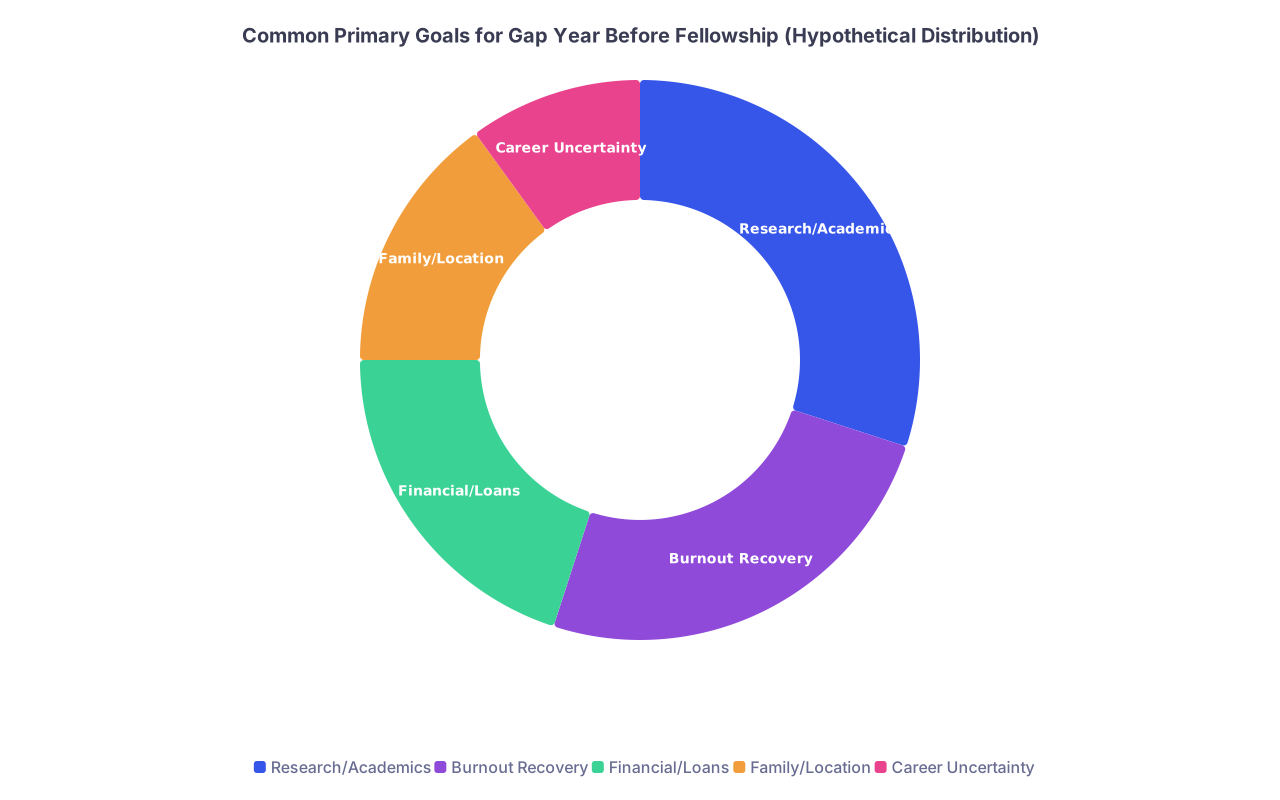
| Category | Value |
|---|---|
| Research/Academics | 30 |
| Burnout Recovery | 25 |
| Financial/Loans | 20 |
| Family/Location | 15 |
| Career Uncertainty | 10 |
Bottom line: Is a gap year between residency and fellowship worth it for you?
Here’s the distilled version:
- A gap year helps if it’s structured, productive, and directly improves either your competitiveness or your sanity in a way you can clearly explain.
- It’s usually a bad idea if it’s vague, purely about escape, or you plan to do nothing relevant to your future fellowship.
- The only answer that matters is the one that aligns with your actual competitiveness, your mental health, and your long-term career goals—not with what your co-residents are doing.


