

The blunt truth: You almost never gain anything by volunteering that you’re also applying in a different subspecialty.
Let me explain why, when you might be the rare exception, and exactly what to say when someone asks you directly.
The Core Answer: No, Don’t Volunteer It
If you’re asking, “Should I tell cardiology programs I’m also applying to pulm/crit?” the default answer is: no. Do not bring it up.
Fellowship programs want to believe you are:
- Genuinely committed to their field
- Likely to match and actually show up
- Not treating them as the consolation prize
The moment you say, “I’m also applying to another subspecialty,” what programs hear is:
- “You are my backup.”
- “My career goals are fuzzy.”
- “I might rank someone else higher even if you rank me to match.”
That’s not always fair. Many residents have legitimate dual interests. But selection committees aren’t running a philosophy seminar; they’re running a risk calculation.
So as a baseline:
- Don’t put this in your personal statement.
- Don’t mention it in your ERAS application.
- Don’t send “transparent” emails confessing your parallel application strategy.
Programs don’t need or expect you to disclose everything about your rank list strategy or parallel plans. They assume some of you are hedging. They just don’t want to be reminded.
When You Actually Might Tell Them (Rare Cases)
There are a few specific situations where disclosing dual applications can make sense. These are the exceptions, not the norm.
1. Combined or Closely Related Fields with a Coherent Story
Example: You’re applying to Pulmonary/Critical Care and also to standalone Critical Care programs. Or Heme/Onc and a small number of Bone Marrow Transplant/Cell Therapy advanced fellowships.
Here, the message isn’t “I want a different field.” It’s “I’m committed to this overarching area of medicine, and I’m exploring different structural pathways within it.”
You can frame it like this, if it comes up organically:
“My long-term goal is to build a career in critical care with a strong focus on X. I’m applying both to Pulm/CCM and standalone CCM programs because I’m open to different structural paths as long as I end up in a role doing Y and Z.”
The key: One clear, consistent end-goal that both pathways logically serve.
2. You Have a Significant Geographic or Family Constraint
This is delicate. Sometimes a dual-application strategy is driven by location, not lack of interest.
Example: Partner’s job is locked to Chicago, or you’re co-parenting and legally tied to a region. You’re applying to nephrology and hospitalist-focused fellowships or a different IM subspecialty, but only in one metro area.
In rare cases, with programs in that same city that you’re genuinely very interested in, a tightly framed explanation can make sense:
“I’m applying only within this metro area because of a non-negotiable family constraint. Within that, I’m primarily focused on [Subspecialty A], but I’ve also applied to a small number of [Subspecialty B] programs here. My long-term goal is to build a career in [X] in this region. If I train here in [A], I’d be looking to do [specific career plan].”
Even then, I’d still avoid leading with this. Only volunteer this if:
- You already have strong engagement with the program (home institution, away rotation, mentor connection), and
- You’re giving a clear message that: “If I match here in your subspecialty, I will be happy and committed.”
3. You’re Asked Directly and Can’t Honestly Dodge It
Some PDs will ask bluntly during interviews:
- “Are you applying elsewhere?”
- “Are you applying to other subspecialties?”
- “What other types of programs did you apply to?”
You should not lie. That will come back to bite you.
But you also do not have to give a full, point-by-point breakdown of your ERAS token history.
The play here is: answer briefly, pivot fast, and anchor hard in their field and their program.
Example script:
“I applied mostly to [Subspecialty A] programs, since that’s where I see myself long term. I did apply to a small number of [Subspecialty B] programs as well, mainly because of [geographic/family/logistic reason]. That said, if I match in [A], that’s exactly the kind of career I’m excited about, especially at a place like this where [specific program feature].”
Short. Direct. No agonizing over details.
Why Programs Dislike Hearing About Multiple Subspecialties
You need to understand their side of the table.
Fellowships are small. A typical class is 2–8 fellows. One bad fit, or one person who doesn’t show, seriously hurts coverage and morale.
When they rank applicants, they’re juggling:
- Board pass rate
- Clinical workload coverage
- Research output
- “Will this person stay in the field?”
- “Are we their first choice, or are they going to bail for another subspecialty?”
If they sense that you’re hedging between specialties, they sometimes downgrade you in their minds from:
- “Future leader in our field” → “Someone drifting between options.”
Is that always rational? No. But it happens. I’ve heard it verbatim in rank meetings:
“He’s also applying to GI; I’m not convinced he’s really committed to cards.”
“Her PS reads like a generic IM subspecialty statement – is she just shotgun applying?”
Which brings me to the next point.
How Dual Applications Quietly Show Up (Without You Saying a Word)
You can say nothing about your second subspecialty and still give yourself away. Here’s how people accidentally do that.
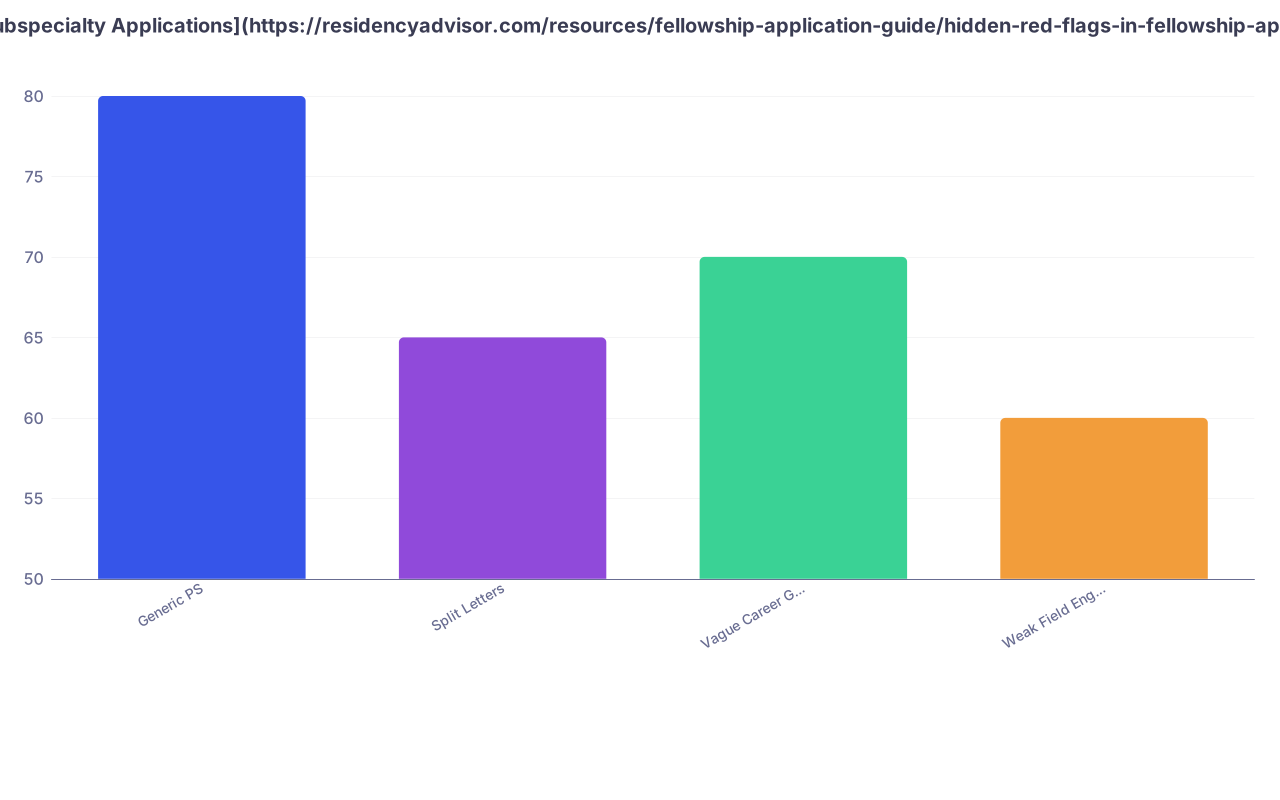
| Category | Value |
|---|---|
| Generic PS | 80 |
| Split Letters | 65 |
| Vague Career Goals | 70 |
| Weak Field Engagement | 60 |
Four classic “you’re probably applying elsewhere” flags:
Generic personal statement
If your statement works equally well for GI, cards, endo, and nephrology, it usually satisfies no one. Programs read hundreds. They can spot template language instantly:- “I enjoy forming long-term relationships with patients…”
- “I like both inpatient and outpatient medicine…”
- “I’m drawn to the intellectual challenge of complex cases…”
None of that says “I must do rheumatology.”
Letters that don’t strongly tie to one field
Three letters from general IM attendings, none from the subspecialty you’re applying to? That screams “I didn’t really commit to this field until late” or “I’m keeping my options open.”Vague, non-field-specific future plans
“I see myself in academic medicine, teaching residents and doing some research” is so generic it’s meaningless. Compare that to:- “I want to focus on inherited cardiomyopathies and develop a niche in genetic counseling integration.”
- “I’m aiming for an academic pulmonary/CCM role with a focus on post-ICU outcomes and QI in respiratory failure.”
No visible engagement in the field
No research, no electives, no QI, no case series, nothing that clearly says, “I’ve tried this and want more of it.”
So even if you never say the words “I’m also applying to X,” your application can still read as non-committal. Fix that first before you worry about what to disclose.
What To Do If You’re Actually Torn Between Two Fields
Let’s be honest: some of you truly are 50/50. Cards vs GI. Heme/Onc vs Rheum. Pulm/CCM vs Nephro. You’re not pretending.
Here’s how to handle that situation in a way that doesn’t sabotage you.
Step 1: Choose One Field to “Lead With” Publicly
You can be personally conflicted and still professionally coherent.
Pick one subspecialty that you will:
- Write a fully committed personal statement for
- Prioritize for research / letters / mentorship framing
- Talk about as your primary long-term direction when asked
This doesn’t mean you can’t apply to the other. It means your story isn’t “I’m lost,” it’s “I’m leaning strongly toward A, but I recognize B as a viable path too.”

| Step | Description |
|---|---|
| Step 1 | Interest in two subspecialties |
| Step 2 | Align PS, letters, story with primary field |
| Step 3 | Schedule more electives and mentorship |
| Step 4 | Reassess after exposure |
| Step 5 | Apply primarily to chosen field |
| Step 6 | Optionally apply to small number of second field |
| Step 7 | Can you pick a primary? |
Step 2: Build a Field-Specific Application for Each
If you truly must submit to two entirely separate subspecialties, do it properly:
- Separate personal statement tailored to each field
- Letters of recommendation that clearly support each field (at least 1–2 in-field letters per subspecialty)
- CV that doesn’t make one field look like a complete afterthought
No one in cards needs to see your GI-focused PS. No one in GI needs to see your cards-centric narrative.
Step 3: Prepare a Clean Verbal Explanation
Programs may never ask. But if they do, you want a ready 2–3 sentence explanation that:
- Acknowledges the dual application
- Emphasizes one subspecialty as your primary direction
- Reinforces your enthusiasm for their field and their program
Example:
“I’ve always been drawn primarily to [Your field], especially because of [specific clinical or research reason]. I did apply to a few [other field] programs given my interest in [some overlapping interest or local factor], but the roles I picture myself in long term—both clinically and academically—align most strongly with [their field], which is why I’m excited about programs like yours.”
Then stop talking. Don’t over-explain.
How Program Directors Actually Find Out
Two ways programs typically discover dual subspecialty applications:
Word of mouth among faculty
Attendings talk. If you’re telling cards you’re “100% cards” and GI you’re “100% GI,” and those divisions share hallways and committee meetings, that can get awkward.You telling different stories in different settings
Saying “I’m academic focused” in one interview and “I want a lifestyle private practice job” in another. If those narratives reach the same ears, you look inconsistent at best, dishonest at worst.
So keep your core story stable:
- Same core long-term values across interviews
- Same general geographic constraints
- Same broad academic vs clinical lean
You can adjust emphasis, but your career story should not radically flip depending on the room you’re in.
Quick Comparison: Telling vs Not Telling
| Strategy | Potential Benefit | Main Risk |
|---|---|---|
| Do not volunteer, only if asked | Maintains focus, avoids doubt | Need to be ready with an honest brief answer |
| Openly volunteer to all | Feels transparent to you | Seen as lack of commitment, lower ranking |
| Selective disclosure (rare) | Can clarify constraints in special cases | Confusion if story is inconsistent |
How To Answer The Direct Question Without Tanking Yourself
You will probably get this question at least once:
“Are you applying in any other specialties or subspecialties?”
Use a 3-part answer:
- Clear, brief acknowledgment
- Reaffirm primary commitment to their field
- Tie back to their specific program
Example:
“I did apply to a small number of [other subspecialty] programs as well. That said, my primary focus is [their subspecialty], especially because of [field-specific interest]. What drew me to your program in particular is [program-specific feature], and if I match here, this is exactly the type of training and career path I want.”
That’s it. No percentages. No breakdown of how many applications. No monologue on your existential crisis.
FAQs: Dual Subspecialty Fellowship Applications
1. Is it unethical not to tell programs I’m applying in another subspecialty?
No. You are not obligated to volunteer your entire application strategy. You must not lie when asked directly, but you do not have to pre-emptively confess to parallel applications. Programs assume many residents hedge; they just want you to present a coherent, committed story to them.
2. Will my home institution fellowship know if I applied to another subspecialty?
Often, yes—at least informally. Faculty talk, especially in smaller departments. If you’re dual-applying at your home institution (e.g., both cards and GI), keep your messaging consistent and respectful in both directions. Avoid telling each division they’re your “absolute one and only dream” if that’s not true.
3. Can I use the same personal statement for two subspecialties?
You can. But you shouldn’t. A generic PS that vaguely fits multiple fields usually reads weak in all of them. Write a separate, truly tailored statement for each subspecialty you care enough about to apply to. If you are too busy to do that, you are spreading yourself too thin.
4. How many subspecialties is “too many” to apply to?
If you’re seriously applying to more than two distinct subspecialties, you don’t have a specialty problem—you have a career-clarity problem. One primary subspecialty with a small secondary option is about the upper limit I’d recommend. Beyond that, committees can tell you’re not truly sure what you want, and your application usually reflects that ambiguity.
5. What if my letters of recommendation are stronger in the “other” field?
Then you have a mismatch you should fix. If your best letters are in cards but you think you want GI, get at least one or two strong letters from GI faculty, even if they’re more recent. Programs in any field want at least one person in their discipline vouching for you as a good fit for that specialty’s work and culture.
6. How do I handle it if my mentor in one field knows I’m applying to another?
Be adult about it and be honest. For example: “I’ve really appreciated your mentorship in [field A]. Over the last year I’ve also developed a strong interest in [field B] for [reasons]. I’m applying in both this cycle while I sort out what fits me best long term. I didn’t want you to be blindsided.” Most attendings respect that, especially if you’re not burning bridges or dismissing their field.
Bottom line:
- Don’t volunteer that you’re applying in a different subspecialty; it rarely helps and often hurts.
- If asked directly, answer briefly and honestly, then firmly re-anchor in their field and their program.
- Whatever you do, build a coherent, field-specific application for each subspecialty and keep your core career story consistent.


