

It’s 10:47 p.m. You just signed out, you’re microwaving whatever passes for dinner, and you open that email about upcoming fellowship info sessions. And it hits you. Everyone is talking about “casting a wide net” and “being geographically flexible” and you’re sitting there thinking:
“I actually can’t move. Not ‘don’t want to.’ Can’t.”
Because your partner’s job is here.
Or your kid’s school and therapies are here.
Or your parent is sick and you’re the only one nearby.
And now your brain is spiraling:
What if needing to stay in one city for fellowship ruins everything?
What if this is the thing that quietly kills my career before it really starts?
Let’s walk through this like someone who’s actually lived in this system and watched a lot of people try to do exactly what you’re thinking about.
First: Are You Actually “Stuck,” Or Is Your Brain Making It Absolute?
Let me be direct: programs hate hearing “I must be in City X” unless there’s a very good reason and you handle it well. But that doesn’t mean you’re doomed. It just means you have to be strategic instead of magical-thinking your way through it.
There are roughly three levels of geographic constraint I see:
| Level | Situation | Flexibility |
|---|---|---|
| Soft | Prefer a region or city | High |
| Medium | Strong reason but could stretch radius | Moderate |
| Hard | Must stay in one metro area | Low |
You’re worried about that “Hard” category. The “if I don’t match here, I literally can’t move” level.
And this is where your brain goes to the darkest place: What if there’s only one relevant fellowship in my city and they don’t pick me? Then what? I wasted all this time and training and I’m stuck as a hospitalist forever.
I’ve seen people in that spot. Some matched. Some didn’t. Some re-applied and then matched. Some changed paths and are actually surprisingly okay now. But the common thread: the ones who didn’t fall apart had a realistic Plan A, Plan B, and sometimes Plan C.
You need that too. Not because you’ll definitely fail. But because relying on a single outcome with zero backup is what keeps you up at night.
How Programs Actually Think About “Geography-Tied” Applicants
Imagine you’re the PD at the only heme/onc fellowship in your city. You’ve got 400 apps for 3 spots. You get an email:
“Dear Dr. X, My entire family is in [City]. I must stay here for fellowship because of [family issue]. This is my top and only choice.”
Here’s what the PD’s brain does:
- “Okay, at least I know they’ll rank us.”
- “If they don’t match, they will be crushed.”
- “If I can’t rank them high because their app isn’t strong enough, they’re depending on something I can’t promise.”
Programs are not emotional support systems. They are trying to staff a service and train specialists. Your personal crisis is real, but to them it’s one data point: “will this person actually come here and complete this program?” They prefer people who genuinely want to be there, not just “I’m trapped in this city.”
So your job is to translate “I need to stay” into something they see as:
- Commitment to the program/region
- Stability (less likely to leave)
- Long-term investment in local patients and systems
Not desperation.
That’s a hard line to walk when you are desperate. But it’s doable.
Reality Check: How Bad Is It if You’re Stuck in One City?
Let’s attack the nightmare questions directly.
“Am I screwed if there’s only one fellowship in my city?”
Short answer: not automatically. But the margin for error shrinks.
You need to look at your city with brutal honesty:
- Does your city even have your fellowship specialty?
- Is there more than one program (university + community, etc.)?
- How competitive is that specialty and that specific program?
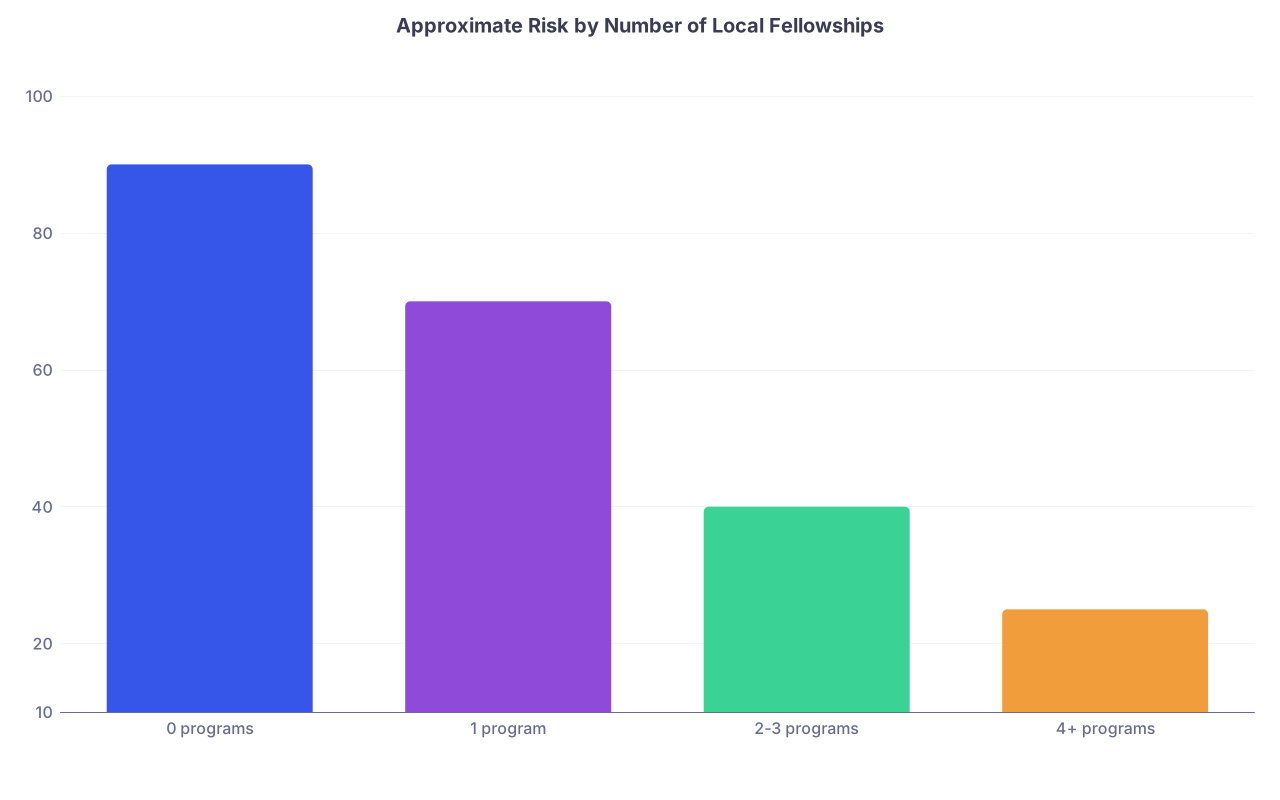
| Category | Value |
|---|---|
| 0 programs | 90 |
| 1 program | 70 |
| 2-3 programs | 40 |
| 4+ programs | 25 |
Those numbers aren’t exact data; they’re vibe-level relative risk. Zero local programs? Then the issue isn’t “staying in one city,” it’s “this plan is impossible as written.”
If there’s only one program:
- You need to be very honest about your competitiveness.
- You need to be plugged into that program now, not a month before ERAS opens.
- You need real mentors who know the PDs or faculty there.
If there are 2–3 programs in your metro area, your risk is lower, but it’s still not “relax, you’re fine” territory. It’s “you really have to not screw up and you still need backups.”
“What if my app is just… average?”
Then you’re in the danger zone if you’re locked to one city.
Average application + narrow geography = high volatility.
But here’s the nuance people don’t tell you: “average” is not the end of the story.
You can:
- Become known locally (rotations, conferences, QI, moonlighting, networking)
- Improve your CV: a couple of submitted papers, posters, leadership roles
- Time your application strategically (PGY-3 vs PGY-4 or later, depending on specialty)
I’ve watched a resident with totally middle-of-the-road stats match GI at the only program in town because he basically became “one of them” during residency. On their wards. On their research projects. Presenting at their M&M.
He didn’t magically “become elite.” He became familiar.
How to Talk About Family Constraints Without Sounding Like a Walking Red Flag
You’re terrified of two things:
- If you say nothing, they’ll assume you’re mobile and then wonder why you’re not applying widely.
- If you say too much, you’ll sound like a liability.
So how do you phrase it?
You don’t lead with “I can’t leave.” You lead with:
- Why this city
- Why this institution
- Why this program’s training fits your goals
Then you briefly anchor it in your life reality.
Something like:
“My long-term goal is to practice in [City] serving [X patient population]. My partner and our extended family are established here, and I anticipate building my career in this region. That makes [Program] particularly appealing, both for its strong [X feature] and its track record of training physicians who stay in the community.”
Notice what you’re not doing:
- You’re not trauma-dumping your parent’s full medical history.
- You’re not saying “I must match here or my life falls apart.”
- You’re not framing it as a demand.
You’re framing it as alignment. People who stay local = people who are more likely to join faculty or local groups = that actually helps the program long-term.
The super-specific, very personal stuff? That’s for one-on-one conversations with mentors who can quietly say to the PD, “Hey, this person really needs to stay in [City] because of family reasons. They’re serious about being here long-term.”
You want that said for you, not by you, ideally.
Building a Local Strategy: Not Just “Apply and Pray”
If you truly need to stay in one city, you don’t have the luxury of passivity. You can’t be the resident who just floats through three years, then suddenly remembers fellowship is a thing.
You need to treat your city like your only job market, starting now.

| Step | Description |
|---|---|
| Step 1 | Now |
| Step 2 | Identify local programs |
| Step 3 | Find mentors tied to those programs |
| Step 4 | Get involved in local projects |
| Step 5 | Signal geographic commitment in app |
| Step 6 | Apply and interview |
| Step 7 | Start fellowship local |
| Step 8 | Reassess - gap year, reapply, alternate path |
| Step 9 | Matched? |
Concrete moves:
Get a mentor who actually knows the local fellowship faculty.
Not just “is in the specialty.” I mean someone who’s been on their selection committee, or who texts the PD, or sends them trainees.
Ask them bluntly:
- “If I need to stay in this city, how realistic is fellowship X for me?”
- “What gaps do you see that would make them hesitate?”
- “Who do I need to work with or get in front of this year?”
Then act. Like yesterday.
Maybe that means:
- Doing a research or QI project with their faculty
- Showing up to their conferences, tumor boards, journal clubs
- Asking to rotate with them as an elective and actually being excellent, not just present
Your goal: by the time they see your application, they’re not asking “Who’s this?” They’re saying “Oh yeah, that’s the resident who did the [X] project with Dr. Y.”
This is how people with geographic constraints quietly de-risk the whole situation.
Worst-Case Scenario: You Don’t Match in Your City
You’ve probably already jumped there in your mind:
“I apply only here. I don’t match. Then what? I’m stuck. I failed. Everyone passes me by.”
This is the scenario that keeps people frozen, so let’s drag it into the light.
If you don’t match in your city and you truly can’t move:
You are not automatically locked out of that fellowship forever.
People:
- Do a year or two as a hospitalist / nocturnist / chief
- Build up research or niche expertise locally
- Reapply with a stronger application
- Match the second time
Does it suck? Yes. It’s emotionally awful. It feels like public failure. You’ll compare yourself to your co-residents who “got out.” But career-wise, it’s not necessarily terminal.
You might also end up pivoting:
- Different, less competitive fellowship that does exist locally
- Clinician-educator path
- Administrative / QI focus
- High-acuity hospitalist role that gives you a lot of what you wanted clinically
Is that what you dreamed of as a naïve MS2? Probably not. Is it “failure”? No. It’s just the version of your career that exists with your real-life constraints.
That’s the uncomfortable truth: you don’t get to pick “unlimited personal life flexibility” and “unlimited career options.” Nobody does. Not really. You pay for every boundary you draw somewhere.
But that doesn’t mean your life is over if you don’t match the exact fellowship in the exact city on the exact timeline.
Some Hard Truths You Probably Don’t Want to Hear (But Need To)
You’re not going to like all of this, but I’m going to say it anyway.
- If your family situation is truly non-negotiable, you have to let go of some fellowship/specialty fantasies that simply don’t exist in your city.
- You can’t have a “must stay here” constraint and a “I’ll only take top-10 type programs” ego. Pick one.
- You can’t coast. Needing to stay local means you have to be annoying-early with planning compared to your co-residents.
- You can’t hide this from mentors until ERAS season and then expect them to fix it. You tell them now. Even if your voice shakes.
Because here’s the bigger truth: the system doesn’t care about your family. Not really. Individual humans within it might. But the machine doesn’t.
So you have to be the one who cares enough to build a path that works for your actual life, not the imaginary “if I were single with no responsibilities” version of you.
A Quick Reality Reframe
Needing to stay in one city for family doesn’t make you weak or less ambitious. It makes you a person with attachments. Which, uncomfortable as it feels right now, is probably more important than your CV in the long run.
I’ve seen attendings in “dream” coastal fellowships with no support system completely burn out. I’ve seen people who stayed near family for a totally unglamorous job be much more stable and, frankly, happier.
Here’s the mental shift:
Instead of viewing your family tie as the tragic barrier to your “real” life, treat it as one of your major constraints—and then optimize inside that box as hard as you can.
Not: “What could I do if I had no constraints?”
But: “Given that I must be here, what is the best, most satisfying version of my career I can realistically build?”
That’s grown-up medicine. Messy, compromised, but honest.
FAQ (Exactly 5 Questions)
1. Should I flat-out tell programs, “I can’t leave this city because of family”?
Not like that. Don’t make it sound like a demand or a plea. In your written materials, frame it as long-term commitment to the region and desire to serve that community. Save the sensitive details (sick parent, custody issues, etc.) for trusted mentors who can advocate quietly. Programs don’t want to feel emotionally blackmailed into ranking you.
2. Will programs judge me for prioritizing family over “going anywhere for training”?
Some people will quietly think you’re less “hardcore” than the applicant who moved across the country three times. Fine. Those are probably not your people anyway. Plenty of faculty respect trainees who make deliberate, family-centered choices. Your job is not to impress the most extreme “medicine is everything” person in the room—it’s to build a sustainable life.
3. What if my partner says they can move later, but I don’t fully believe it?
Then you need to have a brutally honest conversation before you plan your entire career on a hypothetical relocation. I’ve watched couples blow up over exactly this. Don’t base your fellowship strategy on “maybe they’ll come around.” Decide what constraints are actually real today and plan around those, not around fantasy compromises that might never happen.
4. Is it better to delay applying a year so I can strengthen my application locally?
Sometimes, yes. If your current app is clearly weak for a single competitive local program, an extra year as a hospitalist or chief, doing research or heavy involvement with that division, can significantly improve your chances. But don’t just “take a gap year.” Take a purposeful year with explicit goals laid out with a mentor who knows that program’s expectations.
5. If I stay in my city for fellowship, will I be stuck here forever career-wise?
Not necessarily. Plenty of people do fellowship where they have family support, then move later if life shifts. But here’s the twist: a lot of them discover they like being rooted and end up staying by choice. Training locally can actually open more doors in that city (local groups, faculty positions) than going elsewhere. You’re limiting geography, not your entire future.
Open the notes app on your phone right now and write down three things:
- The exact city or metro area you’d be willing to commit to.
- The name of at least one local fellowship program you’d realistically target.
- The name of one attending you can email this week to talk honestly about your situation.
Then send that email before you talk yourself out of it.


