

What if the smartest move for your career is to skip this fellowship cycle entirely?
Let me be blunt: not applying this year doesn’t mean you failed. It can mean you actually understand the game you’re playing.
Most residents apply for fellowship on autopilot because “that’s what people do.” PGY‑2/PGY‑3 hits, everyone’s talking ERAS, letters, research, and you feel like if you don’t jump in now, you’ll be left behind forever.
You won’t. But there are situations where applying this cycle is a bad idea. A waste of money, time, and emotional bandwidth—and sometimes a hit to your long‑term odds.
Here’s when you should seriously consider not applying this cycle.
1. Your Application Just Isn’t Ready (And Won’t Be In Time)
I don’t mean “I wish I had one more paper.” Everyone wishes that. I’m talking about structural weaknesses that are unlikely to improve before programs see your file.
Red flags that say “wait a cycle”
- Weak clinical performance or shaky evaluations
If:
- Your in‑service exam scores are consistently low
- You’ve had remediation, probation, or professionalism concerns
- You’re getting “meets expectations” but not “standout” comments
…you’re not competitive yet. Fellowship PDs talk. They read between the lines in letters. They look at trends.
If your PD can’t write a strong, confident letter this year, pressing pause and spending another year building trust and performance is smarter than forcing an early, lukewarm application.
- Major gaps in your CV for your target specialty
For competitive subspecialties (cards, GI, heme/onc, PCCM, advanced endoscopy, MFM, etc.), the unwritten expectation is:
- Real exposure to the field
- At least some scholarly work (case reports, QI, retrospective projects)
- Clear longitudinal interest
If your CV in July looks like:
- One loosely related poster from intern year
- No subspecialty electives in your field
- No local mentor who knows you well
You’re walking into a fight with no armor. Could you match somewhere? Maybe. But you’re making this much harder than it needs to be.
- Step/COMLEX and training record that need reframing
If you:
- Barely passed Step/COMLEX on second attempt
- Transferred programs
- Have a leave of absence without a coherent story
Programs will ask: “What happened and what changed?” If you don’t have:
- Solid recent performance
- Strong letters vouching for growth
- A clear, credible narrative
…then you’re not ready to sell your story yet. Take the time to create new data points (strong rotations, leadership, teaching, research) that prove the old data is outdated.
2. Your Letters and Mentorship Are Not There
You cannot DIY your way through fellowship applications. You need people with names and reputations standing behind you.
When your letter situation says “hit pause”
You should think hard about skipping this cycle if:
- Your only potential letters are generic “worked hard, showed up” from random attendings
- You don’t have at least one letter from a respected subspecialist in your target field
- Your PD barely knows you or is neutral on you
- You switched interest late (e.g., GI to cards) and have no depth in the “new” field
I’ve seen residents throw in an application with:
- 1 generic PD letter
- 2 random inpatient attending letters
- 0 subspecialty mentors
They get a couple low‑tier interviews, no match, burned money, and now carry a “did not match” label into the next cycle. That’s fixable, but it’s unnecessary if you could’ve taken a year to build:
- One real mentor who knows you
- A small project with your name on it
- Strong rotation performance in that subspecialty
If you can’t identify right now:
- Who’s writing your PD letter
- Which 2 subspecialists will write strong letters
- Who will pick up the phone for you
…you’re not ready.
3. Your Personal Life Is On Fire (Or Close)
Here’s the part people gloss over but matters more than you think.
If you’re:
- Going through a divorce or major relationship crisis
- Dealing with a serious family illness or caregiving responsibility
- Managing your own significant health or mental health issue
- Burned out to the point of barely functioning
You’re not in a good position to:
- Write compelling essays
- Prep thoroughly for interviews
- Travel and perform well on Zoom or in person
- Make clear-headed decisions about where to train for 1–3 more years
Fellowship isn’t an escape hatch from a miserable residency or life. It’s an escalation—more responsibility, more stress, higher expectations.
If your foundation is crumbling, you’re better off:
- Stabilizing your life
- Getting therapy or medical care if you need it
- Rebuilding your energy and focus
Then applying from a place of strength next year.
4. You Don’t Actually Know If You Want This Subspecialty
Huge one. Under-discussed.
Ask yourself, brutally:
- Have you actually liked the real‑world work of this field? Not the idea of it. The daily grind.
- Have you done more than one elective or rotation in it?
- Have you talked to mid‑career attendings about what their lives really look like—call, clinic volume, job market, burnout rates, pay?
- Could you see yourself in this field 10–15 years from now, not just 2–3 years of fellowship?
If your honest answers are:
- “I like the prestige”
- “My program pushes everyone to subspecialize”
- “Everyone in my class is doing fellowship”
- “It seems safer than being a generalist”
That’s not enough.
Going straight through because you’re scared to stop is how people end up:
- In a fellowship they hate
- Trapped in an oversaturated market
- Burned out at 40 with no good exit options
If you’re still genuinely unsure between, say, hospitalist vs. cards vs. heme/onc, you should not be hitting “submit” on a fellowship app. Use a year:
- As a hospitalist or generalist
- To moonlight in different settings
- To get real exposure and clarity
You’ll write a much stronger, more authentic application later.
5. Your Specialty Is Brutally Competitive… And Your File Isn’t
Let’s be real. Some fields are cutthroat right now.
Think:
- Gastroenterology
- Cardiology
- Hematology/Oncology
- PCCM at top places
- Some surgical subspecialties
- Derm/Allergy/Rheum in certain regions
If you’re aiming high in these fields and your file is:
- Middle‑of‑the‑pack in‑service scores
- No first‑author anything, maybe a mid‑tier poster
- No strong letters from known names
- Training at a smaller or less-known community program
You can certainly apply. But you’re playing on hard mode.
Sometimes the smartest play is:
- Take a chief year or hospitalist year
- Crank out 1–2 solid projects
- Get on PD’s good side
- Get more subspecialty time and better letters
Then apply with a real shot, not a hail Mary.
| Situation | Wait vs Apply This Year |
|---|---|
| Unclear subspecialty interest | Strongly favor waiting |
| No subspecialty mentor or letters | Usually wait |
| Major life crisis or burnout | Usually wait |
| Slightly below-average metrics only | Consider applying |
| Competitive field + weak research | Often better to wait |
6. You Need a Gap Year for Money, Visa, or Life Logistics
This is not talked about enough on rounds but it drives real decisions.
You might choose not to apply this cycle because you need:
- Money and breathing room
If your loans are massive, your savings are zero, and you’re barely staying afloat, a year or two as:
- A hospitalist
- Nocturnist
- Urgent care or community attending
…can radically change your financial life. That changes how you feel about fellowship. And whether you even still want it.
- Time to fix visa or immigration issues
If you’re on a J‑1 or H‑1B and your situation is complicated, sometimes:
- A waiver job
- A year or two of attending work
- A different employer strategy
…makes more sense than rolling directly into fellowship and limiting your options. Skipping one cycle can open way more doors later.
- Geographic or family constraints
If:
- Your partner needs to finish training somewhere specific
- You have kids you don’t want to move twice in two years
- You’re tied to a small region with very few fellowship spots
You might be much better off:
- Working locally for a year
- Building local connections
- Then applying from a place of stability with a story that makes sense
7. You’re Only Applying Because You’re Scared
This is the most common bad reason to apply.
Signs this is you:
- You say “I just don’t feel ready to be an attending” more than you say “I’m excited about this field”
- You’re terrified of exams ending and “real” responsibility starting
- The idea of generalist work feels scary, not explored
- You haven’t seriously looked at hospitalist or primary care jobs; you’ve just assumed they’re “less than”
Let me be clear: being scared to finish training is normal. But spending 3 more years in a field you’re lukewarm on just to avoid that fear is not a great solution.
Sometimes the right move is:
- Get a job as a hospitalist or generalist
- Learn what real attending life looks like
- See what you like and what you hate
- If fellowship still makes sense, apply from experience instead of fear
8. Signs You Should Apply This Cycle (Even If You’re Nervous)
Quick reality check. Delaying can be wise, but procrastination dressed up as “strategy” is still procrastination.
You probably should apply this cycle if:
- You have at least one strong subspecialty mentor and letter
- Your PD is supportive and will write a positive letter
- Your clinical performance is solid, even if not perfect
- You’ve done at least some work (electives, QI, research, teaching) that clearly ties to this field
- Your life is stable enough to handle applications and interviews
- You’re genuinely drawn to the day‑to‑day of the subspecialty, not just the label
Your application doesn’t need to be flawless. It needs to be coherent: your story, your experiences, your letters, and your future goals all point in the same direction.
Visual: Decision Flow – Apply Now vs Wait

| Step | Description |
|---|---|
| Step 1 | Thinking about fellowship |
| Step 2 | Consider waiting and working as attending |
| Step 3 | Use next year to build mentorship |
| Step 4 | Stabilize life, apply later |
| Step 5 | Consider gap year for research or chief |
| Step 6 | Apply this cycle |
| Step 7 | Clear subspecialty interest |
| Step 8 | Strong mentor and letters |
| Step 9 | Life stable enough this year |
| Step 10 | Application competitive for field |
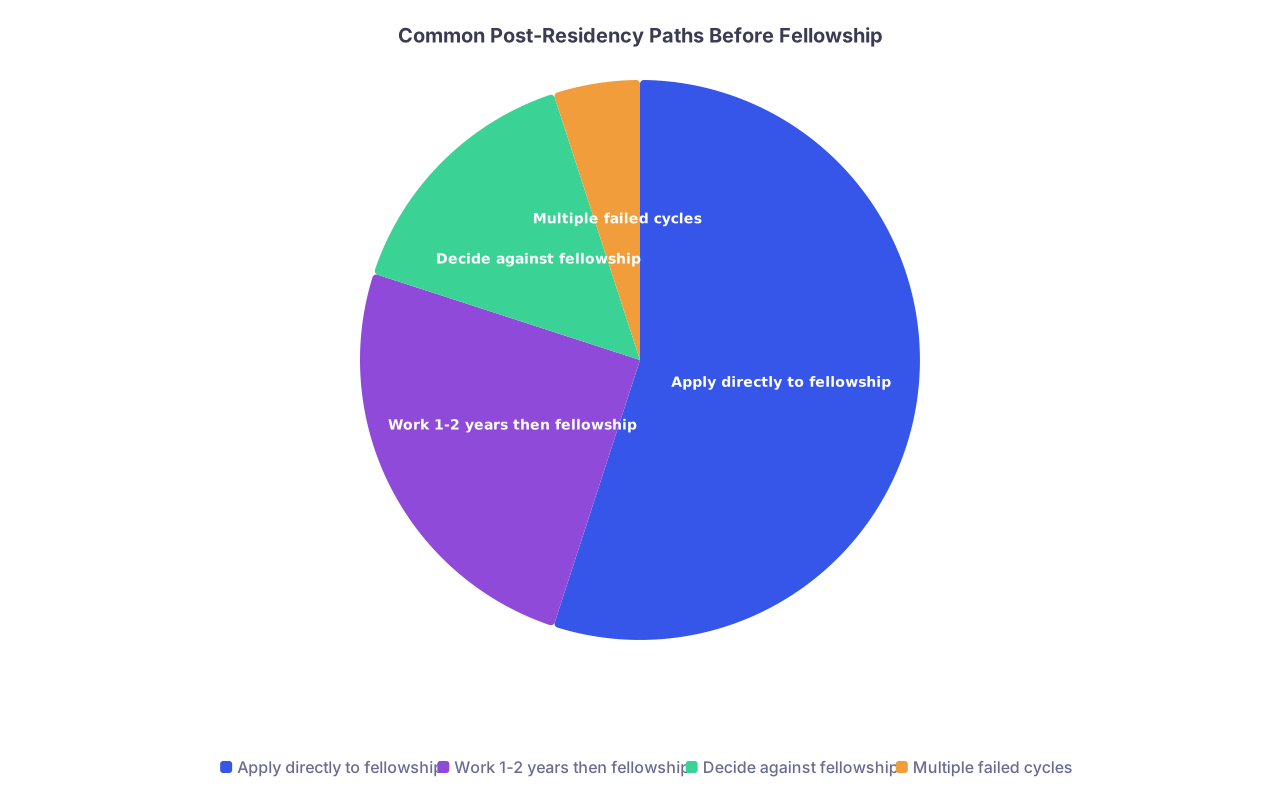
Common Paths People Take (And How They Turn Out)
| Category | Value |
|---|---|
| Apply directly to fellowship | 55 |
| Work 1-2 years then fellowship | 25 |
| Decide against fellowship | 15 |
| Multiple failed cycles | 5 |
Most people go straight through. A solid chunk work first and then do fellowship. A meaningful minority decide—after real attending work—that they don’t want fellowship at all. The miserable group is the 5% who scatter‑apply multiple years in a row without ever stepping back to fix the underlying issues.
Don’t be in that last group.
FAQs: Not Applying for Fellowship This Cycle
1. If I skip this cycle, will programs think something is wrong with me?
Not if your story makes sense.
Programs see tons of applicants who:
- Worked as hospitalists
- Did a chief year
- Spent a year in research
If you can clearly explain: “I took a year (or two) to do X, learned Y, and now I’m confident about Z,” you look mature, not defective. What raises eyebrows is a random gap with no explanation or clearly avoidable repeated failures.
2. Will it be harder to get letters if I wait?
It depends how you use the time. If you disappear for a year and don’t maintain relationships, yes, it’s harder. If you:
- Stay close to your residency program
- Work where you trained or in the same system
- Get involved in teaching or QI with your old program
…it can actually be easier to get great letters because you’re now acting like a junior attending, not just a resident.
3. Is it bad to apply “just to see what happens”?
Usually, yes. Fellowship applications cost:
- Money (ERAS, NRMP, travel if in‑person)
- Time (essays, interviews, time off service)
- Reputation (PDs know if you applied and didn’t match)
If your odds are genuinely low this year, a failed cycle can make next year psychologically harder and sometimes raises questions. “Just to see” is usually code for “I don’t want to confront that I’m not ready yet.”
4. What if my PD is pushing me to apply but I don’t feel ready?
You need a direct conversation. Say:
“I appreciate your support. Here’s what I’m worried about: [weak letters, lack of clarity, life situation]. Do you think I’d be competitive this year for [target field and tier of programs], or would one year of [chief/research/hospitalist] significantly help me?”
A good PD will level with you. If there’s a mismatch between your view and theirs, ask them to be explicit: “If you were me, what would you do?”
5. Does taking a hospitalist job hurt my fellowship chances later?
Not automatically. In many fields (cards, GI, heme/onc, PCCM), a year or two as a strong hospitalist with ongoing academic or QI involvement can help you. What hurts is:
- Doing nothing related to your target field
- Burning bridges
- Having no explanation for what you did with that time
If you work as a hospitalist and:
- Join committees
- Help with QI or research
- Teach residents
You’re not stepping off the track. You’re widening it.
6. How do I know if I’m just scared vs truly not ready?
Ask yourself:
- If I magically got into my dream fellowship right now, would I feel excited or mostly relieved/terrified?
- If fellowship didn’t exist, would I be curious to try being a generalist, or only panicked?
- Have people I trust (PD, mentors) told me I’m actually competitive this cycle?
If your mentors say, “You’re fine, you’re competitive,” and your main feeling is anxiety, that’s normal—apply. If your mentors are lukewarm and you’re clearly ambivalent about the field itself, that’s a sign to pause.
7. What can I do this week if I’m on the fence?
Do three things:
- Book a 30‑minute meeting with your PD or APD specifically to ask, “Should I apply this cycle or wait?”
- Email one subspecialty mentor and ask for their honest assessment of your readiness for that field.
- Draft two lists: “Reasons to apply now” and “Reasons to wait a year.” If your “wait” list is longer and more convincing—even to you—you have your answer.
Open a blank page right now and write the names of 3 people whose opinion on this actually matters (PD, mentor, recent grad in your target field). Send each of them one clear question: “Given my file as it stands today, would you recommend I apply this cycle or wait one year—and why?” Then actually listen to what they say.


