

The idea that you must either go straight into fellowship or you are “off track” is nonsense.
You have two real options:
- Go directly from residency into fellowship.
- Work as an attending first, then apply later.
Both can work extremely well. Both can backfire if you choose for the wrong reasons.
Here is the decision framework you actually need.
Step 1: Get Clear on What Problem You’re Trying to Solve
Before you ask “Should I go straight to fellowship?”, ask: “What is bothering me right now?”
Most residents considering delaying fellowship usually fall into one (or more) of these buckets:
Burned out and exhausted
You’re barely holding things together, your empathy tank is empty, and the idea of more training makes you physically tired.Financial pressure
Massive loans, maybe a family, living in a high-cost area. You’re done with $60–75k and want a real attending salary.Uncertain about specialty
You think you want cardiology, GI, hem/onc, whatever—but you’re not 100% and you’re scared of locking yourself in.CV not strong enough (yet)
Average or weak research, lukewarm letters, late interest in the specialty, mediocre in-service or board scores.Lifestyle/relationship reasons
Partner’s job, kids in school, geographical limitation, or just wanting control over your schedule and location for a bit.
Now connect that to your choice.
- If your core problem is burnout + financial stress, working first might solve a lot.
- If your core problem is uncertainty or weak CV, working strategically can help—but only if you use that time correctly.
- If your core problem is fear (“I’m scared I’ll fail” or “I’m scared to commit”), delaying fellowship won’t magically fix that.
You should not delay fellowship as a default “escape hatch” if you know you ultimately want cardiology/onc/whatever. That just makes the road longer without a plan.
Step 2: Understand How Different Specialties View Taking Time Off
Some fields barely blink if you work first. Others become exponentially harder to break into once you leave residency.
Here’s the reality snapshot:
| Fellowship Type | Competitiveness | Flexibility to Work First | Comment |
|---|---|---|---|
| Cards, GI, Heme/Onc | Very High | Moderate | Delay OK if you stay academic-ish |
| Pulm/CC, Nephrology | High-Moderate | High | Many people work then apply |
| Endocrine, Rheum, ID | Moderate | High | Time off usually fine |
| Hospitalist-only (no fel) | N/A | N/A | Common endpoint after IM |
Here’s how programs typically think:
Highly competitive fellowships (Cards, GI, Onc at big-name places)
They want a tight narrative: strong residency performance, research, letters, continuity. If you work first, you must show:- You stayed academically engaged (QI, research, teaching, committee roles).
- You did not disappear into a community black hole with no scholarly activity.
Less competitive or service-heavy fellowships
They often like applicants who worked:- More clinical maturity.
- Clearer sense of why they’re applying.
- Strong “this person can function as an attending” reassurance.
Surgical subspecialty fellowships
Much more program and field dependent. In some surgical fields, going straight through is the norm. Others (e.g., trauma, critical care) see plenty of people who work first. Ask your faculty, not Reddit.
Bottom line: You are not “ruined” by working first. But your choice must be intentional and aligned with what that specific specialty values.
Step 3: Map the Trade-Offs Honestly (Not Optimistically)
Let’s be blunt about what you gain and lose with each choice.
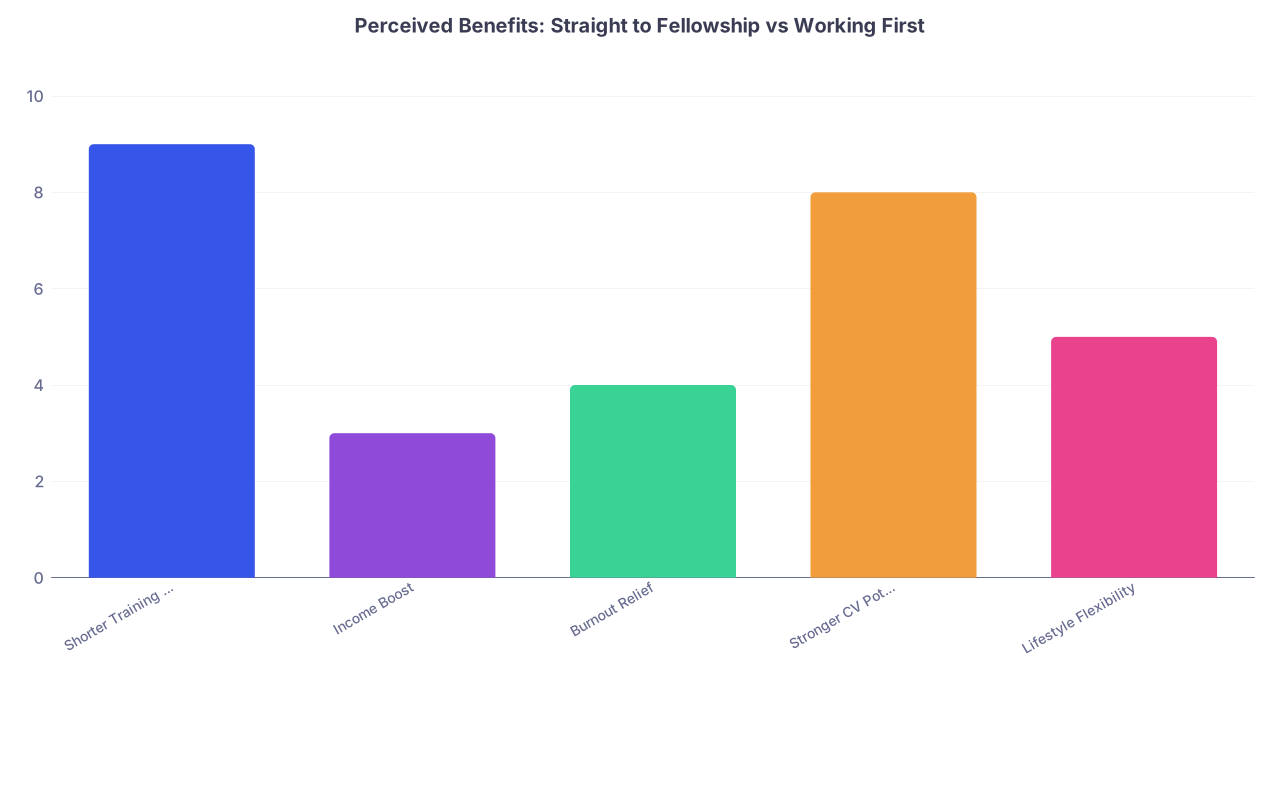
| Category | Value |
|---|---|
| Shorter Training Time | 9 |
| Income Boost | 3 |
| Burnout Relief | 4 |
| Stronger CV Potential | 8 |
| Lifestyle Flexibility | 5 |
(Scale 1–10 for going straight to fellowship; working first flips some of these.)
If You Go Straight to Fellowship
Pros
Shortest time to final career:
You finish residency → finish fellowship → done. No re-entry, no lost momentum.Cleaner academic story:
Programs love linear trajectories: “I knew I wanted cardiology; here are 3 years of evidence.”Easier to keep letters and mentors fresh:
Your APD, PD, and fellowship faculty all know you well. No scrambling for new letter writers.You stay in “training mode”:
You’re used to nights, call, conferences, exams. Fellowship feels like a continuation instead of a reboot.
Cons
No real financial breather:
You stay at trainee level income while loans accrue and life gets more expensive.Burnout risk:
If you’re already crispy in PGY-3, a 3-year intense fellowship can push you over.You might lock in too early:
I’ve seen IM residents who jumped into cards or GI then realized they actually hated that lifestyle but felt “too deep” to back out.
If You Work First
Pros
Money. Real money.
Going from $70k to $250–400k+ (depending on specialty and geography) changes your life and your options quickly. You can:- Crush high-interest debt.
- Build a real emergency fund.
- Help family, move to desired area, or buy time/flexibility.
Psychological reset:
No more evaluations, Milestones, or pages for Tylenol at 3am. You get some control over your schedule and environment.Clarity about what you actually like:
Many IM residents think they want cards/GI because they’ve only seen the inpatient side. Working as a hospitalist or outpatient doc often changes that equation—sometimes in surprising ways.Opportunity to repair your CV:
If you’re intentional, you can:- Join a hospital committee or QI project.
- Do part-time research with your former institution.
- Get killer letters as “one of our strongest junior attendings.”
Cons
Re-entry logistics are annoying:
You’ll need updated letters, transcripts, sometimes board recertification documentation. You’ll feel older than your co-fellows. You may need to re-learn studying.Easy to drift:
Work, good paycheck, maybe kids—suddenly 3 years pass and you never applied. I’ve watched this happen many times.Some competitiveness hit:
Top-tier academic fellowships may quietly prioritize those going straight through, unless your time working was clearly high-value (research, teaching hospital, etc.).
Step 4: Choose Based on Your Scores, CV, and Burnout Level
Here’s a practical framework I’ve used when advising residents.
Scenario A: Strong Applicant, Low Burnout, Clear Goal → Go Straight Through
You should probably go directly to fellowship if:
- You know which fellowship you want and why.
- You have:
- Solid in-training/board scores.
- A few posters or papers, or at least real scholarly activity.
- Strong letters from subspecialists in your field.
- You’re tired but not totally drained.
Why? Delaying mostly just adds time without adding much benefit. You’re ready; do it.
Scenario B: Clear Goal, but CV is Weak → Consider a Structured Gap OR Straight Through
If you know you want, say, cardiology, but your CV is mediocre:
- 0–1 abstract/poster, no publications.
- No obvious subspecialty mentor.
- Middle-of-the-pack in-service or Step/Level scores.
Ask two questions:
Can I fix enough in 6–12 months as a chief or research year?
If yes and you can get a funded chief or research role—great. That often keeps you “in training” and makes fellowship apps stronger without fully exiting academia.If I go work, can I stay academic-adjacent?
Working in a community job with no teaching, no research, no academic mentors is a terrible move if you want a competitive fellowship.
In this scenario, I usually recommend:
- Short, structured extra year (chief, research, hospitalist within your academic department) → then apply.
- Avoid disappearing into a random community job for 3 years if you want a top-tier fellowship.
Scenario C: Highly Burned Out, Moderate/Good CV → Strong Case to Work First
If your CV is decent and your main problem is that you’re mentally, emotionally, or physically cooked, forcing yourself into more training can:
- Flatten your performance.
- Make you miserable.
- Lead to quitting or underperforming in fellowship.
Here, a carefully chosen attending job can be the better move.
What “carefully chosen” means:
- Reasonable schedule (e.g., 7-on/7-off hospitalist, or outpatient with no insane call).
- Some connection to academics if future fellowship is likely:
- Teaching residents/med students.
- Institutional QI/committee work.
- Option to collaborate with subspecialists.
Use 1–2 years to:
- Recover.
- Clarify what you really want.
- Possibly strengthen your application.
Then apply from a position of strength instead of desperation.
Scenario D: Not Sure You Even Want a Fellowship → You Probably Need to Work First
If your answer to “What do you want long term?” keeps changing every month:
- Cards.
- No, maybe hospitalist.
- No, maybe palliative.
- No, maybe GI.
You don’t need more training. You need exposure.
The worst move here is committing to a multi-year fellowship that becomes golden handcuffs. You’ll feel trapped by sunk costs.
Working 1–3 years as:
- A hospitalist (great for IM),
- A general pediatrician,
- A general surgeon in a lower-intensity setting,
lets you see:
- What work you enjoy.
- What lifestyle you tolerate.
- What patient population you actually care about.
Plenty of people discover they don’t need a fellowship at all.
Step 5: Design Your Path So Doors Stay Open
Whichever option you pick, do it in a way that keeps options alive rather than closed.
If You Go Straight to Fellowship
Protect yourself by:
- Picking programs with decent well-being and realistic workloads.
- Asking current fellows privately: “Would you choose this program again?”
- Clarifying where graduates actually end up (private vs academic, location, job types).
If You Work First
Set a 3-part structure:
A clear timeline decision
Example:
“I will work as a hospitalist for 2 years. In year 1 I’ll explore and recover. In year 2 I’ll either commit to fellowship and apply, or I’ll formally decide to stay as a career hospitalist.”Academic or professional anchors
At least one of:- A mentor at your old residency program you check in with twice a year.
- A teaching role (residents or med students).
- Involvement in QI, guidelines, or small research projects.
Concrete application-building goals (if fellowship remains likely)
For example:- Lead 1–2 QI projects and get them presented locally or regionally.
- Co-author 1 paper, review, or case series with your former program.
- Get 2 new letters from people who’ve seen you as an attending.
This is where most people fail. They “plan to apply later” and then realize three years in they’ve built zero new connections and no scholarly work. Do not be that story.

| Step | Description |
|---|---|
| Step 1 | PGY 3 Resident |
| Step 2 | Work first and explore |
| Step 3 | Apply straight to fellowship |
| Step 4 | Work 1-2 years in academic setting then apply |
| Step 5 | Chief or research year then re-evaluate |
| Step 6 | Clear fellowship goal? |
| Step 7 | Burned out? |
| Step 8 | CV strong enough? |
Quick Reality Checks You Need to Hear
A few hard truths I’ve seen play out over and over:
- Working first does not make you lazy or un-academic by default. But it can if you’re not deliberate.
- Going straight to fellowship does not mean you’re “on track” if you are mentally falling apart.
- Being a “career hospitalist” or generalist is not a failure. It’s a perfectly legitimate endpoint. Many people end up happier there than in a high-prestige fellowship.
- If you’re staying in the same institution, your PD and fellowship PD often talk. If you’re thinking about taking time off, have that conversation early and honestly.

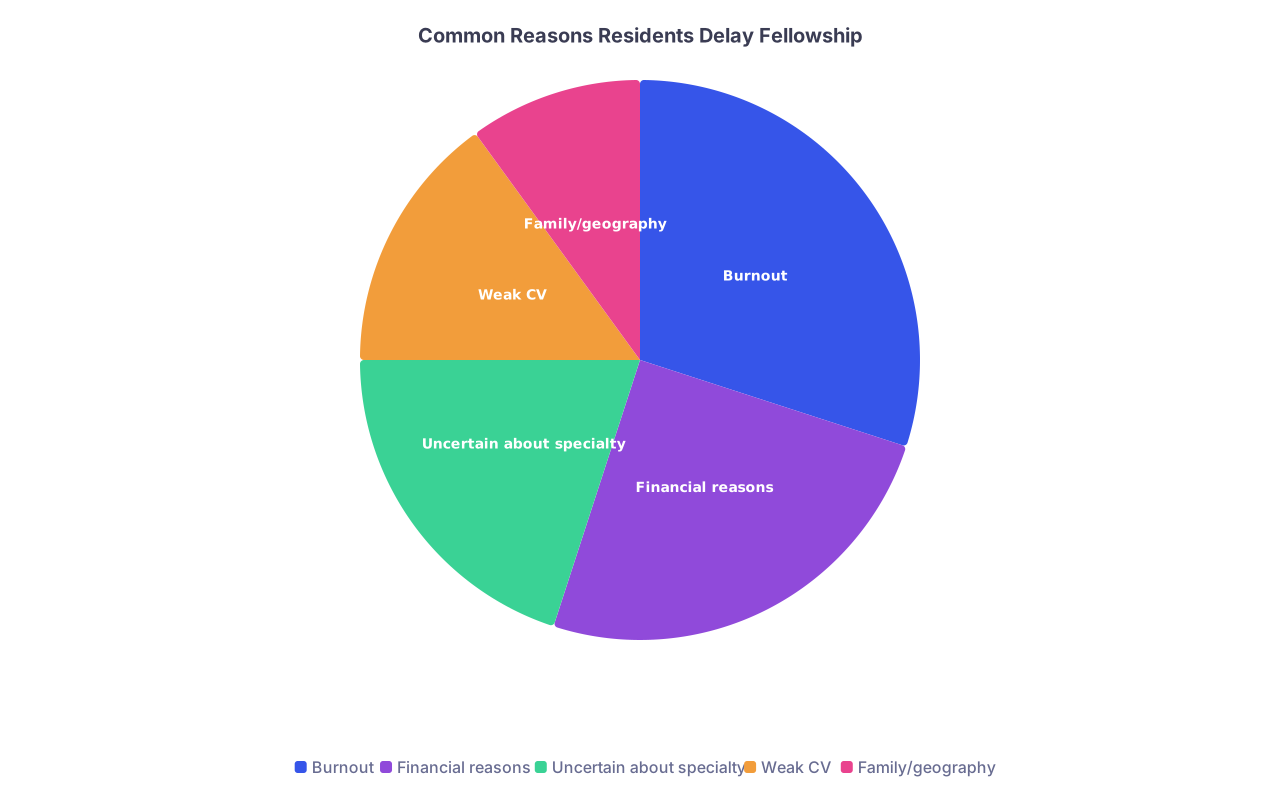
| Category | Value |
|---|---|
| Burnout | 30 |
| Financial reasons | 25 |
| Uncertain about specialty | 20 |
| Weak CV | 15 |
| Family/geography | 10 |

FAQ: Straight to Fellowship vs Working First
1. Will working first hurt my chances at a competitive fellowship (cards, GI, heme/onc)?
It can, but it doesn’t have to. If you disappear into a purely service-heavy community job with no research, no QI, no teaching, and no academic references—yes, your competitiveness drops. If you work in an academic or hybrid role, keep strong connections to your residency program, and build your CV (QI, teaching, maybe some research), plenty of programs will still take you seriously. The more competitive the fellowship and the more prestigious the program, the more “continuous academic story” matters.
2. How long is “too long” to work before applying to fellowship?
There is no magic cutoff, but after about 3–5 years, you start raising more questions: Are your clinical skills and knowledge still at trainee-fellow level? Are your letters current? Have guidelines changed? That said, I’ve seen people successfully match into fellowship 5+ years out—but they usually had strong ongoing academic engagement and clear reasons for the gap (military service, family, major research, etc.). If you’re thinking more than 2–3 years out, be extra intentional about staying connected.
3. If I’m burned out but want a very competitive fellowship, should I still work first?
Sometimes yes, sometimes no. If your burnout is mild and your CV is competitive, pushing through may be better than stepping away and risking loss of momentum. If your burnout is severe—dreading work daily, depression, physical symptoms, strained relationships—then forcing yourself into a high-intensity fellowship is risky. In that case, consider:
- A lighter academic role (e.g., academic hospitalist) for 1–2 years.
- Explicitly planned recovery and support (therapy, time off, schedule boundaries). But understand: you’ll need to maintain some academic profile during that time to remain competitive.
4. What’s the best type of job if I plan to apply to fellowship later?
Ideal set-up:
- Academic or hybrid hospital with residency programs.
- Involvement in teaching (wards, clinic precepting, conferences).
- Access to subspecialists in your target field.
- Support for QI, committees, or small research. For IM, academic hospitalist is the classic option. For peds, an academic children’s hospital gig. For some surgical fields, an assistant/associate position in a teaching hospital. The key is proximity to mentors who can write letters and include you in projects.
5. Will fellowship programs judge me for wanting to earn money first?
Not if you handle it like an adult. Saying, “I needed to support my family, pay down loans, and build some financial stability” is entirely reasonable. What turns programs off is if your application suggests no ongoing growth for several years—no improvement, no engagement, just “I worked for money and now I’m bored.” Frame it as: “I used this time to grow clinically, contribute to my institution, clarify my goals, and now I’m ready to specialize.”
6. How do I explain a gap or work period in my personal statement?
Be clear, concise, and forward-looking:
- One or two sentences on why you worked: “After residency, I chose to work as a hospitalist for two years to gain independent clinical experience, support my family financially, and confirm my long-term interests.”
- A few lines on what you did: teaching, QI, leadership, or research highlights.
- Then pivot quickly to why now: “These experiences reinforced my desire to pursue pulmonary/critical care, especially my work with…” Programs care far more about what you learned and how it shaped your current motivation than the exact reason you delayed.
Key Takeaways
- Working before fellowship is not a failure or career killer—if you stay intentional and connected.
- Go straight through if you’re clear on your goal, not deeply burned out, and competitively positioned.
- If you do work first, choose the job and timeline strategically so that when you apply, you’re stronger, not just older.


