How Formal Should My Tone Be in Residency Thank-You Emails?
What actually happens if your residency thank-you email sounds too stiff… or too casual? Does anyone care, or can the tone quietly hurt you?
Here’s the short version: most applicants either write emails that sound like a legal contract, or like a text to a classmate. Both are off. You want professional, warm, and concise—what I’d call “polished colleague,” not “desperate applicant” and not “Friday group chat.”
Let’s walk through exactly how formal your tone should be, what phrases work, what sounds weird from the PD side, and how to adjust based on specialty and program culture.
The Target: “Professional but Human”
Aim for this: if someone printed your email and handed it to the program director in morning report, nobody would cringe, and nobody would laugh. They would just nod and move on.
That means your tone should be:
- Respectful but not groveling
- Warm but not familiar
- Clear and brief, not flowery
Think of how a strong MS3 might email their clerkship director or department chair. That level.
Here’s a quick gut-check continuum:
Too formal (bad):
“Dear Dr. Smith,
I am writing to once again extend my utmost gratitude for the extraordinary privilege of interviewing with your esteemed program…”
Too casual (also bad):
“Hey Dr. Smith,
Thanks so much for chatting with me yesterday – vibes were great, would love to be there next year lol.”
Just right:
“Dear Dr. Smith,
Thank you for taking the time to speak with me yesterday about the Internal Medicine residency at Riverside. I appreciated hearing about your approach to resident autonomy, especially in the ICU.”
That “just right” example is your template: simple, clear, polite, like a future colleague who has their act together.
How Formal to Be: The 5 Main Levers
There are five places people swing too far formal or too far casual. If you control these, your tone will land exactly where it should.
1. Greeting and closing
Use a standard, professional greeting. Do not get creative here.
Safe options:
- “Dear Dr. [Last Name],”
- “Dear Dr. [Last Name] and the [Program Name] team,” (for group emails)
- For a coordinator: “Dear Ms./Mr. [Last Name],”
Avoid:
- “Hey”
- “Hi [First Name]” (unless they explicitly invited that level of informal address)
- “To whom it may concern” (you’re not submitting a cover letter)
Closing lines that work:
- “Sincerely,”
- “Best regards,”
- “Warm regards,” (fine, especially if they seemed friendly)
- “Best,”
Things that read wrong for residency:
- “Cheers,” (sounds casual/international academic, not typical in US GME)
- “Yours truly,” (too dramatic)
- No closing at all (looks rushed and careless)
2. How you address them (titles and names)
Use professional titles. This matters more than you think.
Default: “Dr. [Last Name]”
Don’t drop to first names unless:
- They signed their emails to you with their first name only, and
- The program culture was obviously first-name based (you heard residents calling them by first name, etc.)
Even in chill programs, “Dear Dr. Patel,” never hurts you. “Hey Jay,” sometimes does.
For PDs and leadership, always:
- “Dear Dr. [Last Name],”
- Never “Dear Program Director,” (impersonal, lazy)
3. Word choice and phrasing
Here’s where people usually overdo it. You’re not applying to the royal court. You’re thanking a busy physician who will skim your email in 10–20 seconds.
Avoid:
- Overly grand adjectives: “esteemed,” “illustrious,” “invaluable mentorship,” “immeasurable gratitude”
- Weirdly formal constructions: “I am writing to express my profound appreciation for the opportunity…”
- Over-apologizing: “I hope I am not taking too much of your time…” (you’re sending a 5–8 line email, you’re fine)
Use:
- Plain, professional language:
- “Thank you again for the opportunity to interview.”
- “I enjoyed learning more about…”
- “I appreciated your insights on…”
- “I’m very interested in your program because…”
You’re allowed to sound like a human:
- “I really enjoyed hearing about…” is fine.
- “I was excited to learn that residents…” is also fine.
Just do not slide into:
- Slang (“super stoked,” “crazy excited”)
- Emojis
- Abbreviations like “u,” “lol,” “omg,” “tbh”
4. Length and structure
Formality isn’t just word choice; it’s how bloated the email feels. Long, over-written emails come off as try-hard and slightly out of touch.
Aim for:
- 1–2 short paragraphs
- Total length: 4–8 sentences
- You should be able to read the whole thing out loud in under 30 seconds
A solid structure:
- Sentence 1–2: Thank them and anchor to the specific interview day.
- Sentence 3–4: Mention one or two specific things you appreciated or connected with.
- Optional last 1–2 sentences: Brief statement of continued interest + polite closing line.
If your email is three chunky paragraphs, you’re writing a personal statement, not a thank-you.
5. Level of enthusiasm
You want clear interest. You don’t want melodrama.
Perfectly normal:
- “I remain very interested in your program.”
- “Our conversation reinforced my strong interest in [Program Name].”
- “Your program is one of my top choices.”
Too much:
- “I have never felt such a strong connection with a program.”
- “I am certain I would rank your program number one.” (often a mistake or against program preference, and can conflict with NRMP policies if overused or implied as a promise)
- “I would be devastated not to match with you.”
Show interest confidently. Don’t sound like you’re begging.
Specialty and Program Culture: Does It Change the Tone?
Yes, slightly. Not as much as people think.
Here’s the reality: even in “chill” specialties, faculty are still reading these as professional communications. You don’t downgrade to group-text level just because the residents wore fleece vests and sneakers.
Here’s how I’d adjust by culture, not by specialty label alone:
| Program Culture Feel | Greeting Style | Language Style | Enthusiasm Level |
|---|---|---|---|
| Very formal academic | Dear Dr. LastName | More polished | Calm, steady |
| Typical mid-level | Dear Dr. LastName | Plain, professional | Clear, moderate |
| Very laid-back | Dear Dr. LastName (still) | Slightly more relaxed | Slightly warmer |
Even at the most laid-back community EM program, “Hey Mike, thanks for the chat, loved the vibe” still looks immature. You don’t know how the PD feels about that tone, and you don’t need to take that risk.
Use the interview day as your guide:
- If everyone called each other “Dr. X,” stay formal.
- If the PD introduced themselves as “Hi, I’m Jen,” and every email from them is signed “Jen,” you can edge language a bit more relaxed but still keep structure and professionalism.
Concrete Examples: What To Send (and What Not To)
Let’s make this painfully clear with side-by-side examples.
Example 1: Program Director
Too formal:
“Dear Dr. Johnson,
I am writing to convey my deepest appreciation for the honor of interviewing with your distinguished residency program yesterday. I was profoundly impressed by the unparalleled clinical training opportunities and the many illustrious faculty members with whom I had the privilege to speak. I would be most humbled to join your residency, and I hope to have the opportunity to contribute meaningfully to your institution’s legacy of excellence.”
Too casual:
“Hey Dr. J,
Thanks so much for the interview yesterday! Loved chatting about the program, seems like an awesome place to train. Would be pumped to match there next year.”
Just right:
“Dear Dr. Johnson,
Thank you for taking the time to speak with me yesterday about the Internal Medicine residency at Cityview Medical Center. I appreciated hearing about your focus on resident autonomy in the ICU and the emphasis on graduating confident, independent internists. Our conversation reinforced my strong interest in your program.
Best regards,
[Your Name]”
Note the tone: professional, specific, not sugary.
Example 2: Individual Faculty Interviewer
Reasonable template:
“Dear Dr. Lee,
Thank you for speaking with me during my interview day for the Pediatrics residency at Northside. I enjoyed hearing about the continuity clinic experience and how residents are supported in pursuing QI projects. I especially appreciated your candid perspective on balancing service and education.
Sincerely,
[Your Name]”
That’s it. No life story, no plea, no ranking commentary.
Example 3: Resident
Residents are closer to peers, but thank-you tone still shouldn’t be “DM on Instagram.”
Reasonable:
“Dear Dr. Patel,” (if they’re a PGY-2/3, especially in some fields, “Dr.” is still safest)
or
“Hi Priya,” (if they explicitly introduced themselves only by first name and the culture was very first-name based)
Email:
“Hi Priya,
Thank you for taking the time to talk with me during the interview day. Hearing about your experience as a PGY-2 and how supportive the senior residents are was really helpful. I appreciated your honesty about workload and how the program has responded to feedback.
Best,
[Your Name]”
Still professional. Still structured. Slightly more relaxed is fine here.
Common Mistakes That Make Your Tone Feel Off
I’ve seen these repeatedly, and they silently downgrade an otherwise fine applicant.
Copy-paste obviously generic language
“Your esteemed program” appears in way too many emails. Programs can tell you sent the same paragraph to 20 places. Use one or two specific details to make it sound real.Overusing “I” and sounding self-focused
“I am excited… I believe I would excel… I have always wanted…”
Shift a bit toward them: “Your program’s focus on ___ aligns with my interest in ___.”Sounding like you’re trying to negotiate
“If you rank me highly, I would be honored to match at your program.”
Don’t do the weird conditional language. It’s awkward and unnecessary.Implying promises or asking them to break rules
“I hope you will consider me for a position and let me know where I stand on your rank list.”
They can’t and won’t tell you that.Writing as if they owe you something
“Given my strong academic record, I believe I would be an asset to your program and hope you will take this into consideration.”
That’s what ERAS was for. The thank-you is not the place to resell your CV.
How Thank-You Emails Actually Get Read
Reality check: these emails are skimmed quickly. Many PDs will tell you they don’t move people up the rank list just for writing a beautiful thank-you. But tone can hurt you if you sound:
- Unprofessional
- Entitled
- Awkwardly over-formal (reads as socially off)
- Immature or too casual
So the goal isn’t to write the most poetic email. The goal is: nothing in your email makes them stop and think, “Huh. That’s odd.”
You want:
- No typos in names or program titles
- A clear, respectful tone
- Specific enough content that it doesn’t feel robotic
That’s it. Anything more is optional polish, not a game-changer.
Quick Template You Can Reuse (and Tweak)
Here’s a baseline you can adapt for almost any interviewer:
“Dear Dr. [Last Name],
Thank you for taking the time to speak with me during my interview for the [Specialty] residency at [Program Name] on [Interview Date]. I appreciated learning more about [specific aspect you discussed], and your perspective on [another specific topic] resonated with me. Our conversation reinforced my strong interest in [Program Name].
Best regards,
[Your Name]
AAMC ID: [optional, but helpful for larger programs]”
Adjust the middle sentence or two, keep the greeting and closing consistent, and you’ll be fine.
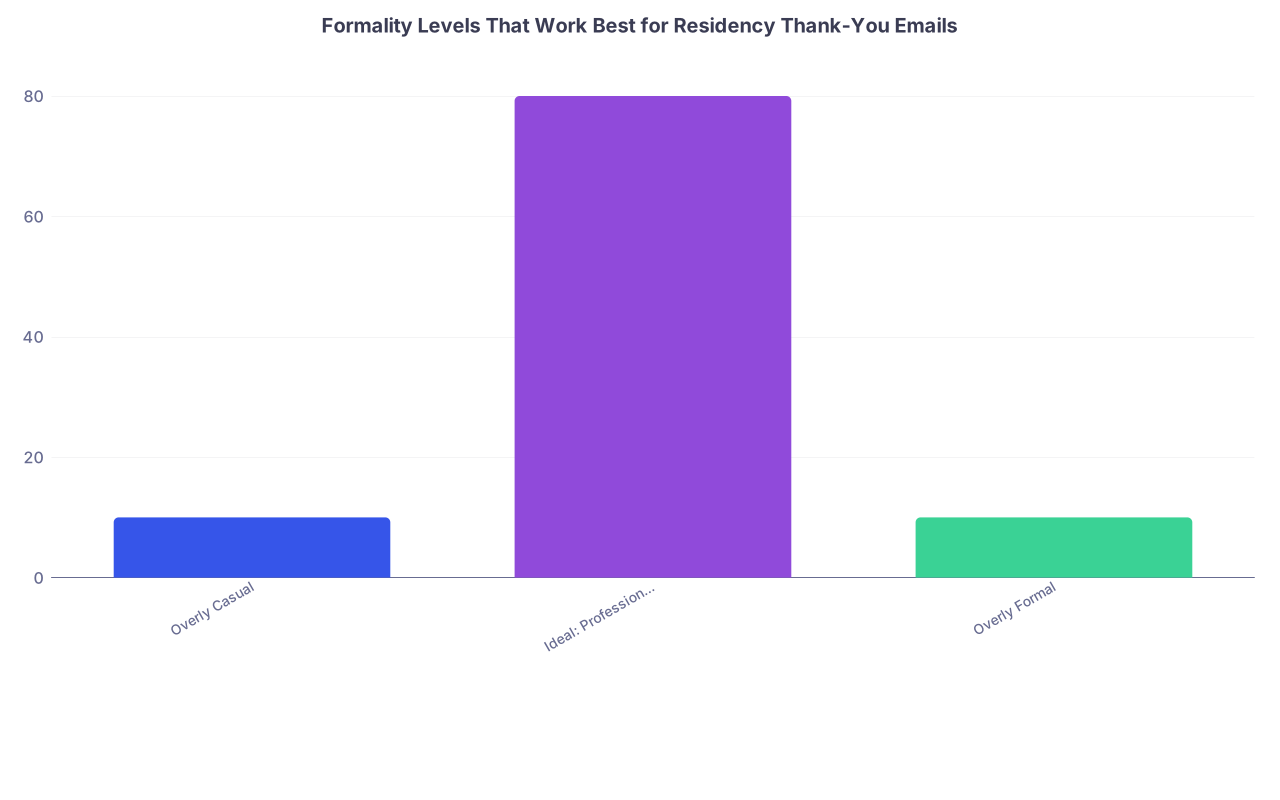
| Category | Value |
|---|---|
| Overly Casual | 10 |
| Ideal: Professional-Warm | 80 |
| Overly Formal | 10 |

| Step | Description |
|---|---|
| Step 1 | Just Finished Interview |
| Step 2 | Who are you emailing? |
| Step 3 | Program Director/Faculty |
| Step 4 | Resident |
| Step 5 | Use Dear Dr. LastName |
| Step 6 | Use Dear Dr. LastName or Hi FirstName if invited |
| Step 7 | Professional, warm tone, 4-8 sentences |
| Step 8 | Still professional, slightly more relaxed |
| Step 9 | Send within 24-48 hours |
Key Takeaways
- Aim for “professional but human”: Dear Dr. LastName, plain language, 4–8 sentences, no slang or grandstanding.
- Use specific details from the interview and a clear, calm statement of interest—skip melodrama, flattery, and informal texting tone.
- Keep titles formal, language straightforward, and structure tight; your goal is a thank-you that leaves exactly zero red flags.