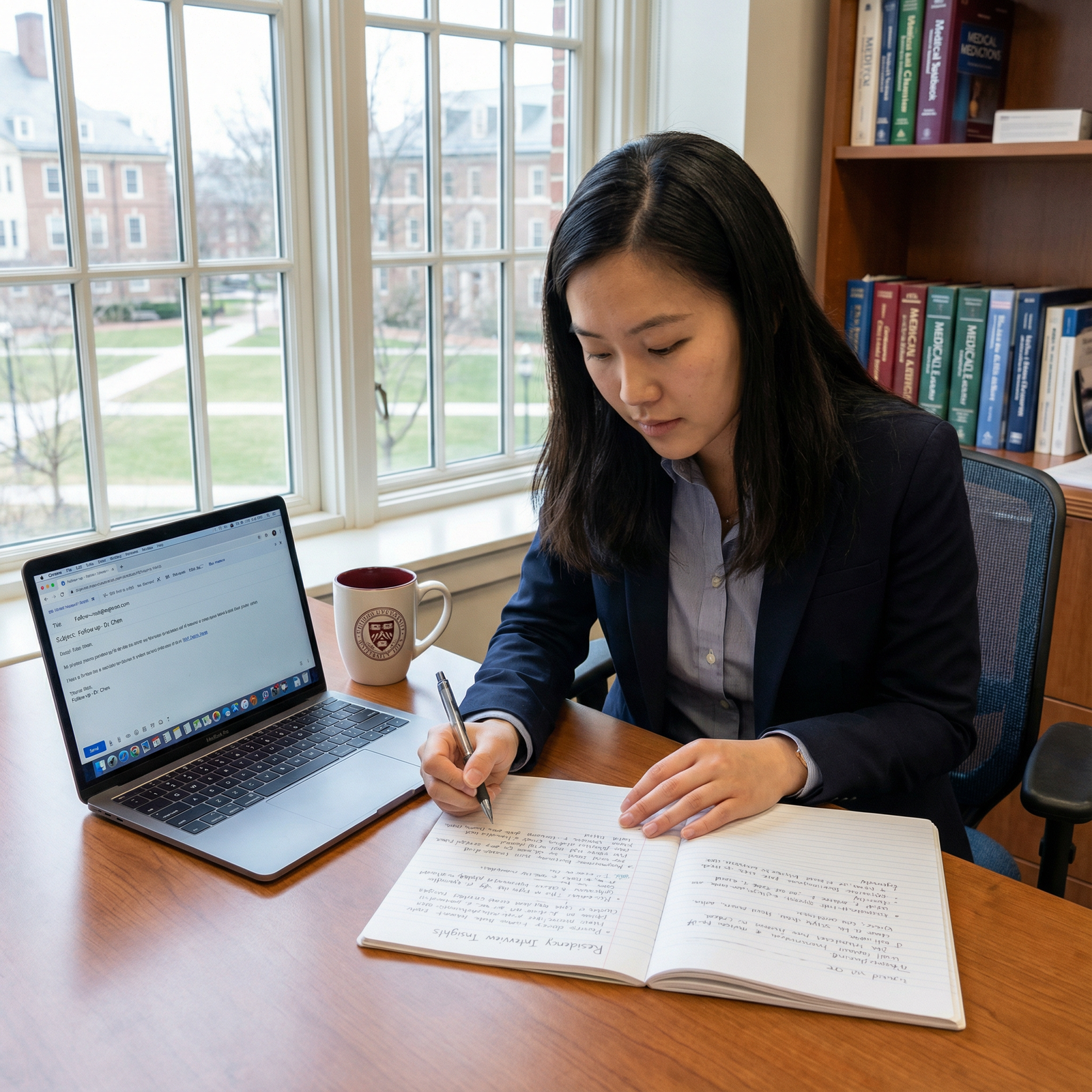
The most overthought line in residency thank-you notes is the one you probably should not write.
Let me be blunt: you usually should not declare “rank #1” intent in a thank-you note. When in doubt, keep it neutral, specific, and professional.
Here’s exactly how to decide, what to say instead, and the few situations where you might strategically signal intent.
The core question: Should you mention rank intent?
Most applicants are really asking three things:
- Will telling a program they’re my #1 help me match there?
- Is it ever appropriate to say where I plan to rank them?
- Could I hurt myself—or break rules—by doing it?
My answers, from years of watching this play out:
- Declaring rank intent in a thank-you note almost never meaningfully improves your match chances.
- Overstating intent, or telling multiple programs they’re #1, is unethical and can backfire.
- You can absolutely show strong interest without revealing your rank list.
So the default rule is simple:
Default: Keep your thank-you notes rank-neutral.
Use them to reinforce fit and professionalism, not to negotiate rank positions.
Why “I’m ranking you #1” rarely helps
Programs are not waiting breathlessly for your thank-you email to decide your fate. Their process is more structured—and more cynical—than that.
Here’s what actually happens behind the scenes:
- Many programs build most of their rank list the same day or week of the interview.
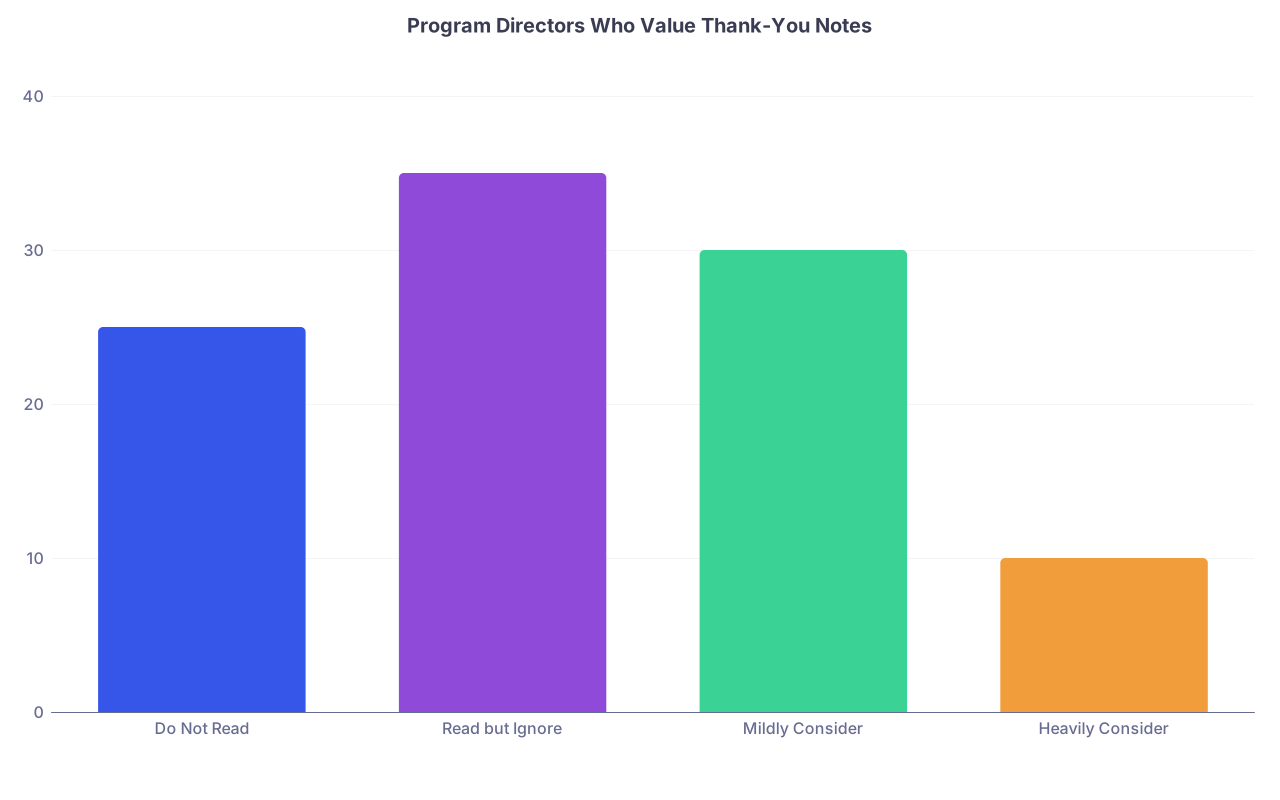
- A lot of PDs barely glance at thank-you notes; some don’t read them at all.
- Some programs have explicit policies not to factor post-interview communication into rankings.
- In competitive programs, almost everyone is “very interested,” so the signal is noisy.
| Category | Value |
|---|---|
| Do Not Read | 25 |
| Read but Ignore | 35 |
| Mildly Consider | 30 |
| Heavily Consider | 10 |
(Those numbers are representative, not exact—but that’s roughly the landscape I’ve seen and heard from PDs.)
What does that mean for you?
- If you are a clear top candidate, your file already shows it. A thank-you note does not make or break you.
- If you are a borderline candidate, a thank-you note might nudge someone’s “gut feeling,” but not because of rank talk—because you seem thoughtful, mature, and aligned with the program.
- Dramatic declarations of rank intent tend to look needy, insincere, or transactional.
So no, tacking “I will be ranking your program #1” onto an otherwise good email does not magically bump you up ten spots.
The one thing you must protect: your credibility
The biggest danger isn’t that your note is ignored. It’s that you say something you cannot back up.
Two hard lines you should not cross:
Do not tell more than one program they’re your definitive #1.
This is lying. PDs talk. Faculty move between institutions. Coordinators gossip. It comes out.Do not make promises you might walk back.
Example of what not to write:
“If I match at your program, I will definitely pursue a fellowship here.”
You’re a med student. You do not know that.
Your reputation follows you. People remember the candidate who was “the one that sent a weird, overly intense email,” or “the one who told us we were #1 and then matched somewhere else.”
You do not want to be that anecdote.
What to actually write: strong interest without rank specifics
Here’s the good news: you can communicate serious interest without saying “#1” or spelling out your rank list.
You want phrases that say:
- “You’re one of my top choices”
- “I see real fit here”
- “I’d be thrilled to train with you”
without committing to exact rank positions.
Use language like:
- “Your program is among my top choices because…”
- “I could easily see myself training here.”
- “Your program stands out to me for [specific reason].”
- “I would be very excited to match at [Program Name].”
Here are two templates you can adapt.
Neutral but enthusiastic thank-you note:
Dear Dr. Smith,
Thank you again for taking the time to speak with me on Monday. I especially appreciated our conversation about resident autonomy on the ICU and your approach to graduated responsibility.
After having time to reflect on the interview day, I’m even more impressed by [Program Name]—particularly the strong critical care exposure, the collegial resident culture, and the clear support for fellowships. I could genuinely see myself thriving in your program and contributing to the resident community.
Thank you again for the opportunity to interview. I hope to have the chance to work with you and your team in the future.
Sincerely,
[Your Name], MS4
Slightly stronger interest signal (still rank-neutral):
…After completing all my interviews, [Program Name] stands out as one of the programs where I feel the strongest fit, both academically and personally. The combination of [X], [Y], and [Z] aligns extremely well with the kind of training I’m seeking. I would be very excited to match there…
Notice: no rank numbers, no promises. But anyone reading that understands: you’re serious.
When explicitly stating rank intent might make sense
There are narrow, specific situations where telling a program they are your #1 can be reasonable.
Here’s the decision framework I actually use when advising people:

| Step | Description |
|---|---|
| Step 1 | Finished All Interviews? |
| Step 2 | Do NOT State Rank Intent |
| Step 3 | Clear, Honest #1? |
| Step 4 | Program Values Post-Interview Communication? |
| Step 5 | Stay Neutral but Strong |
| Step 6 | Single, Explicit #1 Message OK |
You can consider an explicit statement IF:
- You are 100% certain this is your #1 program and that will not change.
- You have completed all interviews or are at the end of your season.
- You have not and will not tell any other program the same thing.
- The program’s culture (from residents/PD) suggests they welcome that level of communication.
Even then, I recommend measured language—more like a clear, sincere statement than a plea.
Example:
After reflecting carefully on all of my interviews, I wanted to let you know that [Program Name] is the program where I feel the strongest fit, and I plan to rank it first on my list. I greatly value the [specific features], and if I’m fortunate enough to match with you, I would be thrilled to train there.
If you cannot say that honestly—or if you are still actively reshuffling your list—do not go there.
What about NRMP rules and “love letters”?
A lot of people are confused (or scared) about what’s allowed post-interview.
Here’s the bottom line:
- NRMP rules do not forbid you from telling a program you intend to rank them highly or even first.
- NRMP does forbid making binding commitments or attempts to coerce ranking decisions.
- Programs are not allowed to ask you, directly or indirectly, how you will rank them. If they do, that’s on them, not you—but tread carefully.
The safest posture:
- You are allowed to express interest and even intent.
- You are not required to disclose anything about your rank list.
- You should never feel pressured to respond to “So, where are we on your list?” questions. A standard, non-committal answer is fine:
“I really enjoyed meeting everyone and I think your program would be an excellent place to train. I’m still finalizing my list, but I’ll be ranking your program very competitively.”
Do not let anxiety push you into over-sharing or over-promising.
Timing: when should you send thank-you notes?
Rank intent aside, people also mess up timing.
Here’s a clean approach:
- Send thank-you notes within 24–72 hours of your interview.
- If you later decide a program is clearly your #1 and you genuinely want to tell them, that follow-up should be a separate, later email, closer to rank-list certification.
- Do not rewrite your thank-you note three times trying to sneak in rank language. Send the professional note first. Adjust later only if it truly makes sense.
| Message Type | Best Time Window | Rank Content |
|---|---|---|
| Standard thank-you | 24–72 hours post-interview | Neutral only |
| Post-interview update | 1–3 weeks later (optional) | Mild interest OK |
| Explicit #1 declaration | After all interviews, before rank deadline | Only if 100% honest |
Most applicants never need that third row. And they do just fine.
Common mistakes to avoid in thank-you notes
A few patterns I see every year that you should skip:
Copy-paste thank-you notes with zero specifics.
“Thank you for the opportunity to interview at your excellent program…” reads like spam. Add at least one real detail from your conversation or the day.Overly emotional or desperate tone.
“I’ve dreamed of your program since I was a child” or “I’ll be devastated if I don’t match here.” Do not make your emotional state their problem.Negotiating vibe.
Anything that sounds like: “If you rank me highly, I’ll rank you #1.” That’s unethical, and programs hate it.TMI about your rank list.
Listing out which regions or programs you’re considering versus them. They don’t need your whole spreadsheet.Superlative inflation.
Telling five different places they were “by far the best program I saw” is not just wrong, it’s lazy.
Keep it simple: specific gratitude, genuine fit, professional tone.
What actually moves the needle (besides rank talk)
Here’s the brutal truth: your thank-you note is not where you win the Match. It’s where you avoid unforced errors and maybe pick up a small edge.
The stuff that really matters more:
- How residents and faculty perceived you on interview day.
- Your letters, scores, CV, and overall application strength.
- Whether you came across as someone they’d trust at 2 a.m. with a crashing patient.
- Whether you seemed like a good human to take call with.
But among the controllable, low-stakes things, a well-written, neutral thank-you note can:
- Reinforce positive impressions (“professional,” “thoughtful,” “mature”).
- Help a borderline faculty member remember you favorably when they glance back at notes.
- Clarify a particular interest (e.g., “I’m especially excited about your global health track”) that aligns with program strengths.
You don’t need to take big risks with rank intent to get those benefits.
Quick checklist: what your thank-you note should and shouldn’t do
Use this like a pre-send audit:
Your note SHOULD:
- Arrive within 2–3 days of the interview
- Be short: 1–3 short paragraphs
- Mention something specific from the day or your conversation
- Reaffirm your interest in the program
- Sound like how you’d speak to a future colleague
Your note should NOT:
- Contain rank positions (unless in that very rare, honest #1 scenario)
- Make promises you’re not sure you can keep
- Sound generic or robotic
- Ask for special favors (“Can you tell me where I am on your list?”)
- Be sent to every single person you met if that means writing 15 bad emails—prioritize PD, chair, and key interviewers
The bottom line
You do not need to weaponize your thank-you note by stuffing it with rank intent. Most of the time, it’s a courtesy and a small professional touch—not a secret backdoor into a higher spot on the list.
If you remember nothing else, remember this:
- Default: keep it rank-neutral, genuine, and specific.
- If you ever explicitly state #1 intent, do it once, late, and only if it’s 100% true.
- Your goal is to leave them thinking, “This is someone I’d be happy to see on July 1,” not “This person is trying too hard.”
Open your last thank-you draft right now and delete any sentence that mentions “#1,” “rank,” or “top of my list.” Replace it with one concrete reason you’d be excited to train there.