
Most residency applicants send too many “update” emails—and end up hurting themselves, not helping.
If you already sent a thank-you email after your interview, you should only send a separate “major update” email in a few specific situations. Everything else is noise.
Let me walk you through when it is worth sending, when it is absolutely not, and exactly what to say if you do.
The short answer: Usually no, sometimes yes
Here’s the clean, honest framework.
You should send a separate post–thank-you update email only if BOTH are true:
- You have a truly meaningful, objective new development, and
- The program has not yet submitted its rank list.
If either of those is missing, you’re probably better off not emailing.
What counts as a “major update”?
- New Step 2 CK score that’s significantly stronger than Step 1/PASS
- New accepted publication (not just “submitted” or “in preparation”)
- New honor/award (AOA, Gold Humanism, departmental award)
- New rank-impacting rotation evaluation (e.g., “Honors in Sub-I at your institution” if they’ll see it)
- Significant change in application status (couples match update, visa change, SOAP-related issue, etc.)
What does not count?
- You “really loved the program” (that’s what the thank-you note was for)
- “Additional interest” or “after reflecting I realized this is my top choice” (unless it’s a single honest “you’re my #1” letter)
- Minor volunteering, another poster, a local talk, small QI change
- Re-sending your CV “with minor updates”
- Weekly or monthly “just checking in” emails
If you’re squinting and trying to convince yourself it’s a major update, it’s probably not.
Understand their timeline first
Before you fire off anything, you need to know one thing: Are they still editing their rank list?
Programs vary, but here’s the rough reality:
- Many programs build their initial rank list within 1–2 weeks after their last interview day.
- Most finalize rank lists well before the NRMP Rank List deadline, not the night before.
- Some explicitly tell you: “We will not consider post-interview communication in ranking.” Believe them.
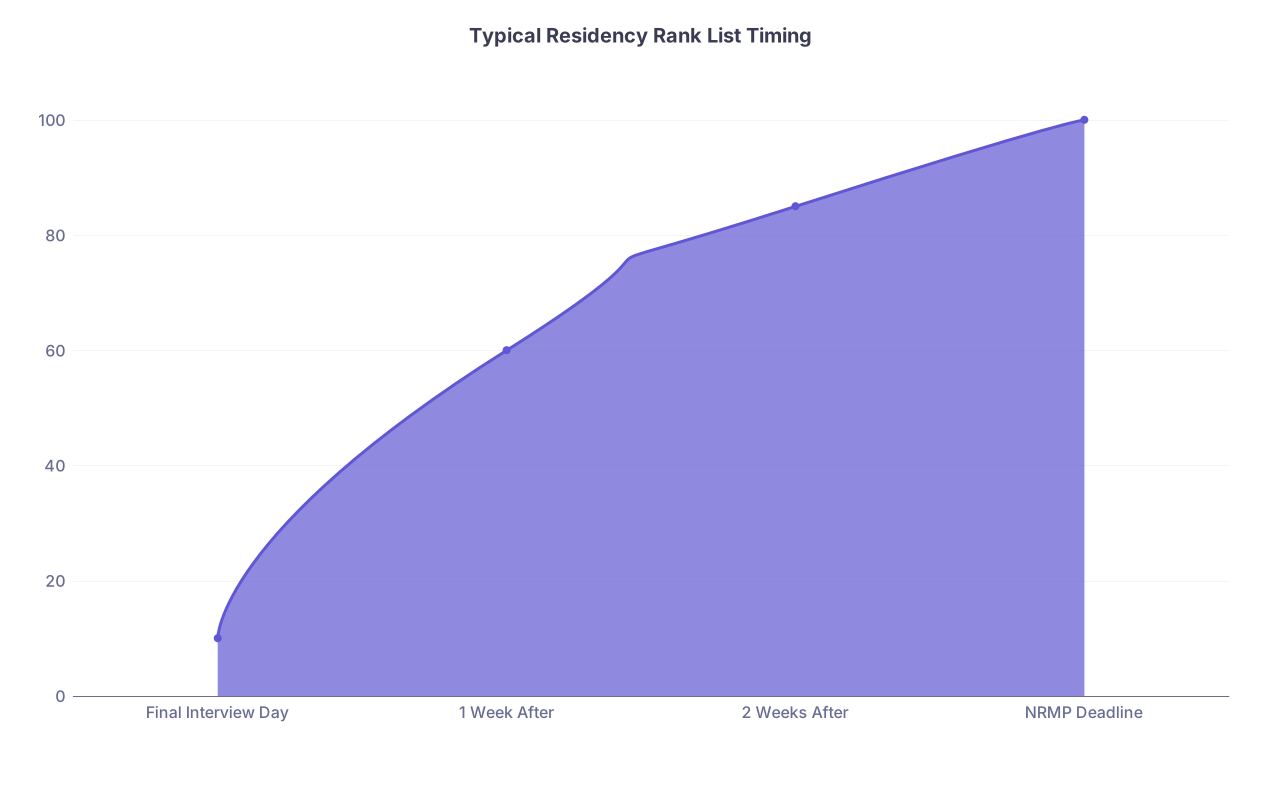
| Category | Value |
|---|---|
| Final Interview Day | 10 |
| 1 Week After | 60 |
| 2 Weeks After | 85 |
| NRMP Deadline | 100 |
That “100” near the NRMP deadline is essentially: everything is locked by then.
So your update email window is real but short.
How to judge timing in practice
Use this order:
- Check their interview day slide deck or email. Some programs say flat out: “We do not accept post-interview updates.”
- Look at your interview calendar. If your interview was in early December and it’s now February and they’re done interviewing—your window is closing.
- General rule of thumb:
- Within 2 weeks of your interview: safe to send a meaningful update.
- Within 2–3 weeks of their last interview date: maybe still helps.
- After that: likely too late, unless it’s a massive thing (e.g., new Step 2 CK that addresses a real concern).
If you’re right up against the NRMP deadline, assume their list is done. An email now is more for your anxiety than their decision-making.
When you definitely should send a separate update
Let’s be concrete. These scenarios almost always justify a separate email after your thank-you.
1. A new Step 2 CK score that changes your story
Example: You had a low or barely passing Step 1, and now you’ve got a strong Step 2 CK.
- Step 1: PASS / 205 equivalent
- Step 2 CK: 244
That is absolutely rank-relevant. Programs care about your trajectory and your ability to pass boards.
What to do:
- Send one concise email to your program coordinator or program director, depending on their stated preference.
- Attach or mention that the score has been released in ERAS.
2. A truly significant research or academic milestone
This means:
- A manuscript accepted at a recognizable journal (even if early online).
- A major national presentation (e.g., podium at ACS, AHA, RSNA, ASCO).
- A substantial award that reflects excellence in the specialty.
“Poster accepted at small regional meeting” is nice. It’s not a major update.
3. Large, clear improvement or validation in clinical performance
- Honors in a key sub-internship in their specialty, especially at a well-known institution.
- Strong letter added from a key faculty in that field (only if it’s now uploaded and visible).
You’re not emailing to brag. You’re signaling: “That concern you maybe had about my clinical or exam strength? Here’s data that addresses it.”
4. Big logistical changes that affect your file
- Couples Match partner now applying to that city or program.
- Visa status changed (e.g., now able to accept a category that program sponsors).
- You had to withdraw from another specialty and are now fully committed to this one (rare but happens).
In these cases, you’re aligning expectations and preventing surprises. Programs would rather know than guess.
When you should not send another email
This is where most applicants mess up.
You do not send a separate update email if:
- You just want to say again that you’re “very interested.”
- You already told them they are your #1 program and nothing new has changed.
- Your “update” is something like: another shadowing shift, a small local talk, or “I’ve continued to grow as a team member on my current rotation.”
- They explicitly told you they do not consider post-interview communication.
And you definitely don’t send:
- Weekly “checking in” emails
- A new email every time a minor CV line appears
- A long emotional essay about how much matching there would mean to you, with no new data
Here’s what programs actually say behind closed doors when they see that repeated stuff: “This person is anxious, doesn’t follow directions, and doesn’t understand boundaries.” That’s not the impression you want.
How to send a major update without being annoying
You only get a few shots at post-interview communication: your thank-you, maybe a genuine “you’re my #1” letter, and at most one true update if warranted.
So if you decide you should send an update after your thank-you, do it like a professional.
Who to email
Default: Program coordinator and Program Director (PD) on the same thread.
If the program told you a specific structure (“all communication through the coordinator” or “contact APD Smith”), follow that.
Never mass-email 8 faculty separately with the same update. They talk. It looks disorganized.
Subject line examples
Keep it clean and obvious:
- “Application Update – [Your Name], [AAMC ID]”
- “New Step 2 CK Score – [Your Name]”
- “Major Application Update – [Your Name], [Specialty] Applicant”
Not: “Quick Update!!!” or “Just checking in about ranking…”
Exact email template you can adapt
Here’s the skeleton that works:
Subject: Application Update – [Your Name], [AAMC ID]
Dr. [PD Last Name] and [Program Coordinator Name],
Thank you again for the opportunity to interview at [Program Name] on [interview date]. I remain very enthusiastic about the possibility of joining your residency program.
I’m writing to share a brief update to my application:
- My Step 2 CK score was released on [date]: [score]. This has been uploaded to ERAS.
OR
- Our manuscript, “[Title],” was accepted for publication in [Journal Name] on [date]. This work is included in my updated ERAS application.
I understand how busy this season is and appreciate your time and consideration.
Best regards,
[Full Name], [Medical School]
AAMC ID: [Number]
[Phone] (optional)
Short. Respectful. Zero fluff. One clear update.
If you’re also sending a single, honest “you are my top choice” letter, do not bury that inside an “update” email. That’s a separate, very specific communication.
Where to put smaller updates instead
If your update is minor but still real (small poster, local talk, ongoing role in a project), here’s the better move:
- Update ERAS (if possible) or your CV.
- Be ready to talk about it if a program brings you back for a second look or calls you.
- Let it live in future conversations and not in their clogged inbox.
Programs do not have time to parse every micro-update from every applicant. They’re trying to remember who you are on interview day, whether you’d be safe and pleasant to work with at 2 a.m., and if your numbers fit their historical comfort zone.
Your 14th poster isn’t going to change that.
Example scenarios: Should you send the email?
Let’s run through real-world examples.
| Scenario | Send Email? | Why |
|---|---|---|
| New Step 2 CK: 248 after Step 1 pass | Yes | Major, rank-impacting |
| Poster accepted at small regional meeting | No | Minor, not worth separate email |
| Manuscript accepted in a solid specialty journal | Yes | Significant academic milestone |
| “I thought more and now you’re my top choice” | Maybe (once) | Only if honest and done once |
| Another month of general volunteering | No | Routine, not rank-changing |
| Visa eligibility improved to common category | Yes | Directly affects program ability to rank you |
If your situation looks like the top, middle-left, or bottom row? Send.
If it looks like the others? Skip the separate email.
How this fits with thank-you notes and “love letters”
Quick hierarchy so you don’t turn into the person with 5 scattered messages:
Thank-you emails
- Sent within 24–72 hours
- Short, specific, polite
- No updates unless they already happened before interview day and are critical
Single preference signal (“You are my #1” letter)
- Optional, but if you do it, do it once, honestly
- Sent after you have your own rank list mostly settled
One true major update email (if needed)
- Only for big, objective changes
- As early as possible once the update is official
If you’re tempted to send more than one of each category to the same program, you’re probably overdoing it.

| Step | Description |
|---|---|
| Step 1 | Interview Day |
| Step 2 | Thank-you Email |
| Step 3 | No Further Update Needed |
| Step 4 | Send 1 Major Update Email |
| Step 5 | May Affect List |
| Step 6 | Low Impact, Still Fine |
| Step 7 | Send 1 Honest #1 Letter |
| Step 8 | Major New Info? |
| Step 9 | Program Still Ranking? |
| Step 10 | True #1 Program? |
FAQ: Major Updates After the Thank-You
1. Should I combine my “you are my #1 program” message with a major update, or send separate emails?
If the timing aligns, you can combine them, but keep it controlled. One email that says, “Here’s my new Step 2 CK score, and I also want you to know your program remains my top choice,” is acceptable. Just don’t send multiple overlapping messages on different days saying the same thing in slightly different words. And never tell more than one program they’re your “#1.”
2. What if my new Step 2 CK score is lower than I hoped—should I still send it as an update?
If it’s already in ERAS or soon will be, you do not need a separate email to announce it. The only time I’d send an explicit update about a weaker score is if: 1) the program told you they’re waiting on your Step 2, or 2) you know they require it before ranking. Then a short, neutral “My Step 2 CK score has been released and is now available in ERAS” is enough—no commentary, no excuses.
3. I got an email from the program saying they don’t use post-interview communication. Should I still send major updates?
No. Take them at their word. These policies exist to keep things fair and to reduce gamesmanship. If they explicitly say “we do not consider post-interview communication,” then sending extra “but this is really important!” updates just shows you can’t follow instructions. Update ERAS instead and let your file speak for itself.
4. How long after my update happens is it still reasonable to email them about it?
Ideally within 7 days of the update becoming official (score release, acceptance email, award notification). The farther you get from that—and the closer to the NRMP deadline—the less it matters. If it’s been a month and you’re within a week of rank list certification, I’d skip the email unless it’s truly massive (e.g., a board-passing score that resolves a previous failure).
5. Can I send different updates to different programs based on what they seemed to care about?
You can choose which programs receive your update, but don’t tailor facts. If your Step 2 CK score came out, it’s not a secret. If you choose to email, stick to the same core information everywhere. Where you can customize is the framing: a research-heavy program might care more about your new publication; a community program might care more about strong sub-I performance. Just don’t exaggerate or omit major pieces selectively.
6. What if I already sent a thank-you, a “you’re my top choice” email, and now I have a big update—am I overdoing it if I send one more?
You’re close to the line, but not automatically over it. If the update is truly big (new strong Step 2, major publication, big award) and the timing is still okay, you can send one more message, very concise, clearly labeled as a factual update. Skip any additional “I love your program so much” language; they’ve already heard that from you. If the update is only medium importance, at this point I’d let it live in ERAS and keep quiet.
Key takeaways:
Most applicants should not send separate “update” emails after their thank-you unless there’s a truly rank-relevant new development and the program is likely still finalizing its list. When in doubt, err on the side of fewer, cleaner, more objective emails—not constant reminders that you exist.