It’s late November. You’ve just finished three interviews this week, you’re exhausted, and your inbox has a bunch of “Thank you for interviewing with us” messages from programs. Everyone keeps telling you to send follow-up emails. You’ve got one “pretty good” template drafted and you’re tempted to just plug in the program name and hit send.
Here’s the question you’re actually asking yourself:
Is one generic template enough for post-interview emails to residency programs—or is that going to hurt me?
Short answer: one base template is fine. One generic email that you barely tweak and blast to every program is lazy, obvious, and not good enough.
Let’s break this down properly.
The Core Answer: One Template vs. One Strategy
You can absolutely start with one master template. In fact, you should. It saves time, keeps you from reinventing the wheel, and prevents stupid errors when you’re tired and post-call from a sub-I.
But no, a single generic paragraph that you send to 20+ programs with only the program name swapped out is not enough if you care about:
- Looking genuinely interested
- Not sounding like a copy-paste robot
- Highlighting fit in competitive programs
Programs read hundreds of these. They can smell generic a mile away. I’ve seen PDs scroll through emails saying, “Same line they sent the other three programs we know they interviewed at.” Yes, they compare.
Here’s the right way to think about it:
- One structure for all programs
- Program-specific content blocks inside that structure
So you use one skeleton, but you personalize 20–40% of the email per program.
What Your Post-Interview Email Actually Needs To Do
Forget the fluff. A post-interview email has 3 jobs:
- Thank them for their time.
- Show you were actually present on interview day (specifics).
- Reinforce fit / clarify interest level.
That’s it. You’re not rewriting your personal statement. You’re not begging. You’re closing the loop and making yourself easier to remember in a stack of very similar applicants.
Here’s a simple structure that works for almost every program.

A Solid Base Template (That You Then Personalize)
Use this as your base. Then we’ll talk about what must be customized.
Subject line options (pick one style and stick to it):
- Thank you – [Your Name], [Specialty] Applicant
- Thank you for the interview – [Your Name]
- [Your Name] – Appreciation for [Program Name] Interview
Body:
Dear Dr. [Last Name] / [Program Coordinator Name],
Thank you for the opportunity to interview with the [Program Name] residency program on [interview date]. I appreciated the chance to learn more about your program and to meet your residents and faculty.
I was especially impressed by [specific detail #1 from interview day] and [specific detail #2 – curriculum, culture, or something you discussed personally]. These aspects align strongly with my interests in [your interest – e.g., medical education, underserved care, research focus].
My experience on interview day confirmed that [Program Name] would be an excellent fit for my training, and I would be excited to contribute to your [service, community, specific clinic or track] as a resident.
Thank you again for your time and consideration.
Sincerely,
[Your Name], MD Candidate
[Medical School]
AAMC ID: [Optional but helpful]
That’s your one template.
Now, here’s what you absolutely must change each time:
- Interview date
- Names (program, PD, coordinator)
- Two specific details unique to that program
- The interest line so it actually matches what they offer
If those four pieces aren’t specific, then yes—you’re sending a generic email, and it’s obvious.
How “Customized” Does This Really Need To Be?
You’re not writing seven new paragraphs per program. You’re intelligently swapping out 2–4 surgical details that make the whole email feel tailored.
Think in terms of three zones:
| Level | What It Looks Like | Good Enough? |
|---|---|---|
| 0 - Pure Generic | Only program name changed, vague compliments | No |
| 1 - Light Custom | 1–2 specific details from that interview | Yes, for most programs |
| 2 - High Custom | Details + ties to career goals + follow-up on specific convo | Yes, for top/competitive choices |
My recommendation:
- Level 2: Top 3–5 programs on your list
- Level 1: Everyone else you’re seriously ranking
- Level 0: Never
Concrete examples of non-generic specifics
These are real-ish things I’ve seen or heard:
- “I appreciated hearing Dr. Smith describe how interns are protected for didactics, and how residents feel comfortable speaking up on rounds.”
- “The resident-led QI project on reducing CHF readmissions at your county hospital really aligned with my interest in quality improvement.”
- “I was particularly drawn to the 3+2 research track and the protected research time you described during the noon conference.”
- “Talking with Dr. Patel about balancing a career in academic neurology with raising a young family was very encouraging.”
Those details prove you were paying attention and that this isn’t the same email you sent to twenty other programs.
Should You Have Different Templates for Different Situations?
This is where people overcomplicate things. Do you need six templates? No. But you should have variants for a few common scenarios.
At minimum, I’d keep these in your toolbox:
- Standard post-interview thank you (above).
- Follow-up to PD / APD you had a longer 1:1 conversation with.
- Email to the program coordinator (logistics-focused, shorter, sometimes same as standard).
- Post-interview “update/interest” email later in the season (January/February).
You can build all four from the same spine.
Example: PD follow-up variant
Dear Dr. [PD Last Name],
Thank you again for speaking with me during my interview at [Program Name] on [date]. I especially appreciated our conversation about [topic – leadership, patient population, subspecialty training, etc.], and your perspective on [specific point they made].
Learning more about [specific clinic, track, or structure] reinforced my sense that [Program Name] would be an outstanding place to grow as a [specialty] physician. I was particularly encouraged by [another concrete thing – resident autonomy, fellowship match, support systems].
I remain very interested in your program and am grateful for your time and consideration.
Sincerely,
[Your Name]
Same bones. Slightly more focused on the content of your specific PD conversation.
Timing, Frequency, and Who Actually Gets an Email
Let me cut through the noise.
When to send
- Standard thank you: within 24–72 hours after the interview
- PD/APD specific follow-up: same window, or within a few days
- Later “I’m very interested” / “rank list” style email: Jan–Feb, after you’ve seen most programs
If you’re more than a week out, send it anyway. Late is better than never.
Who to email
Baseline strategy:
- Always email the program coordinator or centralized program email (they track this stuff).
- Optionally email the PD if:
- You had a meaningful conversation with them, or
- It’s a smaller program where PD contact is clearly the norm.
You do not need to email every single interviewer separately unless they gave you their card or specifically invited follow-up. If you do, keep it very short and specific to your conversation.
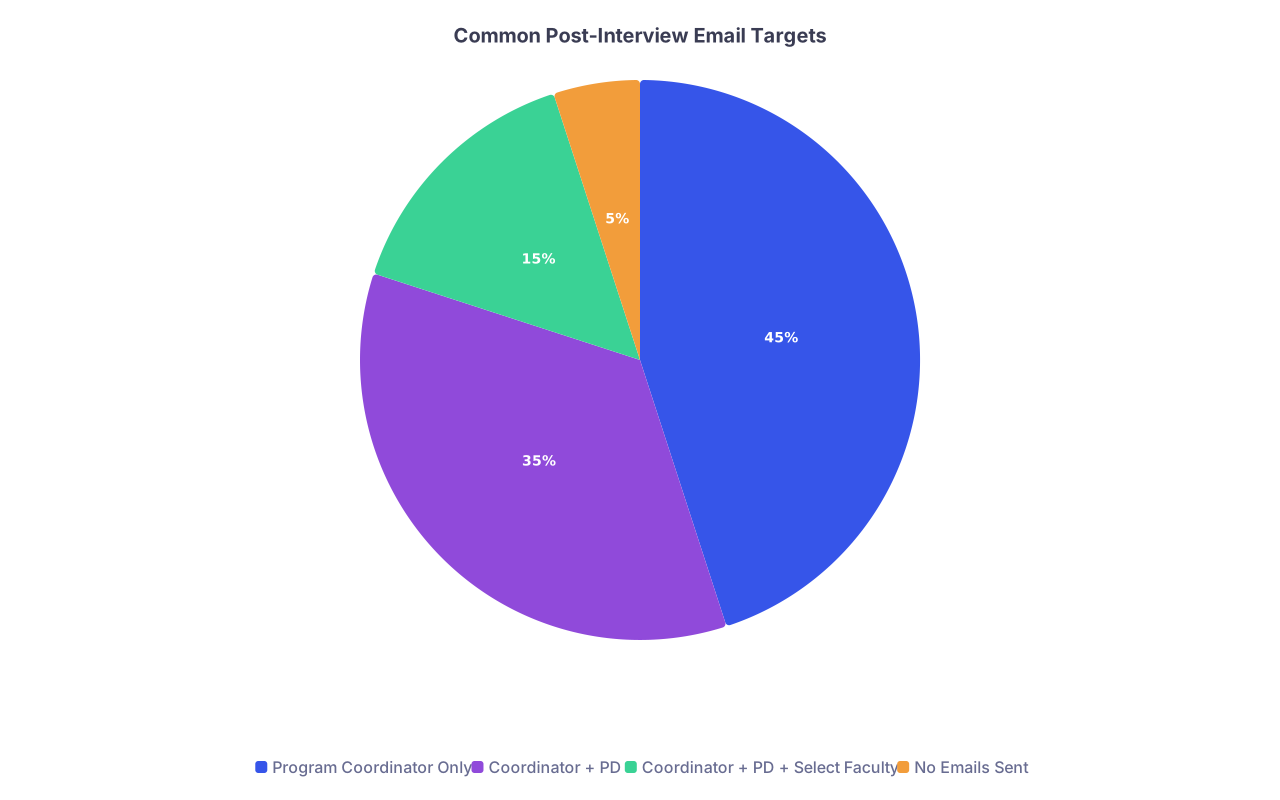
| Category | Value |
|---|---|
| Program Coordinator Only | 45 |
| Coordinator + PD | 35 |
| Coordinator + PD + Select Faculty | 15 |
| No Emails Sent | 5 |
Those numbers aren’t from a single dataset; they’re close to what I’ve personally seen across graduating classes.
How Much Does Any of This Actually Matter?
This is the part nobody says out loud: a great thank you email is rarely the reason you match. But a sloppy or obviously generic one can be a small negative. And when you’re clustered near the margin with a bunch of similar applicants, small negatives add up.
What the emails actually do:
- Keep your name fresh in their mind when they’re finalizing the rank list
- Demonstrate professionalism and basic courtesy
- Give you a channel later to express strong interest (without breaking NRMP rules about soliciting rank info)
What they do not do:
- Turn a weak application into a strong one
- Overrule massive concerns from the interview day
- Guarantee anything about where they put you on the list
Programs are not sitting around saying, “We were going to rank her #18, but that email moves her to #1.” That’s fantasy. But I have heard things like: “She was on the fence, but she’s clearly really interested and seems thoughtful. Let’s keep her in the main list instead of dropping her.”
That’s the realistic impact.
A Practical Workflow So You Don’t Go Crazy
If you’re trying to custom-write every email from scratch, you’ll burn out by your sixth interview. Use a system.
Here’s a clean workflow:
- Before the season starts, build your base template(s) in a text file or note app.
- During each interview, keep a running list of:
- Specific things you liked
- Names of residents/faculty you clicked with
- Any unique program features you actually care about
- Within 24 hours, plug 2–3 of those into your template while the day is fresh.
- Keep a tracking sheet: program, date, who you emailed, and when.

| Step | Description |
|---|---|
| Step 1 | Finish Interview Day |
| Step 2 | Write down 3 specific details |
| Step 3 | Open base email template |
| Step 4 | Customize name, date, details |
| Step 5 | Proofread for wrong program name |
| Step 6 | Send within 24-72 hours |
| Step 7 | Log email in tracking sheet |
One more harsh reality check: if you copy-paste and forget to change the program name, that’s way worse than sending nothing. I’ve seen it; PDs make fun of it; it sticks.
What About “Love Letters” and Rank List Emails?
Different question, but related.
Those later-season “I will rank you highly” or “I’m ranking you #1” style emails should not use the exact same post-interview thank you template. Different purpose.
For those:
- Shorter is better.
- You must actually mean what you say (don’t tell multiple programs they’re #1).
- You still reference specifics, but the main point is your level of interest, not rehashing the entire interview.
And again, you can start from a base template, then edit heavily for the few programs where you send those.
FAQ: Post-Interview Emails and Templates
1. Do programs actually read post-interview thank you emails?
Yes. Not always in detail, but coordinators track them, PDs skim them, and occasionally they’re discussed when applicants are very similar. They’re not decisive, but they’re not meaningless.
2. Is it bad if I do not send any post-interview emails?
Not fatal, but suboptimal. You won’t fail to match because you skipped them, but you’re leaving some professionalism and a small potential advantage on the table. If you’re reading this early enough, just send them.
3. How long should a post-interview email be?
About 1 short paragraph to 3 medium paragraphs. Think 100–200 words. If it starts to feel like a personal statement, it’s too long. The PD will not read a wall of text at midnight after a full clinic.
4. Can I use the exact same template for every specialty/program type?
Use the same structure but adjust content. A community FM program and a research-heavy IM academic powerhouse care about different things. If all your emails rave about NIH funding and R01s to community programs with none, you look tone-deaf.
5. Should I mention where I’ll rank a program in my thank you email?
Not in the initial thank you right after the interview. Keep that neutral and professional. If later in the season you’re certain about your list, a separate, concise email expressing strong or top interest is more appropriate.
6. Do I need to email every single interviewer?
No. Baseline: program coordinator and/or PD. You can email an individual interviewer if you had a particularly meaningful conversation or they invited follow-up, but do not feel obligated to hit everyone. That’s how you end up writing 150 emails and making mistakes.
7. What’s worse: sending a clearly generic email or sending nothing?
Clearly generic with mistakes (wrong program name, obviously mismatched details) is the worst. Then comes obviously generic but technically correct. Then nothing. Best is a short, accurate, mildly personalized email that proves you were paying attention.
Key points to walk away with:
- One base template is fine. One generic email copy-pasted to every program is not.
- Customize 2–4 concrete details per program—names, specific features, and how they match your goals.
- Send short, specific, timely emails; they won’t win the match for you, but they can quietly help—and a sloppy generic one can quietly hurt.