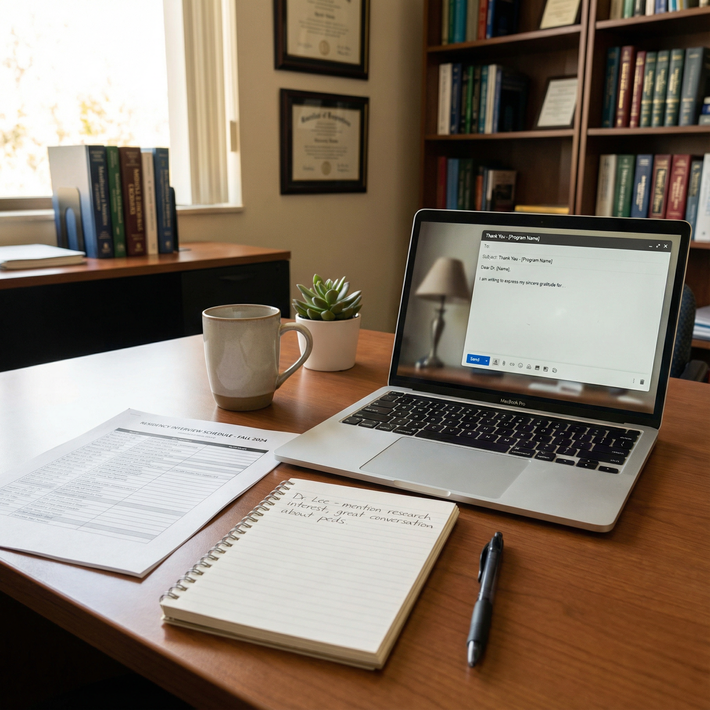
It’s 10:47 p.m. You just finished your third virtual interview of the week, your eyes are fried, your suit jacket is still on your chair, and your inbox is a graveyard of half-written thank-you emails. You’re staring at a blank screen thinking: “Can I just use AI or a template for this and be done?”
Here’s the answer you’re actually looking for:
Yes, you can use AI or templates. But you can also absolutely screw it up and sound fake, lazy, or worse—clueless.
Let’s sort out how to do this the right way.
The Real Role of Thank-You Notes in Residency
Before we talk AI or templates, you need to understand the stakes.
Programs are not sitting there with a spreadsheet ranking your thank-you quality. Thank-you notes:
- Rarely make or break a rank decision.
- Sometimes help a faculty member remember you more clearly.
- Occasionally become tie-breaker “soft data” (“Oh yeah, they followed up about our global health track.”).
- Can hurt you if they’re obviously generic, wrong program name, or sound like ChatGPT hallucinated your interview.
So thank-you notes are low risk / low-to-moderate reward.
Your job: Be professional, accurate, and human. Not Shakespeare.
That’s where AI and templates can help—if you’re in control.
Short Answer: Is It Okay To Use AI or Templates?
Yes. With conditions.
Here’s my stance:
- Using AI or templates as drafting tools = fine, smart, time-saving.
- Copy-pasting AI output or the same template word-for-word to everyone = lazy, risky, and obvious.
- Letting AI invent details about the conversation = no, absolutely not.
Use AI and templates the way you’d use a spell-checker or a phrase bank: to speed up the boring parts while you keep control of the important parts—specifics, tone, and accuracy.
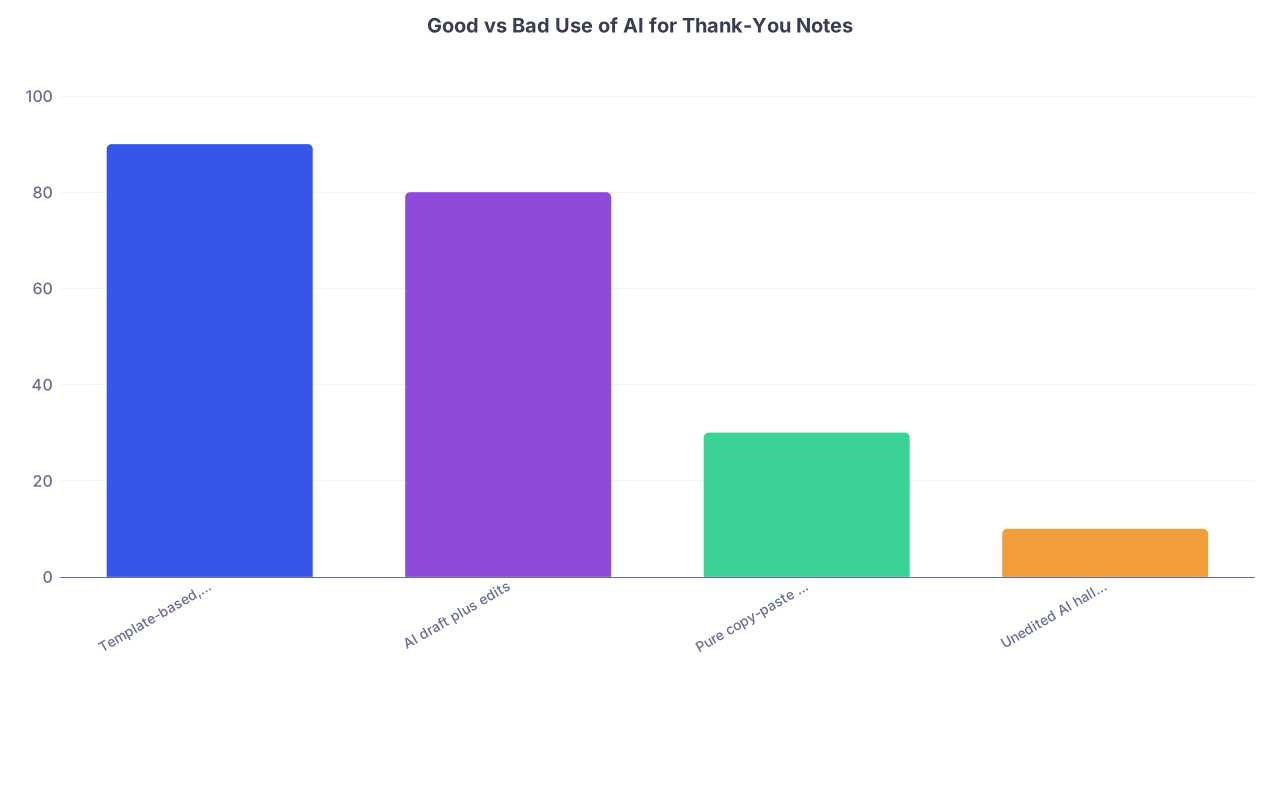
| Category | Value |
|---|---|
| Template-based, personalized | 90 |
| AI draft plus edits | 80 |
| Pure copy-paste template | 30 |
| Unedited AI hallucinations | 10 |
Numbers are approximate “professional-approval” scores out of 100 if you’re wondering.
How Programs Actually Perceive Thank-You Notes
I’ve heard the same lines from PDs and faculty over and over:
- “Nice, but not required.”
- “I skim them on my phone.”
- “I like when they reference something specific we talked about.”
- “I roll my eyes when they clearly sent the same message to everyone.”
Nobody is impressed by:
- “I am writing to express my deepest gratitude for the opportunity to interview…” (AI/classic template red flag)
- A paragraph that could be sent to any program in any city in any specialty.
- Overly formal, stiff language that doesn’t match how you spoke on interview day.
People do respond well to:
- One or two specific callbacks to your actual conversation.
- A quick, clear restatement of your interest, especially if the program is genuinely high on your list.
- A short, readable email—5–10 sentences, not a novel.
So the bar is low, but it’s specific. AI and templates help you hit that bar faster, not for you.
How to Use AI and Templates the Right Way
Here’s the workflow that actually works when you’re exhausted and interviewing constantly.
Step 1: Create One Master Template
Yes, one. Not 15. Something like this:
Subject: Thank you – [Your Name], [Specialty] Interview
Dear Dr. [Last Name],
Thank you for taking the time to speak with me during my interview at [Program Name] on [Interview Date]. I appreciated hearing about [specific topic you discussed].
Our conversation about [second specific or general theme] reinforced my interest in [Program Name], especially because of [program-specific reason]. I can see myself thriving in a program that offers [something true about them that you actually care about].
I’m grateful for the opportunity to interview and to learn more about the residency. Please extend my thanks to the rest of the team.
Sincerely,
[Your Full Name]
[Medical School]
That’s your skeleton. Totally fine to reuse.
Step 2: Use AI for Polishing, Not Thinking
Where AI fits:
- Cleaning up clunky sentences.
- Adjusting tone (more formal / more conversational).
- Shortening a wall of text.
- Turning bullet notes into coherent sentences.
Example: You paste in your messy draft + your bullets from the interview:
- “Talked about her time as program director and wellness initiatives”
- “I liked their 3+1 schedule”
- “Mentioned global health elective in PGY-3”
You ask AI: “Turn this into a 6–8 sentence professional, but friendly thank-you email to the interviewer. Keep it specific to these points.”
Then—this is the critical part—you read every word and fix anything that:
- Doesn’t sound like you.
- Adds details you didn’t say or hear.
- Over-fluffs (“deeply honored,” “profoundly grateful,” etc.).
If you wouldn’t say it out loud, don’t leave it in your email.
How to Personalize Without Killing Yourself
You’re not writing a love letter. You’re writing a professional follow-up. Each note needs some unique content, not total reinvention.
Here’s the minimum personalizing I’d insist on:
Correct name, title, and program.
This is the baseline. Mess this up and you’ve just told them you don’t pay attention.One specific callback to your conversation.
Examples:- “I enjoyed hearing how the X+Y schedule has improved ambulatory training.”
- “I appreciated your honesty about how the program supports residents on tough rotations.”
- “Our discussion about opportunities for resident teaching was especially meaningful to me.”
One program-specific reason you’re interested.
Not just “strong clinical training.” That fits every program.Better:
- “Your emphasis on resident autonomy in the MICU.”
- “The close collaboration with the VA.”
- “The structured global health track with time protected in PGY-2/3.”
If you’re truly slammed, you can batch this:
- Keep a short note file after each interview: 3 bullets per interviewer.
- When writing thank-yous, plug one bullet into the template.
- Optionally have AI help shape the sentence, then edit.

| Step | Description |
|---|---|
| Step 1 | Finish Interview |
| Step 2 | Write 3 Bullet Notes per Interviewer |
| Step 3 | Copy Master Template |
| Step 4 | Insert Name, Program, Specific Detail |
| Step 5 | Use AI to Polish Draft |
| Step 6 | Proofread Yourself |
| Step 7 | Edit for Accuracy and Voice |
| Step 8 | Send Within 24-48 Hours |
| Step 9 | Need Help with Wording? |
Things That Make You Look Obviously AI/Template-Generated
This is where people get themselves in trouble.
Red flags faculty recognize immediately:
- Same identical paragraph sent to multiple people in the same department (they compare sometimes).
- Overly formal phrases: “I am writing to extend my sincerest gratitude…” or “It was an absolute privilege and honor…”
- Zero specifics. If your email would still be true if you changed the program name and specialty, it’s generic.
- Weird AI artifacts: slight repetition, oddly dramatic language, or details that never came up.
Quick self-check before you send:
- Does it mention something we actually talked about?
- Does any sentence sound like a robot or a brochure?
- Could this email be sent to 20 programs unchanged? If yes, it’s too generic.
If you’re using AI, tell it not to sound like a press release. Literally:
“Make this sound like a normal resident applicant, not corporate or dramatic.”
Email vs Handwritten Notes vs Doing Nothing
Let’s kill this debate quickly.
Email thank-you:
- Fast, trackable, normal for residency.
- Easy to personalize lightly.
- Works fine for virtual or in-person interviews.
Handwritten card:
- Nice but not needed.
- Can backfire if it arrives way too late or you mis-spell names.
- Most people won’t have time or energy for this, and that’s okay.
No thank-you at all:
- Often neutral. Many PDs truly don’t care.
- Slight miss on professionalism if everyone else is at least sending one.
- Generally, if you liked the program or want to keep the door open, just send the email. Low effort.
AI/templates are only relevant for the thing that’s actually common: quick emails.
Timing, Length, and Number of Notes
You don’t need an AI for this part; you just need concrete rules.
Timing:
- Aim for 24–48 hours after the interview.
- Later is still better than never, but after a week+ it’s basically an “I remembered you exist” note.
Length:
- 5–10 sentences.
- One screen on a phone. If they need to scroll a lot, it’s too long.
Who gets a note?
- Every faculty member you interviewed with 1:1.
- The PD and APD if you met them, even briefly.
- Optional: chief residents or residents who spent significant interview time with you, especially if they were influential.
Templates + AI shine here: same base, personal tweaks, done.
| Item | Good Target |
|---|---|
| Timing | Within 24–48 hours |
| Length | 5–10 sentences |
| Personal specific detail | 1–2 per email |
| Who to email | All interviewers + PD/APD |
| AI usage | Draft/polish, then human edit |
What You Should Never Let AI Do For You
AI is a tool. You’re the applicant. Some lines you don’t cross:
- Don’t let AI invent stories: research interests you don’t have, rotations you didn’t do, conversations that never happened.
- Don’t auto-generate 20 “unique” emails and send them without reading them.
- Don’t use AI to exaggerate your interest as “I will rank you #1” unless that’s 100% true and appropriate for that program and phase of the season.
If something in the email could be considered a promise, commitment, or factual statement about you—you write and verify that part.
Example: AI/Template Used Well vs Poorly
Bad (obviously templated/AI):
Dear Sir/Madam,
I am writing to express my sincerest and profound gratitude for the opportunity to interview with your esteemed program. It was truly an honor to speak with you and learn more about your exceptional training environment. I was incredibly impressed by your unparalleled commitment to education and patient care. I would be thrilled to have the opportunity to train at your prestigious institution.Sincerely,
[Name]
Could be anyone. Anywhere. Any specialty.
Better (template + light personalization):
Dear Dr. Lopez,
Thank you for taking the time to speak with me during my Internal Medicine interview at Riverside Medical Center yesterday. I appreciated hearing how you’ve built up the primary care track and how residents get continuity clinic from day one.
Our conversation about balancing autonomy with support on night float really stuck with me. I’m drawn to Riverside’s mix of a busy county hospital with strong academic backing, and I can see myself growing a lot in that environment.
I’m grateful for the chance to learn more about the program. Thanks again for your time and for answering my questions so honestly.
Best,
[Your Name]
That email easily could have started from a template or AI draft. Doesn’t matter. It reads like a real person who actually showed up.
Quick Practical System You Can Actually Maintain
If you’re on interview 12 and your brain is mush, use this simple system:
- Immediately after each interview block, open a note on your phone.
- For each interviewer: write 2–3 bullets (specific topic, vibe, anything memorable).
- That evening or next day:
- Paste your master template into an email.
- Fill in name, program, date.
- Turn one bullet into a specific sentence. Optionally use AI to polish it.
- Skim for errors. Check names and program carefully.
- Send. Move on with your life.
You don’t need perfection. You need “clear, polite, specific enough, not weird.”

FAQs
1. Do programs actually care about thank-you notes at all?
Some do, some don’t. Most don’t weigh them heavily. But they can help remind someone who you are and reinforce interest, and they can hurt you if they’re careless, generic, or wrong. Think of them as low-cost professionalism, not a magic ranking boost.
2. Is it dishonest to use AI to draft my thank-you notes?
Not if you’re using AI like a writing assistant, not a ghostwriter. You provide the facts and specifics, you review and edit the output, and you make sure everything is accurate and genuinely reflects you. Letting AI fabricate or exaggerate—yeah, that’s a problem.
3. Can I use the same template for every program?
Yes, the structure can be the same. The content should change: names, program, at least one specific detail from your conversation, and one real reason you like that program. If your note is 90% identical across 20 programs, you’ve gone too far into copy-paste land.
4. What if I forget to send thank-you notes until a week later?
Send them anyway. Skip the fake “sorry this is late” intro. Just thank them, mention a specific detail from your conversation, and express interest. At that point, it’s less about influencing rank and more about closing the loop professionally, but that’s still worth doing.
5. Should I send a separate thank-you to the PD if I already emailed the coordinator/program email?
Yes. If you met the PD or APD personally, they should get a direct note from you. The coordinator email is more for logistics and general appreciation to the team. PDs don’t need a long message—just a short, specific thank-you referencing something from the day.
6. How many is “too many” thank-you emails from one applicant?
One email per interviewer + PD/APD is fine. You don’t need to send follow-up after every single interaction or social event. Don’t spam. No “just checking in” or “wanted to reiterate my interest again” unless it’s late season and you’re sending a formal, honest “you’re my top choice” letter.
Key points to remember:
- Using AI or templates for thank-you notes is fine—if you control the specifics, accuracy, and tone.
- Every note needs at least one real callback to your conversation and one genuine, program-specific reason you’re interested.
- Aim for short, specific, and human. Not dramatic. Not generic. Not obviously copy-pasted.