
Did you tell them you want a very specific career—and now you’re wondering if you should double down on it in your thank-you note?
Good. Because that moment—how you follow up after you’ve already planted a specific career goal in their heads—can quietly make or break how “real” you seem to a program.
You told the PD you’re committed to academic cardiology. Or community primary care. Or peds heme-onc at a tertiary center. Or hospitalist with a big interest in QI and leadership.
Now you’re staring at a blank email draft thinking:
“If I repeat this, will I sound like a robot? If I don’t, will they think I was just saying what they wanted to hear?”
Here’s how to handle that exact situation.
Step 1: Get brutally clear on what you actually said
Before you write anything, reconstruct what you actually told them on interview day. Not what you wish you said. What you really said.
Do this fast—same day if you can, next day at worst.
- Pull up your interview schedule
- Jot down 1–2 bullet points per person: “Dr. Kim (PD) – talked about pulm/critical care interest”
- Note any phrases they latched onto: “You mentioned X… tell me more about that”
If you told three different people three different future plans, you have a bigger problem: inconsistency. You can still fix it, but you need to see the mess first.
This is the rule: your follow-up note must match and refine what you already said, not contradict it.
If on interview day you said:
- “I’m thinking about heme-onc or hospitalist work, not totally sure”
Your email should not suddenly say:
- “I know for certain I will pursue a competitive heme-onc fellowship at an academic center.”
Programs have good memories and shared notes. Do not invent a new version of yourself in a thank-you email.
Step 2: Decide what you’re reinforcing—goal, direction, or openness
You’re not always reinforcing a narrow fellowship goal. Sometimes you’re reinforcing a direction. Or genuine openness.
There are three common buckets:
Specific Fellowship / Niche
- “I’m strongly interested in adult congenital cardiology”
- “My long-term goal is to be a peds heme-onc physician at an academic center”
Broad Direction
- “Leaning toward inpatient-focused careers, possibly hospitalist or critical care”
- “Drawn to primary care with strong interest in underserved populations”
Structured Openness (not ‘I have no idea’)
- “Open to several paths, but know I want a teaching-focused career in an academic setting”
- “Not locked into a single subspecialty, but very committed to research and education”
Your follow-up note should reinforce whichever of these you actually projected in the interview—just a bit sharper, cleaner, and more grounded.
What you do not want:
- Going from fuzzy to absurdly specific overnight
- Going from super-specific to “actually I have no idea” without any explanation
Step 3: Match your goal to what that program can realistically offer
Here’s where applicants quietly shoot themselves in the foot.
Programs read your follow-up note mainly through one filter:
“Can we realistically give this person what they say they want?”
If you wrote:
“I am committed to becoming a physician-scientist with an R01-funded lab”
and you’re writing to a small community program with zero research infrastructure—that sounds fake. Or worse, it tells them they’re just a backup.
You want alignment. Or at least believable partial alignment.
Use this mental table:
| Your Stated Goal | Program Type | How to Frame in Follow-Up |
|---|---|---|
| R01-level research, major academic niche | Big academic center | Emphasize research, mentors, resources |
| Academic clinician-educator | University or hybrid | Emphasize teaching, curriculum, med student exposure |
| Community-based practice | Community program | Emphasize outpatient, continuity, local populations |
| Still deciding, want broad exposure | Any solid program | Emphasize breadth of training, mentorship variety |
If the fit is imperfect, you do not lie. You adjust emphasis.
Example:
You told everyone: “I want to do transplant hepatology,” but this program doesn’t have liver transplant on site.
What you do:
- Emphasize your long-term GI interest and your excitement about their strong GI exposure and ICU experience.
- Mention that you’re looking for solid general IM training + opportunities to work with subspecialty mentors, not “I must do transplant here” (because you can’t).
Step 4: Use your follow-up note to connect your goal to something specific from the interview day
The worst kind of reinforcement is generic:
“Thank you again. I am very interested in cardiology and your program seems strong.”
Nobody remembers this. It reads like a mail merge.
You want something like:
- “Speaking with Dr. Shah about the longitudinal cardiology clinic solidified my interest in your program as a place to prepare for a cardiology fellowship.”
- “Our conversation about your rural continuity clinic aligned with my goal of practicing full-spectrum outpatient medicine in underserved settings.”
You’re doing two things simultaneously:
- Proving you were actually paying attention
- Making them imagine you in their system, doing the thing you say you want
Step 5: Adjust calibration by program type
What you reinforce changes slightly depending on where you’re writing.
1. Big academic programs
They actually care about your niche plans. They want people who will match into good fellowships and produce something: papers, QI projects, curricula.
In your follow-up:
- Name the subspecialty or direction clearly
- Tie it to:
- Research tracks
- Existing fellows/fellowships
- Specific faculty you met
Example language:
“Speaking with Dr. Hernandez about the pulmonary/critical care fellowship and your strong ICU volume affirmed that this would be an ideal place to grow toward my goal of a career in academic critical care, with a focus on quality improvement and medical education.”
Here, you:
- Reinforce critical care goal
- Reference a specific person/conversation
- Connect to their environment (ICU volume, fellowship, QI/education)
2. Community or hybrid programs
They often care more about:
- Bread-and-butter competence
- Whether you’ll stay in the area
- Whether your plans are realistic given their resources
If you told them you want to be a community clinician:
“Discussing the structure of your continuity clinic and the diverse patient population in [local area] reinforced my interest in developing as a strong outpatient internist who can eventually practice in a similar community-based setting.”
If you still want a fellowship:
- Do not pretend they are a massive research powerhouse
- Emphasize clinical strength and targeted mentorship
“I appreciated learning about your graduates who matched into cardiology from a primarily community-based environment. As someone who is strongly considering cardiology fellowship, the combination of high-volume clinical training and individualized mentorship you described is exactly what I’m looking for.”
Step 6: Handle the “I changed my mind after the interview” problem
This is common. You go into interview season saying “heme-onc,” then after three solid days on wards and one inspiring ICU attending, you’re suddenly thinking “hospitalist or critical care.”
What you cannot do is whiplash from one extreme to another between interview and thank-you note.
What you can do:
- Soften from hyper-specific to “directional” without sounding like you were lying.
- Use phrasing that admits evolution, not reversal.
Example:
On interview day, you said: “Very set on peds heme-onc.”
In your follow-up, you write:
“During medical school I became very interested in pediatric heme-onc, and I still see that as a strong possibility for my future. At the same time, the more I’m exposed to inpatient pediatric medicine, the more I recognize that my primary goal is to train at a program that will make me an excellent general pediatrician first, with mentorship to explore several potential subspecialty paths.”
This keeps:
- Your earlier story intact
- Your options wider
- Your credibility intact
If you changed from subspecialty to “honestly, I might just do general practice,” keep it framed as: greater appreciation, not random flip.
Step 7: Concrete email templates you can adapt
Let’s get very practical. Here’s how you actually write these things.
Template A: Specific subspecialty, strong academic fit
Subject: Thank you – [Your Name], [Specialty] Interview on [Date]
Dr. [Last Name],
Thank you again for the opportunity to interview at [Program Name] on [date]. I appreciated our conversation about [specific topic you discussed], especially your description of how residents interested in [subspecialty or niche] are supported through [research, mentorship, fellows, specific clinic, etc.].
As I mentioned during our meeting, my long-term goal is to pursue a career in [specific area – e.g., academic cardiology with a focus on heart failure]. Hearing about [concrete program feature: your cardiology fellowship, the structured research time, the echo lab exposure] reinforced my sense that [Program Name] would be an excellent place to develop the clinical and academic foundation needed for that path.
Thank you again for your time and for sharing more about the program. I left the interview day even more excited about the possibility of training at [Program Name].
Best regards,
[Your Name]
AAMC ID: [ID if you want to include]
Template B: Community-focused or generalist goal
Subject: Thank you – [Your Name], [Specialty] Interview
Dr. [Last Name],
Thank you for speaking with me during my interview at [Program Name]. I especially enjoyed hearing about [their continuity clinic / community partnerships / patient population] and how residents are prepared for independent community practice.
I’ve shared that my long-term goal is to work as a [primary care physician / community internist / hospitalist] serving [brief description: underserved populations, rural communities, etc.]. Learning about your [clinic structure / emphasis on outpatient medicine / strong inpatient training with autonomy] reinforced my belief that your program would prepare me well for that career path.
I appreciate your time and the insights you provided. It was clear from our conversation why residents speak so highly of the training at [Program Name].
Sincerely,
[Your Name]
Template C: Directional interest, still genuinely open
Subject: Thank you – [Your Name], [Specialty] Interview
Dr. [Last Name],
Thank you for taking the time to meet with me on [date] during my interview at [Program Name]. I enjoyed our discussion about [specific rotation, educational structure, or population].
As I mentioned, I’m currently most drawn to [inpatient-focused care / subspecialty training in fields like X or Y], but I’m entering residency with an open mind and a strong desire to build a solid foundation in [core specialty]. Hearing how your residents gain broad exposure across [key rotations, ICUs, subspecialties] and receive early mentorship as they explore different paths made me feel that [Program Name] would be an excellent environment to clarify and pursue my long-term goals.
Thank you again for your time and for sharing your perspective on the program.
Best,
[Your Name]
Step 8: What to avoid saying (because programs roll their eyes)
A few phrases I see that do you zero favors:
“Your program is my top choice” in a generic thank-you to every interviewer
- If you’re going to signal, do it once, late, and mean it.
“I know your program will get me into [highly competitive fellowship]”
- Sounds arrogant and naive. Talk preparation, not guarantees.
“I’m 100% certain I will do [fellowship]” when your CV screams you’ve never touched that field
- Programs can smell when this is performative.
Copy-paste thank-yous where the only thing you change is the program name
- Residents compare these. I’ve seen them read them aloud and laugh.
Your follow-up note should sound like a smart, grounded, semi-tired but thoughtful human wrote it. Not a brochure.
Step 9: Timing and who you send to
Ideal: within 24–48 hours of the interview. After a week, the emotional memory fades.
Who gets a note?
- Program Director – always
- Coordinator – a brief, separate thank-you is fine (they actually run the place)
- Any interviewer you had a real conversation with
- Common sense rule: if you remember something specific you talked about, send a short note
- If it was a 10-minute “hi, I’m the chair, nice to meet you” with no depth, it’s optional
You do not need to write a novel to every person. One solid paragraph each is plenty.
Step 10: Use follow-ups to build a coherent narrative across programs
One more layer if you’re thinking a step ahead.
You can absolutely have slightly different emphasis depending on the program’s strengths:
- At a powerhouse research place: highlight your niche and research
- At a strong clinical community place: highlight your desire to be a superb clinician with maybe future fellowship
But the core story has to be stable.
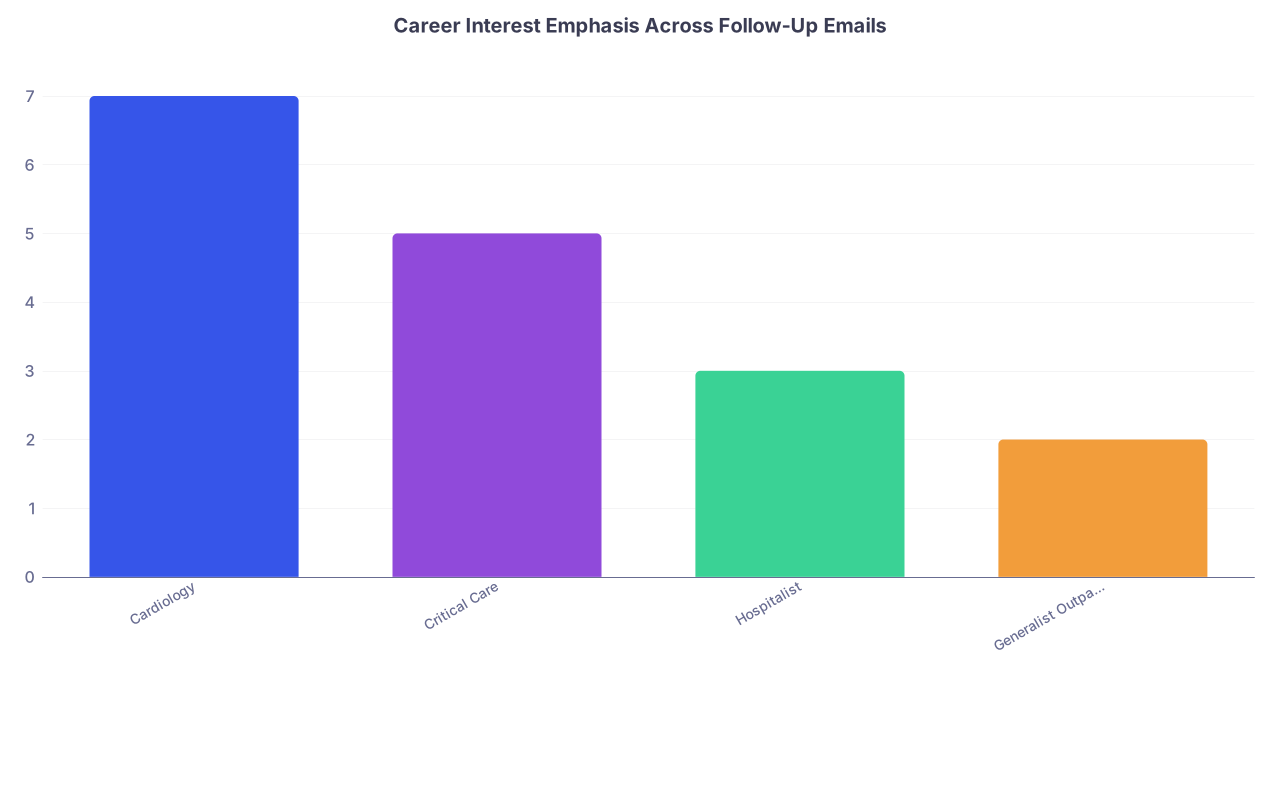
If you plotted how often you mentioned “cardiology,” “critical care,” and “generalist hospitalist” across all your emails, there should be a pattern that makes sense. Not chaos.
Here’s what a sane distribution might look:
| Category | Value |
|---|---|
| Cardiology | 7 |
| Critical Care | 5 |
| Hospitalist | 3 |
| Generalist Outpatient | 2 |
This student is clearly heart/ICU-focused, with some backup discussion of hospitalist and outpatient. That’s coherent.
What you don’t want is everything at “5” because you’re trying to be all things to all people.
Step 11: Handle the “I said something dumb” situation
Maybe in a moment of panic you blurted, “I don’t really see myself doing research,” to a program famous for research.
Your thank-you note can’t erase that, but it can soften it.
You do not pretend you’re suddenly a fake research enthusiast. You can, however, clarify:
“While my primary focus is on becoming a strong clinician, our conversations on interview day helped me appreciate how involvement in scholarly projects—whether quality improvement, curriculum development, or clinical research—can enhance my training. I’d welcome the chance to engage with these opportunities during residency.”
That sounds like someone who reflected, not someone who panicked and reversed position.
A quick mental flow for your next email
Drop this into your brain and run through it every time:

| Step | Description |
|---|---|
| Step 1 | What did I say my goal was? |
| Step 2 | Is it still basically true? |
| Step 3 | What does this program offer that fits that goal? |
| Step 4 | Soften to direction, not rigid plan |
| Step 5 | Name 1-2 specific things from interview day |
| Step 6 | Write 1-2 sentences tying goal to their features |
| Step 7 | Keep it under ~200 words, send within 48h |
Key points to walk away with
- Your follow-up note should reinforce and refine the career goal you already shared—never contradict it.
- Always connect your stated goal to something concrete from that specific program: a clinic, a track, a mentor, a patient population.
- Calibrate honestly: ambitious but believable, tailored to what that program can realistically offer, and stable enough that if they read all your emails side by side, your story would still make sense.