You’ve just finished sign-out in a large US hospital. It’s 7:15 am. You’re an international graduate, PGY-1 or PGY-2, badge still feels slightly foreign on your chest. The senior says, “Check the AI sepsis flag, sync the remote monitoring dashboard, and put in an eConsult if GI needs to weigh in.”
You understand the medicine. You do not fully understand the systems.
Epic looks like a spaceship cockpit. There’s “CDS” alerts you half-ignore, remote telemetry feeds, AI-predicted readmission risk scores, virtual consult platforms, and three different messaging apps someone expects you to monitor. You feel like everyone else grew up with this and you’re playing catch-up at 2x speed, in a second language, in a new culture.
This is the article for that exact situation: an international graduate inside a US system that’s racing ahead with advanced health tech. How to not drown. How to actually turn this stuff into an advantage.
Step 1: Admit The Real Problem (It’s Not Your Intelligence)
Let me be blunt. You’re not behind because you do not “get” technology. You’re behind because:
- You trained in a system where paper charts, WhatsApp, and maybe a basic EMR were the norm.
- The US system layers tech on top of regulatory chaos, billing, malpractice paranoia, and workflow silos.
- No one gives a structured onboarding for “how to think in this tech ecosystem.” They just throw logins at you.
So you need to reframe this: you’re not stupid; you’re under-oriented.
Your goals in the next 3–6 months:
Get baseline functional with the big 4:
- EHR (Epic, Cerner, etc.)
- Decision support tools / AI alerts
- Telehealth / remote monitoring
- Internal communication platforms (Teams, Voalte, secure messaging)
Learn where tech actually improves care vs where it’s just noise.
Position yourself as “the IMG who is surprisingly good with tech,” not “the IMG who struggles with the system.”
Step 2: Build a Personal Map of Your Hospital’s Tech Stack
You cannot master what you cannot see. Right now, it all feels like a blur: different icons, different passwords, different browser tabs.
You need a simple map.
Do this on your next lighter call day or weekend.
Make a 1-page diagram: center bubble = YOU. Around you, draw:
- EHR (Epic, Cerner, Meditech, Allscripts)
- Imaging system (PACS / Sectra)
- Lab system
- Remote monitoring (telemetry, wearables, in-hospital continuous monitors)
- Telehealth/virtual visit platform
- Secure messaging (Voalte, TigerConnect, Teams)
- AI/Decision Support (sepsis alerts, risk scores, order suggestions)
- eConsult/Referral platforms
- Patient portal
Under each bubble, write:
- What you use it for
- How often (daily, weekly, rare)
- One person who is good at it
Put this in your white coat or notes app. This becomes your “system map.”
You are not just learning random tools; you’re learning how data flows around you.
To see how these platforms often stack up in a US academic center versus what you may have used before:
| Function | US Academic Center Tool | Common in Home Country Systems |
|---|---|---|
| Core records | Epic/Cerner EMR | Paper or basic local EMR |
| Imaging | PACS with integrated viewer | Standalone PACS or CDs |
| Communication | Voalte/Teams/Secure paging | WhatsApp/SMS/Phone calls |
| Decision support | Built-in AI/CDS alerts | Guidelines/manual checking |
| Telehealth | Integrated video platform | Phone consults, limited video |
This contrast is precisely why your learning curve feels so steep.
Step 3: Tame the EHR (This Is Your Primary Battlefield)
If you only get good at one thing, let it be the EHR. It controls your time, your notes, your orders, your communication, and — honestly — how people perceive your efficiency.
Here’s the practical play:
a) Ask for a 1:1 session – not “help,” a “pro session”
Every major EHR has “super users” or a clinical informatics person. Stop passively suffering. Send something like this:
“Hi [Name], I’m one of the new residents on [service]. I’m comfortable with basic EHR use but want to be significantly faster and safer with orders and documentation. Could we do a 30–45 minute session focused on workflows and shortcuts that high-efficiency residents use?”
You’re not asking to be rescued. You’re asking to level up. Different energy.
b) Steal other people’s templates
Literally ask your co-interns/seniors:
- “Can I copy your H&P template?”
- “What do you use for progress notes?”
- “How do you structure your discharge summaries?”
Most US grads have quietly built templates since MS3. You do not need to reinvent any of that. Copy, adapt, then customize.
c) Learn 5–10 high-yield shortcuts
Not everything. Just the stuff that will save you an hour a day:
- How to quickly review overnight vitals, labs, I/Os on one screen
- How to pull previous notes, imaging, and problem lists without endless clicking
- How to pend orders and sign in batches
- How to create order sets for your common admits (CHF, COPD, DKA, etc.)
Aim to learn one new shortcut per day for 2 weeks. Write them down. Use them immediately. Repetition is what turns them into muscle memory.
Step 4: Treat AI and Decision Support as a Colleague, Not a Boss
You’re going to see:
- Sepsis alerts
- Deterioration risk scores
- VTE risk tools
- Dose calculators
- “Best practice” advisories pushing you toward certain orders
These tools are not magic. They’re pattern-matching on structured data you know is often incomplete or messy.
Your job is to:
- Respect them — they catch stuff you will miss at 3 am.
- Interrogate them — they’re biased toward over-calling illness, over-imaging, over-ordering.
- Document your thinking — “Sepsis alert fired; patient afebrile, stable, no source; monitored closely.”
What often happens with IMGs:
- You either ignore alerts entirely (dangerous)
- Or you obey them blindly because you assume “the system must be right” (also dangerous)
You need a middle ground: use them as a prompt to pause and reassess, not as a final answer.
To see where your attention should go:
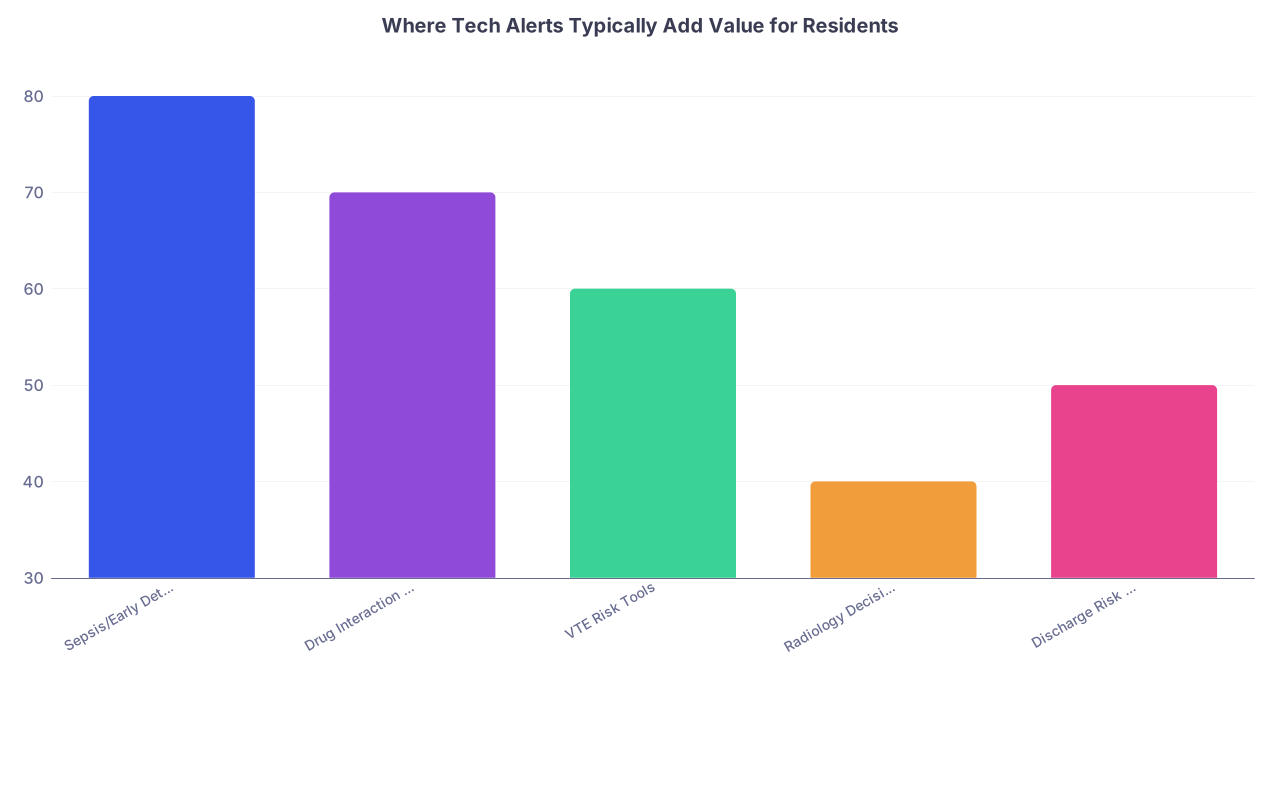
| Category | Value |
|---|---|
| Sepsis/Early Deterioration | 80 |
| Drug Interaction Alerts | 70 |
| VTE Risk Tools | 60 |
| Radiology Decision Support | 40 |
| Discharge Risk Scores | 50 |
Takeaway: sepsis/early deterioration and medication safety alerts are usually highest yield. Start by taking those seriously and understanding their logic.
Step 5: Telehealth, Remote Monitoring, and Virtual Stuff You Did Not See in Training
You may be asked to:
- See patients via video in clinic
- Manage patients on hospital-at-home programs
- Respond to remote monitoring alerts (AFib episodes, low O2, abnormal BP patterns)
- Answer patient portal messages
This feels “less like real medicine” if you trained in a setting where the sickest patients were always in front of you.
Here’s the mindset shift: this is just medicine with different frictions.
Use a simple framework every virtual encounter:
- Identity & safety first: confirm who they are, where they are, what help they can access if they crash.
- Signal quality: can you see/hear well enough to make a call? If not, escalate to in-person.
- Structured assessment: use a script. Symptoms, red flags, basic home vitals, functional status.
- Clear thresholds: “If X happens, you go to ER / call back / call 911.”
- Document like someone will read it in court: because they might.
For remote monitoring dashboards (heart failure programs, post-op ortho, etc.), ask a nurse or APP:
- “What alerts are true emergencies?”
- “What trends worry you?”
- “What’s noise we typically watch but do not act on immediately?”
You’re trying to learn the culture of remote data in that clinic/service, not just the raw numbers.
Step 6: Communication Platforms – Avoid Looking Disorganized
You’ll often have 3–4 parallel channels:
- EHR inbox/messages
- Secure chat/paging (Voalte, Teams, TigerConnect)
- Patient portal messages
If you treat all of them as “I’ll get to it later,” you will miss something important and look unsafe.
Set up a daily check rhythm. Example:
Start of shift:
- Check EHR inbox (results, routed notes, tasks)
- Check secure chat for overnight stuff
Midday (lunch or quick break):
- Quick scan of messages, reply to anything time-sensitive
End of shift:
- Clear inbox of anything that would hurt a patient if left 12–24 hours
- Hand off unresolved items if you’re on inpatient
If your program uses Teams/Slack-type tools for “announcements,” turn on notifications wisely. Not full blast, but enough you don’t miss schedule changes or new protocols.
Step 7: Use Your “Outsider” Status to Your Advantage
There’s something you bring that US grads do not: you have seen low-tech medicine done well. You know what actually matters when fancy devices are not available.
That perspective is incredibly valuable when the system gets drunk on tech.
Where you can actually stand out:
- In quality improvement projects that compare “tech-heavy” vs “simple” workflows
- In cutting down unnecessary clicks / duplicated documentation
- In identifying where AI suggestions contradict solid clinical judgment
Start small:
Ask your chief or attendings: “Is there any tech-related project or committee that residents can join? I’m interested in how these systems affect workflow and patient care, especially coming from a lower-resource environment.”
You’re not just surviving tech; you’re shaping it.
Step 8: Understand Where This Is All Going (So You Can Future-Proof Yourself)
If you plan to practice in the US long-term — or even if you may return home and lead modernization there — you need a 5–10 year view of the “future of healthcare” buzzwords you keep hearing.
Here’s the reality, stripped of hype:
- EHRs are not going away. They will get messier in the short term, then slightly better integrated.
- AI will be everywhere: drafting notes, suggesting orders, reading imaging, triaging messages.
- Remote/hybrid care will expand: hospital-at-home, chronic disease management, pre-op and post-op monitoring.
- Data will follow the patient: cross-system interoperability will slowly improve.
If you invest now in being good at:
- Understanding data quality (what’s real vs what’s junk in a chart)
- Communicating clearly over tech (video, chat, portals)
- Collaborating with non-clinical teams (IT, informatics, QI)
You make yourself hard to replace and very promotable.
To give you a bigger-picture sense:

| Step | Description |
|---|---|
| Step 1 | Start Residency as IMG |
| Step 2 | Basic EHR Survival |
| Step 3 | Efficient Tech User |
| Step 4 | Resident Tech Resource |
| Step 5 | QI or Informatics Project |
| Step 6 | Formal Tech Leadership Role |
You do not need to become a programmer. But you should understand enough to have opinions and lead change.
Step 9: Dealing with the Emotional Side (Frustration, Shame, Comparison)
Let’s talk about the part no one admits.
I have watched IMGs who were outstanding clinicians back home feel small and stupid in US hospitals — not because of medicine, but because of buttons, alerts, and workflows.
Signs you’re in that zone:
- You delay opening new tools because you’re afraid you’ll click the wrong thing.
- You always copy what others do, even when it feels inefficient.
- You start to think: “Maybe I am just slow.”
You’re not. You learned medicine in a different operating system. Now you’re being asked to run the same apps on totally different hardware.
Three things that help:
Scheduled practice in “play mode”
Ask IT or your EHR team if there’s a “sandbox” environment. Many hospitals have demo versions of Epic/Cerner. Spend 30–60 minutes once a week just experimenting. No patient harm, no pressure.Peer pairing
Tell one co-resident you trust: “I want to get really comfortable with [Epic/telehealth/CDS]. Can you show me exactly how you manage your day with it?” Watch them click. Ask dumb questions.Small wins journal
Sounds cheesy. Do it anyway. Keep a note where you write:- “Today I figured out how to build my own order set.”
- “Today I led a telehealth visit without getting flustered by the tech.”
Momentum beats perfection.
Step 10: Concrete 30-Day Plan
If you’re overwhelmed, here’s a simple month-long sequence.
Week 1:
- Map your hospital tech stack on one page.
- Book a 30–45 minute session with an EHR superuser.
- Steal at least one good note template.
Week 2:
- Learn and use 1–2 EHR shortcuts per day.
- Ask a nurse or APP to walk you through how they use remote monitoring.
- Do one supervised telehealth or virtual encounter if your service uses it.
Week 3:
- Ask a senior how they handle alerts (sepsis, CDS, risk scores) — copy their mental approach.
- Clean up your messaging workflow: commit to a daily check rhythm.
- Identify 1 tech-related frustration you could turn into a tiny QI idea.
Week 4:
- Talk to someone in informatics/QI about resident involvement.
- Revisit your tech map and update it with what you’ve learned.
- Decide: are you happy with “functional,” or do you want to aim for “go-to tech person” over the next year?
To visualize the gradual build-up:
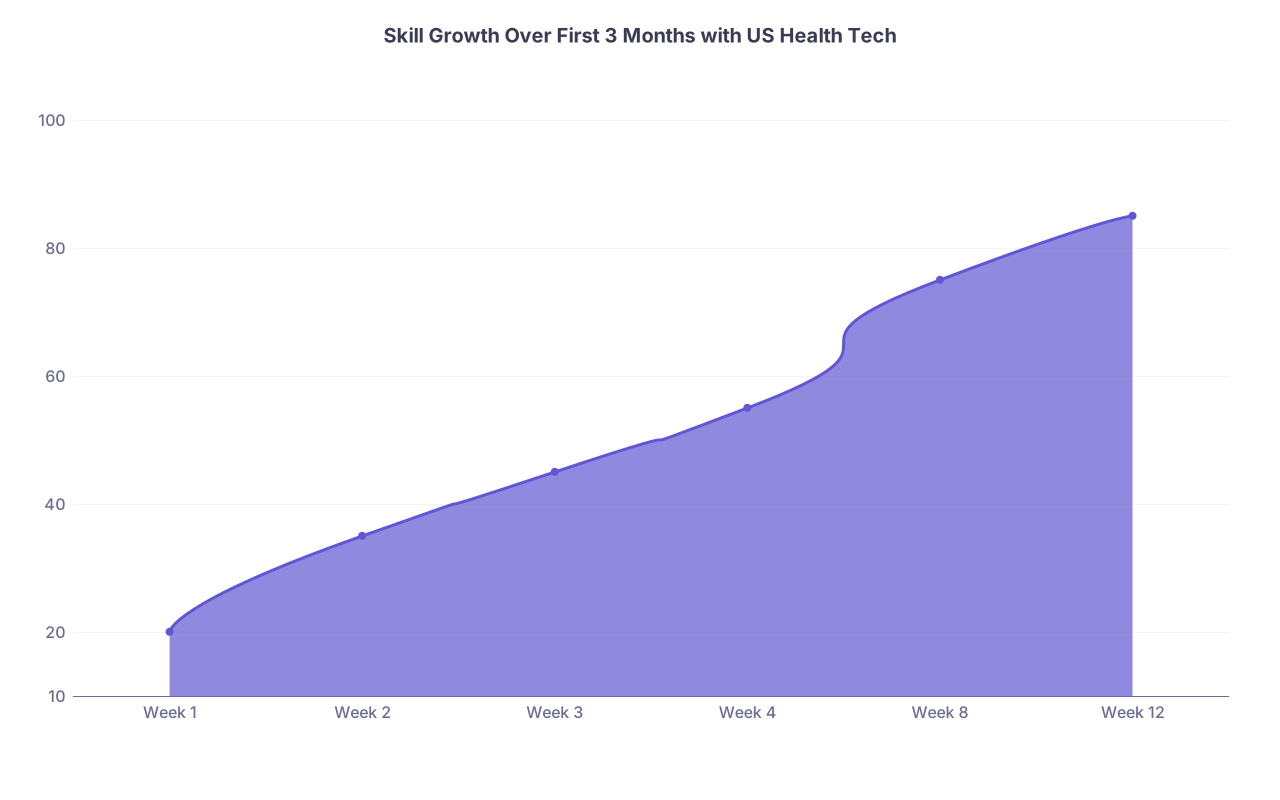
| Category | Value |
|---|---|
| Week 1 | 20 |
| Week 2 | 35 |
| Week 3 | 45 |
| Week 4 | 55 |
| Week 8 | 75 |
| Week 12 | 85 |
You’re not trying to jump from 0 to 100. You’re aiming for steady, noticeable progress.
Where This Really Pays Off
If you can become comfortable — not perfect, just comfortable — with advanced health tech as an IMG, you gain leverage:
- Attendings trust you with complex telehealth, tech-heavy pathways, remote care pilots.
- You become the bridge between old-school clinical reasoning and new-school digital workflows.
- If you ever return to your home country, you bring concrete experience in building and using systems they’re just starting to adopt.
You stop being “the international graduate trying to catch up” and become “the international graduate who can run circles around the system.”
To show how your unique background intersects with future roles:
| Role | Where It Lives | Why You Fit |
|---|---|---|
| Clinical informatics liaison | Hospital/Health system | You get both low and high-tech care |
| Telehealth program lead | Outpatient/Virtual | Cross-cultural + remote experience |
| QI/Patient safety lead | Departments/QI office | You see workflow gaps clearly |
| Digital health advisor abroad | NGOs/Health ministries | You know US tools and local reality |
FAQ (Exactly 5 Questions)
1. I feel slower than US grads because of the EHR. Will this hurt my evaluations?
If you stay slow for 6–12 months, yes, it can show up as “efficiency concerns.” But early on, attendings care more about safety, reliability, and improvement. If they see you asking for help, using shortcuts, and clearly getting faster month by month, you’ll be fine. Document your own progress and, if needed, tell your program leadership: “I’m investing heavily in EHR efficiency; you’ll see this improve.”
2. Should I click “accept” on every AI/decision support recommendation to be safe?
No. That’s lazy medicine and creates over-testing and over-treatment. Use CDS/AI as a prompt to think carefully, not as a command. When you decline a suggestion that’s clinically relevant (like antibiotics when a sepsis alert fires), document briefly why. You’re aiming for thoughtful use, not blind obedience.
3. I’m not “into tech.” Do I really have to care about this stuff?
If you’re in the US system, yes. It is now part of baseline competence. But you do not have to become a coder or an enthusiast. You just need to be: safe, reasonably fast, and not a bottleneck. Beyond that, treat tech like any other tool: useful when it helps your patients, ignorable when it doesn’t.
4. How do I handle patients who use the portal to send endless messages?
First, know your clinic’s policy. Many systems now have billing codes and triage logic for portal overload. Use message templates, clear boundaries in your replies (“For issues like X, please schedule an appointment”), and involve nursing/APPs where appropriate. If one or two patients are clearly out of control, talk with your attending about a structured plan; do not just silently drown.
5. I want to go back to my home country after training. Should I still invest in learning US health tech?
Absolutely. Many health systems worldwide are 5–10 years behind US tech adoption but moving in the same direction: EHRs, telehealth, basic AI support. Your US experience will make you extremely valuable for leadership, implementation, and training roles back home. Learn the principles — data flow, workflow design, safe AI use — not just the brand names like Epic or Cerner.
Open your schedule for tomorrow and pick one patient encounter you know will be tech-heavy — maybe a telehealth visit or a sepsis alert-prone admission. Decide, right now, which one new skill you’ll practice in that encounter (a new EHR shortcut, a clearer telehealth script, better AI alert handling). Write it down. Tomorrow, do just that one thing better. Then build from there.