
The politics around robotic surgery hiring are far more brutal than the brochures and glossy “innovation” videos suggest.
If you think it’s just about “clinical excellence” and “patient outcomes,” you’re already behind. In a lot of ORs right now, your future comes down to three things nobody will say out loud: who controls the robot block time, whose revenue the hospital is protecting, and whether you’re seen as an asset or a threat in that ecosystem.
Let me walk you through how it actually works when a hospital says they’re “hiring a robotic surgeon.”
The Robot Is Not a Tool. It’s a Territory.
First thing you need to understand: the robot is not just equipment; it’s real estate. Political, financial, and reputational real estate.
On paper, the pitch is: “We’re a forward-thinking institution investing in cutting-edge technology to improve patient care.” In meetings behind closed doors, I’ve heard almost the exact opposite priorities laid out:
- “We bought this $2.5M system; it needs to be running to justify the capital.”
- “We cannot piss off Dr. X; he owns the hernia and prostate market in this region.”
- “If we bring in this young hotshot, are we just fueling an eventual move to another hospital once their volume grows?”
Nobody puts that in the job ad. But it drives the hiring process.
Here’s what’s really going on:
Existing robotic “power users” treat that machine like turf. They have blocked OR time, loyal staff, preferential access to prime-day scheduling, and often a direct line to the OR director and CMO. When your CV lands saying “fellowship-trained in robotics, high-volume, ready to build a program,” some of them don’t see “colleague.”
They see competition.
And they will absolutely shape your fate before you ever touch the console.
Who Actually Decides If You Get Hired
If you think the chair or service line director alone hires you, you’re missing half the picture.
On paper, this is what the org chart says. In reality, at most mid-to-large hospital systems, the following people quietly determine whether your “robot dreams” become a real job or a slow-motion disappointment:
- The high-volume robotic surgeon(s) already there
- The OR director and OR business manager
- The C-suite bean counter (CFO/COO or service line administrator)
- Occasionally, anesthesia leadership (if your cases are long and expensive)
And they’re all asking self-interested questions.
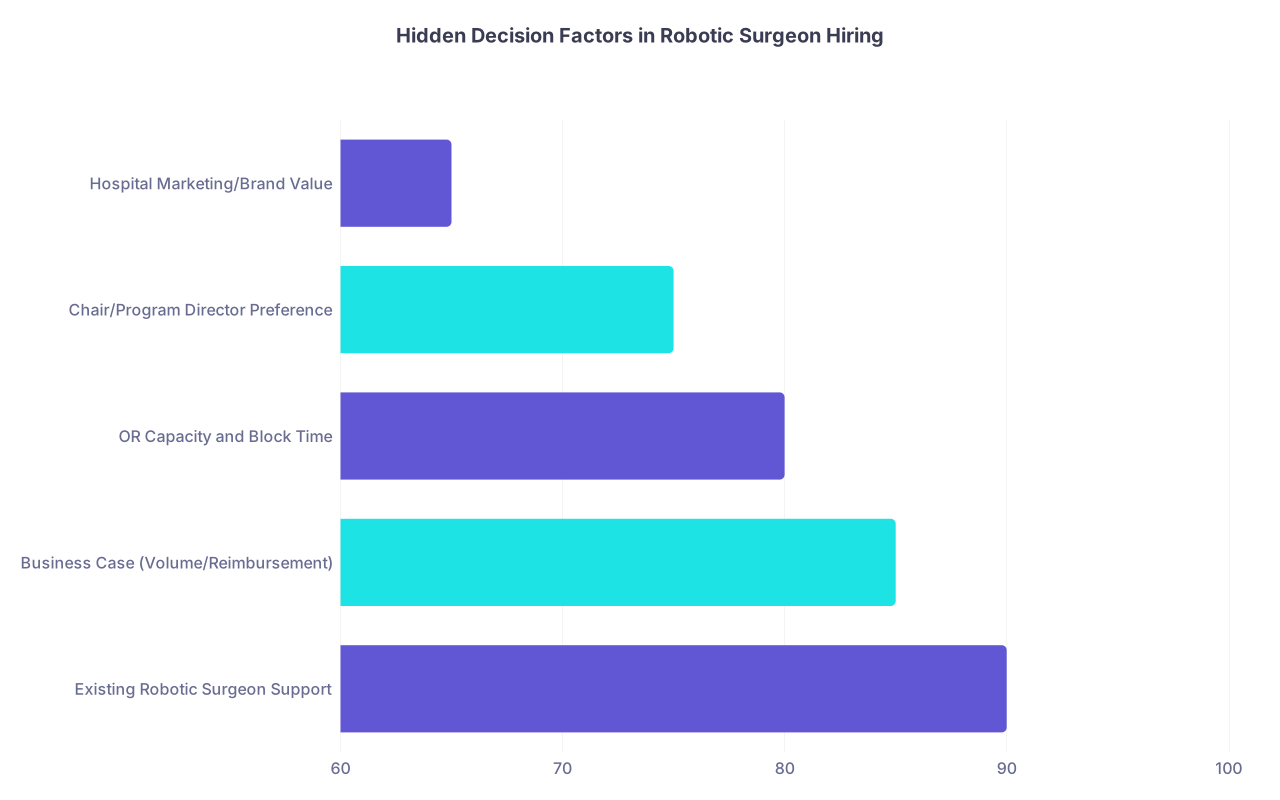
| Category | Value |
|---|---|
| Existing Robotic Surgeon Support | 90 |
| Business Case (Volume/Reimbursement) | 85 |
| OR Capacity and Block Time | 80 |
| Chair/Program Director Preference | 75 |
| Hospital Marketing/Brand Value | 65 |
That 90 for “Existing Robotic Surgeon Support” is not exaggeration. I’ve sat in hiring meetings where everything looked green — strong fellowship, great references, research, clean record — and the conversation died as soon as the incumbent high-volume robotic surgeon said one sentence: “I’m not sure we have the OR capacity for another robotic user right now.”
Translation: “Protect my turf.”
You don’t see the email that follows: “Let’s slow-walk this candidate.” Suddenly, HR “has some delays,” or “budget is being reviewed,” or “we may need to hold off on creating another robotic position until Q3.” Months pass. You end up signing somewhere else. Problem solved for them.
The Economics You’re Never Shown
Let me strip the marketing language off robotics for you: it’s a margin game.
Robotic platforms are not really bought for “better outcomes” first. They’re bought because:
- The hospital doesn’t want to lose market share to the center down the road that advertises “robotic everything.”
- Certain procedures reimburse basically the same regardless of technique, but robotic cases can be billed with higher complexity codes, and marketed at a premium.
- Surgeons will fight to work at places that have a robot, so it’s a recruitment tool.
Here’s what the CFO sees when your CV says “robotics-trained”:
| Factor | CFO Internal Question |
|---|---|
| Capital already spent | Are we underutilizing an expensive robot? |
| Current robotic volume | Will this hire grow the pie or steal cases? |
| Payer mix | Will these robotic cases actually pay well? |
| OR efficiency | Will this surgeon slow down our days? |
| Competitive landscape | Do we need more robotic names for marketing? |
You’ll notice what’s missing: “Is this person technically superb?” That’s not first. Sometimes not even third.
If the hospital’s current robot is booked 3 days a week and the rest is empty, you’re a potential asset — if you can fill it. If it’s already running flat-out by one or two surgeons, and they’re close with leadership? You’re a threat.
How Robotics Experience Can Hurt You (Yes, Really)
Here’s the part nobody tells residents and fellows: in some environments, heavy robotic training doesn’t help you. It pins a target on your back.
I’ve watched three versions of this play out:
1. The “We Want Robotics” Mirage Job
This is common in community hospitals and smaller systems.
They tell you: “We really want to grow our robotic program. You’ll be the champion.” You show up, eager, credentialed, maybe just out of fellowship.
Then reality:
- The robot is shared between multiple services with no protected block time.
- Staff are poorly trained and rotating; no dedicated robotic team.
- Cases take forever, so the OR manager hates robotic days.
- You start losing cases to open or lap because “we just don’t have time today.”
On paper you’re “the robotic surgeon.” In practice, you’re doing 2–3 robotic cases a month, getting rusty, and being judged for not ramping up as “promised.”
The unspoken politics: They wanted the marketing line (“we have a robotic surgeon”), not the operational headache.
2. The Incumbent Protects Their Kingdom
This one is common in urology, gyn, and general surgery.
You’re recruited as “another robotic surgeon” because volume is high. The pitch: “We’re drowning in cases, you’ll help.” You arrive, and then you discover:
- All prime robotic block time is assigned to one or two senior surgeons.
- Any attempt to request prime time meets “we’ve always done it this way.”
- The OR scheduler quietly rearranges your robotic cases to 4pm starts, or random days.
- Staff gravitate to the senior surgeon’s room because he “gets things done.”
You end up with the junk: emergency add-ons, lower-paying cases, odd times. Your ramp-up is slower. Then at the 1-year review: “Your robotic volume is less than expected. Are you really committed to robotics?”
That last line I have heard. Verbally. In a review. From someone who knew damn well the scheduling was the issue.
3. The Academic Bait-and-Switch
At academic centers, the politics are even more layered.
You’re told: “We need someone to do robotic cases and also build a research/education profile.” Then you find:
- All interesting robotic cases are already assigned to the “name” surgeons.
- You get low-complexity, low-prestige cases that don’t help your CV.
- Robotics block time is prioritized for attendings with big grants or reputation.
- Residents have to log cases, so you’re pressured to staff your cases with junior residents, slowing everything further.
You’re “on the robotic team” but not actually building the kind of volume or academic profile that lets you leave or negotiate strong later. You’re stuck in the middle — useful enough to run cases, not valued enough to get the spotlight.
What Program Directors Actually Say About Robotics Fellows
Let me share the private conversations you’re not in the room for.
When department chiefs and program directors discuss candidates with heavy robotic training, the talk sounds like this:
- “Great robotics background, but will they convert to open if needed or will they fight the robot for every case?”
- “Our OR is already stretched; robotics days kill our schedule if they’re not fast.”
- “Is this someone we can grow over 3–5 years, or are they going to build a name and then bounce to a higher-paying private group?”
- “I like them, but Dr. Y is already complaining we’re taking away her cases.”
There’s a quiet suspicion toward “robotics-first” surgeons at many places. Not everywhere, but far more than you’d think.
The fear is inefficiency and politics, not outcomes.
I’ve watched chairs choose a less-robotics-heavy candidate for one blunt reason: “He will stir up less trouble in the OR.”
That’s the level of pettiness you’re up against.
How You’re Evaluated Behind Closed Doors
You think they’re just looking at your case log and letters. They’re not.
They’re dissecting three things:
Are you trainable in our culture, or are you going to try to change everything?
If your interview vibe is “I’ll revolutionize your robotic program,” some institutions love that. Others hear “you’re all doing it wrong and I’m here to fix it.” Guess which one kills offers.Will you threaten existing relationships?
If the existing star is a 58-year-old high-volume robotic surgeon bringing millions in revenue, and you’re a 34-year-old fellowship grad with a slick SAGES video and a charismatic interview — some chairs will protect the older surgeon every time. Safer. Less internal blowback.Can they sell you to the CFO?
They won’t say this, but I’ve seen spreadsheets where your projected RVUs, payer mix, and “anticipated robotic utilization” are modeled like you’re a new product line. If the numbers don’t look good, no amount of glowing mentorship letters will save you.

| Category | Value |
|---|---|
| Cultural Fit with Existing Robotic Users | 95 |
| Projected RVUs/Year | 90 |
| Perceived OR Efficiency | 85 |
| Academic/Marketing Value | 70 |
| Technical Skill Alone | 60 |
Notice where “Technical Skill Alone” lands. That’s not a typo.
How to Read the Politics During Interviews
You can get a sense of the robotic politics before you sign. Most candidates don’t know what to ask, so they get blindsided later.
You need to stop asking, “Do you have a robot?” and start asking questions that expose the power structure.
Here’s how to probe, and how to interpret the answers.
Ask: “Who currently uses the robot and how is block time allocated?”
If the answer is vague — “Oh, several surgeons use it; it’s shared” — that’s a red flag. Press a little:
- “Do robotic surgeons have dedicated block days, or is it requested per case?”
- “How many days per week is the robot currently in use?”
If you hear: “Well, Dr. A does most of the robotics, and then others here and there,” understand you’re walking into someone’s kingdom.
Ask: “What was your last year’s total robotic case volume by service?”
You’re not prying; you’re assessing whether your ramp-up is even structurally possible.
If they won’t give numbers, that usually means: volume is lower than they want you to think, or they haven’t tracked it well. Both are concerning.
Ask: “What support systems are in place? Do you have a dedicated robotic team?”
If the answer is “we’re working on building that” and “staff are cross-trained,” you should mentally translate that as: you will be fighting for trained staff and your cases will be slower for a year or more. If you’re okay with that, fine. If you want to be high-volume fast, you’re in the wrong shop.
Watch the nonverbal when robotics comes up
In group interviews or dinners, watch:
- Who speaks up when robotics is mentioned.
- Who stays silent but stiffens.
- Whether the OR manager looks enthusiastic or resigned.
- Whether anesthesia rolls their eyes when long robotic cases are referenced.
I’ve seen more truth in a smirk from the OR nurse manager than in a 20-minute polished answer from the chair.
The Future: More Robots, Tighter Politics
The future of healthcare is not “more robots, less politics.” It’s more robots and more complicated politics.
Why?
- Multi-platform environments are coming. Hospitals will negotiate between vendors, and surgeons will get caught in the crossfire of loyalty, pricing, and “standardization” battles.
- AI-augmented systems will generate data on your performance — docking times, console time, complications. That data will not stay purely “for quality improvement.” It will end up in hiring and renewal discussions. Guaranteed.
- Regional consolidation means your reputation as a “team player” or “robot diva” will follow you across hospitals in the same system.

| Step | Description |
|---|---|
| Step 1 | Vendor Competition |
| Step 2 | Multi Robot Platforms |
| Step 3 | Data on Surgeon Use |
| Step 4 | Performance Dashboards |
| Step 5 | Hiring and Renewal Impact |
| Step 6 | OR Scheduling Complexity |
| Step 7 | More Turf Battles |
Robotics will become less of a shiny differentiator and more of a basic expectation for certain fields. That means the “who controls what” question becomes even sharper.
Being robotic-trained will be table stakes. How you fit into robotic politics will be the differentiator.
How To Position Yourself So The Politics Don’t Crush You
You can’t erase the politics, but you can stop being the naive victim of them.
A few blunt pieces of advice I’d give any resident or fellow eyeing a robotics-heavy career:
Stop worshipping the robot.
If your entire professional identity is “I am a robotic surgeon,” you’re fragile. You need to be able to credibly do open/lap when the environment or case demands it. Chairs like flexibility. OR directors breathe easier.Signal that you’re efficient, not just fancy.
Have your numbers. Average case times. Docking times. Complication rates. And then talk about how you worked with staff to streamline workflow. That language — throughput, efficiency, team-based optimization — calms OR leadership and admin.Form alliances early with the right people.
In your first year, your most strategic relationship may not be the chair. It may be the OR director, the lead robotic nurse, and yes, the senior robotic surgeon whose shadow you’re stepping into. Make it clear you’re there to grow the pie, not steal it.Insist on clarity in your contract or offer letter.
Not just “access to robot.” That means nothing. Push (politely but firmly) for language like: “X half-day of robotic block time per week after 6 months, contingent on meeting Y volume threshold.” If they refuse anything concrete, that tells you what you need to know.Plan a 3–5 year arc, not a 1-year fantasy.
Building a real robotic practice — in a politically charged OR — takes time. You’ll eat some garbage cases. You’ll get bad time slots at first. But if the structure is there (block time, support, leadership buy-in), you can grow into real power. If the structure is not there, you’re just bleeding time and skills.
FAQ (Read This Before You Sign Anything)
1. Is it safer to downplay my robotics interest during interviews to avoid being seen as a threat?
No. Hiding your actual skill set is stupid. What you should do is frame it correctly. Don’t walk in as “I’m your next robotic star and I’ll rebrand your program.” Walk in as “I’m strong in robotics and I’ve also done a lot of standard lap/open; I’m interested in helping grow your program in a way that fits your current workflows.” You want them thinking “integrator,” not “disruptor with an ego.”
2. How can I tell if existing robotic surgeons will sabotage my growth before I accept?
You watch behavior, not words. If they’re “too busy” to meet you, that’s a sign. If they meet you but never once suggest co-scrubbing cases, mentoring you, or helping with block time, that’s another. Ask them directly: “If I joined, how would you see us sharing the robotic platform?” If the answer is vague (“Oh, we’d work it out”) with no specifics about days, mentoring, or case types, assume you’ll be at the back of the line.
3. For the future of my career, is it better to pick a job with a strong but crowded robotics program, or a weaker one where I’m the main robotic surgeon?
If you’re early and still building reps, go where volume and structure already exist — even if you’re “number two or three” for a while — as long as they truly share cases and block time. Your first five years should be about becoming undeniably good and efficient. Later, once you’ve got volume, videos, outcomes, and a name, you can move into a place where you’re the flagship. Going to a “you’ll be the robotics champion” hospital with terrible infrastructure straight out of training is how people end up underutilized and stuck.
Bottom line:
Robotics in the OR hiring process is not a meritocracy. It’s a political game wrapped in technology branding.
If you want to survive it, remember three things: the robot is territory, existing users are gatekeepers, and your value is judged as much by how you fit into power structures as by how well you sew from the console.