

Why do so many students walk into med school thinking, “If I pick a high-paying specialty, I’m basically signing away my life”?
That idea is everywhere. Attendings saying “I chose surgery, so I knew I’d never see my kids.” Classmates muttering, “Yeah, derm is competitive because it’s the only good lifestyle.” Reddit threads acting like income and lifestyle are on opposite ends of a seesaw and you get to pick one. Only.
The problem? That story is clean, simple, and wrong.
The data are a lot messier—and more interesting—than “money = misery.”
Let’s blow up the myth and look at what actually happens once training ends.
The Myth: Income Up, Lifestyle Down
The usual narrative goes like this:
- Primary care = lower pay, better lifestyle
- Procedural/surgical/high-RVU fields = higher pay, terrible lifestyle
- Pick one: money or happiness
It sounds intuitive. It’s also lazy.
Look at Medscape’s annual Physician Compensation and Physician Lifestyle/Burnout reports over the past few years and three things jump out:
- Some of the highest earners report relatively good work-life balance and lower burnout.
- Some of the lowest earners are absolutely miserable.
- Inside almost every specialty, lifestyle varies dramatically based on practice setting, geography, and how you structure your work.
Let me put numbers behind that.
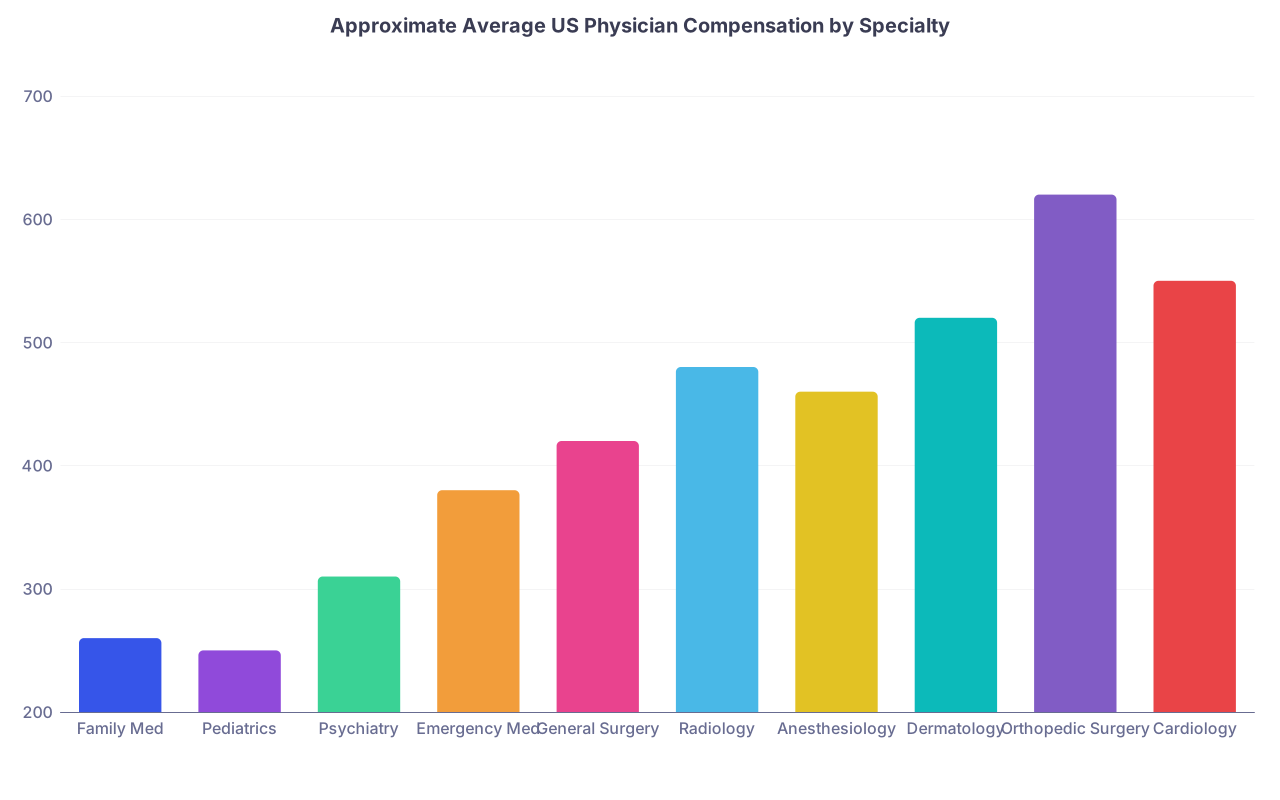
| Category | Value |
|---|---|
| Family Med | 260 |
| Pediatrics | 250 |
| Psychiatry | 310 |
| Emergency Med | 380 |
| General Surgery | 420 |
| Radiology | 480 |
| Anesthesiology | 460 |
| Dermatology | 520 |
| Orthopedic Surgery | 620 |
| Cardiology | 550 |
Now, compare that rough income landscape to what those same surveys show about burnout and lifestyle satisfaction: it does not line up cleanly with income brackets. At all.
Where the Myth Comes From (And Why It’s Outdated)
This “high pay = bad life” idea isn’t random. It’s built from a few half-true observations.
1. Training in high-pay fields is brutal
Neurosurgery, ortho, ENT, vascular, CT surgery—yes, residency is punishing. Long hours, high acuity, call-heavy. You feel like you live in the hospital because, functionally, you do.
Students then commit the classic mistake: they assume residency equals real life.
It doesn’t.
I have watched neurosurgery attendings who barely see their families. I have also watched a private-practice orthopod in a mid-size city who works 3.5 days a week, operates two mornings, leaves by 4 pm, and clears more than most academic surgeons by a mile. Same field. Completely different life.
Residency is the worst version of almost every specialty.
2. Old guard culture still echoes
There’s an older generation of surgeons and interventionalists who were trained in the “work until you drop, brag about never seeing your kids” era. They still give talks. They still make comments on rounds.
But the practice environment has shifted:
- Hospitalists took night admits from many outpatient subspecialists.
- Intensivists took over most ICUs.
- APPs and nocturnists now absorb a ton of call and overnight burden.
- Teleradiology and remote reads changed imaging.
- Shift-based models expanded beyond EM—hospitalist cardiology, anesthesia groups, tele-ICU, etc.
The lifestyle of a 60-year-old cardiothoracic surgeon circa 2000 is not the lifestyle of a 35-year-old structural cardiologist in 2026.
3. Students only see one slice
You see the high-acuity tertiary center. You see academic attendings who are on-call for complex cases, running research, teaching, and doing admin.
You don’t see:
- The proceduralist doing mostly outpatient work in a community setting
- The radiologist working hybrid telerad from home
- The anesthesiologist doing ambulatory surgery center cases and zero trauma
- The orthopod who dropped high-risk call and does mostly sports in the suburbs
So you anchor to the loudest example: the miserable, overextended academic surgeon.
What the Data Actually Show: It’s Not That Simple
Let’s pull together what multiple Medscape and specialty workforce surveys have consistently shown over the last few years:
- Some higher-paid specialties have moderate to lower burnout: derm, ENT, plastics, ophtho, some radiology groups.
- Some mid-range or lower-paid specialties consistently sit near the top of burnout: EM has been a disaster zone recently, OB/GYN is often high on burnout and litigation pressure, internal medicine and family med struggle with admin load and lower pay.
- Lifestyle happiness often tracks autonomy, schedule control, and outpatient vs inpatient mix, more than pure pay.
Here’s a simplified snapshot to make the point.
| Specialty | Approx Pay Tier | Typical Burnout/Lifestyle Pattern* | |
|---|---|---|---|
| Orthopedic Surg | Very High | High hours; lifestyle varies widely by practice model | |
| Dermatology | Very High | Generally good hours, low call, relatively low burnout | |
| Radiology | High | Variable; decent control, telerad improving lifestyle | |
| Anesthesiology | High | Shift-based; lifestyle tied to call and case mix | |
| Emergency Med | Mid–High | Shift-based, high burnout recently despite pay | |
| Cardiology | High | Tough early; outpatient-heavy later can be good | |
| Family Medicine | Low–Mid | Lower pay, high admin load; lifestyle all over the map | |
| Pediatrics | Low | Lower pay; mix of meaningful work and burnout | |
| OB/GYN | Mid–High | High call, litigation stress; burnout common | |
| Psychiatry | Mid | Flexible schedules often; many report good lifestyle | |
| Specialty/Model | Hours & Call | Income Tier | Lifestyle Feel |
| --------------------------- | ----------------------------- | ------------ | ------------------------ |
| Ortho - Level 1 Trauma | 60–80 hrs, heavy call | Very High | Intense, high acuity |
| Ortho - Community Sports | 40–50 hrs, limited call | High | Busy but controllable |
| Cards - Interventional | 50–70 hrs, STEMI call | High | High stress, rewarding |
| Cards - Non-Invasive | 40–50 hrs, minimal call | High | Outpatient-heavy |
| Radiology - Academic | 50–60 hrs, some call | High | Moderately intense |
| Radiology - Telerad | Block shifts, from home | High | Flexible, shift-based |
Notice what changes lifestyle here: model, not just specialty name or salary.
Reality Check: You Can’t Hack This With One Variable
If you’re looking for a magic quadrant—high pay, low hours, zero stress—you’re going to be disappointed. Every specialty has its tradeoffs. Every single one.
But the simplistic story “highest paid specialties have the worst lifestyle” is just that: simplistic. Reality is:
- Some of the worst lifestyles are in mid-pay or even lower-pay fields that are drowning in admin and chaos.
- Some of the best, most controlled lifestyles are in very high-paying, outpatient-heavy specialties.
- Within each high-paying specialty, there are miserable ways to practice and surprisingly sustainable ones.
So when you’re thinking about “highest paid specialties” and “lifestyle,” stop treating it like a binary.
Start asking smarter questions: What work do I actually like in real life, not on Instagram? How much unpredictability can I tolerate? Where do I want to live? How much call am I really willing to take at 45 with kids?
Years from now, you probably won’t brag about your W-2 number or your call schedule; you’ll remember whether your career felt like something you owned—or something that owned you.


