

Only 8–12% of a typical high‑risk surgeon’s gross clinical revenue ends up going to malpractice premiums.
Most physicians I talk to guess two or three times that. They feel the pain of a $70,000 or $120,000 annual bill and intuitively think it is eating the majority of their income. The data tells a different story.
What actually matters for you, choosing or practicing in a high‑risk specialty, is not the sticker shock of the malpractice premium. It is the ratio of malpractice cost to take‑home pay after all the other line items—taxes, overhead, call stipends, RVU bonuses—have had their say.
Let’s quantify that.
The basic math: premiums as a slice of revenue
Malpractice pricing varies by state, risk pool, and claims history, but we have decent ranges from Medical Liability Monitor and major carriers.
For context, here are representative annual claims‑made premiums for a mid‑career physician with clean history in an average‑risk state:
| Specialty | Approx Premium (USD) |
|---|---|
| Neurosurgery | $110,000–$180,000 |
| OB/GYN | $70,000–$130,000 |
| Orthopedic Surgery | $40,000–$90,000 |
| General Surgery | $30,000–$70,000 |
| Emergency Medicine | $25,000–$60,000 |
Now compare that to revenue. A typical full‑time private practice, procedure‑heavy physician might generate:
- Neurosurgery: $1.4–2.0M collections
- Ortho (adult recon, spine, trauma mix): $1.0–1.6M
- OB/GYN (full spectrum): $700k–1.1M
- Gen Surg: $650k–1.0M
- EM (by hours rather than panel): $450k–750k in comp, but malpractice usually comes out of group overhead, not individual pockets
Do the division. Even at the high end of premiums:
- Neurosurgery: $150k ÷ $1.7M ≈ 8.8% of clinical revenue
- OB/GYN: $100k ÷ $900k ≈ 11.1%
- Ortho: $70k ÷ $1.3M ≈ 5.4%
- Gen Surg: $50k ÷ $800k ≈ 6.3%
You see the pattern. Painful, yes. But it is nowhere near half your pay.
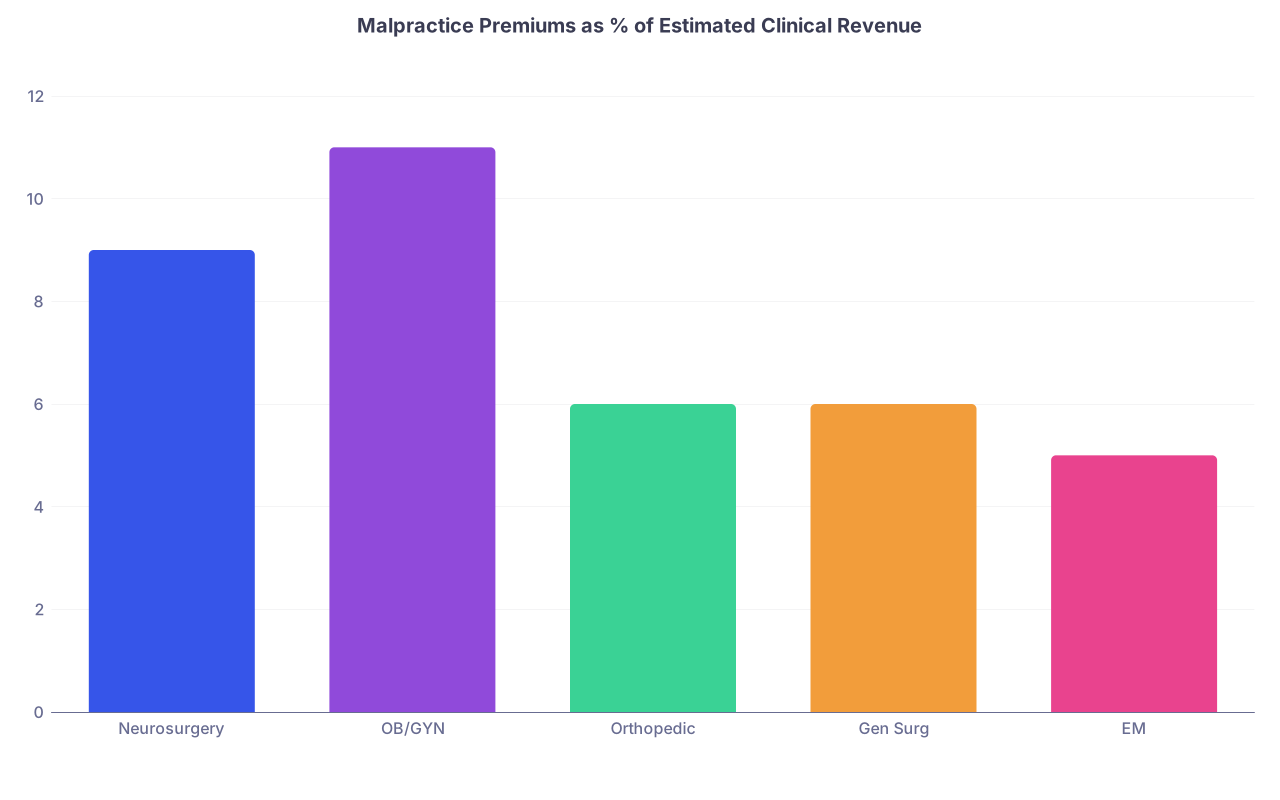
Here is a visual to ground those percentages.
| Category | Value |
|---|---|
| Neurosurgery | 9 |
| OB/GYN | 11 |
| Orthopedic | 6 |
| Gen Surg | 6 |
| EM | 5 |
The data shows that, at a system level, malpractice is a single‑digit to low double‑digit share of revenue for high‑risk specialties. The real question is how that translates to your take‑home after everything else.
From gross revenue to take‑home: where malpractice actually sits
Strip a practice income statement down to the big levers. For a private‑practice surgeon, a rough but realistic breakdown looks like this:
- 100%: Professional collections
- 45–60%: Practice overhead (staff, rent, supplies, billing, IT, benefits)
- 8–12%: Malpractice premium
- 15–30%: Taxes (depending on structure and deductions)
- Remainder: Take‑home (salary + distributions)
Let me put numbers to one scenario: a busy general orthopedic surgeon in a mid‑cost state.
Assumptions (all grounded in what I have seen in real P&Ls):
- Collections: $1.3M
- Overhead (excluding malpractice): 47% → $611k
- Malpractice: $65k (5% of collections)
- Practice profit before taxes: $1.3M – $611k – $65k = $624k
- Effective tax on that profit: 30% → $187k
Take‑home ≈ $437k. Malpractice as a fraction of take‑home = $65k ÷ $437k ≈ 14.9%.
So premiums went from 5% of gross to ~15% of net. That is how they feel so heavy to individual surgeons. They compress the last, most valuable slice of the pie.
Now compare that to OB/GYN, where revenue is lower and malpractice somewhat higher.
Example OB/GYN, full‑scope, mid‑volume:
- Collections: $900k
- Overhead (excluding malpractice): 50% → $450k
- Malpractice: $100k (11.1% of collections, realistic in a litigious state)
- Profit before taxes: $900k – $450k – $100k = $350k
- Taxes at 30%: $105k
Take‑home ≈ $245k. Malpractice as share of take‑home: $100k ÷ $245k ≈ 40.8%.
This is where the pain is acute. The OB doing nights of call for $245k take‑home while sending $100k straight to the carrier every year. That ratio is why you see “OB without OB” jobs and experienced clinicians dropping deliveries in their 50s.
Here is a side‑by‑side comparison to crystallize it.
| Specialty | Collections | Malpractice | Take-Home (after tax) | Malpractice as % of Take-Home |
|---|---|---|---|---|
| Orthopedics | $1,300,000 | $65,000 | $437,000 | 15% |
| OB/GYN | $900,000 | $100,000 | $245,000 | 41% |
Same rough workload intensity. Very different financial friction from malpractice.
Employment vs private practice: who actually pays?
A resident often asks, “Will I personally cut a $100,000 check every year?” Usually not—if you are employed.
Most high‑risk physicians now work under one of three models:
- Hospital or health‑system employed (salary + bonus; hospital buys the coverage)
- Large single‑specialty or multi‑specialty group, often with partnership track (group buys coverage; cost hits your comp pool)
- Solo or small independent practice (you buy coverage directly; full effect is visible)
The premium does not vanish in employed models. It just moves upstream into your RVU rate, base salary, and group’s margin.
Hospitals run these numbers ruthlessly. An employed neurosurgeon generating $1.8M in collections may be offered:
- Base salary: $750k
- Bonus potential: up to $150k tied to RVUs/quality
- Benefits: $80k
- Employer malpractice cost: $140k
From the system’s perspective, your fully loaded cost is near $1.2M. Malpractice is 12% of that “cost of labor” line. Save $40k on coverage (by switching carriers, tort reform, or risk management) and they can theoretically bump your salary or just keep the margin.
In stark contrast, a small private group with two OBs bringing in $1.8M together and facing a shared malpractice bill of $180k sees 10% of practice revenue disappear before they pay staff, rent, or themselves. There is no buffer.
So the data tell you this: employment arrangements do not eliminate malpractice costs; they just obscure them. The tighter and more transparent the P&L you live on, the more you will feel every malpractice dollar.
Location: the silent multiplier
The same neurosurgeon can pay $50k or $200k for essentially the same risk profile depending on zip code. That is not hyperbole; liability environments vary that much.
High‑risk states (historically): New York, New Jersey, Pennsylvania, Florida, Illinois
More moderate or lower‑risk: Texas (post‑tort reform), Colorado, Indiana, many central and mountain states
Let me quantify with a stylized neurosurgery example.
Neurosurgeon A – New York:
- Collections: $1.6M
- Malpractice: $180k
- Overhead (ex‑mal): 50% → $800k
- Profit before taxes: $1.6M – $800k – $180k = $620k
- Assume 32% effective tax: $198k
- Take‑home ≈ $422k
- Premium as % of take‑home: 42.7%
Neurosurgeon B – Texas (post‑tort reform region, similar clinical practice):
- Collections: $1.5M (slightly lower reimbursement)
- Malpractice: $70k
- Overhead (ex‑mal): 47% → $705k
- Profit before taxes: $1.5M – $705k – $70k = $725k
- 32% tax: $232k
- Take‑home ≈ $493k
- Premium as % of take‑home: 14.2%
Same specialty. Similar work. About $70k more take‑home in the lower‑liability state and a drastically gentler malpractice-to-net‑income ratio.
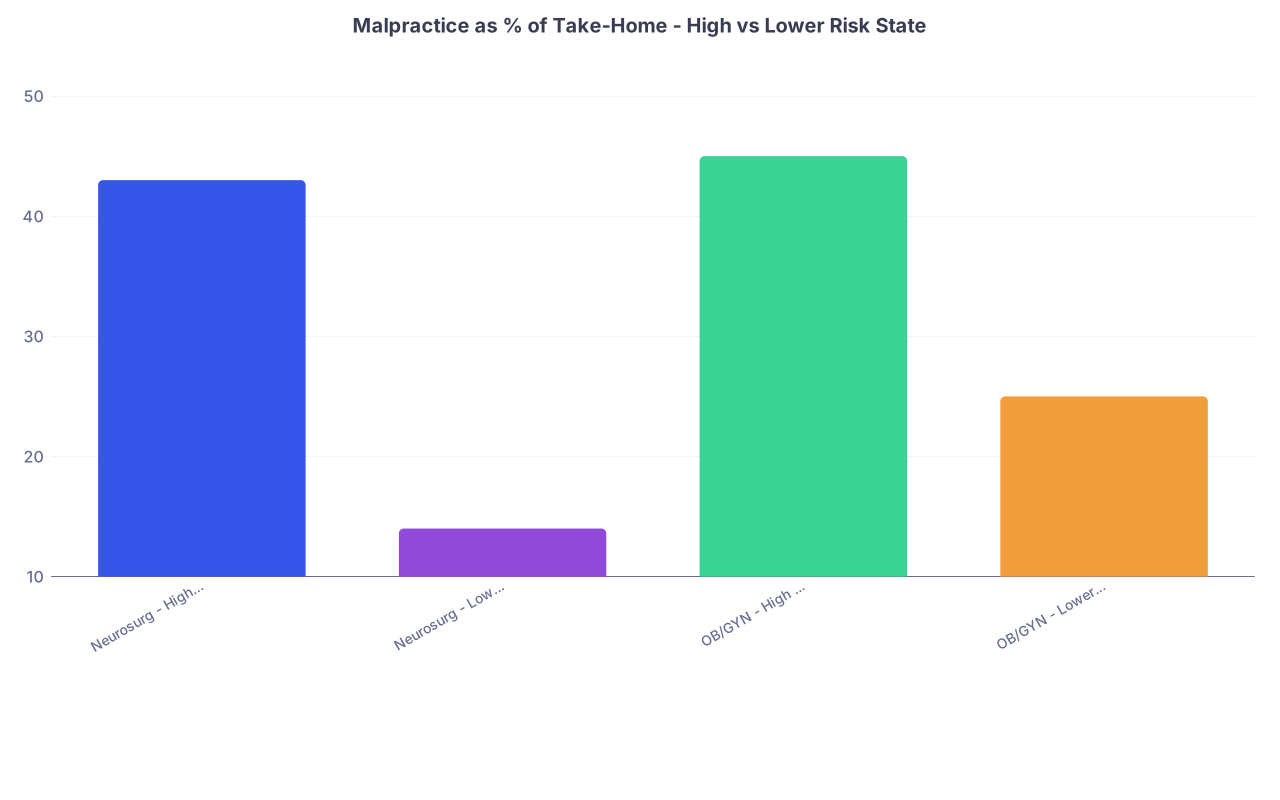
Here is a simple chart to visualize how location amplifies the impact on net compensation, not just the premium line.
| Category | Value |
|---|---|
| Neurosurg - High Risk State | 43 |
| Neurosurg - Lower Risk State | 14 |
| OB/GYN - High Risk State | 45 |
| OB/GYN - Lower Risk State | 25 |
When you see a job posting touting “$750k neurosurgery opportunity in the Northeast,” you should mentally subtract not just the cost of living, but exactly this kind of liability drag. The gross number is deceptive.
Specialty comparisons: high pay vs high premium
Some residents think “highest paid specialties” and assume malpractice scales linearly with income. It does not.
The data shows several clear patterns:
- Neurosurgery, ortho spine, some interventional radiology lines: very high income and very high premiums, but premiums remain a modest share of revenue.
- OB/GYN: medium‑high income, high premiums, and poor ratio of risk to pay, especially when you account for nights and lifetime legal exposure.
- EM: mid income, moderate premiums, with costs often socialized across large groups or hospital contracts.
- Dermatology, pathology, radiology (non‑interventional sections), PM&R: solid incomes, relatively low premiums.
To put rough ratios next to each other, assume “typical” national compensation and mid‑range premiums:
| Specialty | Typical Comp | Typical Premium | Premium as % of Comp |
|---|---|---|---|
| Neurosurgery | $900k | $140k | 16% |
| Orthopedic Surg | $650k | $70k | 11% |
| OB/GYN | $340k | $90k | 26% |
| Emergency Med | $420k | $40k | 10% |
| Dermatology | $450k | $15k | 3% |
These are blended national medians, not offers, but the pattern holds: OB/GYN stands out as having a particularly bad premium‑to‑income ratio. Neurosurgery pays so much that even a monstrous premium still eats “only” 15–20% of gross comp.
That is why you see neurosurgeons angry at call burden and lifestyle, but not usually fleeing purely for malpractice cost reasons. OBs, on the other hand, routinely redesign practices specifically to avoid deliveries and high‑risk cases, because the financial trade does not pencil out.
Real contract impact: how premiums show up in offers
I have sat with surgeons looking at offers where the malpractice details were buried like a bad subplot. You have to read for:
- Type: occurrence vs claims‑made
- Limits: standard is $1M / $3M, but higher limits cost more
- Tail coverage: who pays if you leave?
- Surcharges: high‑risk procedures (OB, spine, bariatrics) sometimes carry extra costs
For your take‑home, two things matter most:
- Is the employer paying the full premium during employment?
- Will you be on the hook for a one‑time tail bill that can equal 150–250% of the annual premium if you leave?
A few numeric scenarios.
Scenario 1: Employed OB/GYN, “we cover everything”
- Salary: $350k, bonus up to $50k.
- Malpractice: employer‑paid, occurrence policy.
- Your ongoing malpractice cost: effectively zero, baked into the offer.
- Take‑home after 30% tax (no bonus): ≈ $245k.
Here, malpractice premium absolutely affects your salary (they would likely offer more if premiums were $20k instead of $100k), but you will not personally write the check.
Scenario 2: Employed OB/GYN, claims‑made with tail on you
- Salary: $350k, bonus up to $50k.
- Claims‑made policy with annual premium around $80k. Employer pays while you are there.
- Tail coverage on departure: 2x annual premium, $160k, your responsibility per contract.
If you leave after 5 years, you will have enjoyed maybe $1.2–1.5M cumulative take‑home after taxes during that period. Then you write a $160k check to avoid being naked for lingering claims. That lumpsum risk is effectively a hidden reduction in your average annual net income of $32k.
So in present value terms, your “true” annual net drops from around $245k to something closer to $213k once you price in tail risk.
Tail clauses are where a lot of physicians get burned, especially in high‑risk specialties where tails are biggest.

| Step | Description |
|---|---|
| Step 1 | Clinical Work |
| Step 2 | Collections |
| Step 3 | Employer Revenue |
| Step 4 | Employer Expenses |
| Step 5 | Net Margin |
| Step 6 | Physician Salary Offer |
| Step 7 | Physician Take Home |
| Step 8 | Tail Coverage Clause |
| Step 9 | No Extra Cost |
| Step 10 | Lump Sum Tail Payment |
| Step 11 | Leave Job? |
If you do not quantify that tail, you are not actually comparing offers. You are gambling.
Behavioral effects: how malpractice reshapes practice patterns
You cannot talk about premiums vs take‑home without talking about what doctors do to keep those numbers tolerable.
I have seen the following, repeatedly:
- OBs in high‑risk states stop doing VBACs or complex high‑risk deliveries, shift to low‑risk gyn surgery and clinic. Revenue per hour stays decent, risk and premium growth are contained.
- General surgeons drop bariatric or complex hepatobiliary cases.
- Ortho surgeons avoid spine or hand call because the marginal risk to premium and litigation is not justified by modest incremental pay.
- People leave high‑liability states entirely once they hit a certain net worth threshold.
The decision is usually quantitative, even if the physician would not phrase it that way. Typical thought process:
“I can work 15 more nights of OB call this month, increase my gross by $12k after collections and overhead, but any one bad outcome could generate a claim that boosts next year’s premium by $10–20k and lives on my record for a decade. Net expected value just does not justify the anxiety.”
They are doing expected value math, not poetry.
What this means for residents eyeing high‑risk, high‑pay fields
You do not need to become a malpractice actuary, but you do need to understand which numbers matter.
When you evaluate a high‑risk specialty, separate these questions:
- What is the realistic range of attending compensation in my desired practice type and region?
- What are the typical malpractice premiums there, and who pays?
- For offers: how is malpractice structured (claims‑made/occurrence, limits, tail responsibility)?
- After backing out taxes, overhead, and malpractice (including tail), what is my approximate net per 1.0 FTE?
The ranking of “highest paid specialties” changes if you switch from gross comp to risk‑adjusted, malpractice‑adjusted take‑home.
That $800k neurosurgery job with 1:2 call in a New York borough may net less per hour of sleep‑deprived life than a $550k ortho job in a moderate‑risk state, when you factor in premium burden, call stipends, state taxes, and tail.

A quick quantitative framework you can actually use
If you want a simple rule of thumb to compare options, here is the stripped‑down formula I use when walking fellows through offers:
Net Annual Take‑Home ≈
(Advertised Base + Realistic Bonus)
– (Your share of malpractice premium + amortized tail risk)
– (Your share of non‑malpractice overhead if in a partnership or small group)
– Taxes (approx 30–35% of what is left)
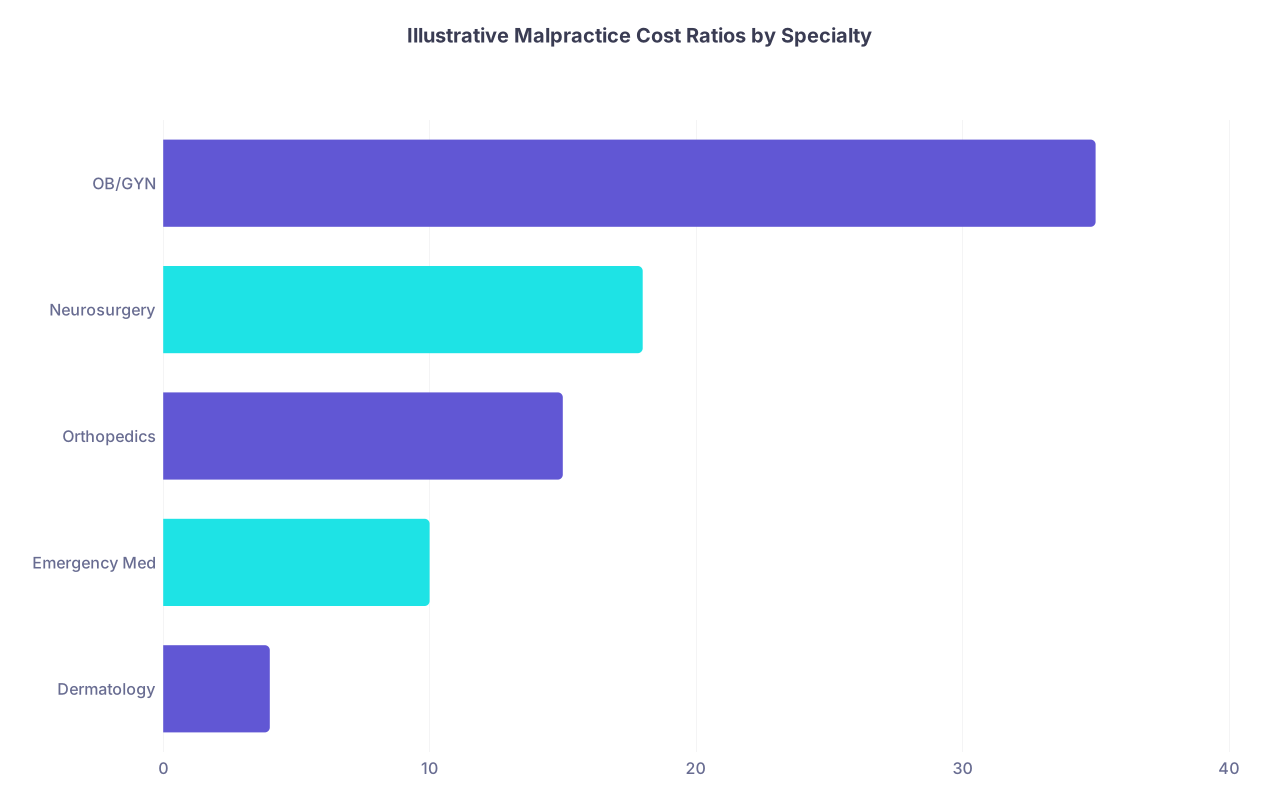
Then calculate: Malpractice Cost Ratio =
(Your share of malpractice premium + amortized tail) ÷ Net Take‑Home.
If that ratio is:
- Under 10%: malpractice is a modest drag, manageable.
- 10–25%: significant; watch for call expectations and legal climate.
25%: you are in OB/GYN‑like territory. You should love the medicine, because the financial risk‑return is not stellar.
| Category | Value |
|---|---|
| Dermatology | 4 |
| Emergency Med | 10 |
| Orthopedics | 15 |
| Neurosurgery | 18 |
| OB/GYN | 35 |
You will not get precise numbers as a resident, but you can usually get within ±5 percentage points with some honest questions and a spreadsheet.

Key takeaways
- In high‑risk specialties, malpractice premiums usually consume 5–12% of revenue but can take 15–40% of your take‑home once all other costs are stripped out—OB/GYN is the classic worst case.
- Employment models and state liability climates change where and how you feel malpractice costs, but they never make them disappear; tail coverage terms are often the hidden landmine.
- If you want a high‑risk, high‑pay career, stop fixating on absolute salary and instead compare net, malpractice‑adjusted take‑home per year (and per hour of call) across locations and contracts—the data there will tell you which jobs are genuinely worth it.


