

Money in medicine makes people weird.
The second you say “I’m thinking derm, ortho, plastics, anesthesia, rads…” people suddenly have Opinions about your soul.
You’re not imagining that.
You’re also not a bad person for caring about salary, lifestyle, or loans.
Let me go straight at the fear you’re probably circling:
“If I’m honest that I care about money, everyone will think I’m selfish, unempathetic, or not ‘mission-driven’ enough to deserve this career.”
Let’s pull that apart.
1. Yes, There Is Judgment Around High-Paying Specialties
You’re not being dramatic. There’s a culture here.
I’ve heard all of these in real life:
- “Oh, of course he’s going derm. Must be nice.”
- “She was all about primary care until she saw her Step score.”
- “He’s doing ortho because he wants toys, not patients.”
- “Radiology is for people who like money and hate people.”
This stuff gets said. In workrooms. In call rooms at 2 am. In group chats.
And it hits especially hard when:
- You come from a lower-income background
- You’re drowning in loans
- You actually like a higher-paying specialty, but you feel guilty saying that out loud
Here’s the thing most people won’t say bluntly:
Some folks resent that you’re chasing what they wish they had the numbers, courage, or life circumstances to go for. That resentment often gets dressed up as moral superiority.
“Real doctors do primary care.”
“We need more people willing to sacrifice.”
“Derm isn’t real medicine.”
Translation half the time: “I’m burned out, underpaid, and I need to believe I’m better than you to make peace with that.”
Not always. But often enough that you’ll see the pattern.
2. What Program Directors Actually Care About (Spoiler: Not Your Student Rumors)
Let me tell you what I’ve literally heard from program directors in “competitive” specialties: derm, ortho, ENT, plastics, anesthesia, radiology.
None of them said:
- “I only want residents who don’t care about money.”
- “I’ll reject anyone who mentions loans.”
They care about:
Will you be safe and competent?
Not killing patients is, understandably, a priority.Will you do the work?
Take call, follow through, not disappear when things get hard.Are you decent to work with?
And not a nightmare for staff, co-residents, or patients.Are you serious about this field?
Actual interest. Some exposure. A story that makes sense.
That’s the core.
Your “I worry people will judge me for choosing a high-paying specialty” anxiety is valid socially. But admissions and PDs? They’re not sitting there thinking, “Hmm, ortho applicant, probably greedy.”
They’re thinking:
- Do they have the scores/grades?
- Do their letters back up the story?
- Did they show up on the rotation?
- Are they normal when you talk to them?
You know what actually raises red flags?
Not “I care about paying off my loans.”
It’s:
“I have no idea what this specialty really is, I just heard it pays well and has good hours.”
There’s a difference. Huge one.
3. Let’s Talk About Money Without Pretending You’re a Saint
You’re allowed to care about money. Period.
Tuition is insane.
Cost of living is worse.
Interest eats you alive.
Here’s a reality check with rough ballpark numbers you’ve probably already doom-scrolled:
| Specialty | Approx Median Pay (USD) |
|---|---|
| Family Med | 250,000–280,000 |
| Internal Med | 260,000–300,000 |
| Anesthesiology | 420,000–500,000 |
| Orthopedics | 550,000–650,000 |
| Dermatology | 450,000–550,000 |
| Radiology | 450,000–520,000 |
Ask yourself honestly:
If you’re sitting on $300k+ of loans, is it irrational to care about that difference?
No.
What’s irrational is pretending you don’t care, then silently hating your life 7 years from now because you picked something out of guilt.
Here’s the actual ethical line:
- Unethical: Exploiting patients, cutting corners, ordering unnecessary procedures, letting money override medical judgment.
- Totally fine: Choosing a specialty that pays more and matches your interests, values, and life goals.
People conflate those two. They’re not the same.
4. The “Mission-Driven” Guilt Trap (And Why It’s Messier Than People Admit)
There’s this unspoken script in medicine:
“Good doctors choose lower-paying, high-need fields.
Selfish doctors choose high-paying lifestyle specialties.”
It’s garbage. But it lingers.
What no one likes to say out loud:
- Burned out, resentful doctors are not magically “more moral.”
- A miserable cardiologist isn’t better for patients than a happy dermatologist.
- You can do enormous good in any specialty, including the ones that pay well.
I’ve watched:
- Anesthesiologists quietly waiving professional fees for uninsured patients having necessary surgery.
- Ortho attendings spending weeks in low-resource countries doing complex cases for zero pay.
- Derm attendings running free skin cancer screening clinics.
- Radiologists catching cancers that literally saved someone’s life because they took an extra careful look when they could’ve rushed.
Is that “less meaningful” than managing diabetes in clinic? No. It’s just different.
We need:
- PCPs
- Surgeons
- Radiologists
- Dermatologists
- Anesthesiologists
- The whole ecosystem
You picking a better-paid piece of that ecosystem doesn’t collapse the moral universe.
5. How Honest Can You Be in Personal Statements and Interviews?
Here’s the annoying nuance:
You’re allowed to care about money.
You’re just not allowed to lead with that in applications.
Harsh but true.
There’s a professional script you need to respect.
Bad answer in an interview:
“Honestly, I want to do dermatology because the pay is great and the lifestyle is good.”
You might as well say: “I know nothing about this field except vibes and salary tables.”
Better, honest-but-professional:
“A few things drew me to dermatology. First, I really like the visual diagnostic aspect—pattern recognition is genuinely fun for me. Second, I saw how much impact you can have on quality of life, especially with chronic or visible conditions. Third, I do think about longevity in this career, and derm offers a way to be present for my family and still practice at a high level for decades. With my loan burden, being able to achieve financial stability is also part of what makes this sustainable long term.”
See the difference?
You’re not:
- Pretending you don’t care about your life.
- Making money the headline.
You’re saying: “I care about the work, patients, AND my long-term sustainability as a human being.”
That’s actually responsible.
6. Will Co-Residents and Attendings Judge You? Yeah, Some Will.
Let’s not sugarcoat it. Some people will absolutely:
- Roll their eyes when you say “derm”
- Joke that you’re chasing money
- Assume you’re soft if you pick rads/anesthesia over gen surg, EM, etc.
You’ll see patterns:
The “martyr” types:
“I chose primary care because someone has to care about patients, not just a paycheck.” (Often burned out, often projecting.)The “bitter” types:
“Must be nice going home at 3 pm while I’m still here.” (Understandable frustration, but still their issue.)The “performative” types:
On social media: “Medicine isn’t about money.”
In private: complaining constantly about salary, loans, and call.
Here’s who you actually listen to:
- The senior resident who says:
“Just make sure you like the work. Money doesn’t fix hating your job.” - The attending who says: “I wish I’d thought more about my long-term life when I chose.”
- The people who are clearly tired but don’t insult you for choosing differently.
You can’t control who judges you. You can control:
- Whether your choice is grounded in actual experience (shadowing, rotations, talking to people)
- Whether your story makes sense (not “I got a 265 so I have to do derm now”)
- Whether you still show up as a good teammate no matter your field
7. Reality Check: Every Specialty Has Sacrifices (Even the High-Paying Ones)
The fantasy is:
“High-paying = easy life, everyone happy, no downsides.”
Your anxiety knows better, which is why you’re here spiraling.
High-paying doesn’t mean:
- No call
- No stress
- No difficult patients
- No burnout
Different specialties just package the pain differently.
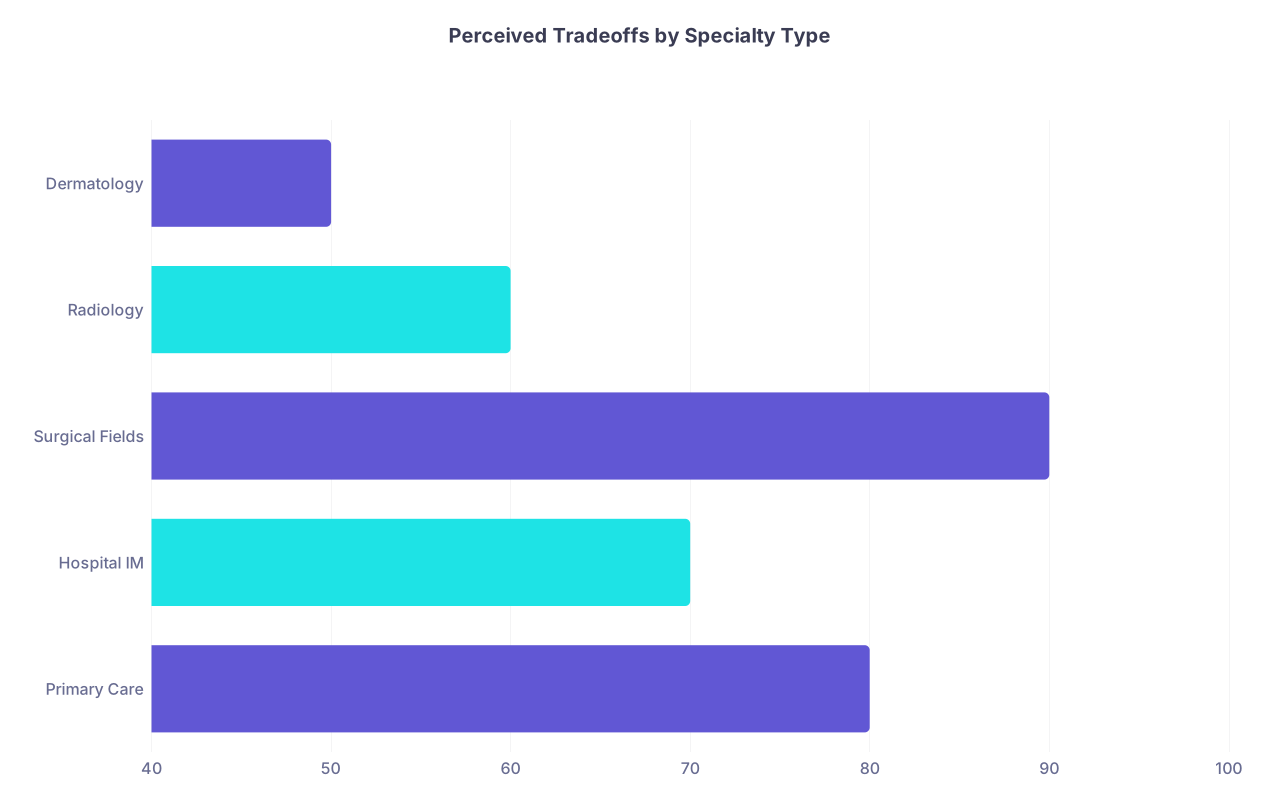
| Category | Value |
|---|---|
| Primary Care | 80 |
| Hospital IM | 70 |
| Surgical Fields | 90 |
| Radiology | 60 |
| Dermatology | 50 |
Think of those numbers as “overall burnout/pressure load” vibes, not gospel.
Examples you rarely see on Instagram:
- Ortho: 2 am open fractures, heavy physical work, long OR days.
- Anesthesia: High-stakes responsibility, constant vigilance, rare disasters that haunt you.
- Rads: Fatigue from intense focus, anxiety about misses, productivity pressure.
- Derm: Emotional load from disfiguring disease, cancers, cosmetic vs medical tension.
You’re not gaming the system by choosing a well-paid field. You’re picking a different flavor of hard.
The real mistake is pretending any specialty is “easy money.” That’s when people end up bitter.
8. How to Talk About Debt and Lifestyle Without Sounding “Greedy”
You’re terrified of saying the wrong thing and getting mentally blacklisted. Fair.
Here are safe, honest ways to frame your concerns:
Instead of:
“I don’t want to be poor.”
Try:
- “I’m very mindful of my loan burden and want a career that’s sustainable financially.”
- “I want to be able to support my family and still show up fully for my patients.”
Instead of: “I want a chill lifestyle.”
Try:
- “I know I function best when I’m not constantly at the edge of burnout. I’m looking for a specialty where I can be present both at work and at home.”
- “Work-life balance matters to me because I want to have a long, healthy career.”
Instead of: “I picked this for the money.”
Try:
- “Compensation isn’t the only factor, but it’s one piece of making this career sustainable for me alongside the clinical work I enjoy.”
It’s not lying. It’s professional framing.
9. A Quiet Fear: “Will Patients Respect Me Less?”
I’ve heard this one a lot from future derm, plastics, rads folks:
“If I tell patients what I do, are they going to think I’m superficial or just in it for cash?”
Some might. You can’t fully control that.
But most patients care about:
- Were you kind?
- Did you listen?
- Did you help?
A radiologist who calls the team to push for a CT because something feels off—that’s remembered.
A dermatologist who takes acne seriously instead of dismissing it as vanity—that’s life-changing for a teenager.
Patients almost never say:
“Wow, I bet my anesthesiologist is rich.”
They’re thinking:
“Please don’t let me die.”
Your specialty reputation is background noise. Your behavior in the room (or reading room, or OR) is what sticks.
10. What To Do Right Now If You’re Still Spiraling
You’re probably bouncing between tab after tab:
salary data, Reddit, SDN, specialty forums, PGY-2 meltdown posts.
Here’s how to get out of your head and into something useful.
Write down the actual fears in plain words.
Not the fancy versions. The raw stuff:- “I’m scared my family will think I sold out.”
- “I’m scared my classmates will talk shit about me.”
- “I’m scared I’ll regret picking something ‘too easy’ or ‘too greedy.’”
Then ask for each fear:
a) Is this a social fear or a real career risk?
b) What data do I have, not just vibes?Talk to 2–3 attendings in that specialty and literally ask:
- “Did you feel judged for choosing this?”
- “Do you ever regret it?”
- “What’s the un-glamorous side no one told you about?”
- “How do you think about money and meaning in this field?”
You’ll notice something:
The happiest people are the ones who picked the specialty whose day-to-day work they can tolerate—or even like—most of the time.
Not the ones who tried to “win” some unspoken moral Olympics.
FAQ (Exactly 5 Questions)
1. Will PDs secretly judge me if they think I chose this specialty for the money?
They’ll judge you only if your application screams “I don’t actually care about this specialty.” If your experiences, letters, and story show genuine interest and you speak professionally about lifestyle/financial sustainability, they’re not sitting there moralizing your motives. They’re hiring future colleagues, not saints.
2. Can I mention loans or financial stability in my personal statement?
Yes, lightly. One or two sentences is fine if it’s framed as part of your desire for a sustainable, long-term career. Don’t make it the central theme. Lead with what you like about the work—procedures, patient population, pathology, problem-solving—and place financial stability as a secondary, adult consideration.
3. What if my classmates say I “sold out”?
People project. A lot. Some wanted your specialty and didn’t get it. Some feel trapped in theirs and cope by acting superior. You don’t owe them self-sacrifice to validate their choices. What you do owe yourself is an honest career that fits your brain, your body, and your life—whatever the salary number ends up being.
4. Is it wrong to rank lifestyle above “impact” when choosing a specialty?
No. The impact narrative is over-glorified and oversimplified. You can have huge impact in any field, and you can burn out in any field. Choosing something you can do for 30 years without falling apart is responsible. A furious, exhausted doctor is not “more noble” than a well-rested one.
5. What’s one sign I’m choosing a high-paying specialty for the wrong reasons?
If you can’t name specific parts of the work you genuinely enjoy—or at least don’t dread—and all your reasoning is score, prestige, pay, and lifestyle, that’s a big warning flag. You don’t have to be obsessed with every aspect, but if the job itself is an afterthought, you’re setting yourself up for regret, no matter how big the paycheck is.
Open a blank page right now and write one paragraph answering this:
“If money didn’t exist and all specialties paid the same, what would still pull me toward this field?”
If you can’t answer that yet, your next step isn’t to panic—it’s to go find that answer through rotations, shadowing, and real conversations.


