
The idea that you “have to” choose a high-paid specialty to be financially safe is a trap.
I’m saying that as someone who has done the math, watched residents panic on Match Day, seen people with $400k+ debt still sleep at night—and others in derm making $600k who are still broke and stressed.
If you’re anxious about debt and drawn to a lower-paid specialty, you’re not crazy. You’re just stuck in the mental loop of: “What if I regret this forever and end up the underpaid martyr with crushing loans and no life?”
Let’s walk through that fear properly. Worst case and all.
The uncomfortable baseline: what “lower-paid” actually means in medicine
First, “lower-paid” in medicine is still wildly different from “lower-paid” in the rest of the world.
| Tier | Example Specialties | Approx Median Salary (US) |
|---|---|---|
| Very High | Ortho, Cards, Derm | $550k–$700k+ |
| High | EM, Anesthesia, GI | $400k–$550k |
| Moderate | IM, Peds, Psych | $230k–$320k |
| Lower-Moderate | FM, PM&R | $220k–$280k |
You’re probably worried about being in that “moderate” or “lower-moderate” group: internal medicine, pediatrics, family medicine, psychiatry, maybe hospitalist work.
Let me say the scary part out loud:
- You can absolutely graduate with $300–500k in loans.
- You can absolutely choose a $230–280k specialty.
- And yes, you can still end up okay financially.
Not rich-by-Reddit-standard. Not “retire at 40 and buy a boat” okay. But “loans under control, savings growing, life not run by money” okay.
The people who end up not okay are usually not there because of their specialty. They’re there because of:
- Zero plan for loans
- Massive lifestyle creep the second they become attendings
- Divorce plus debt plus no emergency fund
- Doing nothing for 5–10 years and then realizing interest is a monster
You’re worrying about this now. That already puts you way ahead of a lot of people who just shrug and say, “Future me will figure it out.”
The nightmare scenario you’re picturing (let’s actually spell it out)
Here’s the mental horror movie most anxious applicants run on a loop:
You match into something you love but it pays less, say pediatrics or family medicine.
You finish residency with $350–450k in federal loans at 6–7%.
You get your attending job, realize your paycheck isn’t what Instagram promised, and between rent/mortgage, childcare, and loans, you feel like you’re drowning.
You imagine being 45, still paying loans, exhausted, watching your surgery and anesthesia friends buy big houses and “win at life.”
You’re not wrong to fear this. Pieces of it happen to real people.
But the part your brain is skipping is: there are levers you can pull that dramatically change the outcome even in a lower-paid field.
Let’s walk through them without sugarcoating.
The math: can a lower-paid specialty carry big debt?
Let’s take a fairly ugly but realistic setup:
- Total loans at end of residency: $400,000
- Interest rate: ~6.5% (typical federal)
- Attending salary as a general pediatrician or FM doc: ~$230–260k
- Filing single, living in a moderate cost-of-living area
If you try to pay that off “old school” with the standard 10-year plan and no forgiveness, your monthly payment can be around $4,500–$5,000. That’s brutal on $230k, especially with taxes.
That’s where people panic and say, “See? You have to do ortho or derm.”
But lower-paid docs aren’t paying like that. They’re doing one of three things:
- Income-Driven Repayment + PSLF (Public Service Loan Forgiveness)
- Income-Driven Repayment + long-term taxable forgiveness
- Aggressive payoff with lifestyle restraint for 5–7 years
Let me be blunt:
If you’re choosing a lower-paid specialty and you don’t think through one of those paths, you’re setting yourself up for anxiety. But if you do structure it, the picture changes a lot.
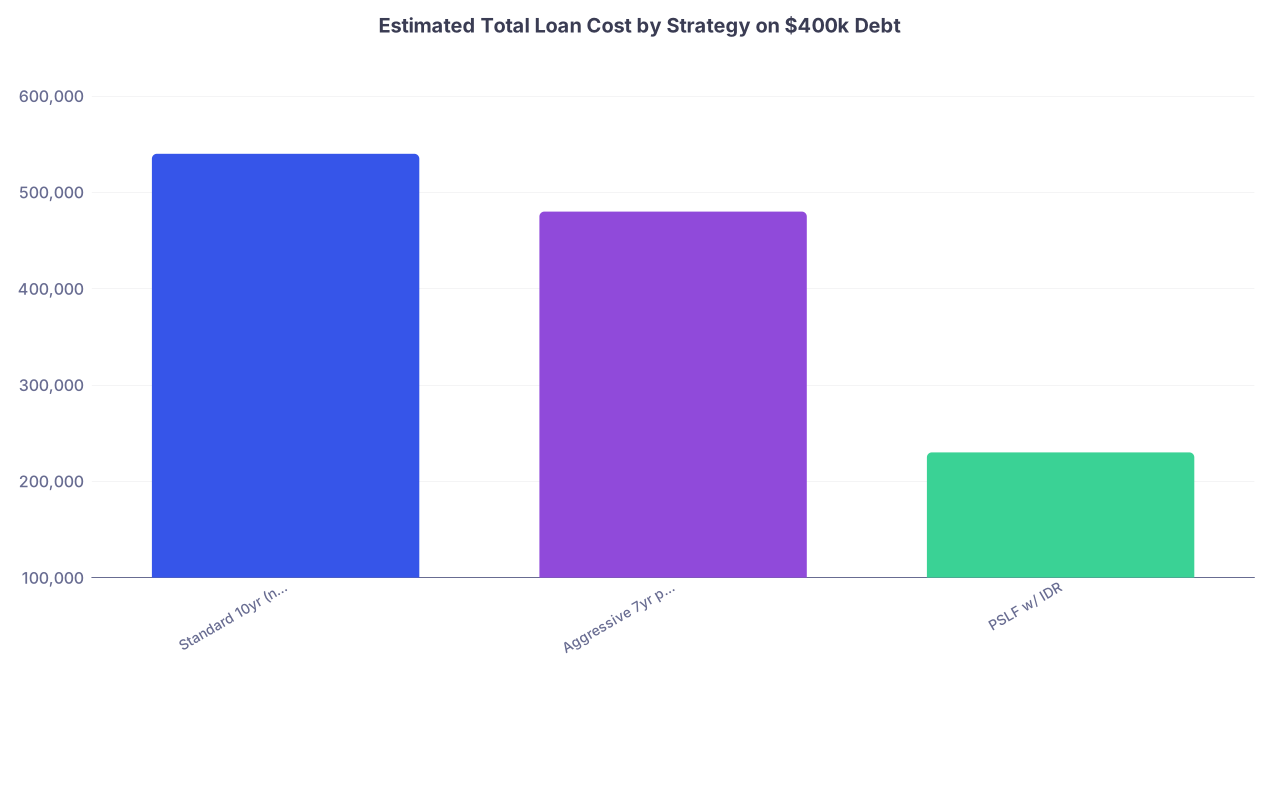
Here’s a rough comparison if you work full-time in a qualifying nonprofit hospital or clinic:
| Category | Value |
|---|---|
| Standard 10yr (no forgiveness) | 540000 |
| Aggressive 7yr payoff | 480000 |
| PSLF w/ IDR | 230000 |
Those numbers depend on specifics, but the pattern holds: on an IDR plan with PSLF, a “lower-paid” doc isn’t doomed. They may actually pay less total than a high-earning doc who doesn’t qualify for PSLF and just brute-forces it.
So is a lower-paid specialty financially safe?
It can be.
If you pick the right repayment structure and don’t pretend loans don’t exist.
Where the real financial danger actually is
Here’s the part nobody tells you during med school tours when they’re handing out free tote bags.
The riskiest combo is not “low-paying specialty + debt.”
It’s:
- Any specialty
- high debt
- big fixed expenses early (house, luxury car, private school, etc.)
- no forgiveness plan
- no boundaries on working more to “fix” the money anxiety
Let me give you two very real composite examples I’ve seen:
- A pediatrician making $250k at a nonprofit hospital
- Married, two kids, renting modestly for a while
- PSLF eligible
- On SAVE/REPAYE with steady payments for 10 years
- Modest car, vacations but not lavish, starts investing early
- Loan forgiven at year 10, net worth positive with growing retirement accounts
Versus:
- An anesthesiologist making $480k in private practice
- Buys $1.2M house, two luxury cars within 2 years
- No PSLF eligibility (for-profit group)
- Pays loans on 10-year standard but also running high monthly expenses
- Has basically no cushion if income drops or group dissolves
Who’s “safer”?
On paper, everyone points to the anesthesiologist. In real life, the pediatrician often has less financial fragility because their lifestyle isn’t hanging on every RVU.
The trade you’re actually making: money vs control vs meaning
Here’s what you’re really choosing when you pick a specialty:
- Baseline income range
- Hours/shift type (and what that does to your brain)
- How easily you can moonlight or add side income
- How portable your job is if you want to move or go part-time
Some “lower-paid” fields secretly have better flexibility to play the long game.
Family medicine, psych, and hospitalist internal medicine can give you:
- Easier access to PSLF (many jobs at nonprofits/FQHCs)
- Opportunities to stack part-time telehealth, urgent care, locums
- Flexibility to move to lower cost-of-living areas and keep the same income
If you’re a catastrophizer like me, think of it this way: safety isn’t just “highest salary.” Safety is “maximum ability to pivot if life punches you in the face.”
A lower-paid but flexible specialty plus a solid loan plan is more financially resilient than a high-paid but rigid one that requires you to be full-time high-output forever.
How to reality-check a lower-paid specialty choice (without lying to yourself)
Here’s the uncomfortable checklist I wish students did before panicking about debt and peds/FM/psych:

| Step | Description |
|---|---|
| Step 1 | Interest in lower paid specialty |
| Step 2 | Plan for IDR or PSLF |
| Step 3 | Standard or aggressive payoff possible |
| Step 4 | PSLF track - likely safe |
| Step 5 | Long term IDR with taxable forgiveness |
| Step 6 | Lower paid specialty likely safe |
| Step 7 | Recalculate budget and expectations |
| Step 8 | Loans over 250k? |
| Step 9 | Willing to work at nonprofit or FQHC? |
| Step 10 | Comfortable with 5 to 7 year grind? |
Ask yourself, in writing:
- How much debt am I actually on track for? Not a vague “a lot.” Numbers.
- Am I willing to do PSLF-type work (academic, nonprofit hospital, FQHC) for 10 years?
- Would I tolerate living like a resident or slightly above for 5–7 attending years to crush loans?
- Where do I want to live—and what does a normal attending salary in my field really buy there?
If your answers are:
- “Yes, I’d do PSLF,” or
- “Yes, I’m willing to live below my means for 5–7 years,”
then a lower-paid specialty is very likely financially safe for you.
If your answers are:
- “No way I’m doing nonprofit/FQHC anything,” and
- “No, I’m not giving up the big house / private school / BMW expectations,”
then yeah, be honest: you’re going to feel financial strain in a lower-paid field with heavy debt.
Not because the field is “unsafe,” but because your lifestyle expectations and the math don’t match.
The mental health part nobody factors in
You know what doesn’t show up in those salary comparison charts?
- Malignant call schedules
- Burnout rates
- Divorce rates
- The feeling of hating your day-to-day but being “trapped” because of income
I’ve watched people chase “safe money” into higher-paying specialties and then spend residency (and beyond) secretly Googling “how to switch specialties after PGY-2” at 2 a.m.
You’re anxious about debt right now. Fair. Rational.
But are you prepared for the version of you who’s debt-free at 42 but miserable every single day at work?
There’s risk either way:
- Risk 1: You choose a lower-paid specialty you love and you have to be intentional and disciplined about money for 10–15 years.
- Risk 2: You choose a higher-paid specialty you don’t love and you wake up 15 years later with money but regret.
I’m not going to pretend one of these is obviously “better” for everyone. But I can tell you this: the people who seem most at peace with their finances are not always in the top-paying specialties. They’re the ones who:
- Actually like their work enough to sustain a career
- Matched their spending to their reality early
- Picked a loan strategy and stuck to it
There is nothing financially safe about burning out so hard you cut back your hours or leave medicine entirely.
Concrete signs a lower-paid specialty can be financially safe for you
If you see yourself in most of these, you’re probably okay:
- You’re open to working at a nonprofit hospital, academic center, VA, or FQHC
- You’re willing to use an income-driven repayment plan and not freak out at a big theoretical “total” number
- You don’t need to live in SF/NYC/SoCal in the most expensive zip codes on day one
- You’d be fine renting for a while instead of buying immediately
- You’re willing to drive a normal car and delay the “doctor flex”
- You care more about day-to-day job fit than impressing anyone with your salary
If all of the following feel non-negotiable to you:
- Luxury home in a high-cost coastal city right away
- Brand new luxury car within a year or two
- Private school for multiple kids
- Traveling like an Instagram influencer
- Zero interest in forgiveness programs or stretching out loan payoff
Then no, a lower-paid specialty with $350–500k of debt may not feel financially safe. The math can still technically work, but your anxiety will stay cranked.
And that’s the real question: not just “Is it mathematically possible?” but “Is this combination of specialty + debt + lifestyle going to let me sleep at night?”
How to calm your brain down enough to decide
Here’s what I’d do if I were you, spiraling about this:
- Get a realistic projected debt number from your financial aid office. Not a guess.
- Use an online student loan calculator (or studentaid.gov) to model:
- IDR + PSLF on your likely specialty salary
- IDR without PSLF
- Aggressive payoff (what monthly payment would it take to clear in 7–10 years?)
- Then ask: “Would I rather adjust my lifestyle or change my specialty?”
Sometimes, when you see that PSLF would likely wipe out a big chunk of your loans with manageable payments on a $230–260k salary, your brain will finally stop screaming, “I must do ortho or I’ll die!”
And if the numbers genuinely don’t work for your goals, better to know now than after you match.
FAQ (the four questions you’re probably still obsessing over)
1. Is it actually realistic to do PSLF in a lower-paid specialty, or is that a fantasy?
Very realistic. Many lower-paid specialties are heavily represented in PSLF-qualifying environments: academic centers, children’s hospitals, community hospitals, FQHCs, VAs. A pediatrician, psychiatrist, or family med doctor at an academic or nonprofit hospital is basically the PSLF poster child. The “fantasy” is assuming PSLF won’t exist at all; even with policy changes, historically programs get grandfathered. Is there some political risk? Sure. But for many people, the risk of ignoring PSLF and paying everything cash is higher.
2. What if I do a lower-paid specialty and then regret the money—am I stuck forever?
No. You have levers. In many fields you can: pick up extra shifts, do locums, add telehealth, shift to hospitalist work, move to a lower cost-of-living area with higher relative pay, or take leadership/admin roles. A family med doc making $230k in a big coastal city might make $275–300k in a mid-sized city with a much lower cost of living. That move alone can feel like a massive raise. You’re not locked into a single salary number for 30 years.
3. Is it dumb to even think about lower-paid specialties if I know I’ll have $400k+ of debt?
Not dumb. It just means you can’t “wing it.” At $400k+, you need an intentional plan: probably PSLF or long-term IDR, or a serious 5–7 year attending grind with modest living. If the thought of budgeting, delaying lifestyle upgrades, or choosing PSLF-type jobs makes you furious, then yes, high debt + low pay is a bad mix for your personality. But that’s about you, not about the specialty being inherently unsafe.
4. Will residency programs judge me if I say I’m worried about money and debt in interviews?
Yes, if that’s your whole personality. No, if you’re thoughtful. Saying, “I’m mindful of my loans, but I chose this specialty because I can’t see myself happy long-term in anything else. I’ve looked into PSLF and income-driven repayment and I know it’s manageable,” actually sounds mature. Saying, “I just want a high salary,” in a peds or psych interview? That’ll land badly. You can acknowledge reality without sounding like you’re only there for a paycheck.
Open a blank page and write down:
- your projected total debt,
- your top 1–2 specialties,
- where you’d be willing to work (nonprofit/academic vs not).
Then run one concrete repayment scenario (PSLF or aggressive payoff) for each specialty. Don’t just think the numbers. Look at them.