The obsession with “highest paid specialties” is blinding smart people into making really bad decisions about their lives.
You picked a lower-paid field. Or you’re pretty sure you’re going to. And now the panic spiral has started: did I just screw my future self? Will I be the only doctor who can’t afford a house, daycare, vacations, and retirement?
Let’s walk straight into the worst fears instead of dancing around them.
The Fear Behind “Lower-Paid Field”
You’re not actually asking, “Will I make enough money?”
You’re asking:
- Am I going to regret this in 10–20 years?
- Will I always feel “behind” compared to my classmates in ortho, derm, radiology, gas?
- Did I just trap myself into a life of grinding work and permanent financial stress?
Because on paper, sure, you know you’ll be “fine.” But you also know attendings in primary care or pediatrics who are:
- Seeing 25–30 patients a day
- Fighting with prior auths during lunch
- Pissed off about their RVU bonus
- Complaining in the workroom about their loans and 401(k)
And then you see the ortho people talking about buying a house with a three-car garage.
So your brain does the math:
Low-paying specialty + high loans + late start = financial disaster.
Let’s put some actual numbers and structure to this instead of vague dread.
What “Lower-Paid” vs “Highest Paid” Really Looks Like
First, some rough, typical ballpark attending salaries in the U.S. (yes, it varies by geography, call, practice type, etc. — I’m not trying to write a compensation textbook).
| Specialty | Approx Annual Salary |
|---|---|
| Orthopedic Surgery | $600k–$800k+ |
| Dermatology | $450k–$650k |
| Anesthesiology | $400k–$600k |
| Radiology | $450k–$650k |
| Internal Medicine (outpatient) | $230k–$300k |
| Pediatrics | $200k–$260k |
| Psychiatry | $250k–$320k |
You don’t need precision here, you need scale.
The difference between, say, outpatient IM at $260k and ortho at $700k is gigantic on paper. And your brain instantly jumps to lifetime earnings:
“Over 30 years, that’s millions of dollars. Millions.”
Here’s the twist: both truths can exist at once.
- Yes, high-paying specialties can generate much more lifetime income.
- No, you did not automatically destroy your financial future by choosing the “wrong” one.
Because your financial life is not just “income.” It’s timing, lifestyle creep, debt strategy, and burnout risk. And most people absolutely waste the advantage of high income anyway.
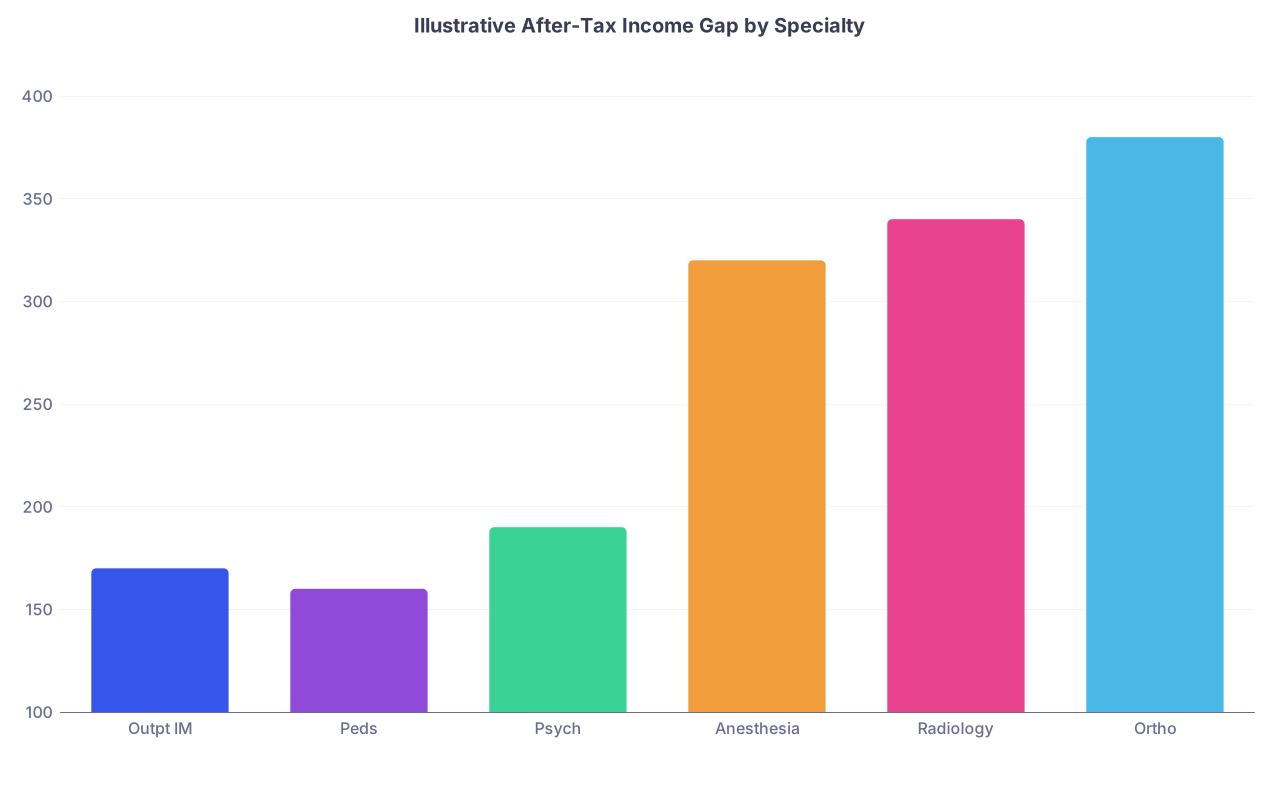
To make this less abstract, look at this:
| Category | Value |
|---|---|
| Outpt IM | 170 |
| Peds | 160 |
| Psych | 190 |
| Anesthesia | 320 |
| Radiology | 340 |
| Ortho | 380 |
That’s not exact tax math, just an illustration of after-tax income. Yes, the ortho doc has way more. But notice something: everyone on that chart is making more than enough to build wealth if they don’t light it on fire.
Which… a shocking number of physicians do.
Worst-Case Scenarios (Let’s Actually Say Them Out Loud)
Let’s imagine all the dark scenarios your brain is spinning up.
1. “I’ll Never Pay Off My Loans”
Say you owe $300k–$500k. You choose peds/IM/psych instead of ortho.
Here’s what actually happens, in real life, to people I’ve seen:
- They use income-driven repayment + PSLF at an academic or nonprofit hospital and pay a manageable percentage of their income for 10 years while loans quietly evaporate.
- Or they forgo PSLF, live like a resident for 2–5 years as an attending, and wipe out loans with aggressive payments.
Where things go bad:
- They graduate, immediately buy a $900k house, two new cars, private school, and “reward” vacations, then complain they’re “stuck” with loans at age 45.
- They make attending money but still think like a stressed resident and never build a plan.
You can absolutely screw yourself in a lower-paid specialty if you pair modest income with high lifestyle creep and zero strategy.
You can also absolutely screw yourself in ortho by doing the exact same thing — just with nicer cars.
The specialty didn’t ruin them. Their behavior did.
2. “I Won’t Be Able to Afford a Decent Life Where I Want to Live”
The geographic fear is real. You want:
- A high cost-of-living city (NYC, SF, LA, Boston)
- Maybe kids
- Maybe a spouse who doesn’t have a huge income
- A life that doesn’t feel like permanent sacrifice
People jump from that to: “So I need derm-level money or I’m doomed.”
But income is only one variable.
- You can increase compensation within a “lower-paid” field by joining the right group, taking on certain roles, adding telehealth or side gigs, or moving slightly outside the most saturated area.
- You can have a spouse/partner whose income matters more than you’re currently factoring in.
- Or you accept that if you want Manhattan + private school + big apartment on a peds salary with one income… yeah, that might not compute. But that’s not a “you chose peds” problem. That’s a “those are objectively expensive choices” problem.
One thing that helps is to stop treating “lower-paid” like “poor.”
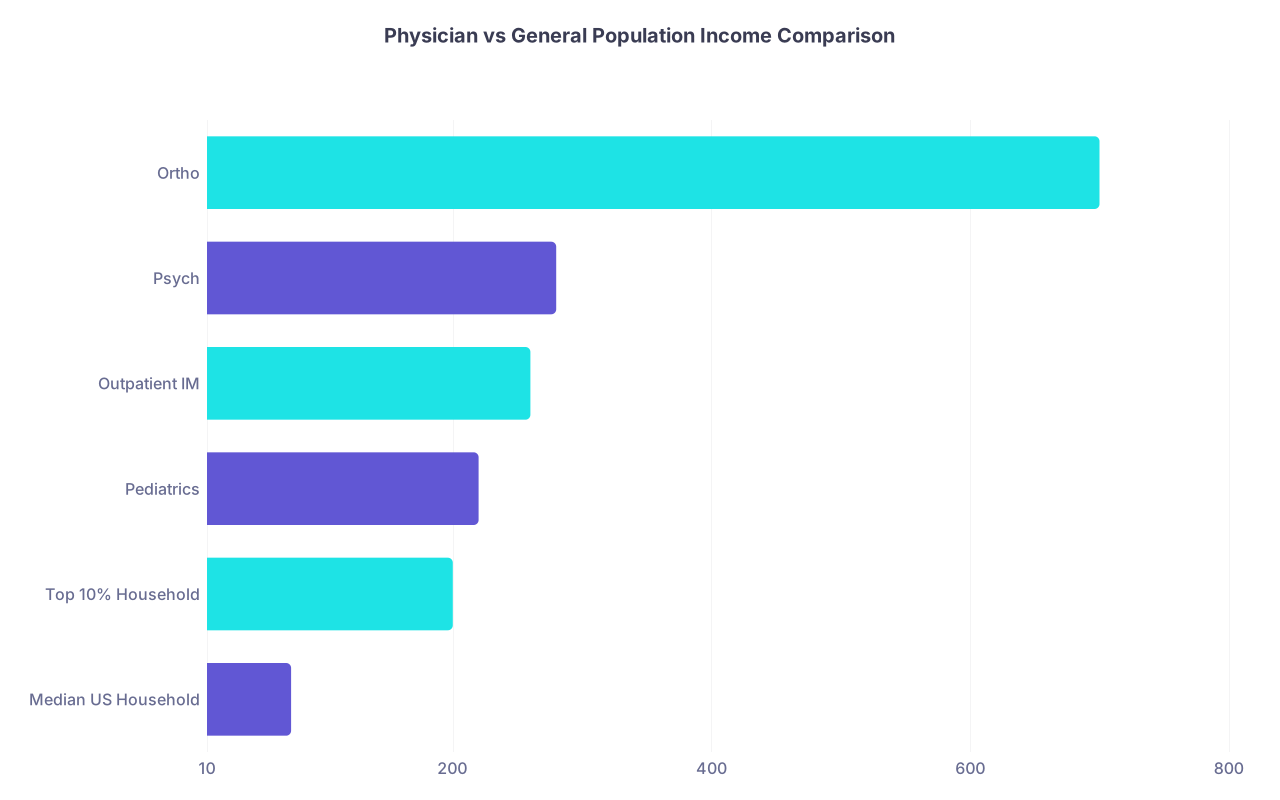
Look at what even “low” physician salaries look like in the general population:
| Category | Value |
|---|---|
| Median US Household | 75 |
| Top 10% Household | 200 |
| Pediatrics | 220 |
| Outpatient IM | 260 |
| Psych | 280 |
| Ortho | 700 |
You’re not comparing “peds vs ortho.” You’re comparing “peds vs literally almost everyone else in the country.”
Does cost of living still matter? Yes. Can it feel tight with daycare and housing in a HCOL city on 230k–260k? Yes. But that’s different from “ruined.”
3. “I’ll Be 45, Burnt Out and Regretting Everything”
This one’s brutal because you’ve seen it. The attending who says, “If I could go back, I’d do radiology or anesthesia. Better money. Better hours.”
The problem is: you’ve also seen anesthesiologists and radiologists who are completely fried and fantasizing about quitting medicine.
Money does not protect you from burnout. In some settings it actually fuels it, because the practice model is “see more, do more, bill more, don’t question it.”
From what I’ve watched over the years, regret usually sounds like this:
- “I never actually liked this field, I just chased the lifestyle/money.”
- “I built a life on a huge fixed monthly spend and now I feel trapped.”
- “I always told myself I’d ‘cut back later’ and I never did.”
Not: “I loved my patients, the day-to-day work was meaningful, but I wish I’d made $250k more per year.”
That might happen. Sure. But when people really crack, it’s usually identity + lack of control, not “only” a money gap.
If you chose something you genuinely enjoy and are good at, you eliminated one major source of long-term misery. That is not nothing.
How Much Does Specialty Choice Actually Matter for Money?
I’m not going to lie to you: specialty does matter for lifetime wealth. A lot.
Let’s say:
- Primary care doc: $260k
- Ortho doc: $700k
Assume they both start attending life around 32, work until 65, save a fraction of their income, etc.
If both of them behave identically — save the same percentage, invest similarly, avoid ridiculous lifestyle choices — the ortho will end up massively ahead. No question.
But here’s what actually happens:
- The high earner often inflates lifestyle at the same pace as income. More house. More car. More private school. More “we deserve this.”
- The lower earner is either:
- careful and intentional, or
- just as bad, but with less room for catastrophic mistakes.
So you get weird situations like:
- A primary care doc who hits millionaire status in their 40s because they kept fixed expenses reasonable and maxed retirement accounts.
- A surgeon in their 50s sweating every market downturn because they’re carrying a $1.5M mortgage, multiple car payments, college for 3 kids, and a divorce.
There’s also timing. Your income doesn’t start properly until your early 30s. What you do in those first 5–10 attending years is disproportionately powerful.
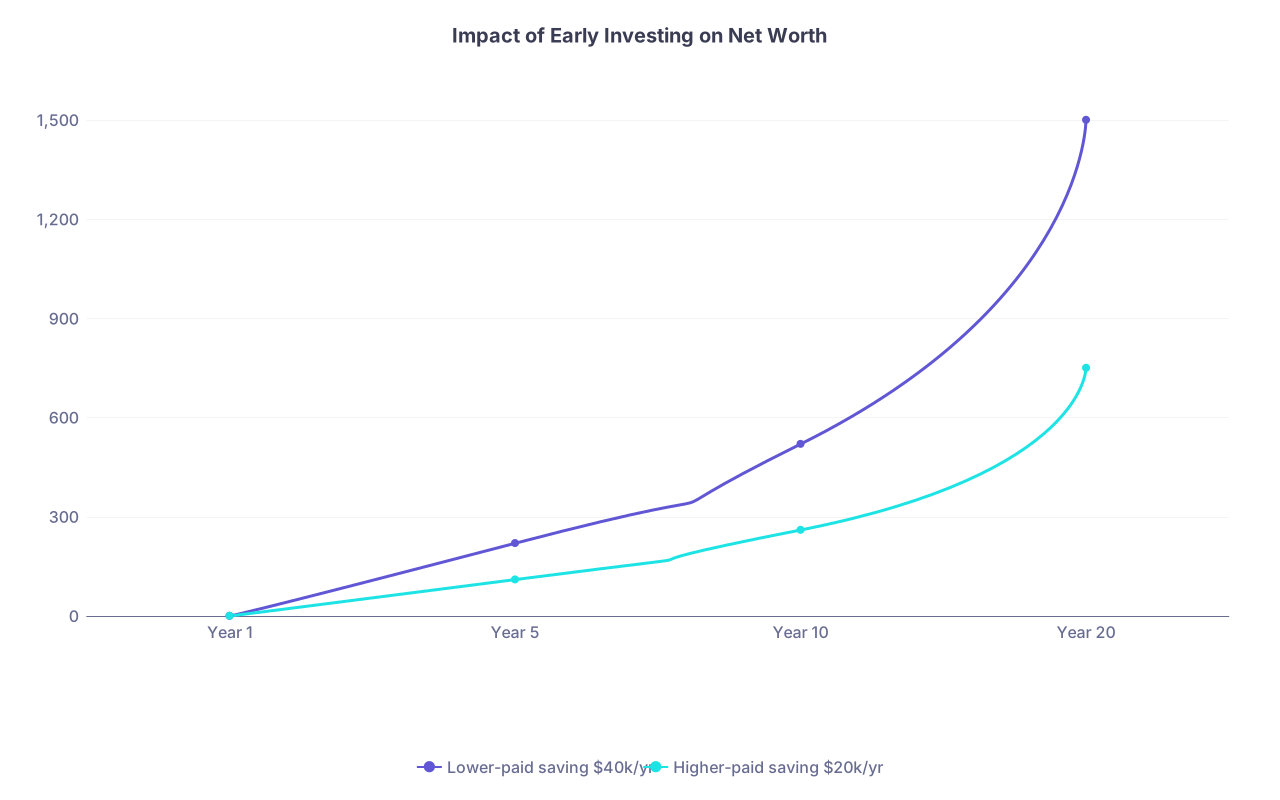
Here’s an illustration of something people underestimate:
| Category | Lower-paid saving $40k/yr | Higher-paid saving $20k/yr |
|---|---|---|
| Year 1 | 0 | 0 |
| Year 5 | 220 | 110 |
| Year 10 | 520 | 260 |
| Year 20 | 1500 | 750 |
Again, not perfect math. Just the point: a lower-paid doctor saving more intentionally can absolutely outrun a higher-paid doctor saving less and spending more.
The Stuff That Actually Saves or Destroys Your Financial Future
Let me be blunt: what matters way more than “IM vs Ortho” is this:
Do you avoid golden handcuffs?
The big, irreversible fixed costs: huge mortgage, luxury car leases, private school that your budget can’t truly support, social circle that expects fancy everything.Do you give your money a job?
Automatic retirement contributions. Extra loan payments (if not using PSLF). Intentional investing instead of just letting cash sit in a 0.01% savings account.Do you have a realistic picture of your field’s typical life?
Not Instagram. Not the one unicorn attending with a boutique cash-only practice and 3-day weeks. The actual median lifestyle.
This is where you actually have leverage. Especially early.
And no, this doesn’t mean martyrdom. You don’t have to live like a monk forever. You just can’t pretend you’re an ortho doc on a peds salary and think math won’t catch up with you.
If You’ve Already Chosen (Or Matched) a Lower-Paid Field
You’re probably not starting from a blank slate. You might already be an IM intern, a psych resident, a future pediatrician with a signed contract that says $240k.
And the thought creeps in: “Too late. I messed up. I should have pushed for a more competitive field.”
Here’s what I’d do in your shoes.
Not generic “budget better.” Concrete things.
Get uncomfortably clear on your numbers.
How much debt, what interest rates, what your attending salary will actually be in your geographic area, what call pay or bonuses look like. Not Medscape survey fantasies — literal job offers or MGMA ranges.Decide on a repayment path on purpose.
PSLF? Then you commit to a qualifying employer and stick with an IDR plan.
No PSLF? Then you plan a 2–5 year “live like a resident” period after training and destroy the loans.Preempt lifestyle creep with future-you in mind.
Before that first attending paycheck hits, decide:- Max 401(k)/403(b)?
- Roth IRA/backdoor Roth?
- How much to throw at loans monthly? And then you let your remaining money define your lifestyle — not the other way around.
Be strategic inside your field.
Not all jobs in “lower-paid” specialties are equal. Academic vs community. W2 vs partnership track. RVU vs salary. Location tradeoffs.
You can sometimes bump pay by $50k–$100k just by choosing a less saturated area or a higher-need system. That is non-trivial on a $250k base.
What If You’re Still Choosing Your Specialty?
If you’re still in med school or early residency and haven’t locked yourself in yet, here’s the hard question:
If money were equal across all specialties, what would you actually do?
If your answer is still your “lower-paid” field, you’re probably okay. You’re choosing based on the work, not the paycheck. That’s durable.
If your honest answer is something like, “I’d actually do anesthesia/rads/EM, but I’m scared I won’t match / think I’m not competitive / my school culture says primary care is ‘more noble,’” then money is not actually your main problem. It’s confidence, strategy, and fear.
But don’t twist that around and punish yourself.
You are not forever banned from course-correcting. People absolutely:
- Do fellowships that bump their earning power inside a “low” field.
- Transition to admin, consulting, industry, telehealth, or niche practices.
- Move from Manhattan to a mid-sized city and suddenly make $80k+ more with a lower cost of living.
Your choice at 26 doesn’t tattoo itself on your forehead.
You Didn’t Ruin It. But You Do Need a Plan.
Here’s the uncomfortable truth: saying “I’ll be fine, I’m a doctor” is how you quietly drift into being the 55-year-old who isn’t fine.
But “I ruined everything by choosing psych instead of anesthesia” is just as wrong. And useless.
Your specialty is the starting line, not the whole race.
What will make or break your financial future is:
- whether you actually like what you do enough to keep doing it without completely burning out;
- how you handle the first 5–10 years of attending life when the temptation to spend is at its absolute peak;
- and whether you’re willing to look your numbers in the face and steer, instead of closing your eyes and hoping it all works out.
You chose a lower-paid field. Okay.
That’s not a death sentence. It just means you don’t have as much margin for dumb, expensive mistakes as your ortho friend. So you compensate with intentional choices instead of raw income.
Key points, stripped of fluff:
- No, you didn’t automatically ruin your financial future by picking a lower-paid specialty; you still have an income that, used well, can build real wealth.
- The gap between “comfortable” and “trapped” is much more about loans, lifestyle, and early decisions than about squeezing into the top-earning specialty.
- If you pair a realistic plan with a specialty you actually like, future-you will almost certainly be more okay than your anxiety is telling you right now.