Can I Still Switch to a Better Paying Specialty After Match Day?
What if you realize after Match Day that you chose the “wrong” specialty… and now you’re stuck making hundreds of thousands less for the rest of your life?
That’s the mental spiral, right?
You matched. People congratulated you. Your family posted it on Facebook. And now this little voice in your head keeps asking:
“Wait… did I just lock myself into making $220k when I could’ve been at $500k+?”
Let me say this plainly:
You are not completely trapped. But switching to a higher-paying specialty after Match Day is possible only in certain scenarios, and it comes with real trade-offs, risks, and ego-bruising.
Let’s walk through it honestly. Not sugar-coated. Not doom-and-gloom either. Just what actually happens.
First: Are You Actually Asking About Money… Or Regret?
Most people don’t Google this because they suddenly love vascular surgery.
They Google it because:
- They matched primary care or a mid-paying specialty
- They keep hearing “derm, ortho, rad onc, plastics, GI, cardiology, anesthesia money…”
- They’re staring at their loan balance and doing the math
And underneath that:
- “Did I undershoot?”
- “Did I waste my Step scores?”
- “Am I going to resent this forever?”
You’re not evil for caring about money. You’re not “less of a doctor.” You’re just someone who took on med school debt the size of a house and doesn’t want to spend the next 30 years financially suffocated.
But you deserve brutal clarity on how the system actually works.
What Actually Changes (and What Doesn’t) After Match Day
Match Day feels like a permanent branding. Like your identity is now “FM resident” or “IM resident” or “peds person” and that’s it.
Reality is more complicated:
- You did commit to a specific program and specialty for at least one year
- Programs built their schedules assuming you’re coming
- The NRMP has rules about backing out or switching, and they aren’t “just do whatever”
But also:
- People change specialties all the time
- Some switch within residency
- Some finish one residency then do a second (yes, again)
- Some pivot with a fellowship into better-paying niches
You’re more flexible than your brain is telling you. Just… not infinitely flexible.
Hard Truth: Some Paths to Higher Pay Are Way More Realistic Than Others
Here’s the piece everyone avoids saying out loud: there are roughly three “tiers” of post-Match switching situations if your main driver is income.
| Path Type | Example Goal | Realistic? |
|---|---|---|
| Internal pivot | IM → Cards/GI/CCM | High (with strong performance) |
| New residency, same competitiveness | IM → Anesthesia/EM | Moderate |
| New residency, ultra-competitive | FM/IM → Derm/Plastics/Ortho | Very low but not zero |
Let’s break them down.
Path 1: Staying In Your Specialty But Moving to a Higher-Paying Niche
This is the most realistic, least soul-crushing path.
You matched IM, FM, peds, or something not at the top of the income charts. Your brain goes: “I need derm or ortho.” But before you blow everything up, look at the “inside game.”
Examples:
- Internal Medicine → Cardiology, GI, Pulm/CCM, Heme/Onc
- Pediatrics → NICU, PICU, peds cards, peds GI
- Family Med → sports med, urgent care, pain (through certain routes), procedural-heavy outpatient
- Psychiatry → interventional psych (ECT, ketamine, TMS), forensic psych, high-demand niches
- OB/Gyn → MFM, REI (if you can get in), UroGyn
Some of these fellowships and niches pay very, very well. Especially if you land in:
- high-RVU private practice
- partnership-track groups
- procedural-heavy settings
- underserved areas with big incentive packages
So yeah, if you’re IM and panicking about “only $250k,” but you’re realistically competitive for cards or GI… your income problem may already be solvable without switching residencies.
What this path requires:
- Crushing your current residency: strong evals, good relationships, leadership
- Studying again: boards performance, maybe research
- Networking: find attendings in those subspecialties, ask for mentorship early (intern year, not PGY-3 panic)
This is the “quiet grind” route—no dramatic rematch, just playing the long game inside your current field.
Path 2: Switching to a Different Residency After You’ve Already Matched
Here’s where most of the anxiety lives.
Scenario: You matched FM, IM, peds, psych, EM, whatever. Now you want to go to anesthesia, radiology, or another specialty that usually pays more on average than what you matched into.
Is it possible? Yes.
Is it guaranteed? Absolutely not.
Is it messy? Sometimes.
There are two broad versions:
A. Switching Early (Before or During PGY-1)
If you matched categorical IM but realize you desperately want anesthesia before starting or quickly after:
- Step 1: Read the NRMP All-In/Rules, because you can’t just ghost a program without consequences
- Step 2: Talk (carefully) to your PD after you’re sure you’re serious
- Step 3: Look for PGY-1/PGY-2 open positions in the target specialty (these pop up when people drop out, programs expand, etc.)
Your PD can be your biggest obstacle… or your biggest ally. I’ve seen PDs say:
- “I’m disappointed but I’ll support you”
- “No chance, you’re staying here”
If they actively block you, your life gets harder. If they support you, open spots suddenly become more real.
Reality check: Switching into “mid-competitive” specialties like anesthesia, EM (less so now with market saturation), and some radiology programs is sometimes doable if:
- Your scores are decent
- You didn’t have red flags
- You’re a solid team player
- You move fast and strategically
B. Switching After a Year or More
This one hurts more.
You’re PGY-2 in IM, feeling trapped, and want radiology. Or you’re in peds and want anesthesia. At this point:
- You might have to re-apply through ERAS
- You might need to re-enter the Match
- You might “lose” years of training (they don’t always count your previous years)
- You might reset your seniority and salary level
That means: more years of resident pay, more delay before attending income shows up.
Financially, that can still be worth it in the long run. But emotionally? You have to be okay with:
- Watching your co-residents finish while you start again
- Feeling behind your med school classmates
- Re-explaining your story 200 times
I’ve watched people do this. Some ended up extremely happy and financially better off. Some ended up burnt out, bitter, and regretting the time lost more than the income gap.
Path 3: The “I Want Derm/Plastics/Ortho/Rad Onc Now” Scenario
You knew this part was coming.
If you matched FM/IM/peds/psych and now want to flip into:
- Dermatology
- Orthopedic surgery
- Neurosurgery
- Plastic surgery
- ENT
- Rad Onc (ignoring market reality for a second)
- Certain super-competitive fellowships
Is it technically possible? Yes. People have done crazy come-backs with post-graduate research years, incredible mentorship, and reapplication.
But if we’re being honest:
For most people, after Match Day, that door is mostly closed unless:
- You had strong boards/Step scores to begin with
- You’re willing to do 1–3 years of research
- You’ve got phenomenal letters from big names
- You’re willing to tolerate a non-zero chance it never works out
So if your brain is saying:
“I matched FM. I’ll just do a year, then switch to derm and make $600k.”
You’re basically banking your entire future on a low-probability universe where everything miraculously goes right.
That doesn’t mean “never try.” It means: don’t delay building a good life now on the assumption that the unicorn plan is guaranteed.
But How Much Does Switching Actually Change the Money?
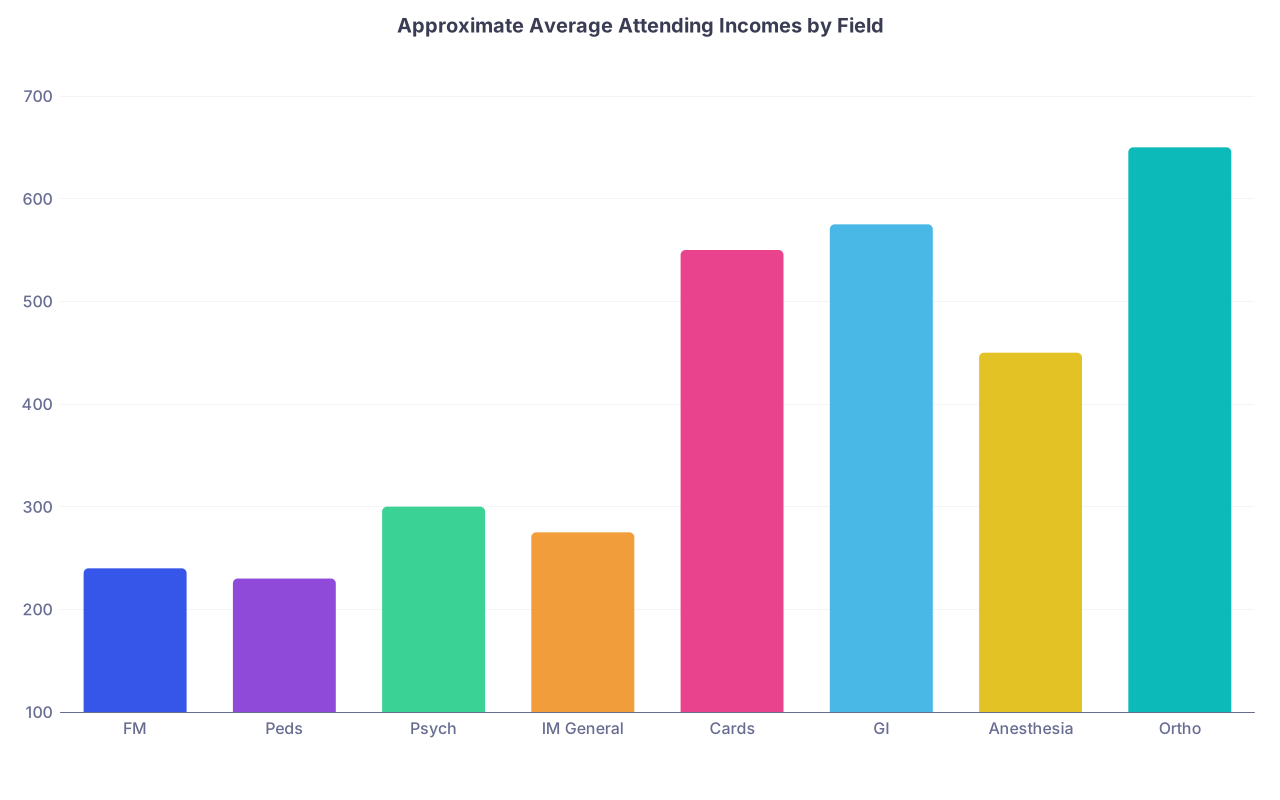
Let’s be blunt and look at ballpark attending incomes (yes, this is generalized; markets vary, etc., but your brain wants numbers, so let’s feed it).
| Category | Value |
|---|---|
| FM | 240 |
| Peds | 230 |
| Psych | 300 |
| IM General | 275 |
| Cards | 550 |
| GI | 575 |
| Anesthesia | 450 |
| Ortho | 650 |
These are rough US averages (many make more, some make less), but the gaps are real.
This is why your brain is freaking out. Because you see:
- FM vs cards: ~ $300k difference/year
- Peds vs ortho: ~ $400k+ difference/year
Over 20–25 years, that’s millions. Your anxiety is not irrational.
But stack that next to:
- Extra years of residency at $60–70k
- Potential delayed retirement savings
- Burnout risk from doing something you hate for the money
- Risk of not successfully switching and losing time for nothing
It’s not “just switch and profit.” It’s “switch and accept a heavier, more uncertain path” vs “optimize where you are.”
Concrete Moves If You’re Already Matched and Panicking
Here’s how I’d triage it if you came to me spiraling:
1. Separate “I want more money” from “I hate my specialty”
Ask yourself:
- If my current specialty paid like ortho, would I still want to leave?
- Do I like the day-to-day work, or am I only reacting to salary graphs?
- Does this specialty fit my personality/energy long-term?
If you like your specialty but are money-anxious, you probably don’t need a full specialty jump. You need:
- Better geographic strategy
- Specific practice setting choices
- Negotiation and business literacy
- Maybe a higher-paying fellowship niche
If you hate the work itself? Then it’s not “am I greedy?” anymore. It’s “am I willing to invest years now to avoid being miserable for 30+ years?” That’s a different question.
2. Do a sanity check on realistic switch targets
Don’t just say “something that pays more.”
List your actual options given your starting point:
- From FM: EM (though market is messy), anesthesia (tough but possible), IM (then cards/GI later), some pain pathways, urgent care heavy models
- From IM: anesthesia, EM, maybe radiology in rare cases, or internal high-paying subspecialties
- From peds: anesthesia (ETO path in some places), PICU, NICU, peds cards
- From psych: niche/private cash practices, interventional psych
Write them down. Then stare at which of those you can actually tolerate doing.

3. Quietly gather intel before announcing anything
Don’t walk into your PD’s office on a bad-call-day and say “I think I’m leaving.”
Instead:
- Talk to trusted senior residents who’ve seen people switch
- Ask: “Has anyone from this program ever gone into anesthesia/rads/etc after starting here?”
- Find an attending in the target specialty and ask for a reality-check conversation: “Given my background, how realistic is it?”
Get those answers before setting anything on fire.
4. If you decide to pursue switching, go professional and strategic
If you’re serious:
- Meet with your PD respectfully, with a plan, not vibes
- Emphasize: you want the best long-term fit, you respect the program, you’ll work hard while there
- Ask if they’d support you applying to other specialties or open PGY-2 spots
- Start ERAS prep, letters, personal statement that calmly explains your path (not: “I just want more money”)
I’ve seen PDs open doors that applicants thought were permanently closed, simply because they handled the conversation like adults.
What If You Can’t Switch? Are You Financially Doomed?
This is where the catastrophizing ramps up hard:
“If I stay in FM/peds/psych/IM, I’ll never get out of debt, never buy a house, never retire, etc.”
That’s just not true.
A “low” paying physician making $230–280k who:
- Lives in a reasonably priced area
- Doesn’t inflate lifestyle to match peers in derm/ortho
- Uses PSLF or smart repayment if eligible
- Actually saves/invests consistently from early on
…can absolutely end up with:
- Loans gone in 10–15 years
- Comfortable home and savings
- Net worth in the millions by retirement
Is it as fast or dramatic as ortho private practice money? No. But you’re not condemned to financial misery unless you combine low-ish pay with bad financial decisions.
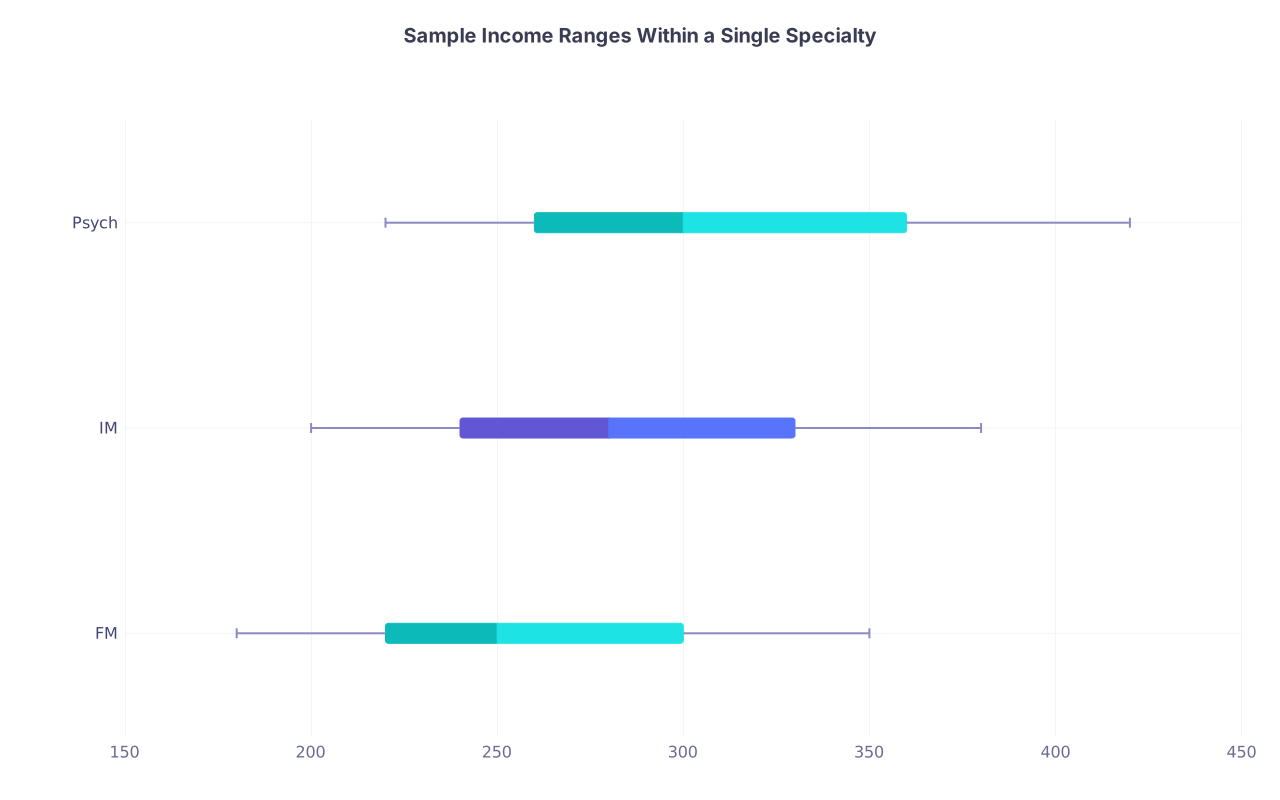
There are also ways to amplify income within a “lower-paid” specialty:
- Urgent care shifts
- Inpatient work
- Rural/underserved premiums
- Leadership/admin roles
- Side gigs: consulting, telemedicine, teaching, etc.
| Category | Min | Q1 | Median | Q3 | Max |
|---|---|---|---|---|---|
| FM | 180 | 220 | 250 | 300 | 350 |
| IM | 200 | 240 | 280 | 330 | 380 |
| Psych | 220 | 260 | 300 | 360 | 420 |
See the spread? That’s the difference between “I just took a random job” versus “I intentionally chose a high-yield setup.”
The Emotional Part No One Talks About
Even if everything I just said makes logical sense, there’s still:
- The shame of thinking you “settled”
- The comparison to classmates in derm, ortho, IR who post their lives on social media
- The subtle condescension you sometimes feel when people say, “Oh, you’re just doing FM/peds/etc?”
You’re allowed to grieve the specialty you didn’t get. You’re allowed to be pissed that someone with worse clinical skills but a 3-point higher Step score ended up with a $600k job while you’re grinding in clinic.
But don’t let that grief bully you into a fantasy where switching to a “better paying” specialty will magically fix:
- Burnout
- Lack of boundaries
- Poor financial habits
- Underlying depression/anxiety
I’ve seen miserable orthopods and ecstatic family docs. I’ve seen cardiologists who’d trade $200k a year to get their life back.
Money helps. A lot. It doesn’t fix everything.
Quick Reality Recap
If your brain is spinning, here’s the distilled version:
- Yes, you can sometimes switch to a better paying specialty after Match Day. It’s most realistic when you move to a nearby specialty or stay in your field and aim for a high-paying fellowship.
- Completely jumping into ultra-competitive, high-pay specialties after Match is very low probability. Not impossible, but you shouldn’t build your entire future on that assumption.
- Even if you never switch, your financial life is not doomed. What you do within your matched specialty (fellowship, geography, practice type, financial habits) can matter almost as much as the specialty label itself.
You’re not as stuck as you feel right now.
But you’re also not as unlimited as your panic is pretending.
The real power move isn’t chasing a fantasy specialty. It’s making deliberate, informed decisions from where you actually stand today—so 10 years from now, you don’t look back and think, “I kept waiting for a miracle instead of playing the hand I had as well as possible.”