
The idea that you must choose between high pay and outpatient is a lie that stresses people out for no reason.
You don’t have to love the OR. You don’t have to round at 5 a.m. forever. And you’re not doomed to make $220k seeing 24 patients a day in primary care if what you actually want is more money and a life that doesn’t feel like constant churn.
You do have to be strategic. Because some “outpatient” dreams are fantasy, and some “high pay” stories are cherry-picked unicorn jobs.
Let me walk through this like someone who’s been up at 1 a.m. on Reddit, refreshing r/medicalschool and r/residency, reading horror stories and salary threads, and then quietly panicking about choosing the wrong specialty and hating my life at 40.
Step 1: Be Honest About What You Actually Want
Before we list specialties, you need to define your nightmare, not your dream.
Most of us in your shoes have some version of this fear loop:
- “I don’t want to be on call all the time.”
- “I’m scared of hating inpatient and still being stuck doing it 50% of the time.”
- “What if I pick something ‘lifestyle’ and then realize I’ll never break $300k and can’t pay off loans?”
- “What if I pick a higher-paying field and I burn out, get depressed, or regret everything?”
So let me translate “I prefer outpatient but want high pay” into specifics you should think through:
How outpatient do you mean?
- 90–100% clinic?
- OK with occasional procedures in an ASC?
- OK with 1 week inpatient every 6–8 weeks?
These are very different realities.
How high is “high pay” in your head?
- $300–350k?
- $400–500k?
- Over $600k?
Because some are realistic in outpatient; some are YouTube clickbait.
What’s your risk tolerance?
Higher-paying outpatient work often means:- Eating what you kill (productivity RVUs, private practice, bonuses).
- Business headaches.
- Market risk and location constraints.
None of this means “don’t do it.” It means if you want the money and the lifestyle, you can’t pretend you’re picking a no-risk, no-tradeoff path. That’s how people end up stunned and bitter later.
Step 2: Specialties That Actually Can Be High-Paid AND Mostly Outpatient
Here’s the short reality: yes, there are real options.
They’re not guaranteed. They’re not automatic. But they’re real.
Let’s talk concrete fields.
1. Dermatology
This is the cliché answer for a reason.
- Work: Almost entirely outpatient clinic and procedures.
- Pay: Often $400k–$600k+ in private practice, sometimes higher with cosmetics.
- Lifestyle: Predictable hours, minimal call, lots of control.
The catch? It’s brutally competitive. You know that. It’s the specialty where people say, half-joking, “Just be a 260 + AOA + 20 pubs + cure cancer.”
Reality check:
You do not need to be perfect, but you need:
- Strong Step 2 (now that Step 1 is pass/fail).
- Research in derm or at least some publications.
- Early networking and possibly away rotations.
If you already know you’re nowhere near derm-competitive (and don’t want to rebuild your entire CV around it), then fine. Don’t torture yourself. There are other options.
2. Outpatient-Oriented Neurology (esp. subspecialties)
This one surprises people.
General neurology can be rough inpatient. Strokes, codes, consult hell. But outpatient neuro, especially subs like:
- Headache
- MS
- Movement disorders
- Neuromuscular
can be highly outpatient and well-paid, especially if you’re efficient and in the right market. Academic salary might land in the $250–350k range, but private groups and high-demand areas can jump that.
Not derm money, but often significantly more than standard primary care, with less chaos than acute neuro.
Caveat: residency has a lot of inpatient. If the thought of wards/ICU in training makes you miserable, this may feel like a slog even if attending life can be mostly outpatient.
3. Gastroenterology – But Be Very Clear on Structure
GI is usually thought of as procedural + hospital. That’s accurate for most, but there are flavors:
- Many GIs do heavy outpatient with procedures in an ASC (endoscopy center).
- Some create schedules that are majority elective scopes and clinic.
Pay can be huge. We’re talking $500k–$800k+ in some private practices with ownership in an ASC. Those $1M+ GI income stories? Mostly tied to ASC ownership, insane volume, or rural/high-demand.
But: this isn’t cushy clinic derm.
- There’s still call.
- You will deal with GI bleeds at 3 a.m. during some weeks.
- Training (IM → GI) is inpatient-heavy and pretty brutal.
This is more “high pay with some outpatient and less OR” than “chill outpatient clinic only.” Still, if your main issue is operations rooms and surgical lifestyle rather than all acute care, it can fit.
4. Pain Medicine (Anesthesiology or PM&R Route)
Pain is sneaky in a good way:
A lot of what people want from “high-paid outpatient” can be found here.
- Mostly outpatient procedures and clinic.
- Relatively little inpatient once you’re established.
- High pay in the right private-practice settings, often $400–700k+ depending on volume and ownership models.
But there’s nuance:
- Some jobs are closer to “chronic opioid refill mill” (soul-crushing).
- The best jobs combine injections, interventions, maybe some neuromodulation… and they expect productivity.
- Training path: usually anesthesia or PM&R → pain fellowship. Both cores have their own lifestyle tradeoffs.
This can be a sweet spot if you like procedures, want to avoid the OR itself, and are okay with business and volume pressures.
5. Radiology (Especially Outpatient Imaging Centers)
Radiology isn’t “clinic” in the traditional sense, but it’s:
- Non-surgical.
- No inpatient rounding like medicine/surgery.
- Increasingly flexible: telerads, outpatient centers, remote work.
Pay is often high: $400–700k+ in some private practices, especially in less desirable locations or high-volume groups.
But you have to be honest with yourself:
- You’ll be reading inpatient and ED scans too, even if employed by an outpatient-heavy group.
- Night shifts, evenings, and weekends may be expected, especially early career.
- It’s mentally demanding in a “no mistakes” kinda way.
If your “outpatient” desire is really “I want to avoid floor work, pagers, and families yelling at me in a hallway,” rads might hit the mark even if it’s not clinic-based.
6. Psychiatry – The Underrated Outpatient + High Pay Combo
People chronically underestimate psych income. Yes, academic jobs can be $230–280k. But in private practice, locums, or high-demand areas:
- $350–500k+ is very possible with outpatient-only work.
- Telepsych has changed the game, allowing multiple job models.
This usually means:
- High volume OR niche cash-pay practices.
- Some mix of employed + side work or building your own practice.
Is it derm money? No. But for pure outpatient, flexible schedule, and real high pay relative to training length and burnout risk—psych is one of the best realistic combinations.
7. Outpatient EM “Alternatives”: Urgent Care & Occupational Medicine
Not top-tier earners, but worth mentioning:
- Urgent care: Often $250–350k with shifts and no inpatient.
- Occupational medicine: Less stress, more corporate, income can approach or slightly beat primary care in some contexts.
These won’t hit GI/rads/derm numbers, but they beat the horror-story “$200k and drowning in admin” primary care setups, and they’re firmly outpatient.
Step 3: Reality Check – Pay vs. Outpatient vs. Training Pain
Here’s where people fool themselves: they look at attending lifestyle and ignore residency/fellowship reality.
If your brain is screaming “I can’t handle IM residency + GI fellowship” or “the idea of neurology wards makes my chest tight,” listen to that. Training is not a footnote. It’s 3–7 years of your actual life.
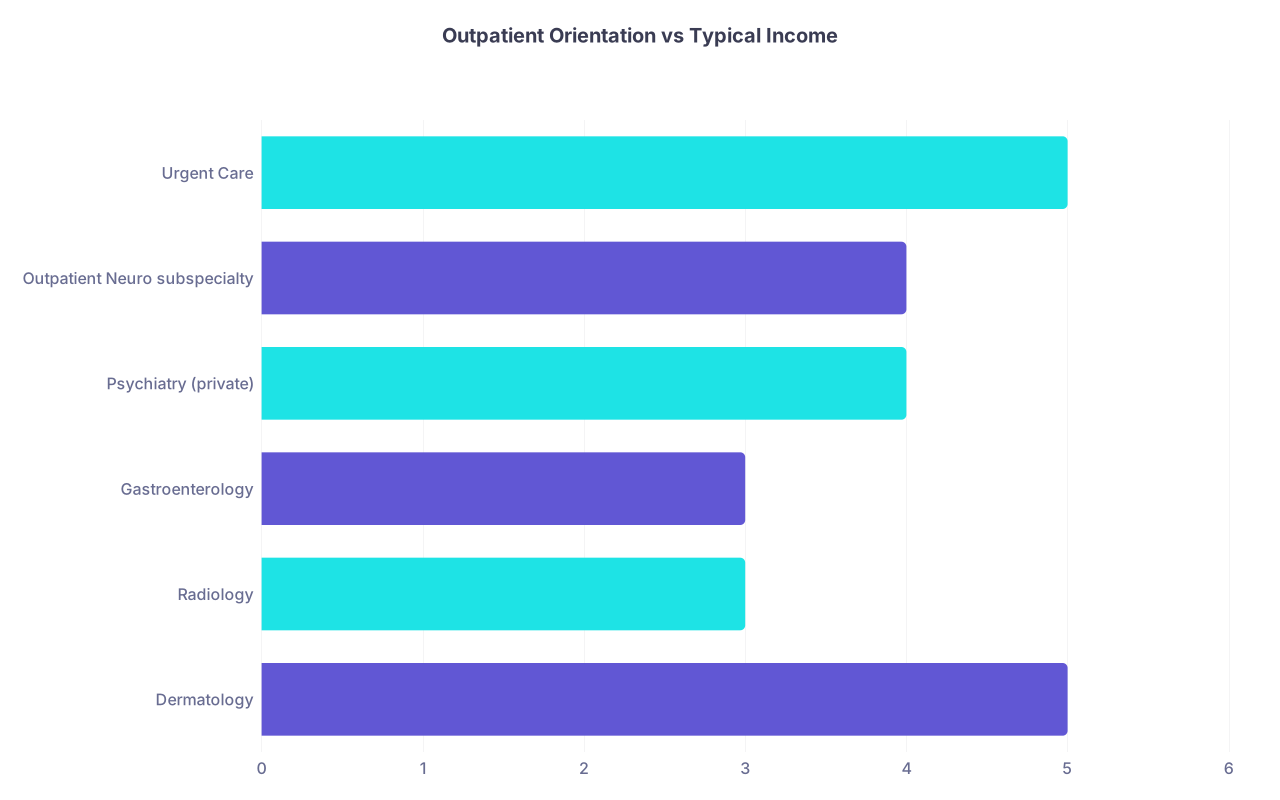
| Category | Value |
|---|---|
| Dermatology | 5 |
| Radiology | 3 |
| Gastroenterology | 3 |
| Psychiatry (private) | 4 |
| Outpatient Neuro subspecialty | 4 |
| Urgent Care | 5 |
(Scale 1–5: 5 = almost fully outpatient, 1 = mostly inpatient/OR. Rough, but you get the idea.)
| Specialty | Typical Setting | Pay Potential (upper realistic) | Outpatient-ness |
|---|---|---|---|
| Dermatology | Private clinic | $500–700k+ | Very high |
| Radiology | Group / telerads | $500–700k+ | Medium |
| Gastroenterology | Group + ASC | $600–900k+ | Medium-high |
| Psychiatry (PP) | Private clinic | $350–500k+ | Very high |
| Pain Medicine | ASC + clinic | $400–700k+ | High |
Numbers vary wildly by region, years in practice, ownership, and market demand. But if your mind spirals at 2 a.m. asking, “Am I crazy to want high pay and outpatient?”—see that table. It’s not crazy. It’s just… you need a plan.
Step 4: The Business Side You’re Probably Ignoring
Most of the true “high pay, mostly outpatient” gigs have a few things in common:
- Private practice or physician-owned group.
- RVU or productivity-based comp.
- Opportunity for buy-in/ownership (especially ASC or imaging).
Translation: your income ceiling goes up, but so does risk, variability, and politics.
You have to accept some uncomfortable truths:
- The cushiest lifestyle jobs (academic, large system, W-2 on salary) usually pay less.
- The highest-paid jobs demand:
- High patient or procedure volume.
- Stress tolerance.
- Willingness to play the business game.
Can you find a unicorn job with low volume, great pay, and no nights/weekends? Maybe. But you can’t build a life plan around unicorns.
What you can control now:
- Pick a field that leaves the door open to high-paying outpatient options.
- Don’t box yourself into the absolute lowest-paying path unless it’s truly your calling.
- Learn enough about contracts, RVUs, and practice models so future-you doesn’t get screwed signing a trash deal.
Step 5: Worst-Case Fears vs. What Actually Happens
Let’s name the nightmare scenarios you’re probably cycling through:
- “I’ll pick something like IM thinking I’ll do GI, never match GI, and be stuck as a hospitalist forever making $280k and hating my life.”
- “I’ll chase derm or rads, not match, and waste years scrambling for something else.”
- “I’ll pick psych thinking it’s outpatient and chill, then burn out seeing 25 complex patients a day for $260k in some system that treats me like a script dispenser.”
Here’s the pattern I’ve watched in real people:
- People who stay flexible and realistic usually land somewhere fine, even if it’s not their “dream.”
- People who pick a specialty purely for money do get burned—but mostly when they ignore their own red-flag feelings during rotations and training.
- The ones who do best with “outpatient + high pay” know themselves early and plan accordingly (research, mentoring, networking, programs that fit their target).
So if you’re anxious right now, that’s actually good. It means you’re not sleepwalking your way into a 30-year mismatch.
A Simple Framing That Might Help You Breathe
Stop asking “What single perfect specialty will guarantee high pay and outpatient forever?”
Start asking:
Which specialties:
- I don’t hate day-to-day.
- Keep me mostly away from inpatient rounding long-term.
- Have at least some high-income paths?
Among those, where can I realistically be a strong applicant with:
- My scores.
- My research.
- My timeline and tolerance for extra training?
That’s usually a short list. For a lot of people like you, it ends up looking like some combination of:
- Dermatology (if competitive enough and you actually like skin).
- Radiology.
- Psychiatry.
- Neurology (with outpatient intent).
- PM&R → Pain.
- IM → GI (if you can stomach the training).
From that list, you choose not perfection, but the least-bad set of tradeoffs.

| Step | Description |
|---|---|
| Step 1 | Prefer outpatient and high pay |
| Step 2 | Consider Derm, GI, Pain, Rads |
| Step 3 | Consider Psych, Outpatient Neuro |
| Step 4 | Include Derm, Rads, GI paths |
| Step 5 | Focus more on Pain, Psych, Neuro |
| Step 6 | Explore academic vs private options |
| Step 7 | Comfort with procedures? |
| Step 8 | Competitive metrics strong? |
FAQs
1. What if I’m not competitive for derm or rads—am I just stuck with low-paid outpatient?
No. That’s the catastrophizing talking. There’s a huge gap between “derm/rads or bust” and “$200k forever in miserable primary care.” Psych private practice, outpatient neuro, PM&R → pain, and even certain urgent care or high-acuity clinic models can land you well above the floor. You might not hit $800k, but you can absolutely live comfortably, crush your loans, and still work mostly outpatient.
2. Is it stupid to pick psych mainly because I want outpatient and okay money?
Not inherently. It’s only stupid if you actually dislike psych and convince yourself you’ll “learn to like it” because of lifestyle. You need to at least tolerate the work: severe mental illness, risk management, emotionally draining cases. If you can see yourself genuinely engaged with that, psych is one of the most realistic outpatient + solid income picks out there.
3. How much should I let money influence my specialty choice?
More than the “follow your passion” crowd admits. Less than the r/financialindependence threads might push you toward. Money does matter—loans, family plans, housing, future burnout all tie into it. But if you pick something you actively dislike just for money, future you will either: a) quit, b) cut back dramatically, or c) stay and be deeply unhappy. Think of money as a major factor, not the only factor.
4. What if I choose a specialty and realize during residency that I hate inpatient?
It happens. More than people admit openly. But people pivot:
- IM → focus on clinic-heavy jobs, urgent care, or non-hospital roles.
- Neuro → outpatient subspecialty.
- Rads → outpatient groups, telerads with flexible shifts.
- Psych → pure outpatient or tele.
You’re not locked into the worst version of your specialty. You are somewhat constrained by your chosen field, but there’s usually more room to move toward outpatient and better pay than you think—especially if you’re willing to change locations or settings.
Key points to keep in your brain when the anxiety spikes:
- Yes, there are real paths that are mostly outpatient and well-paid—but they require planning and accepting tradeoffs.
- You don’t need a unicorn job. You need a specialty with at least a few high-pay, outpatient-friendly paths you can realistically reach.
- The worst mistake isn’t “not picking derm.” It’s ignoring your own red flags about a field’s day-to-day reality because you’re chasing someone else’s idea of status or security.