
It’s late February. Your NRMP rank list is technically “done,” but you’re sitting there, cursor blinking, staring at a few programs at the bottom. The ones that felt off. The malignant rumors. The location you swore you’d never move to.
And now the panic spiral:
“If I rank them, I might end up miserable for 3+ years.”
“If I don’t rank them, I might not match at all.”
“Am I seriously about to gamble my entire career on a vibe from a 20‑minute Zoom interview?”
You’re trying to answer one deceptively simple question:
Should I rank every place that interviewed me… or cut my list and risk no match?
Let me be direct: this fear is extremely common, and the way most people think about it is half emotional, half wrong, and all anxiety-provoking.
Let’s untangle it.
How the Match Actually Treats Your Rank List (Not the Urban Legend Version)
The Match is cold. Mathematical. It does not care how guilty you feel about not ranking a program.
Core truth:
You don’t “lose points” or get punished for not ranking a program. There is no bonus for having a long list. There is no penalty for leaving programs off.
The algorithm only uses one thing from your list:
- The order of programs you rank.
- And which programs you rank at all.
That’s it.
The algorithm tries to give you your highest-ranked program that also wants you. If none of the programs on your list rank you high enough to land you a spot, you go unmatched. Whether your list was 4 programs long or 14 doesn’t inherently matter. What matters is: did at least one of those programs rank you high enough?
So why does everyone scream “RANK ALL YOUR INTERVIEWS!!!” like it’s a moral commandment?
Because statistically, the more reasonable programs you rank, the higher your chance that at least one of them also wants you. Not because the algorithm rewards long lists.
But here’s what people don’t tell you:
Ranking programs that you truly would not attend is not “safe.” It’s self-sabotage. Because if you match there, you are going. Full stop.
The Real Risk: Long List vs Short List
Let’s separate your fear into two concrete questions:
- Does shortening my list increase my chance of going unmatched?
- Is that increased risk worth avoiding some programs I hate?
You’re not crazy for worrying about this. You should think carefully. But you also need actual numbers, not just vibes.
| Specialty Type | Rank ~5 Programs | Rank ~8 Programs | Rank ~12+ Programs |
|---|---|---|---|
| Very competitive | Risky | Better | Safest |
| Moderately competitive | Moderate risk | Pretty safe | Very safe |
| Less competitive | Often OK | Safe | Very safe |
These are rough, big-picture patterns I’ve seen over multiple cycles—not magic guarantees.
Here’s the pattern that keeps repeating:
- Applicants who rank ~10+ realistic programs in a moderately or less competitive specialty usually match somewhere on their list.
- People who go unmatched with 10+ interviews and a full rank list almost always have something else going on: red flags, Step failures, visa issues, or way too top-heavy lists.
- People who get burned by short rank lists are often the ones who:
- Had 4–6 total interviews
- Cut 1–2 “safety” programs at the bottom
- Went all-in on “fit” and then didn’t match anywhere
So yeah. Shortening a short list? That can absolutely push you into dangerous territory.
But again—this depends on your situation.
When You Really Should Rank All Your Interviews
Let’s be brutally honest. There are scenarios where “I don’t like the call schedule” is not a good enough reason to cut a program.
If you’re in one of these boats, I’d tell you flat out: rank every program where you could tolerate training.
You should lean heavily toward ranking all interviews if:
- You’re in a very competitive specialty (Derm, Ortho, ENT, Plastics, etc.)
- You had <10 interviews in Internal Medicine / Pediatrics / FM / Psych / Neuro
- You’re an IMG (US or non-US) in any specialty
- You have Step failures, multiple leaves of absence, or major academic issues
- You’re geographically restricted (partner, kids, visa) and already limited your application region
In these cases, your risk of going unmatched is not hypothetical. It’s real. The numbers are not on your side the way they are for a typical US MD applying to FM with 18 interviews.
So if a place:
- Will train you well enough to pass boards
- Isn’t abusive or clearly malignant
- Is in a location you can survive for 3–4 years
…then yeah, rank it. Even if you hated the drapes and thought the residents looked tired.
Because no matter how awful interview day felt, it usually does not beat the nightmare of SOAP + possible reapplying + explaining a gap year for the next decade.
When It Might Be Reasonable (or Smart) to Shorten Your List
Now, let me validate the darker fear you probably aren’t saying out loud:
“What if matching somewhere I hate actually breaks me?”
That’s not drama. That’s a real concern. Burnout, depression, giving up on the specialty—these aren’t made-up consequences.
I’ve seen people absolutely wrecked by:
- Malignant programs where attendings humiliate residents daily
- 100+ hour weeks disguised as “we’re a hardworking program”
- Places with obvious racial / gender / IMG hostility
- Cities where they have zero support system and already have mental health struggles
In those cases, ranking everything “just to be safe” is not actually safe. It’s a different kind of risk.
You might reasonably shorten your list if:
- You have a solid number of interviews for your specialty and applicant type
- Example: US MD, IM or Peds, 14+ interviews
- Your application is strong on paper (good scores, no red flags)
- The programs you’re considering cutting are:
- Clearly malignant or widely rumored to be
- So geographically isolated you know you’ll be alone and miserable
- Actively disrespectful or unprofessional on interview day
- Way outside your deal-breaker limits (e.g., you cannot, for mental health or family reasons, live in that region)
But even then, don’t lie to yourself. There’s a difference between:
“I don’t like cold weather.”
vs.
“I have bipolar disorder that worsens severely with winters and no support network.”
One is a preference. The other is a legitimate, serious reason.
The “Would I Rather Unmatch Than Go Here?” Test
Here’s the question I want you to force yourself to answer for each borderline program:
If the only two outcomes were:
- Matching at this program
- Going completely unmatched this year
Which would I choose?
Not: “Would I be happy here?”
Not: “Is this my dream?”
Literally: Which pain would I prefer?
- If you would honestly rather go unmatched than spend three years there, do not rank that program. You’re not being dramatic. You’re being clear.
- If you’d rather match there than scramble for SOAP + risk reapplying, rank it. Even if you hope you never drop that low on your list.
That’s the only honest way to do this.
How Many Programs Should You Rank Based on Your Situation?
You wanted concrete numbers. Let’s talk rough targets. These are not official NRMP guarantees, but realistic “I’ve watched too many cycles” guidance.
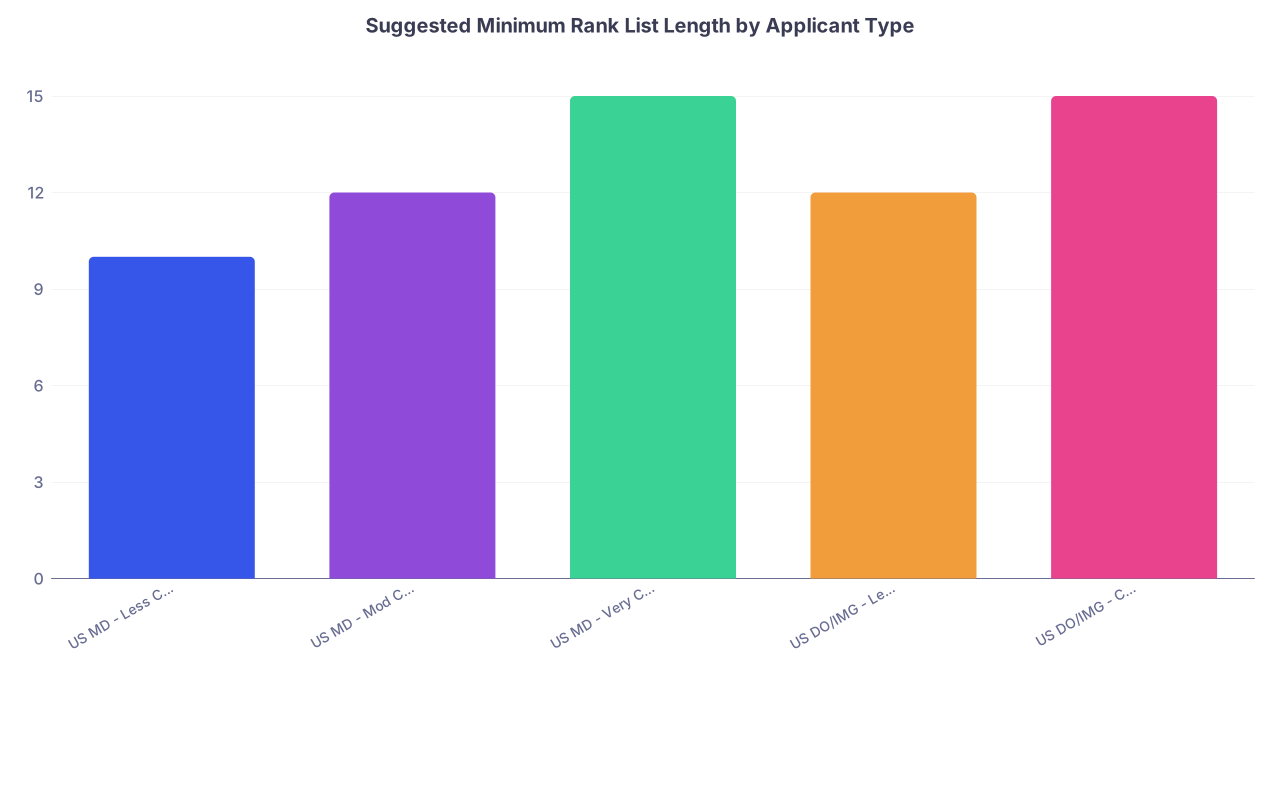
| Category | Value |
|---|---|
| US MD - Less Competitive | 10 |
| US MD - Mod Competitive | 12 |
| US MD - Very Competitive | 15 |
| US DO/IMG - Less Competitive | 12 |
| US DO/IMG - Competitive | 15 |
If you’re a US MD:
Less competitive specialties (FM, IM, Peds, Psych)
Aim to rank: 10+ programs
If you’ve got 12–15 interviews, cutting 1–2 truly toxic programs is usually fine.Moderately competitive (OB/GYN, EM, Neuro, Anesthesia)
Aim to rank: 12+
If you had 8–10 interviews, I’d be very cautious about cutting anything that’s not genuinely malignant.Very competitive (Derm, Ortho, ENT, Plastics, etc.)
Honestly: rank every single interview where you can tolerate training. You don’t have the luxury.
If you’re US DO or IMG:
Be more conservative.
- Less competitive:
Try to rank 12+ if you can. - Competitive specialties or limited interview count (<10):
Rank every place that isn’t unsafe or abusive.
This sucks. It’s unfair. But the match numbers don’t care about fairness.
Red Flags That Justify Leaving a Program Off
There are a few situations where I don’t even hesitate telling people: “Don’t rank them.”
- Residents repeatedly hinted “we’re not allowed to say much, but it’s rough here”
- Multiple graduates warn you off the program directly
- Openly sexist, racist, or hostile comments on interview day
- Big mismatch between advertised and actual workload (80+ hour weeks disguised as “we’re busy”)
- PD or faculty openly disrespectful, dismissive, or mocking toward residents or students
- Your gut is screaming, and you can articulate why (not just “I didn’t vibe with them”)
For these, the risk of 3+ years of misery is high enough that I’d support you taking the unmatched risk if you have at least a semi-realistic shot elsewhere.
How to Sort Your List Without Spiraling
You’re probably already doom-scrolling Reddit and comparing yourself to everyone’s “14 interviews, should I be worried?” posts. That’s not data. That’s panic gasoline.
Do this instead:
Write down your non-negotiables.
Things like: “Must not be malignant,” “Must be within X hours of partner/children,” “Must not have 7+ consecutive nights frequently.”Label each program (green / yellow / red).
- Green: I’d be okay or happy here.
- Yellow: Not my favorite, but I could survive.
- Red: I would seriously rather reapply than go here.
Rank all the greens first. In true order. Don’t rank based on “where do I think I’ll get in?” Rank based on preference.
Decide on the yellows one by one using the “unmatch vs here” question.
Delete all reds from your list. Don’t play chicken with your future self. If you could not emotionally handle that match email, don’t put them on.

| Step | Description |
|---|---|
| Step 1 | List all interviews |
| Step 2 | Define non negotiables |
| Step 3 | Mark each program green yellow red |
| Step 4 | Rank all green programs |
| Step 5 | For each yellow ask - unmatched or here |
| Step 6 | Keep yellow on list |
| Step 7 | Remove from list |
| Step 8 | Finalize list |
The Quiet Truth: Most People Overestimate the Risk of Total Disaster
Here’s the part your anxiety refuses to believe:
If you:
- Are applying to a reasonable specialty for your stats
- Have a decent number of interviews (10+ for most non-ultra-competitive fields)
- Rank all the places you can tolerate
…your odds of going completely unmatched are actually low. Not zero. But low.
I’ve watched plenty of people shorten their list a little—cut 1–3 truly awful programs—and still match fine. Because they had enough other realistic options.
The ones who get burned are usually:
- Applying too competitively for their profile
- With very few interviews
- Then cutting “safety” programs to protect a dream that was never guaranteed
So your job isn’t “rank all to be safe” or “shorten to protect your happiness.”
Your job is to make one clear-eyed decision:
Where would I rather take my chances—on possibly being miserable, or on possibly being unmatched?
Neither choice is painless. But pretending you’re not making that trade-off is how people end up hating their outcome.
What You Can Do Today
You’re exhausted, overwhelmed, and your brain is basically a spinning NRMP logo. So keep it simple.
Today, do this one thing:
Open your rank list and, for every program you’re unsure about, literally write this sentence on a piece of paper:
“If my only options were to match here or go unmatched this year, I would choose: _______.”
Fill in the blank. No dodging. No “it depends.” Just pick one.
Then adjust your list to match those answers.
That’s how you end up with a list you might still worry about—but at least you won’t betray yourself with it.
FAQ (Exactly 4 Questions)
1. Is it true I should always rank all my interviews?
No. That’s oversimplified advice. You should rank all programs where you’d rather train than go unmatched. If there are places you truly would not attend—even if they were your only option—don’t rank them. But if your application is weaker or you have few interviews, you should be very conservative about cutting anything.
2. I have 7 interviews in IM as a US MD. Is it too risky to cut 2 programs I didn’t like?
Yes, that’s risky. With only 7 interviews, your margin for error isn’t huge. I’d only cut those 2 if they fall into your absolute red-flag category (genuinely malignant, unsafe, or completely incompatible with your life circumstances). If you just “didn’t vibe” or didn’t love the city, I’d still rank them low rather than drop them.
3. I’m an IMG with 10 FM interviews. Can I be picky with my rank list?
Careful. FM is friendly to IMGs, but the bottleneck is still real. With 10 interviews, you’re in a decent spot, but you don’t have luxury-level safety. I’d only remove programs that are truly intolerable for you—think serious red flags, not just “I didn’t love the cafeteria” level complaints. In your shoes, I’d rank almost everything that’s not clearly toxic.
4. What if my gut hated a place but I can’t point to one specific red flag?
Then you need to interrogate that gut feeling. Is it about safety, respect, and your mental health? Or is it about prestige, city aesthetics, or minor things? If your gut says, “I will not survive here, I will break,” I’d listen and consider leaving it off—if you have enough other interviews to make that survivable. If your gut just says, “Meh, not my favorite,” I’d rank it low but still rank it. Your future self might be very glad the safety net was there.