
The advice you’ve been told about “how many programs to rank” is not what attendings tell their own kids. Not even close.
When it’s their child’s career on the line, the sugar‑coating disappears. The “NRMP recommends…” slides vanish. What you hear instead, behind closed doors at kitchen tables and over whispered post‑rounds phone calls, is blunt, numbers‑driven, and frankly a little ruthless.
Let me walk you through what actually gets said.
What Attendings Really Worry About (That You’re Not Hearing)
Attendings don’t obsess over “average number of programs ranked.” They obsess over one thing: the pain of not matching.
Every attending over 40 has lived through at least one horror story: the brilliant student who over‑trusted their home program, the couple who under‑ranked in a couples match, the IMG who listened to bad online advice and went “targeted.”
So when it’s their kid? The tone changes.
You know what they say?
“Listen, I’d rather you rank too many and waste a few months of your life being tired and broke on the interview trail than spend a full year as a preliminary surgical intern you never wanted.”
That’s the real calculation. Not money. Not “prestige.” It’s risk tolerance versus the emotional and career wreckage of not matching.
And here’s the other ugly truth: attendings know how programs actually talk about borderline applicants. So they know when their kid is safe… and when they are absolutely not.
The Hidden Algorithm: How Attendings Quietly Size Up Their Own Kids
Nobody prints this in a handbook, but I’ve seen this exact mental flowchart used over and over. A cardiologist at a big academic center advising her daughter in EM. A community FM doc helping his son apply to Gen Surg. A hospitalist whose daughter is gunning for Derm.
They all run through the same internal checklist before they ever suggest a number.

| Step | Description |
|---|---|
| Step 1 | Assess Competitiveness |
| Step 2 | Rank 12 to 18 |
| Step 3 | Rank 10 to 15 |
| Step 4 | Rank 15 to 25 |
| Step 5 | Rank 25 to 40 or more |
| Step 6 | Top tier? |
| Step 7 | Competitive specialty? |
| Step 8 | Middle tier? |
Let’s decode how the conversation really goes.
Step 1: “Where do you actually sit in the pool?”
Parents who are attendings don’t ask, “How do you feel about your chances?” They ask:
- “What’s your Step 2 score compared to the national average for your specialty?”
- “How many honors do you have in core clerkships?”
- “Any red flags?” (LOA, remediation, bad comment in the MSPE, failed Step, SOAP history)
- “What does your home PD actually say when you’re not in the room?”
The harsh part? They believe the PD more than they believe their own kid. If the PD says, “She’s strong, but not a lock for our program,” that attending hears: not top tier nationally.
I’ve watched an attending push their child to double their initial program list after a single five‑minute call with a PD who said, “He’ll match somewhere.” That phrase — “somewhere” — sounds reassuring to you. To an attending, it’s a warning.
They then mentally drop their kid into one of four buckets:
| Bucket | Typical Profile | Risk Level |
|---|---|---|
| A+ Lock | Top 10% scores, honors, strong home advocacy | Low |
| Solid | Around average or slightly above for specialty | Moderate |
| Borderline | Below average metrics, one or two weaknesses | High |
| At Risk | Multiple red flags, low scores, IMG | Very High |
That bucket, plus specialty, drives the real list‑length advice.
Specialty Matters More Than You Think (And Attendings Know the Numbers)
Here’s what attendings never say on rounds but absolutely say at home:
“Derm is a lottery. IM is an insurance policy. Don’t confuse the two.”
They know that “how many to rank” in Family Medicine is not the same conversation as Plastics. But when advising their own kids, they don’t use hand‑wavy words. They use numbers.
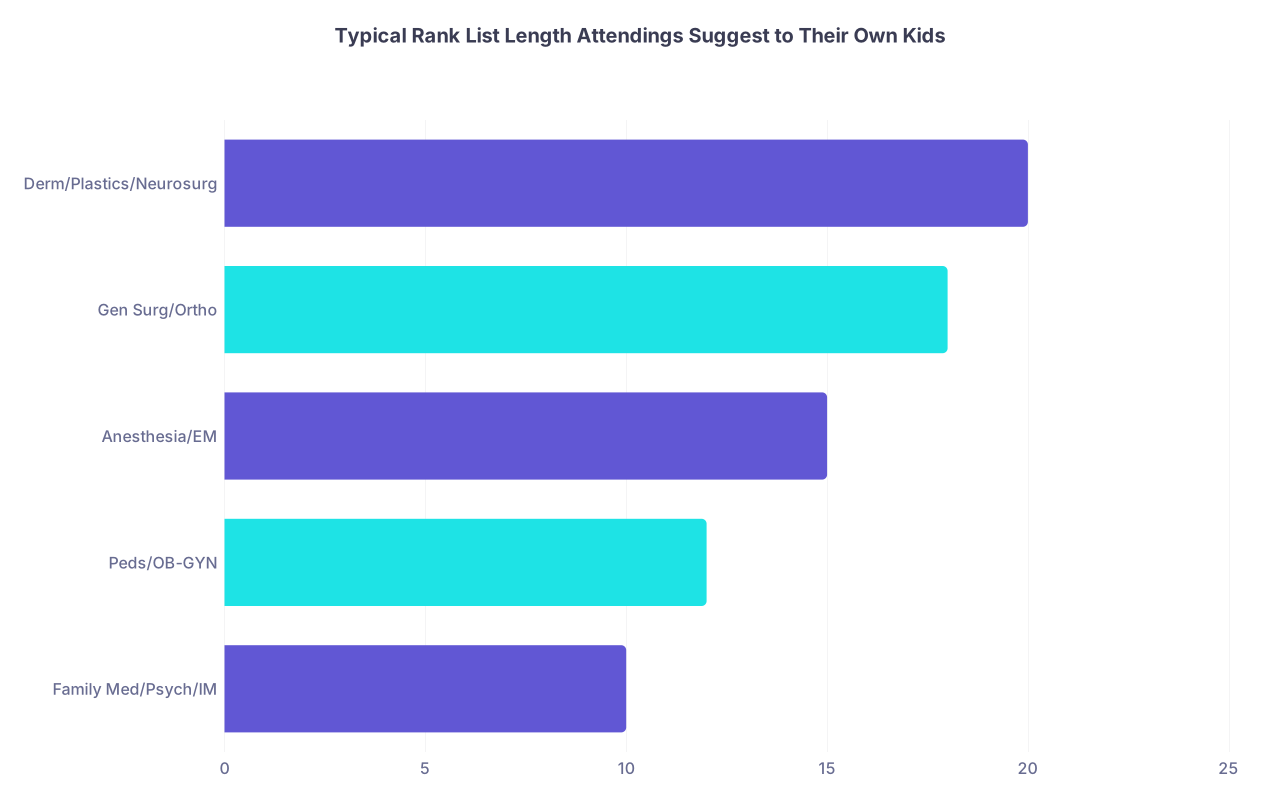
| Category | Value |
|---|---|
| Family Med/Psych/IM | 10 |
| Peds/OB-GYN | 12 |
| Anesthesia/EM | 15 |
| Gen Surg/Ortho | 18 |
| Derm/Plastics/Neurosurg | 20 |
Those are typical numbers I’ve heard repeatedly in real conversations, for well‑positioned applicants. Watch what happens when you’re not an “A+ lock.”
What They Tell Their Kids in Low‑Risk, Mid‑Risk, and High‑Risk Situations
Let’s walk through how this actually sounds in a living room conversation.
1. The “A+ Lock” Kid
This is the student everyone talks about: 260+ Step 2, multiple honors, home program loves them, no red flags, often at a strong med school.
How the attending parent thinks:
“This kid will match. I am not worried about matching. I’m optimizing for fit and location now.”
What they usually say:
If it’s a non‑competitive specialty (IM, FM, Psych, Peds):
“Make a list of 12–15 places you’d actually be happy to go. Don’t pad it with places you’d hate. You don’t need 30.”If it’s a moderately competitive one (Anesthesia, EM, OB‑GYN):
“Aim for 15–20. Have a mix — stretch, realistic, and a couple of safety‑ish places in less popular cities.”If it’s highly competitive (Derm, Ortho, ENT, Urology, Neurosurg):
“Even for you, 20+ is not crazy. The bottleneck isn’t just your stats, it’s the limited slots. You’re not competing against average, you’re competing against other killers.”
Here’s the twist: these kids often want to rank more places. Their parents sometimes have to talk them down from over‑interviewing.
Why? Attendings know the diminishing returns curve. After ~15–20 interviews in most fields, your marginal benefit is tiny, and your burnout risk is massive.
2. The “Solid But Not a Unicorn” Kid
This is the majority. Good student, no disasters, average or slightly above average scores for their specialty.
For these kids, attending parents quietly become actuaries.
They think in “risk bands,” not vibes.
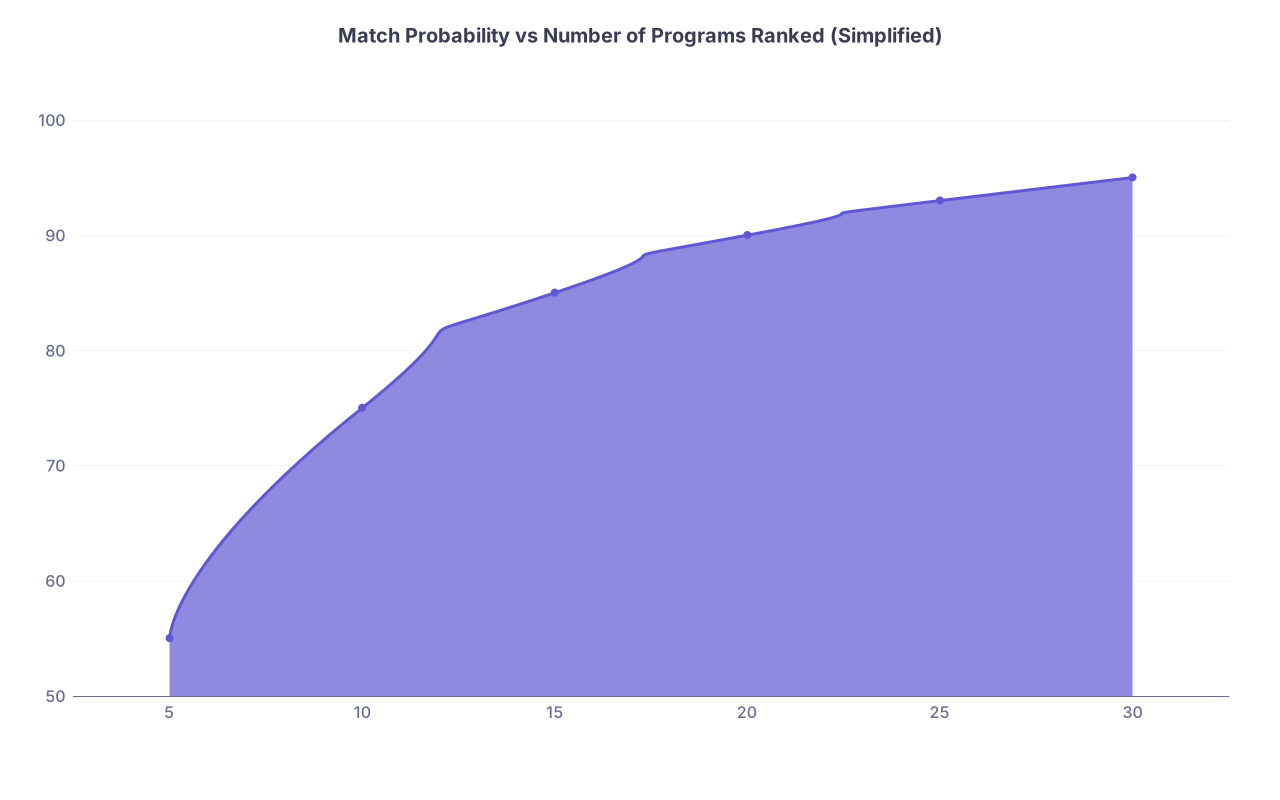
| Category | Value |
|---|---|
| 5 | 55 |
| 10 | 75 |
| 15 | 85 |
| 20 | 90 |
| 25 | 93 |
| 30 | 95 |
They’ve all seen that NRMP chart that looks like this. They don’t quote it. They internalize it. Then they translate it like this:
- “Under 10 ranks is playing with fire unless you’re at the top of your specialty.”
- “15 is where I start to breathe easier for most core specialties.”
- “20–25 is where I want you if you’re average for a competitive field.”
So you’ll hear them say things like:
For IM, FM, Psych, Peds:
“I want you at 12–18 ranked programs. Not interviews. Ranked. If that means interviewing at 15–20, do it.”For EM, Anesthesia, OB‑GYN, Gen Surg:
“Target 18–25 on your rank list. If you walk into rank day with 10, I’m going to be nervous.”
And notice this part: they don’t trust programs that say “If we interview you, you’re ranked to match.” They’ve sat on rank committees. They know how meaningless that sentence is.
3. The “Borderline or At‑Risk” Kid
This is where the advice becomes brutally unrecognizable compared to what most schools tell students.
We’re talking:
- Below average Step 2 for the specialty
- DO or IMG without strong home‑field advantage
- Failed Step attempt, significant leave, or harsh MSPE comments
- Applying to a competitive specialty without the matching CV
With students like this, medical schools often soften the message to avoid crushing morale. Attending parents do not. Because they’ve watched borderline kids not match.
Here’s how an attending will talk to their own child in this scenario:
“Look, you’re not an easy match. Stop pretending you are. You need to throw a wide net or you need to rethink specialty now.”
On numbers, they get aggressive:
Community‑friendly specialties (FM, IM, Psych):
“You should apply to 60–80+ if you can afford it, and I still want 25–30 programs on your rank list if at all possible.”Mid‑tier competitiveness (Anesthesia, EM, OB‑GYN, Gen Surg) with weaknesses:
“You’re living in the 25–35 ranked range if you want me to sleep the week of Match.”High‑risk combinations (weak metrics + competitive specialty):
“Either you apply very, very broadly — 40+ rankable options if you can get them — or we have a serious talk about backup specialties or a research year.”
It sounds harsh. It’s protective. These same attendings have watched non‑matching destroy confidence and delay careers by years.
The Part Nobody Admits: Geography, Ego, and the “But I Don’t Want To Go There” Problem
Here’s a fight I’ve seen multiple times:
Student: “I don’t want to go to the Midwest.”
Attending parent: “The Midwest might be what stands between you and SOAP. Put three Midwest programs on the list.”
Attendings understand three things far better than students:
Everyone wants the same cities
Coasts. Big name metros. Warm weather. Those slots get flooded with strong applicants.Programs in less popular regions quietly save careers
They may not be shiny, but they’re stable, solid training pathways that reliably fill with a normal mix of applicants.Geographic snobbery is a luxury of the top 10–15%
For everyone else, it’s a liability.
So when their own kids insist, “I’d rather re‑apply than go there,” the experienced attendings push back, hard:
“Rank a few places that are not your dream. You don’t have to love the zip code. You just need a place to train well, get board‑certified, and move later.”
That’s the inside advice: widen geography when you’re not a lock. It’s an easy, unsexy way to add safe programs without torpedoing your career.
Couples Match: Where Attendings Quietly Panic
If you want to see two attendings go from calm to quietly terrified, watch them when their child enters the couples match.
Public advice always has this reassuring tone. “Couples have slightly lower match rates, but most couples match together.”
Behind closed doors, the language is different:
- “Couples match is not 1+1. It’s multiplication of risk.”
- “You do not get to have both of you be picky.”
- “Your rank list needs to be disturbing in length.”
The hidden rule attending parents use here: whatever number they’d recommend for each of you individually, they mentally multiply your combined “risk” and inflate the length.
So if each of you would have been “fine” with 15–20 alone, you’ll hear advice like:
“You two should end up with 25–35 combined pairings on that couples rank list, especially if even one of you is in a competitive field or has weaker scores.”
And they mean real pairings. Not 10 fantasy combinations in Boston and Seattle. They’re pushing their kids to seriously include:
- One partner in a big name program + the other in a smaller community site nearby
- C‑tier city options neither partner loves but both can tolerate
- Scenarios where one person compromises more than the other
Attendings know this: couples match heartbreak is brutal. Double unmatched or one matched / one not can derail both careers. So they counsel toward long, sometimes ugly lists… that work.
What Attendings Ignore (That You Obsess About)
To you, the number of programs to rank feels like this enormous, identity‑defining decision. To attendings, it’s just one part of a much bigger strategy.
Here’s what they don’t overvalue:
“Program vibe” after a single interview day
They know every program can fake being “nice” for six hours.Name prestige beyond the first job
They’ve watched plenty of top‑tier graduates flounder and community grads crush it.“But my friend said they only ranked 8 and matched fine”
They see that as survivorship bias, not guidance.
What they care about:
- Getting you a seat at the table somewhere decent.
- Avoiding obvious, preventable non‑matches.
- Leaving you flexibility after residency to move or subspecialize.
So while you’re fretting, “But is 18 too many?” your attending parent is thinking, “Is there any world where this kid ends up in SOAP? If yes, we go higher.”
Translating Attending‑Level Advice Into Your Situation
If you don’t have an attending parent, you can still run the same internal calculation they do. Be ruthless for 10 minutes.
Ask yourself:
- Honestly, where do I sit for my specialty? Top, middle, or below average on scores, letters, and school reputation?
- Do I have any red flags, even “soft” ones? Awkward comments in MSPE, weaker home PD support, failed shelf, long LOA?
- Am I applying to a field where supply and demand are mismatched? (Derm, Ortho, ENT, Neurosurg, IR, PRS, some EM markets.)
Then overlay the “attending parent” mindset:
- If you’re top‑tier in a non‑competitive field → 10–15 reasonable ranks is often fine.
- If you’re solid in a mid‑competitive field → think 15–25.
- If you’re borderline or at risk, or you’re going couples → 25–35+ is not crazy, especially if you’re geographically picky.
One more blunt truth they all know: no one ever lost their career because they interviewed at “too many” places. They just had a miserable few months. People do lose a year — or more — from under‑ranking.
Quick Reality Check Table: What Attendings Quietly Tell Their Own Kids
This is the closest you’ll get to the “hidden handout” that never leaves faculty offices.
| Scenario | Typical Attending Advice on Rank Length |
|---|---|
| Top‑tier applicant, non‑competitive specialty | 10–15 |
| Solid applicant, mid‑competitive specialty | 15–25 |
| Borderline or with red flag, non‑competitive | 20–30 |
| Borderline in competitive specialty | 25–40+ |
| Couples match with any risk factor | 25–35 pairings |
These are not hard rules. They’re the quiet, conservative guardrails attendings use when it’s their own child’s future, not a random student they see once in a mock advising session.
The Real Question Attendings Ask Their Kids
After all the numbers and scenarios, the conversation between an attending and their kid usually comes down to a single question:
“If you did not match, could you honestly say you did everything reasonable to prevent that?”
Ranking 8 programs when everyone in your situation should rank 20? That’s not “everything reasonable.” That’s gambling because you’re tired or stubborn.
Attendings carry the memory of students they failed to warn strongly enough. When it’s their own kid, they don’t sugar‑coat. They push for conservative, often slightly uncomfortable list lengths.
You should do the same for yourself.
You’re not just choosing places to rank. You’re building a safety net around the next phase of your life. Stretch it a little wider than feels comfortable.
You’ll curse it during interview season. You’ll bless it on Match Day.
And once that envelope opens, your next question won’t be “Did I rank too many?” It’ll be “How do I thrive where I landed?” But that’s a story for another day.