
Most people wildly underestimate how specialized physician‑scientist tracks are—and they apply like it’s a normal categorical IM or peds cycle. That is a mistake.
If you are aiming for physician‑scientist tracks (PSTP, ABIM Research Pathway, “research track” prelims, structured 2+2 programs), you are not in a standard applicant pool. You are in a tiny, high‑yield, high‑scrutiny niche. The question “How many programs do I apply to?” has a different answer here than it does for a typical categorical applicant.
Let me break it down specifically.
1. First, be clear what you’re actually applying to
People throw around “physician‑scientist track” like it’s one thing. It is not. The answer to “how many programs” depends entirely on which of these you mean.
| Track Type | What It Actually Is |
|---|---|
| Formal PSTP (IM-heavy) | NRMP-listed pathways with guaranteed research time, often ABIM research pathway |
| ABIM Research Pathway | Reduced clinical training + fast-tracked subspecialty + research years |
| Categorical with built-in research track | Standard categorical spot with protected research blocks or T32 support |
| Departmental PSTP outside NRMP | Parallel selection by department, sometimes after matching categorically |
| “Soft” research-friendly programs | No formal track but strong infrastructure and culture |
If by “physician‑scientist track” you mean:
- A formal PSTP / ABIM research pathway in Internal Medicine, Pediatrics, or Neurology
- Or a clearly labeled “Physician Scientist Training Program” pathway on NRMP
…that is the group I am talking about here. The number of such spots is small. At many institutions, 2–5 positions per year. At some, just 1.
So you are making decisions in a low‑denominator environment. That matters.
2. The core answer: realistic application ranges
I will give you numbers up front, then defend them.
For formal physician‑scientist tracks (PSTP / ABIM research pathway):
Top‑tier, heavily research‑loaded applicant
(e.g., PhD or near‑PhD‑level output, 2–3+ first‑author papers, strong Step 2, strong letters from known PIs, coherent research vision):- PSTP / research tracks: 10–15
- Categorical “safety net” programs: 8–12 (regular categorical IM, peds, neuro, etc.)
- Total ERAS list: ~20–25 programs
Solid but not “blue‑chip” research applicant
(1 first‑author paper or several middle‑author, strong or decent Step 2, meaningful research time but not clearly top‑1% academic):- PSTP / research tracks: 15–20
- Categorical safety net: 10–15
- Total ERAS list: ~25–30 programs
Borderline for formal PSTP
(heavy research intent but weaker metrics: no first‑author yet or manuscripts “in prep,” mid‑tier Step 2, or less connected mentorship):- PSTP / research tracks: 8–12 (high yield only—do not cast a fake “wide” net)
- Categorical research‑friendly / safety net: 15–20
- Total ERAS list: ~25–30 programs
If you want one sentence:
Most serious PSTP applicants should apply to 10–20 true physician‑scientist tracks plus about as many categorical programs as a safety net, for a total of roughly 20–30 programs.
Anyone telling you to apply to 50+ PSTPs is either panicking or has no clue how small that universe actually is. There are not that many realistic PSTP slots that fit your research field, geography, and subspecialty interests.
3. Why you cannot just copy categorical IM numbers
Categorical Internal Medicine or Pediatrics: people talk about 20–30 programs, sometimes 40+ for weaker applicants. That logic breaks when you switch to PSTPs for three reasons.
3.1. The pool and positions are tiny
Look at a typical IM PSTP at a big-name place:
- Places like Penn, Hopkins, BWH, UCSF, WashU:
- PSTP positions per year: often 3–6
- Applicants per position: 10–30 serious applicants for each slot, sometimes more
You are not applying to 30 PSTP programs with 30 PSTP slots each. Realistically:
- There may be 25–40 programs nationally with a formal, NRMP‑listed research path in your field.
- Of those, maybe 15–25 align with your subspecialty and research area enough to be worth it.
So “I’ll apply to 40 PSTPs” is fantasy. The supply does not exist.
3.2. Each PSTP application is heavily read
Your PSTP application is not skimmed by a junior chief in 30 seconds. It is often read by:
- Program director
- PSTP director
- Key physician‑scientist faculty in your likely subspecialty
- Sometimes division chiefs
They read your personal statement, research statement, and CV carefully. If you apply to 35+ PSTPs, you will:
- Write shallow, generic research statements that sound copy‑pasted.
- Fail to connect your work to specific PIs, cores, or programs.
- Look unserious to people who can absolutely tell when a statement was written for “generic top academic IM program X.”
You are better off with 15 tailored applications than 35 generic ones.
3.3. You must balance PSTP vs categorical tracks at the same institution
Some institutions want you to apply to:
- PSTP track only
Others want: - PSTP + categorical simultaneously
And some say: - Apply categorical; PSTP is decided later internally
If you apply too broadly without understanding each structure, you end up:
- Burning money on redundant applications
- Getting lost in the wrong applicant bucket
- Losing leverage because they think you are not clearly invested in the research pathway
So the right number is not just “as many as possible.” It is “a realistic subset where you can actually make a case.”
4. Hard numbers: what it takes to match a physician‑scientist track
Let me put some data‑style structure on what is otherwise anecdote and experience.
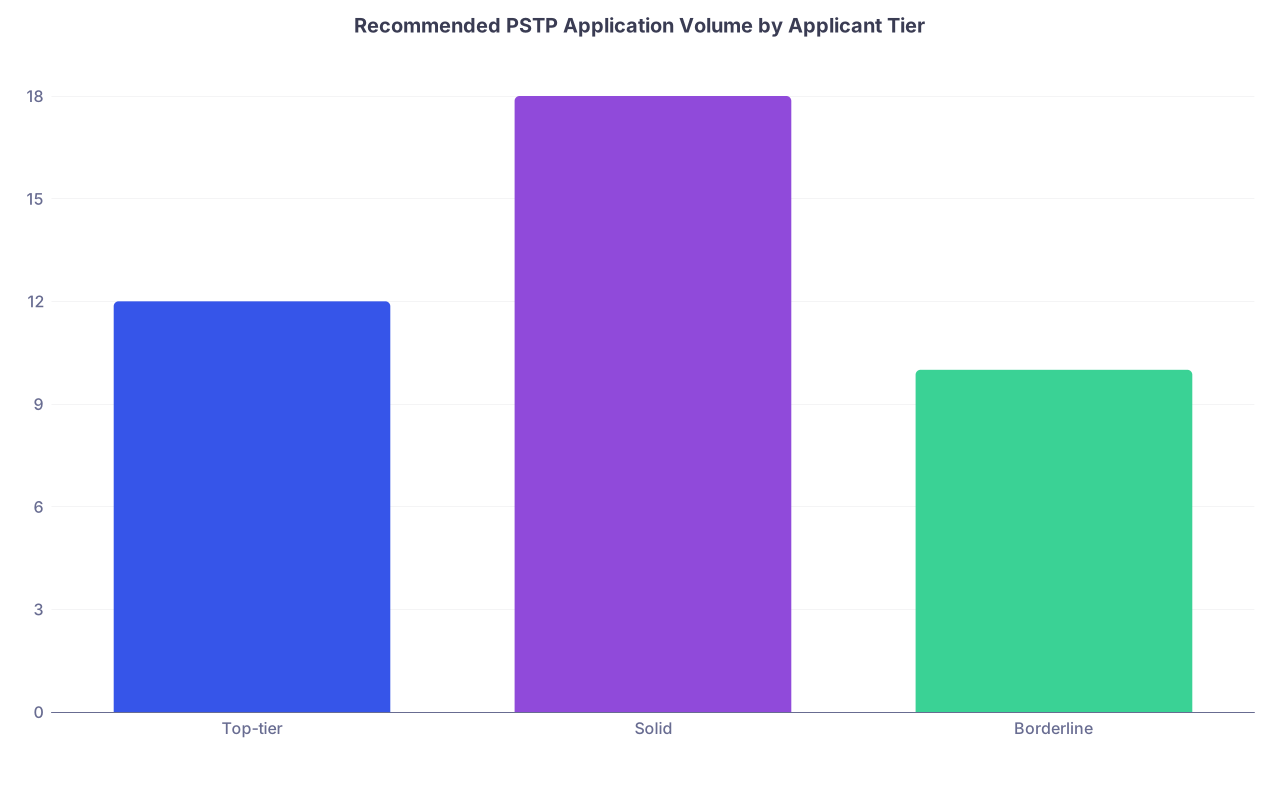
| Category | Value |
|---|---|
| Top-tier | 12 |
| Solid | 18 |
| Borderline | 10 |
Those numbers are PSTP‑specific applications (not total).
Behind that bar chart is an implicit assumption: your odds of matching PSTP at any single program, even if competitive, are not super high. Maybe 10–30%, depending on fit and interview performance.
People severely misinterpret that. They think:
- “30% per program, I’ll get one for sure if I apply to 5–6.”
Wrong. That is not how this process behaves. It is not independent coin flips because:
- The same concerns will follow you (e.g., limited clinical strength, narrow letters, unclear research direction).
- The same strengths will also follow you (e.g., unique skill set, big K99‑level mentor, stellar publications).
- Program PSTP directors talk to each other. Not constantly, but enough.
So to question “how many?” the real answer is: enough that your odds of landing 4–8 interviews are high, because below that your chance of matching to a PSTP drops fast.
For PSTPs and formal research tracks, I like this mental target:
- Aim for 6–10 PSTP interviews.
- Expect that greater than ~4 PSTP interviews gives you a decent shot of at least 1–2 rankable offers.
If you want to visualize where that sits on the spectrum of total interviews:
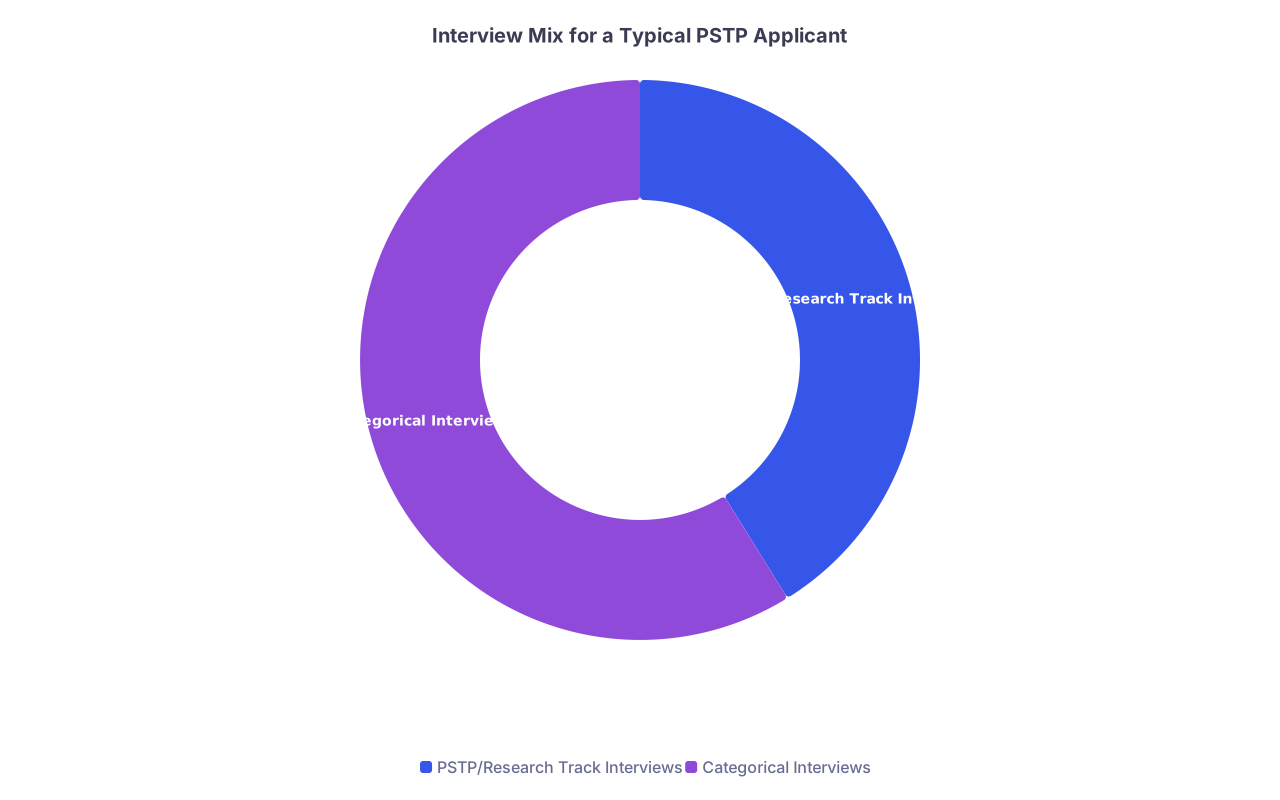
| Category | Value |
|---|---|
| PSTP/Research Track Interviews | 7 |
| Categorical Interviews | 10 |
That breakdown (roughly 7 PSTP + 10 categorical) is what I have seen among successful physician‑scientist candidates who end up happy: they have real options on both sides.
5. Balancing PSTP vs categorical applications
You are not applying in a vacuum. You are applying with a Plan A and a Plan B.
5.1. Plan A: land a formal PSTP / research pathway
For this, you need:
- Enough applications to secure at least 6–10 interviews.
- Realistic targeting: programs that actually do meaningful research in your area.
- Letters and statements clearly oriented to physician‑scientist development.
This is where the 10–20 PSTP applications come from.
5.2. Plan B: match somewhere genuinely research‑friendly as a categorical resident
This is not failure. Many K08/K23‑funded investigators started in standard categorical slots. What you need here:
- Programs with:
- T32 training grants in your likely subspecialty
- Track record of residents getting into top fellowships and protected research years
- Infrastructure: CTSI, cores, mentoring programs
Your “how many” on this side depends on your overall competitiveness as a standard applicant:
- Strong overall (good scores, good letters, solid clinical evaluations):
- 8–10 categorical applications probably fine
- Mid‑range or with a few red flags:
- 12–15 categorical applications
Your final ERAS list then looks roughly like:
- 10–15 PSTP / research tracks
- 10–15 categorical research‑friendly programs
- Total: about 20–30 programs
That balance gives you:
- Enough PSTP shots to be viable
- Enough categorical options that you do not end up with a binary all‑or‑nothing outcome
6. Strategy by applicant profile (realistic scenarios)
Let me walk you through three very common scenarios I have seen.
6.1. The MD/PhD with strong publications and clear subspecialty interest
Profile:
- MD/PhD, 3–4 years of focused research
- 2+ first‑author papers in solid journals (does not have to be Cell/Nature)
- Step 2: >245–250 range
- Clear aim: e.g., pulmonary/critical care, heme/onc, cardiology
- Strong letters from well-known PIs
For this applicant:
- PSTP applications: 12–15
- Mostly top‑20 academic centers that are strong in their subspecialty
- A few mid‑tier institutions with outstanding specific labs or PIs
- Categorical applications: 8–10
- Mix of top‑tier and strong mid‑tier programs with rock‑solid research culture
They can probably land 8–12 PSTP interviews and 8–10 categorical. Applying to 30+ PSTPs would be pointless; the incremental programs are not meaningfully better than their categorical safeties.
6.2. The MD with intensive research but not a PhD
Profile:
- No PhD, but did 1–2 dedicated research years
- 1 first‑author + a couple of co‑authors, maybe one under review
- Step 2: 235–245
- Good but not famous PIs writing letters
- Research interest more general (e.g., health services, clinical translational)
For this applicant:
- PSTP applications: 15–20
- A realistic mix: some top places, many mid‑tier academic centers with PSTPs
- Categorical applications: 10–15
- All academic IM or peds, skip purely community sites if long‑term goal is R01‑level science
They need more PSTP applications because their signal is good but not overwhelming. Many PSTPs will wonder if they are a better fit as “research‑intensive categorical” instead of fast‑track ABIM.
6.3. The MD/PhD with weaker clinical metrics
Profile:
- MD/PhD, but Step 2 in the low 220s–230s
- Research strong; maybe a K99‑track mentor
- Some marginal clinical comments or a mediocre clerkship grade
For this applicant:
- PSTP applications: 8–12
- Only programs that are truly research‑obsessed and willing to trade slightly weaker clinical metrics for high scientific upside
- Categorical applications: 15–20
- Target academic programs with a softer emphasis on scores and more holistic review
Here, throwing 25 PSTP applications at the wall will not fix the underlying issue. Many PSTPs will quietly screen for minimum standardized test performance because they need you to survive and excel in fellowship.
Better to apply to fewer PSTPs where your research is exactly what they want, and heavily reinforce your categorical side.
7. Geographic constraints: when fewer programs is risky
Geography sabotages many smart strategies.
If you say:
- “I must stay in the Northeast.”
- And you also say: “I want a formal PSTP in heme/onc.”
You have just shrunk your real options by a factor of 3–4.
If you restrict to a region, you must:
Apply to almost every credible PSTP in that region.
Not just the brand names. Even the “solid but not flashy” programs that have T32s and NIH‑funded faculty.Increase categorical volume.
Because local PSTP numbers are limited. Maybe:- 8–10 PSTPs in your region
- 15–20 categorical programs in your region
Accept that prestige takes a backseat to location.
That is the price of geographic restriction. You compensate with more applications and more flexibility on tier.
If you are fully geographically flexible, you can safely keep your total around 20–30 programs. If you are strongly constrained, 25–35 total may be more reasonable, skewed heavily categorical.
8. Time and money: the practical ceiling
People forget that PSTP applications are time‑intensive in a way categorical apps are not.
You often need:
- 1 general personal statement
- 1–2 targeted physician‑scientist / research statements
- Program‑specific tailoring:
- Mentioning specific PIs
- Referencing cores, centers, and training grants (CTSA, T32s)
- Explaining why their structure (2+2, 3+2, etc.) fits your needs
You simply do not have the bandwidth to do that well for 40 programs while on sub‑I’s. If you do, it will show. As in: generic “I love research” paragraphs with no specificity.
Typical constraints:
- Money: 25–30 programs is already not cheap.
- Time: custom statements and emails to PSTP directors for 15–20 programs is a lot.
The “sweet spot” where quality and quantity intersect for a serious applicant is:
- 10–20 PSTP/research tracks
- 10–15 categorical
- Total 20–30
Going much beyond that usually produces diminishing returns in interview yield per program added.
9. How to build your actual list (stepwise)
Here is how I tell people to do it, step by step.

| Step | Description |
|---|---|
| Step 1 | Define specialty and research focus |
| Step 2 | Identify all PSTPs in that specialty |
| Step 3 | Filter by geography and research fit |
| Step 4 | Rank by research alignment not just prestige |
| Step 5 | Select 10-20 PSTP targets |
| Step 6 | Add 10-15 categorical research friendly programs |
| Step 7 | Check total volume and adjust |
More concretely:
List every PSTP / ABIM research pathway in your target specialty nationwide.
Use program websites, APDS, APDIM, subspecialty societies, and the NRMP directory.Cross‑match with your research area.
If you are doing systems neuroscience, maybe that mid‑tier IM program with no wet lab support is out. If you do implementation science or health services, almost any large academic IM department might work.Flag three tiers:
- A tier: Top fit (research and culture), clear PIs for you, good city for your life.
- B tier: Reasonable fit; would still advance your physician‑scientist goals.
- C tier: Technically PSTPs, but the research fit is weak or mentoring structure is unclear.
Take almost all A’s, some B’s, very few C’s.
This is how you get into the 10–20 PSTP range in a rational way.Build your categorical list around research‑friendliness.
Programs where:- Residents publish regularly.
- Graduates match into fellowship at places you respect.
- There is some version of a “research track,” even if informal.
10. Red flags that you are applying to the wrong number of programs
Let me be blunt. If any of these describe you, your application count is off.
You have 30+ PSTPs on your ERAS list.
There are not that many good‑fit PSTPs per specialty. You are doing shotgun, not targeting.You have 5 PSTPs and 3 categorical programs total.
That is begging for a bad Match Week.You are applying to 0 categorical programs because “PSTP or bust.”
Unless you have a K99 in your pocket and Nobel‑caliber letters, this is reckless.You are applying to 20 small community programs with no research and calling this a physician‑scientist strategy.
It is not. You can do scholarship everywhere, but R01‑level training demands certain infrastructure.You wrote one generic “I love research” statement and submitted it everywhere.
PSTP directors will see right through that.
11. Key takeaways for how many programs to apply to
Let me distill this into three actionable numbers:
Formal PSTP / ABIM research tracks:
- Competitive MD/PhD or MD‑equivalent: 10–20 programs
Calibrate within that by how strong and focused your research record is.
- Competitive MD/PhD or MD‑equivalent: 10–20 programs
Categorical, research‑friendly residencies:
- Typically 8–15 programs, depending on your clinical competitiveness and geographic limitation.
Total ERAS applications:
- For most serious physician‑scientist applicants: 20–30 programs is the correct ballpark.
- Go closer to 30 if:
- You are geographically restricted, or
- Your clinical metrics are weaker and you need more categorical safety.
Do not copy your classmates who are applying to 50 categorical IM programs with no research plan. You are playing a different game.
FAQ (exactly 6 questions)
1. If I am only applying to categorical programs but want a research career, should I still cap at ~30 programs?
Yes. If your goal is a physician‑scientist path but you are not applying to formal PSTPs, the right strategy is still 20–30 programs, almost all at academic centers with strong research output. More than that rarely adds meaningful options; it just drains money and time you should spend on stronger letters and a better personal statement.
2. Can I apply to both PSTP and categorical tracks at the same institution?
Often yes, but it varies by program. Some want a single application; some explicitly tell you to apply to both tracks; some handle PSTP selection internally after you have matched categorically. You must read each program’s instructions carefully and, when unclear, email the PSTP director or coordinator. As a rule of thumb, if you are serious about an institution, being in their categorical pool as a backup does not hurt.
3. Is it dangerous to apply to too few categorical “backup” programs?
Very. I have seen candidates with 12 PSTP interviews and only 3 categorical interviews end up in a panic when PSTP ranks did not go their way. Aim for at least 8–10 categorical interviews. Back‑calculate from that by looking at your stats and prior match data to decide whether you need 10, 12, or 15 categorical applications.
4. Do I need a PhD to justify applying to 15–20 PSTP programs?
No. A PhD is helpful, but not mandatory. What matters more is demonstrated research productivity and trajectory: serious publications, substantive research time, and clear commitment to a scientific career. A non‑PhD MD with 1–2 strong first‑author papers and good letters from established investigators is absolutely a reasonable candidate to apply to 15–20 PSTPs.
5. How do SOAP and unmatched risks differ for PSTP applicants?
If you structure your list as “PSTP‑heavy with little categorical backup,” and you do not match a PSTP slot, you may also not match categorically, leaving you in SOAP with very few academic, research‑friendly options. That is why I am adamant: PSTP applicants need a robust categorical safety net. You are not immune from unmatched risk just because you have a PhD.
6. Should I tailor my personal statement separately for PSTP vs categorical divisions?
Yes. Have:
- One core personal statement that highlights both clinical and research interest for categorical programs.
- A more pointed research‑oriented statement (sometimes called a “PSTP research statement” or “physician‑scientist statement”) that you either upload as an additional document or integrate into program‑specific essays. Trying to use one generic document for every track and every program is a fast way to sound vague and unfocused.
Two final points:
- Treat PSTP applications as a high‑precision exercise, not a spray‑and‑pray.
- Anchor your total around 20–30 programs with a real Plan B—because a physician‑scientist career is a marathon, and the residency label on your coat is just one, not the only, gate you need to pass.