
If You’re Couples Matching: How to Scale Program Numbers Together
What happens when you realize the number of programs you ‘should’ apply to individually is nowhere near enough once you’re couples matching?
Let me be blunt: the normal rules for “how many programs should I apply to” break the moment you hit that couples match checkbox. The math changes. The risk changes. The budget changes. And if you pretend you can just “add a few extra programs,” you’re setting yourselves up for a bad March.
This is the playbook I wish more couples had before ERAS opens.
1. First, Accept This: Couples Matching Multiplies Risk, Not Adds It
Everyone underestimates this.
When you apply as a couple, you are no longer asking:
“Will I match?”
You’re asking:
“Will we both match in the same geographic setup we can live with?”
Those are very different questions.
Here’s the issue: your chance of both matching somewhere together is roughly the product of your individual match probabilities in that region setup. That’s why couples who would’ve matched easily as individuals can end up with scary close calls or one person going unmatched.
So, before you scale program numbers, you need a realistic sense of:
- Your individual competitiveness
- Your joint competitiveness in each specialty combo
- Your non-negotiables on geography and distance
Then you decide how aggressive you must be with total program numbers.
2. Know Your Baseline: Individual vs Couple Numbers
If you were not couples matching, there are rough ranges that most advisors throw around (yes, they’re imperfect, but they give you a starting point):
| Specialty Type | Solo Competitive Applicant | Solo Average Applicant | Solo At-Risk Applicant |
|---|---|---|---|
| Very Competitive (Derm, Plastics, Ortho, ENT) | 60–80+ | 80–120+ | 120–150+ |
| Competitive (EM, Anesthesia, Rads, OB/GYN) | 40–60 | 60–80 | 80–120 |
| Moderately Competitive (IM categorical, Gen Surg, Peds) | 25–40 | 40–60 | 60–80 |
| Less Competitive (FM, Psych, Path, Neuro) | 20–30 | 30–50 | 50–70 |
Those are solo numbers.
For couples? You almost always need to push up a tier.
General reality:
- Strong–Strong couple:
You can often get away with ~1.3–1.5x your solo numbers each. - Strong–Average or Average–Average:
Think more like ~1.5–2x solo numbers each. - Any partner at risk / red flags / specialty bottlenecks:
2x or more. Plus a strategy change, not just “more programs.”
You’re not just “adding programs.” You’re increasing the number of viable pairings you can rank.
That’s the real metric: number of plausible pairings on the couples rank list, not number of individual applications.
3. Step One: Define Your Realistic Scenarios (Not Your Fantasy)
Before you touch ERAS filters, decide what scenarios are acceptable. For real. Not in theory.
There are four broad buckets couples end up with:
- Same institution, same city
- Same city, different institutions
- Commutable distance (say, ≤1–1.5 hours)
- Long distance (different cities/states, flights or long drives)
You need to decide:
- Which of those are truly acceptable?
- Would you actually rank long-distance options high enough to match there?
- Is there a geography you absolutely will not live in, even if it’s the only place you both match?
If you say “we’re open to anything” but then refuse to rank anything outside three metro areas, you’re lying to yourselves. The algorithm does not care what you said in October. It cares what you rank in February.
This decision determines how many programs you’ll need.
4. Step Two: Get Honest About Your Combined Competitiveness
Now the painful part. You have to be brutally honest as a pair.
Look at each of you:
- Step/COMLEX scores or pass/fail context + shelf performances
- Class rank / AOA / Gold Humanism (if applicable)
- Research output (especially for competitive specialties)
- Red flags: leaves of absence, failures, professionalism issues
- IMG vs AMG, DO vs MD, Visa needs
Then look at your specialty combination:
- IM + Psych? Fairly flexible.
- FM + Peds? Very flexible, especially outside big cities.
- Derm + Ortho? That’s brutal. You are climbing a cliff together.
- General Surgery + OB/GYN in the same urban areas? Tough but doable with a smart plan.
If one of you is in a bottleneck specialty (Derm, Ortho, ENT, Plastics, Neuro IR, etc.), the entire couple’s risk goes up. You don’t fix that by sprinkling in 5 extra programs. You fix it by:
- Massive program list expansion
- Real geographic flexibility
- Serious backup planning (prelim years, less competitive specialty option, etc.)
5. Step Three: Build Your Geographic Buckets
This is where couples either get smart or get stuck.
You should build 3–5 geographic “buckets” where you’d reasonably live. Example:
- Bucket 1: “Home region” – Midwest, near family
- Bucket 2: Major coastal cities – say, NYC / Philly / Boston
- Bucket 3: Broad South – Carolinas, Georgia, Tennessee
- Bucket 4: True flex – anywhere with decent programs, including mid-size cities
Then you assign a priority level to each bucket:
- Tier A: Dream / ideal
- Tier B: Good / acceptable
- Tier C: If we end up here, we’ll make it work
Now ask:
- Are there enough programs in each bucket for both of you?
- Are there specific cities with multiple programs in both specialties? (gold mines)
- Are you over-anchored on 1–2 cities that don’t have enough positions?
Where both specialties overlap strongly, you might not need insane numbers.
Where overlap is weak, you need to compensate with raw volume.
6. Step Four: Estimate Your Target Application Numbers
Let’s make it concrete with a few scenarios.
Scenario A: IM + Psych, both average applicants, moderate flexibility
Solo recommended (average):
- IM: ~40–60
- Psych: ~30–50
As a couple, aiming safe but not ridiculous:
- IM partner: 60–70 programs
- Psych partner: 50–60 programs
Why more for IM? Because IM often has more programs per city/region, which provides pairing opportunities.
You’re probably ending up with:
- 2–3 high-density cities where both have ≥4–5 programs
- Several regions with 1 program in one specialty and 2–3 in the other
- A long tail of single-program cities for one partner, paired with nearby cities for the other
Scenario B: Gen Surg + OB/GYN, one slightly weaker applicant
Solo average-ish:
- Surgery: 40–60
- OB: 40–60
As a couple, more conservative:
- Surgery partner: 70–90
- OB partner: 70–90
You must cast a wide geographic net. And be willing to rank:
- Same hospital
- Same city, different hospitals
- Nearby cities within 60–90 minutes drive
If the weaker partner is in Surgery, you might need >90 applications and consider adding some community-heavy regions you wouldn’t target solo.
Scenario C: FM + Peds, at least one strong applicant, high flexibility
Solo average:
- FM: 25–40
- Peds: 25–40
Couples:
- FM partner: 40–50
- Peds partner: 40–50
If you’re truly flexible geographically and neither has red flags, you can afford to be more restrained. But I still wouldn’t drop below ~40 each. Why? You’re buying insurance for both of you matching in the same general area.
7. The Math That Actually Matters: Pairings, Not Program Count
Everyone obsesses over “how many programs did you apply to?” Wrong unit.
For couples, the real engine is how many reasonable pairings you can rank:
- Same program pairings (best-case)
- Same city/different program pairings
- Commutable city pairings
- Long-distance “safety” pairings (if you’re truly willing)
Rough guide:
- 50–100 rank pairs: Very risky for most couples unless you’re both strong in less competitive fields and very geographically open
- 100–200 rank pairs: Where most reasonably planned couples should land
- 200–400+ rank pairs: Common for couples in at least one competitive specialty or with preferences for specific metro areas
You create those pairings by:
- Applying widely
- Being thoughtful about geography
- Not artificially limiting yourselves to 1–2 city fantasies
If you end up with 60 programs each but only 40 decent rank pairings, you’re still exposed.
8. Cost, Burnout, and Where to Draw the Line
Yes, this gets expensive. And exhausting.
Application fees for two people each applying to 70–90+ programs can get ridiculous. You shouldn’t burn money blindly.
Here’s where to be strategic:
- Above ~70–80 programs in one specialty, you get diminishing returns—unless that specialty is very competitive or you have real risk factors.
- For specialties like FM, Psych, Peds, Path with strong applications and flexibility, going past 60–70 often doesn’t change much.
- Do not waste apps on programs that obviously will not interview you (e.g., all top-10 IM places with a 215 Step score and no research).
Also be realistic about interview fatigue. Couples tend to:
- Overbook interviews out of fear
- Spend thousands flying to cities they’d never realistically rank high
- Burn out in January and barely remember which program was which
Better move: apply broadly, then prune interview invites thoughtfully once you see your numbers. Especially if travel is a major cost.
9. When One Partner Is Clearly Weaker
This is the situation no one wants to say out loud, but everyone deals with.
If one partner is significantly weaker (scores, red flags, late specialty switch, IMG/visa, etc.), your strategy must bend around that reality.
What you do:
Anchor to the weaker partner’s prospects.
They need:- More programs
- More geographic flexibility
- Often less prestige-sensitive choices
Stronger partner applies up, down, and sideways.
That means:- Some reach programs
- A lot of mid-range, geographically overlapping programs
- Some “I’d never choose this if solo, but I would for us” programs
Seriously consider alternative pathways.
Prelim year + reapply
Switch to a slightly less competitive specialty
Or have an explicit, honest plan:
“If one of us doesn’t match, what happens?”
It’s cruel, but the algorithm doesn’t care about fairness. You either plan for this or you let Match Week chaos dictate for you.
10. How to Actually Coordinate Lists Without Losing Your Minds
The logistics will eat you alive if you don’t get organized.
Use something—Google Sheets, Notion, whatever—that has:
Columns for each program:
- City, state, region bucket
- Specialty (IM/Psych/etc.)
- Program type (university, community, university-affiliated)
- Your competitiveness estimate (reach, target, safety)
- Notes: couples-relevant info (same institution as X, nearby Y program, commute data)
Then:
- Mark cities with multiple overlapping programs for both of you. These are high-yield.
- Rank cities/regions before you ever rank programs. Decide as a couple: “We'd take any pairing in City A over any pairing in City C.”
- As interviews come in, update: “Invited,” “Waitlisted,” or “Rejected.”
You’ll see quickly where you’re thin on overlap. That’s your early warning system.
11. Timeline: When to Expand vs Hold
If you’re couples matching, you can’t just “see what happens” and react in January. You need a built-in decision timeline.
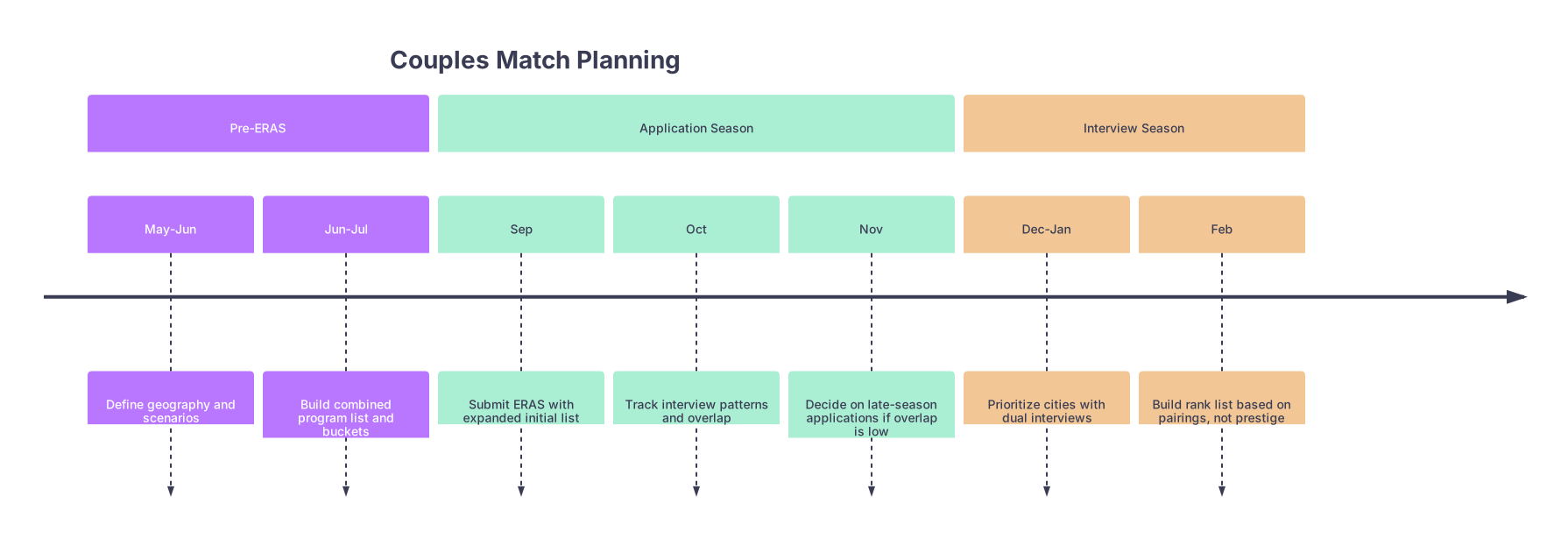
| Period | Event |
|---|---|
| Pre-ERAS - May-Jun | Define geography and scenarios |
| Pre-ERAS - Jun-Jul | Build combined program list and buckets |
| Application Season - Sep | Submit ERAS with expanded initial list |
| Application Season - Oct | Track interview patterns and overlap |
| Application Season - Nov | Decide on late-season applications if overlap is low |
| Interview Season - Dec-Jan | Prioritize cities with dual interviews |
| Interview Season - Feb | Build rank list based on pairings, not prestige |
Key pivot points:
Late October / early November:
If one partner’s interview numbers are weak, or you see minimal geographic overlap, you still have time to add some programs that interview later.December:
Decide which interviews to keep vs cancel, focusing on cities/regions where both of you have realistic options.
By late January, you’re not “fixing” anything. You’re just arranging what you already have.
12. Backup Planning Without Blowing Up the Relationship
You need to talk about worst-case scenarios before they happen.
Questions to answer explicitly:
- If one of us doesn’t match, do we:
- Go long distance for a year?
- Have the matched partner consider SOAPing into a different region?
- Have the unmatched partner SOAP into a prelim / different field?
- Are we willing to take a less desirable city for the sake of being together if it’s the only pairing?
None of this is romantic. It’s adult.
The couples who crash hardest are the ones who say, “We’ll figure it out if it happens.” That’s code for: “We’re going to fight in March.”
13. A Quick Reality Check Table
Here’s how I’d sanity-check couples based on what I’ve seen:
| Couple Profile | Geography Flexibility | Recommended Apps Each | Overall Risk Level |
|---|---|---|---|
| Both strong, less competitive fields | High | 40–60 | Low |
| Both average, moderate competitiveness | Moderate | 60–80 | Moderate |
| One weaker, both moderate fields | Moderate–High | 70–100 | Moderate–High |
| One in very competitive specialty | High | 90–130+ for competitive partner, 70–100 for other | High |
| Both with red flags / limited visas | Must be high | 100–150+ | Very High |
It’s not perfect, but it keeps people from pretending they’re in Category 1 when they’re living in Category 4.
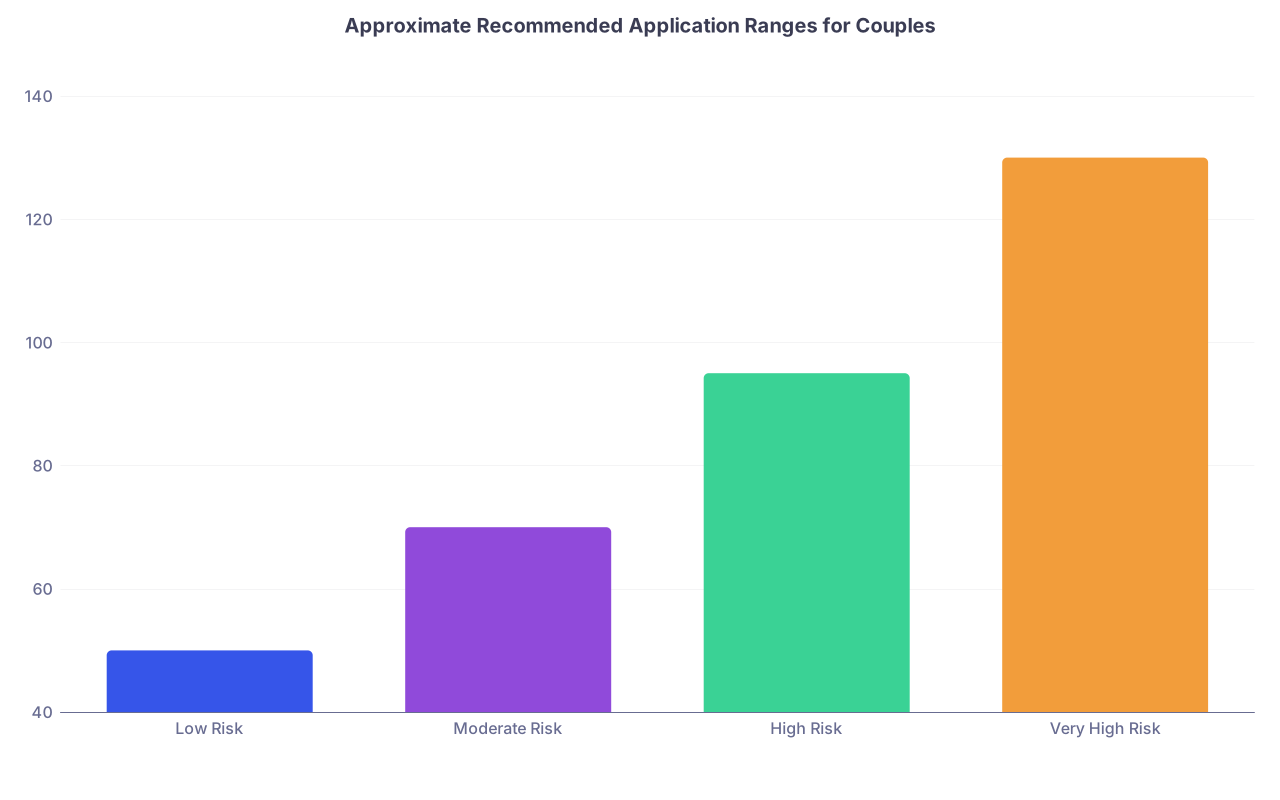
| Category | Value |
|---|---|
| Low Risk | 50 |
| Moderate Risk | 70 |
| High Risk | 95 |
| Very High Risk | 130 |
FAQs (Couples Matching Application Numbers)
If we’re both applying in FM and very flexible on geography, is 30 programs each enough?
Probably not if you’re couples matching. Solo, a strong FM applicant could get away with ~25–30. As a couple, I’d be more comfortable around 40–50 each, especially if you want to avoid ending up in truly random small-town programs you’d never have chosen.We’re IM + Psych, both solid applicants, and only want Northeast major cities. Can we keep it to 40–50 each?
That’s risky. The bottleneck is your geographic restriction, not your stats. If you’re truly only willing to be in a few metros, I’d bump that to 60–80 each, targeting every reasonable program in those cities plus some commutable areas. Otherwise you might simply run out of pairings.One of us is applying Derm and the other IM. How many programs should we apply to?
Derm partner is in “as many as humanly reasonable” territory—often 80–120+, depending on their strength. IM partner should mirror those geographies and likely hit 70–90. But the real answer is: you also need a Derm backup plan (prelim, TY, or alternate specialty) and to accept that the risk is high no matter the program count.Can we save money by each applying to fewer programs and then just ranking long-distance pairings?
You can, but you’re trading application fees now for a year (or more) of long-distance stress later. Long-distance pairings belong near the bottom of your rank list as safety nets, not as your main plan. For most couples, it’s smarter to pay more upfront, expand overlap, and use long-distance as a last resort.We already submitted ERAS with 40 each and now realize it’s too low. Are we screwed?
Not automatically, but you should watch early interview numbers closely. If by late October one of you has low interviews or there’s almost no overlap in cities, you can still add programs—especially in less competitive specialties and community-heavy regions that interview later. It’s salvageable if you move early and are willing to expand geography.
Key takeaways:
- Do not use solo applicant numbers for a couples match; you almost always need 1.5–2x as many programs each.
- The real goal isn’t “X programs per person”; it’s 100–200+ realistic rank pairings that you’d actually accept.
- Geography, specialty competitiveness, and the weaker partner’s profile should drive your numbers—not wishful thinking or budget alone.