
The usual “apply to 80 programs just to be safe” advice will wreck you if you’re a strong applicant changing specialties late. Your risk isn’t numbers; it’s alignment and timing.
You’re not the average applicant anymore. You’re a moving target. And that means you need a different strategy for how many programs to apply to—and which ones.
Let’s set the scene.
You’re a solid or even excellent applicant on paper: strong scores, strong evaluations, maybe even publications. You started down one specialty path—maybe you’re a PGY-1 in IM realizing you actually want anesthesia, or an MS4 pivoting from gen surg to radiology in August. You’re late relative to the standard timeline for this new specialty. Letters are lagging. Your story is complicated.
Now you’re staring at a spreadsheet thinking: “Do I apply to 30? 60? 120? Am I insane if I don’t carpet-bomb the whole country?”
You need rules. Not vibes.
Here’s how to resize your program list specifically for a strong applicant changing specialty late.
1. Get Honest About Your Actual Risk Level
Strong stats don’t erase the “late switch” penalty. But they do change the math on how big your list needs to be.
First, categorize yourself brutally:
- Step 1: Pass (first attempt)
- Step 2 CK: what score?
- Class rank / AOA / honors?
- Current level: MS4 applying new specialty late? Categorical PGY-1 or 2 wanting to switch? Prelim in something?
- Any red flags: leave of absence, failed course/step, professionalism issue, big gap?
Then look at how you compare to typical matched applicants in the new specialty.
| Specialty Tier | Examples | Typical Step 2 CK Range | Relative Competitiveness |
|---|---|---|---|
| Very High | Derm, Plastics, Ortho | 250+ | Extreme |
| High | ENT, Urology, Rad Onc | 245–255 | Very High |
| Moderately High | Anesthesia, EM, Rads | 240–250 | High |
| Moderate | IM, Gen Surg, OB/GYN | 235–245 | Moderate |
| Lower | FM, Psych, Peds | 225–240 | Relatively Lower |
If you’re above the typical range and your only “issue” is switching late, you are not in the same boat as someone with weak scores trying to match the first time. You still need breadth. But not a panic list.
On the flip side, if you’re average for the specialty and late, the late switch becomes a bigger problem. That’s where you bump up your numbers.
Rule of thumb I use:
- Strong applicant + late switch = treat yourself like a mid-range first-time applicant.
- Average applicant + late switch = treat yourself like a borderline applicant.
That framing is going to drive your program count.
2. Understand Your Late-Switch Red Flags (The Ones PDs Actually Care About)
If you switch late, programs worry about three things. Not twenty. Three.
- Commitment – “Are you just flailing, or do you actually want this specialty?”
- Continuity – “Are you going to bail on us too?”
- Logistics – “Can we actually get you into our schedule and funding slot?”
Notice what’s not on this list: “You didn’t decide in MS2 like a good little planner.” They do not care about that.
The red flags that matter in your file:
- You have almost zero exposure to the new specialty (no rotation, no sub-I, no home letter)
- Your previous specialty is wildly different (Psych → Ortho, FM → Neurosurg) with no bridge
- Your letters are still all in your old specialty
- You’re already in a categorical spot and asking to leave mid-training (they know this creates drama)
- The switch is extremely late:
- MS4: you’re switching after summer/early fall
- Resident: you’re looking for an off-cycle or PGY-2 transfer
These don’t mean “don’t apply.” They mean “you need more programs and more tailored outreach.”
3. Ballpark Numbers: How Many Programs for Your Situation
Here’s what you came for. The numbers.
Do not treat this as sacred scripture; treat it as rational guardrails.
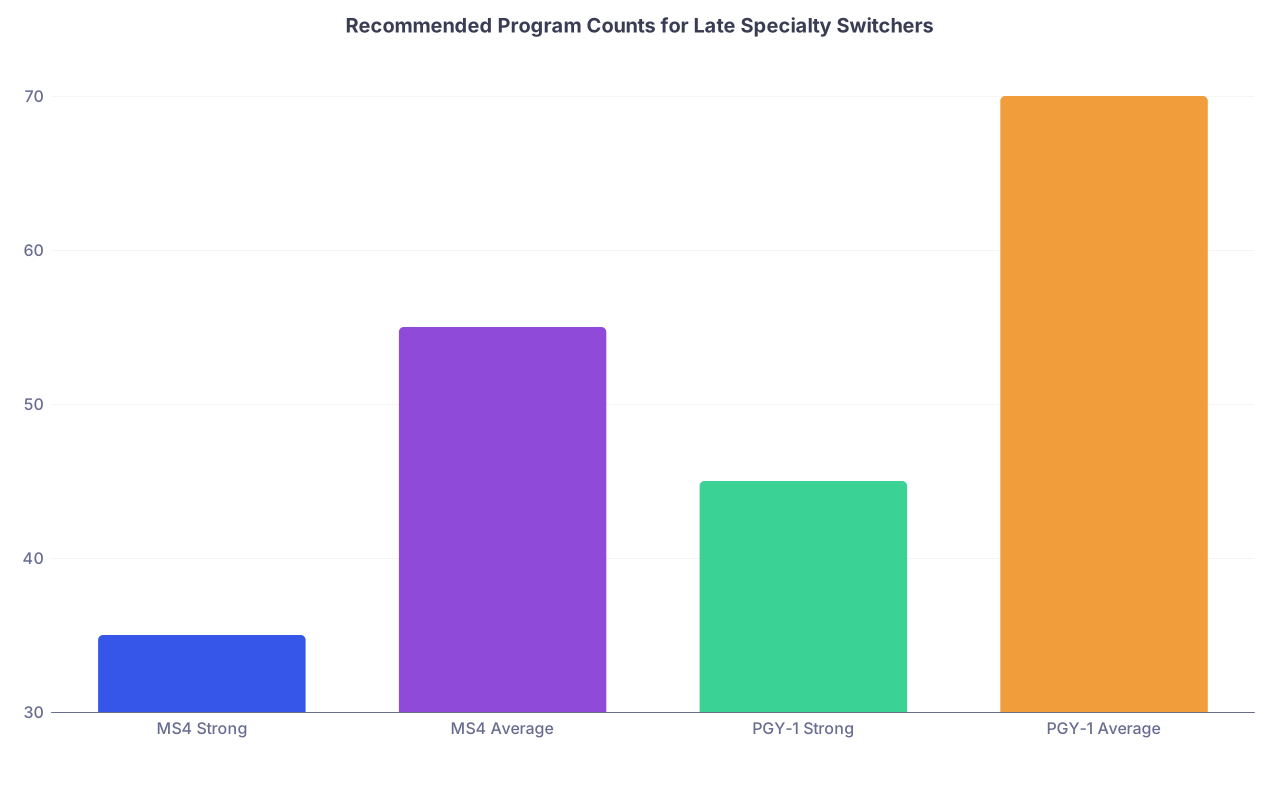
| Category | Value |
|---|---|
| MS4 Strong | 35 |
| MS4 Average | 55 |
| PGY-1 Strong | 45 |
| PGY-1 Average | 70 |
Now let’s break it down by scenario.
Scenario A: MS4, Strong Applicant, Switching Late but Still Same Cycle
Example: You were heading toward IM, did an anesthesia elective in August, fell in love, decide to switch. Step 2 CK 252, honors in core rotations, some research, no major red flags.
You should not apply to 80 programs. You also should not apply to 10.
Reasonable target range:
- Moderately competitive specialty (anesthesia, EM, rads): 35–50 programs
- More competitive (ENT, ortho, urology): 50–70+ programs
- Less competitive (FM, psych, peds): 25–35 programs
You scale up or down inside those ranges based on:
- Whether you have a home program in the new specialty
- Whether you have at least one strong letter in that specialty
- Geographic flexibility (willing to go anywhere vs 2–3 regions)
If you:
- Have a home program
- Have at least 1–2 strong specialty-specific letters
- Are willing to leave your home region
Then you’re on the lower end of those ranges.
If you:
- Have no home program
- Have 0–1 new specialty letters
- Are restricted to 1–2 regions
You go to the higher end or add 10–15 more for protection.
Scenario B: MS4, Strong Applicant, But Switch is Very Late (Letters Tight, Few Rotations)
Example: You finish a November rads elective and realize this is it. You were late to rotate, your letters are barely coming in, and your personal statement still sounds like IM.
In this case, think: your profile is strong, but your signal is weak.
Reasonable target range:
- Moderately competitive specialty: 50–65 programs
- Highly competitive: 70–90 programs
- Less competitive: 35–45 programs
Here you’re buying margin because you’ll be filtered out automatically at many places that:
- Holistically review but still screen by “evidence of commitment”
- Already filled their interview slots before your file was complete
You make up for being late with breadth + direct outreach (we’ll talk about that).
Scenario C: Current PGY-1 (or PGY-2) Strong Resident Switching Specialty
This is its own beast.
Example: You’re a categorical IM PGY-1 with excellent evaluations and a Step 2 CK 250. Mid-year, you realize you want neurology or anesthesia instead. You’re applying for either:
- A PGY-2 transfer spot
- Or a new categorical PGY-1 position next match cycle
Here, strength helps you a lot. But now PDs need to solve:
- Funding (can they pay a transfer?)
- Schedule (do they have a spot that lines up?)
- Politics (your current PD relationship, letters, release date)
Reasonable target range if you’re strong and flexible:
- For moderately competitive specialty (neuro, anesthesia): 40–60 programs
- For more competitive (rads, EM depending on market year): 60–80 programs
- For FM/psych/peds: 25–40 programs
If you’re:
- Limiting to one city/commuting radius, double your list. I’m not exaggerating.
- Needing a very specific start date (only PGY-2, only July), again add 10–20.
If you already have:
- A PD who fully supports you and will call directly
- Good current evaluations
You can sit closer to the lower end of those ranges.
4. Building the Right Mix: Safety / Target / Reach (For Switchers)
You’re not just picking numbers; you’re picking tiers.
For a strong late switcher, I’d roughly split like this:
- 30–40% “safety” or safer
- Community programs
- Newer programs
- Mid-tier academic that list average stats below yours
- Less desirable locations (to most people)
- 40–50% “target”
- Mid-to-upper tier academics where you match the typical profile
- Programs that routinely take non-traditional or transfer applicants
- 10–20% “reach”
- Famous names
- Hyper-competitive programs
- Places that rarely take transfers or have lots of home students
Example for anesthesia, strong MS4 late switcher applying to 45 programs:
- 15 safer
- 22 target
- 8 reach
Don’t get cute and apply to 80% reach because “my scores are good.” That’s how you end up unmatched with a gorgeous CV.
5. How Geography Changes Your Numbers
Geography decisions matter more than people admit.
Here’s the honest version:
- If you’re willing to go anywhere, your list can be on the lower side of the ranges above.
- If you limit to 2 major metro areas (say NYC + Boston, or LA + SF), you either:
- Increase your number by 20–30%
- Or accept a significantly higher risk of no interviews.
Rough guide:
| Geography Flexibility | Adjustment to Base Range |
|---|---|
| Nationwide, no constraints | 0 |
| 2–3 regions, multiple states | +10–15 programs |
| One region only | +20–25 programs |
| One metro area / commuting | +30–40 programs or more |
So if your “logical” number is 40 based on your scores and specialty—but you’re only applying in California and New York—realistically you should be closer to 55–65.
If you refuse to expand geography and refuse to expand your list size, then you’re trading security for location. Own that trade consciously.
6. When to Stop Adding Programs (And When You Actually Should Add)
Here’s the trap: ERAS makes it stupidly easy to go from 40 to 80 programs with three clicks. Every anxious friend will tell you, “Just add more. Why not?”
You need stopping rules.
You stop adding programs when:
- You’ve hit a rational number for your situation based on:
- Strength of your application
- Competitiveness of new specialty
- Geography limits
- You have:
- A real mix of safety/target/reach
- At least some programs in less saturated regions (Midwest, South, etc., unless absolutely impossible for you)
- Any extra programs would be:
- Extremely low fit (strong peds program when you want heavy ICU, etc.)
- Places you’d quietly dread matching at
You do add more programs when:
- It’s late October/November and your interview count is low:
- For moderately competitive specialties as a strong switcher, “low” is:
- Fewer than 6–8 invites by early November
- For less competitive specialties:
- Fewer than 5–6 by mid-November
- For moderately competitive specialties as a strong switcher, “low” is:
At that point, you add:
- 10–20 more programs in the safest available tier
- Emphasize community, newer, and non-coastal programs
And you pair this with targeted emails, not blind applications.
7. Direct Outreach: How It Lets You Be Slightly More Aggressive With Numbers
Late switchers live and die on outreach.
If you’re changing specialty late but strong on paper, you can slightly trim the raw program count—if you compensate with smart, personal contacts.
Places to focus your outreach:
- Your home program in the new specialty (if it exists)
- Programs where:
- You rotated
- Your faculty know the PD or APD
- Alumni from your school or current program are residents there
What to do:
- Ask your current PD (if supportive) or a senior mentor in the new specialty to:
- Email 3–5 PDs personally
- Mention your scores, work ethic, and why the switch is serious and thoughtful
- You write direct emails to:
- Programs where you have any connection (school, rotation, faculty link)
- Programs in regions you’re serious about
Short, to the point:
- Who you are
- Current level and specialty
- Why you’re switching
- Why their program
- Attach CV
If you’re doing this well, you can sometimes:
- Sit toward the lower half of the recommended ranges
- Because you’re increasing the chance each application actually gets seen
If you’re not doing outreach at all and just uploading into ERAS black hole, lean toward the upper end of the ranges.
8. Timing Reality: How Late Is “Too Late” and What That Means for Your List
Late isn’t binary. There’s “a little late” and “borderline impossible.”
Here’s the rough season reality for a typical match-year:
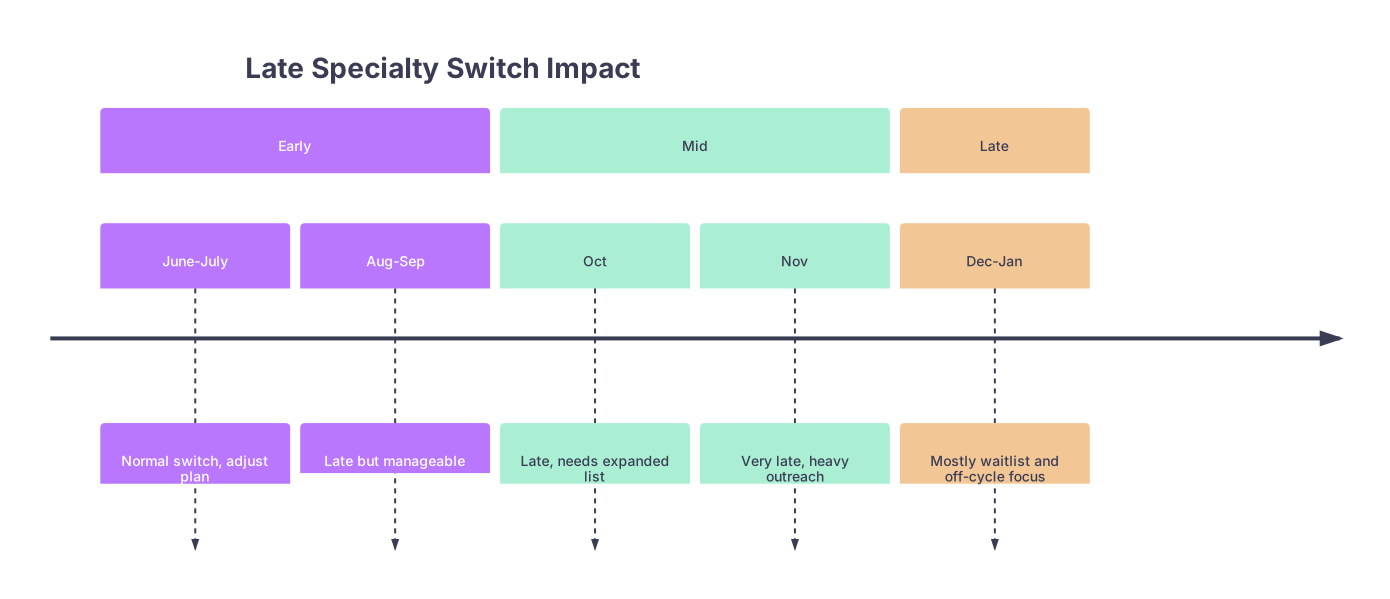
| Period | Event |
|---|---|
| Early - June-July | Normal switch, adjust plan |
| Early - Aug-Sep | Late but manageable |
| Mid - Oct | Late, needs expanded list |
| Mid - Nov | Very late, heavy outreach |
| Late - Dec-Jan | Mostly waitlist and off-cycle focus |
If you’re:
- Switching in June–August before ERAS opens: you’re just “late in planning,” not system-late yet. Use normal ranges.
- Switching in September–October after ERAS submission: increase your program count by 10–20 and go aggressive on outreach.
- Realizing in November–January: your realistic targets are:
- SOAP
- Off-cycle openings
- Next year’s Match with a very strong story and plan
Anyone telling you, “Just apply to 120 programs, you’ll be fine” in December is lying to you or hasn’t actually sat at a rank meeting table.
9. Quick Reality Checks Before You Finalize Your List
Before you lock in and hit submit, ask yourself:
- If I only got interviews from my “safeties,” would I still be willing to go?
- If no, those aren’t real safeties. Fix that.
- Do I have at least 8–10 programs where I’d be genuinely happy?
- Not just brand-name lust. Actual fit.
- If I removed the 10 fanciest logos from my list, does my application still make sense?
- If no, you’ve overstuffed reach.
- Does my number of applications match my story?
- “I’m open to anywhere, I just want to do anesthesia” should not come with 15 applications all in Boston/NYC.
- “Family is anchored in this region” probably requires either more apps or more conservative specialty choice.
Strip it down: three things to remember
You’re not an average applicant anymore; you’re a late switch. Size your list like a mid-range applicant in your new specialty, then adjust by geography and timing—not by fear alone.
Breadth is a tool, not a religion. Most strong late switchers land safely with 35–65 well-chosen programs (more for very competitive fields, fewer for less competitive) plus targeted outreach—not 100+ blind clicks.
Match your numbers to your story and your constraints. The more restricted you are (time, geography, weird start dates), the more programs you need. If you refuse to broaden location or count, accept that you are raising your risk and plan a backup path now, not in March.