
It’s mid-October. ERAS is submitted. Interview invitations are rolling out among your classmates. Your phone, meanwhile, is silent. You refresh your email again and again, but what you’re really watching is just one line on your spreadsheet: your home residency program.
That’s the one you were banking on. The one where everyone “knows you,” where the PD nodded at you on rounds, where the seniors said, “You’ll be fine, they always take strong home students.”
And then the rumor drops. Or the email does. Home program invites went out.
Your name isn’t on the list.
Now you’re in an ugly headspace: “If my own program won’t interview me, who will?” You applied to very few places because you thought home was a lock. Maybe literally just your home program plus a tiny handful of “safeties.” Now you’re under-applied and behind the curve.
This is the situation we’re handling. You’re undersubscribed on interviews, the season is active, and your home program just told you—directly or indirectly—“not this year.”
Here’s what to do next, step by step.
Step 1: Stop Guessing Why, Start Getting Data
The worst move now is to sit in your apartment and catastrophize. You need information.
You have three questions to answer fast:
- Did they actually decide not to interview you, or are invites rolling out in waves?
- Is this about you, or is this about numbers / weird year / internal politics?
- How far off target are you overall (total interview count vs what you need to safely match)?
You do that with very plain, very specific actions.
1. Clarify your actual status at the home program
Do not email the PD with a dramatic essay. Keep it tight and professional. Example message to the PD or APD who knows you:
Dear Dr. Smith,
I hope you are well. I wanted to briefly ask about my application status for our residency program. A few classmates mentioned they received interview invitations this week, and I have not yet heard. I remain very interested in staying at [Institution] for residency.
Do you expect additional waves of interview invitations, or should I interpret this as our program not moving forward with my application this cycle? Any brief guidance would be very helpful as I reassess my broader application strategy.
Thank you for your time and for all your support,
[Name]
You’re not begging. You’re not arguing. You’re trying to categorize your situation: “not yet” vs “no.”
If you have a mentor or clerkship director closer to the PD, sometimes better to ask them to quietly check first so you don’t put leadership on the spot.
2. Audit your current interview reality
Make a simple table for yourself:
| Category | Count |
|---|---|
| Programs Applied To | ? |
| Interview Invitations | ? |
| Rejections | ? |
| No Response Yet | ? |
Then ask:
- What specialty are you in?
- How many interviews do you actually need to have a decent shot at matching in this specialty with your stats?
As a rough, not-perfect guide (for categorical specialties):
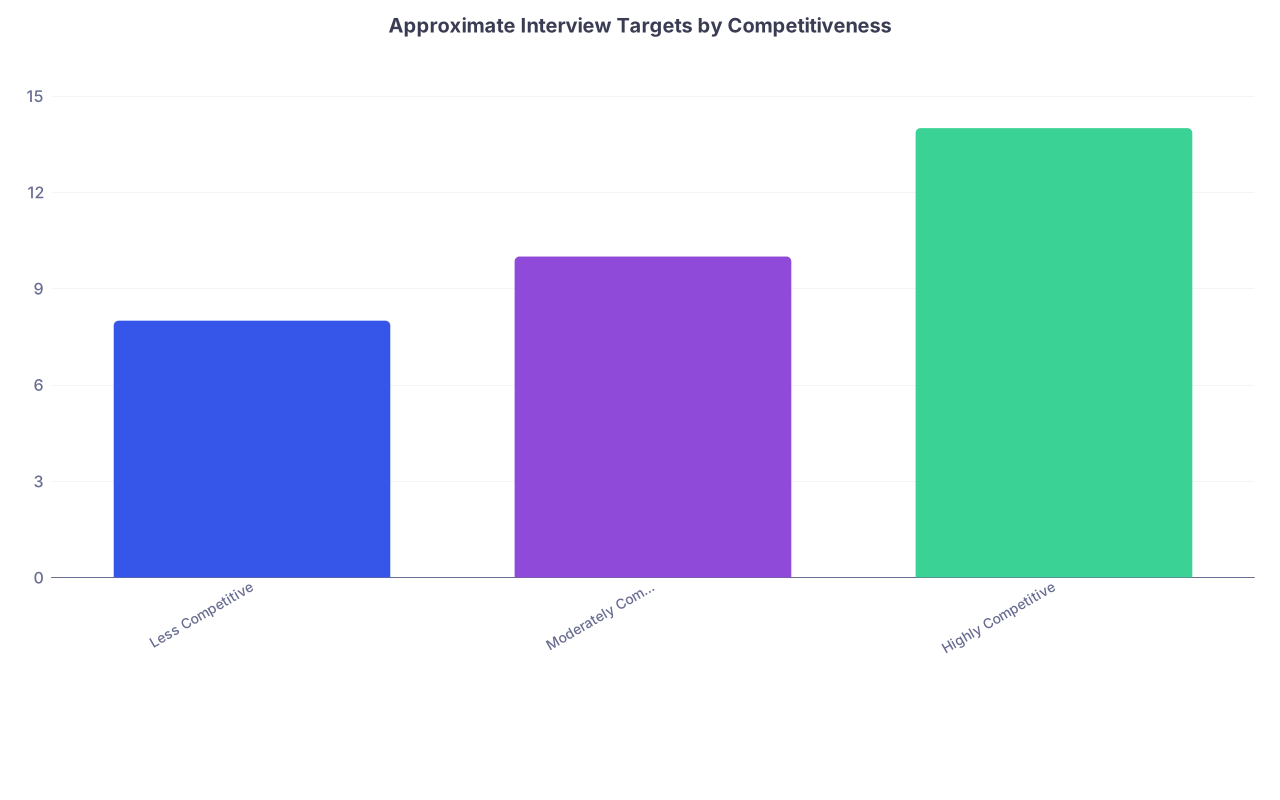
| Category | Value |
|---|---|
| Less Competitive | 8 |
| Moderately Competitive | 10 |
| Highly Competitive | 14 |
That’s not gospel, but if you’re aiming for something like Internal Medicine and you have 1–2 interviews in late October, you’re behind. If you’re aiming for Derm and you have 2 interviews, you’re essentially out unless your research is insane. Harsh but true.
You need to see, in cold numbers, how short you are.
Step 2: Accept the Signal, But Don’t Overinterpret It
Here’s the part no one likes hearing: when your home program doesn’t interview you, that’s a negative signal. Programs usually like their own students because they know them. When they pass, they’re saying some combination of:
- You’re not competitive for their program this year
- They had too many home applicants and you were lower on their list
- Some specific concern (exam, professionalism, weak letters, low rotation evals)
But here’s the common mistake: people treat that as a global verdict.
“I’m dead everywhere.”
Not necessarily. I’ve seen students not interviewed by their own mid-tier IM program who matched at another mid-tier or even slightly stronger program. I’ve seen EM students get passed over at home but match at well-known community programs that loved them.
Your home program has the most information about you. That means they may weigh certain inside-baseball issues that no one else knows about. Other programs are going off your paper file, a couple LORs, maybe one away rotation.
So yes: it’s a bad sign. Use it as a wake-up call to expand your list and be aggressive. But don’t declare your whole season over based on one program’s decision.
Step 3: Expand Your List Intelligently (and Fast)
If you under-applied and it’s still early/mid season (October/early November), you can still add programs in most specialties.
You have two goals:
- Increase total number of applications quickly
- Shift the mix of programs to include more realistic options
You don’t fix this by just spamming 40 top-tier programs. You fix it by recalibrating.
1. Re-stratify your program tiers
Look at where you actually stand compared to typical matched residents.
Be brutally honest:
- Step 1: Pass/Fail now, so ignore.
- Step 2 CK: compare to national averages for matched applicants in your specialty.
- Letters: Do you have any big names? Any PD/Chair letters?
- Research: Is it strong for your specialty or basically none?
Then create three buckets for new applications:
| Tier | Description |
|---|---|
| Reach | Above your profile |
| Target | Match your profile reasonably |
| Safety-ish | Slightly below / less competitive overall |
You should be adding mostly Target and Safety-ish now. Maybe 10–20% Reach, just in case there's a fit.
2. Focus on program behavior this season
This is where most people are lazy. They pick a list from some “Top 50” ranking and call it a day.
You need live intel:
- Look at program Instagram/Twitter/X: are they posting about having lots of spots left? Emphasizing holistic review?
- Check your specialty Reddit / Student Doctor Network threads. Yes, they’re crazy environments, but you can still see which programs have started or finished sending invites.
- Ask upperclassmen from your school who matched in your specialty: “Which programs seemed friendlier to mid-range stats?”
You want:
- Community programs
- Newer programs
- Former DO-only programs now taking MDs and DOs
- Programs outside saturated metros (Midwest, South, etc.)
3. Use geography to your advantage
Programs like applicants with:
- Regional ties
- Family nearby
- Training in a similar patient population
If you have any:
- Prior address in that state
- Family there (even extended)
- Undergrad there Say it in your personal communications or in any supplemental ERAS questions honestly and clearly.
Step 4: Decide If You Need a Parallel Plan (Backup Specialty or Prelim)
This is where things get uncomfortable.
If you’re:
- In a highly competitive field (Derm, Ortho, ENT, Plastics, Rad Onc, Neurosurg)
- Under-applied originally
- Now missing an interview from your home program
You must at least discuss a backup plan with someone experienced. Not in a group chat. With a real mentor or your Dean’s office.
That backup might be:
- Adding a prelim year (Medicine or Surgery) while reapplying to your desired specialty
- A true parallel plan (e.g., applying to IM or FM in addition to your dream field)
- Taking a research year and reapplying stronger
For categorical fields like IM, FM, Peds, Psych:
- A home program no-interview is a bad sign, but if your numbers are okay you’re often still salvageable by expanding aggressively toward more community and lower-to-mid-tier university programs.
- Backup specialty is sometimes overkill; more often you need more realistic programs.
I’ll say this plainly:
If you are applying to a very competitive specialty and you do not have any interviews by early November and your home program passed, you are almost certainly in trouble. At minimum, you should be adding prelim/TY/backup applications. Waiting and “hoping for the best” is fantasy.
Step 5: Start Strategic Outreach (Without Being Annoying)
You cannot cold-email 100 programs begging for interviews. That just annoys coordinators.
But targeted, thoughtful outreach through your existing network? Different story.
1. Use your school’s faculty network
Talk to:
- Your specialty advisor
- Clerkship director for that field
- Any attending you worked closely with on rotation
Tell them plainly:
- Home program didn’t offer an interview (if that’s confirmed)
- You under-applied initially
- You are very concerned about matching and want to expand intelligently
Then ask them:
- “Are there any programs you’d feel comfortable reaching out to on my behalf?”
- “Do you know PDs or APDs at [Region X or Y] where I might be a reasonable fit?”
Even one sincere email from a respected faculty member to a PD can move your application from the giant pile to the “take a serious look” pile.
2. Very limited direct emails from you
For a few programs where you have a real connection (not imaginary):
- You rotated there
- You have a strong LOR from their faculty
- You grew up in that town and wrote that into ERAS
You can send a short email to the PD or program coordinator. Something like:
Dear [Program Coordinator/Dr. X],
My name is [Name]. I recently applied to your [specialty] program through ERAS. I completed [a rotation / my undergraduate / significant time] in [City/Region], and I’m very interested in training there long-term.
I realize interview season is very busy. If my application is still under consideration, I’d be grateful for the opportunity to be reviewed for an interview. I’d be excited to contribute to your program.
Thank you for your time,
[Name, AAMC ID]
Send that to maybe 5–10 programs, not 100. Focus on where a connection exists.
Step 6: Fix the Parts of Your Application You Can Still Influence
You can’t rewrite your personal statement now for every program. You can’t retake Step 2 CK mid-cycle. But you still have moving parts.
1. Signals and supplements (if your specialty uses them)
If your specialty uses:
- Signals/Preference signals
- Supplemental ERAS questions
Double-check you didn’t waste signals on reaches that already rejected you. If there’s any late opening or additional signal opportunity (some specialties do weird things), direct those to more realistic programs.
2. Online presence and professionalism
Programs do occasionally Google you when they’re on the fence:
- Clean up public social media
- Make sure your professional email signature looks normal
- If you have a simple professional LinkedIn highlighting your interests in X specialty, not a bad thing
Not a huge factor, but you’re tuning every little knob you still control.
3. Keep your performance strong on current rotations
I’ve seen this happen:
A student tanks their mood after home program rejection, their end-of-year Medicine Sub-I eval tanks, and the PD letter or update to ERAS quietly reflects “less engaged, less consistent.”
You cannot afford that.
If your school sends post-submission updates or new narrative comments, make them good ones. That means showing up, staying engaged, and not letting this disappointment bleed into daily performance.
Step 7: Understand the Timeline You’re Working Against
Interview calendars vary, but a rough pattern:
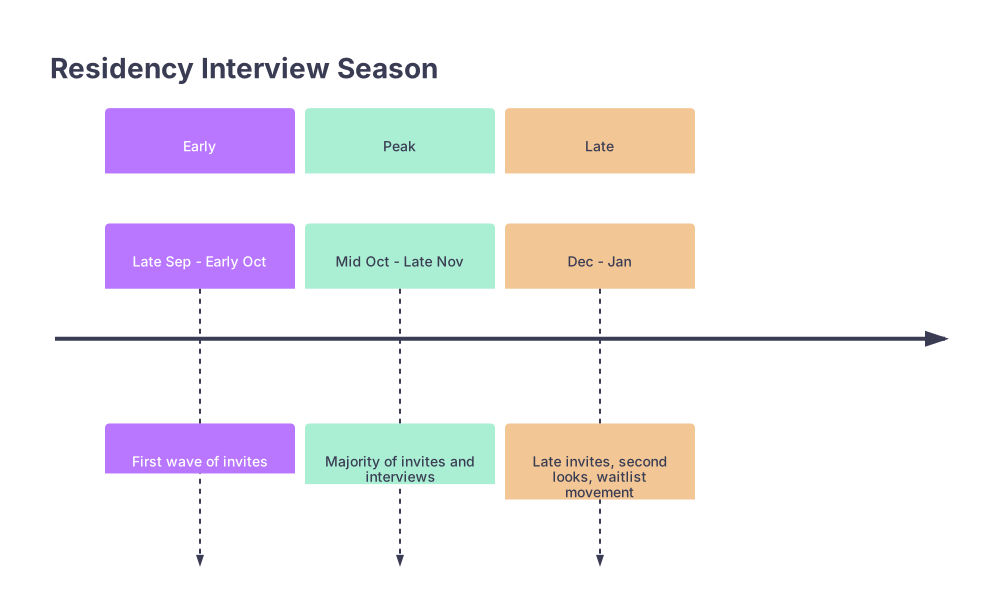
| Period | Event |
|---|---|
| Early - Late Sep - Early Oct | First wave of invites |
| Peak - Mid Oct - Late Nov | Majority of invites and interviews |
| Late - Dec - Jan | Late invites, second looks, waitlist movement |
If you realize in:
- Early October: You have time to aggressively expand your list and still be in the main review wave.
- Late October/Early November: You’re behind but still can catch some programs, especially community and those that send later invites.
- December: You’re mostly fishing for cancellations and waitlist movement. Hard, but not impossible.
So your response speed matters. The day you realize home passed and that your list is too short, you should be working on:
- New program list that same day or weekend
- Submitting additional applications within days, not weeks
- Meeting mentors within the week
Step 8: Adjust Expectations but Keep Playing the Game
Look, if your entire strategy was “I’ll match at my home program, they love me,” and they did not even interview you, your fantasy version of this cycle is gone. Fine.
Now the job shifts to:
- Aim to match somewhere solid and train well
- Avoid going unmatched
- Preserve mental bandwidth and dignity
A few realities:
- Many excellent physicians trained at community programs they’d never heard of in med school.
- Almost no attending cares where you did residency as much as what you can do.
- It is much easier to transfer programs after matching somewhere than to re-enter the Match from an unmatched state.
So yes, you should still apply to some programs you’d love. But you have to fill your list with enough places where you are realistically in the top half of their applicant pool.
Quick Example Scenarios
To make this real, here are three condensed situations and what I’d advise.
Scenario 1: Mid-tier IM, under-applied, home rejection
- Step 2 CK: 232
- Mid-tier US MD school
- Applied to 25 mostly university IM programs
- Only 1 interview by October 25
- Home IM program did not interview
My move:
- Add 25–35 more programs heavily slanted to:
- Community IM
- University-affiliated community programs
- Regions you have any tie to
- Ask IM clerkship director to reach out to 2–3 programs they know in your target geography.
- No need for backup specialty yet if you end up with ~8+ interviews by mid-November.
Scenario 2: EM, no home interview, low Step 2
- Step 2 CK: 219
- EM as first choice
- Home EM did not interview you
- 1 away EM interview so far
My move:
- Immediately discuss backup: FM or IM.
- Add 15–25 FM or IM programs in places you could live.
- Continue with existing EM apps but mentally accept that backup might be where you match.
- Prioritize any interviews you get, even if “not ideal location.”
Scenario 3: Derm, no interviews, home passed
- Step 2 CK: 247
- 1–2 derm abstracts, nothing major
- It’s November 1, zero interviews anywhere
My move:
- Derm is effectively done this cycle.
- If you’re committed: seek a research year now, explicitly in derm.
- Simultaneously apply to prelim/TY IM spots to avoid a gap if research cannot start right away.
- Meet with Dean’s office to strategically plan a re-application with stronger research.
FAQ (Exactly 3 Questions)
1. If my home program doesn’t interview me, should I confront them about why?
No “confrontation.” You can respectfully ask for feedback, but don’t expect a detailed answer mid-season. Many PDs won’t provide specifics until after Match (if at all). A simple “Was there something specific that hurt my application that I can work on?” is fine. If they dodge, let it go and focus on expanding your list and getting help from non-PD mentors.
2. Is it worth adding programs late, or have most places already sent invites?
In most specialties, adding programs in October and even early November can still help. Many community and mid-tier programs review later or send invites in waves. Yes, you missed the earliest batch, but there’s ongoing movement, cancellations, and late openings. Submitting late is far from ideal, but it’s still better than sitting on a clearly too-short list.
3. Should I consider withdrawing from the Match this year if my home program and others don’t interview me?
Only in very specific scenarios. If you’re in a hyper-competitive specialty with basically zero interviews by late November, a controlled “pause” plus research year and strategic re-application may make more sense than going unmatched. For primary care and core specialties, though, it’s usually better to expand applications, add more realistic programs, consider prelims/backups, and push hard to match somewhere rather than pull out entirely.
Key points:
- A home program not interviewing you is a serious warning sign, not an automatic death sentence. Treat it like data and adjust quickly.
- You fix an under-applied situation by expanding smartly toward realistic programs and, in competitive specialties, seriously considering backups or prelims.
- Stop guessing in isolation. Talk to mentors, push for targeted advocacy, and keep your on-rotation performance strong while you repair your list.