
The biggest mistake MS3s make in spring is pretending “how many programs should I apply to?” is a September problem. It is not. By the time September hits, your options are already boxed in by choices you made right now.
You should start estimating your target number of residency programs in early MS3 spring and refine that number every few weeks. Not because you will nail it perfectly in March. Because your estimate will quietly drive how hard you push research, away rotations, Step 2 timing, and frankly, how much financial damage application season will do.
Let’s walk this chronologically, the way your year actually unfolds.
February–March of MS3: First Pass Estimate (Rough but Crucial)
At this point you should not be opening ERAS. You should be opening a blank document and forcing yourself to answer three questions:
- What specialty am I leaning toward?
- What does my competitiveness actually look like on paper?
- Am I comfortable with the idea of applying broadly (more expensive, more travel) or do I want to keep it lean if possible?
Week 1–2 of “Decision Season”
At this point you should:
- Lock in a working specialty choice (or narrow to 2).
- Pull objective data in one place:
- Step 1 (P/F but programs still see it).
- Step 2 CK practice scores or NBME projections if you have any.
- Clinical grading pattern so far (Honors / High Pass / Pass).
- Meaningful research / leadership / unique experiences.
Then you create your first rough band of how many programs you might need.
Use this as a starting framework:
| Scenario (per specialty) | Rough Range |
|---|---|
| Very strong applicant in less competitive field (FM, IM non‑academic, Peds) | 15–25 |
| Average applicant in those fields | 25–40 |
| Below-average in those fields | 40–60 |
| Very strong in moderately competitive (EM, OB/GYN, Anes, Neuro) | 25–40 |
| Average in those | 40–60 |
| Below-average in those | 60–80 |
| Any applicant in very competitive (Derm, Ortho, ENT, Plastics, Rad Onc, IR, Urology) | 60–100+ plus a parallel backup |
Do not obsess over the exact number yet. You just want the order of magnitude. Are you a 20–30 applicant or a 60–80 applicant? That distinction needs to happen now.
Because this will change your spring priorities.
Week 3–4: Connect Numbers to Behavior
At this point you should:
Translate your rough range into pressure level:
- If you seem to be in the 15–30 range, you can afford to be more selective:
- You may not need 3 away rotations in obscure locations.
- You can target higher-yield research or leadership instead of panicking.
- If you are clearly in the 60+ range, you are in volume strategy:
- You must plan for higher application costs.
- You need to prioritize Step 2 CK timing and core clerkship Honors to move that number down if possible.
- If you seem to be in the 15–30 range, you can afford to be more selective:
Start a simple spreadsheet with columns:
- Specialty
- Tentative competitiveness tier (strong / average / below-average)
- Provisional program number range
- Notes on what would reduce that number (e.g., Step 2 > 250, 2 strong aways, new research pub)
You are not choosing specific programs yet. You are defining your ballpark.
April of MS3: Data Check and Specialty Reality
By April, most people have finished IM, Surgery, and maybe Peds or OB. You have more data.
At this point you should be upgrading your rough guess to a more honest estimate.
Early April: Reality Calibration
You should:
Review:
- Clerkship evaluations: Are attendings calling you “top 10%” or “solid, reliable” or “needs direction”?
- Shelf scores versus class percentiles.
- How letters are likely to read (you usually know).
Pull up NRMP Charting Outcomes and recent specialty-specific match data:
- Look at:
- Match rate by Step 2 score band.
- Match rate by number of programs ranked.
- Distribution of program types (community vs university vs top-tier academic).
- Look at:
Compare your numbers with those charts and ask:
- “If I stay exactly like this, how many programs do people like me usually need to match?”
This is where you stop using rumors from classmates and start using actual data.
To make this visual:
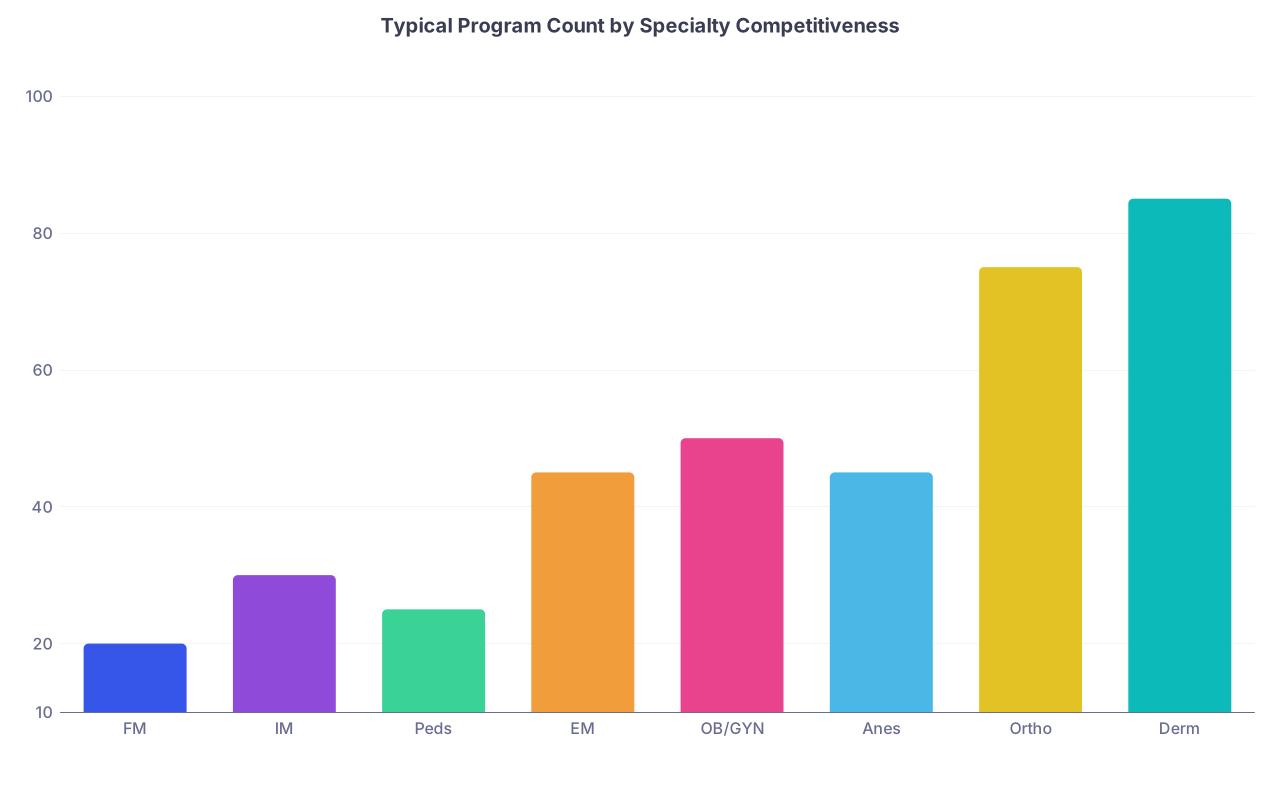
| Category | Value |
|---|---|
| FM | 20 |
| IM | 30 |
| Peds | 25 |
| EM | 45 |
| OB/GYN | 50 |
| Anes | 45 |
| Ortho | 75 |
| Derm | 85 |
You are not trying to be the exception who “matched Derm with 20 apps.” You are planning like someone who believes statistics.
Late April: Financial and Logistics Pass
At this point you should confront the money and time side of your estimated program count.
Rough math:
- ERAS first 10 programs are cheap.
- After that, each additional program adds up. Fast.
You should:
- Multiply your rough app count by typical ERAS fee tiers to get an approximate cost.
- Add estimated:
- Interview travel / lodging (unless you assume fully virtual).
- Away rotation costs (housing, travel, application fees).
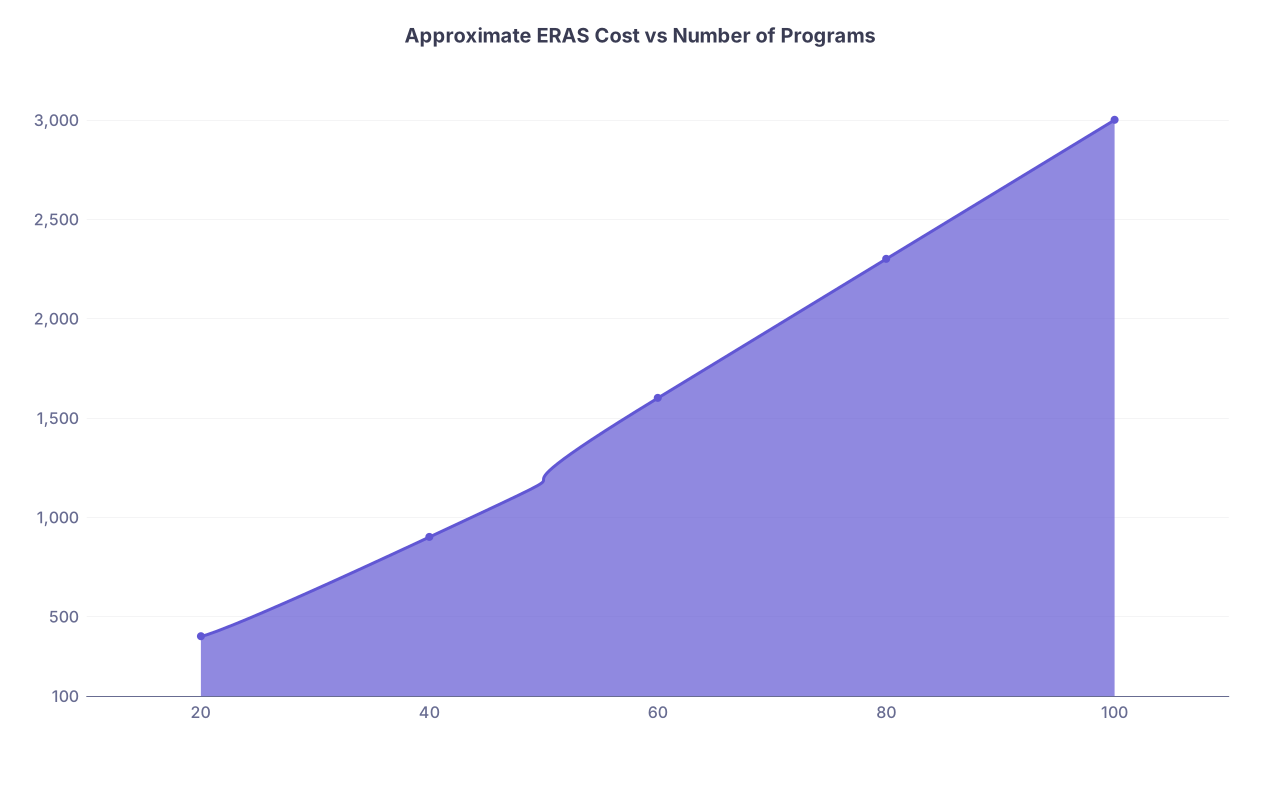
| Category | Value |
|---|---|
| 20 | 400 |
| 40 | 900 |
| 60 | 1600 |
| 80 | 2300 |
| 100 | 3000 |
If the number horrifies you, good. You are early enough to adjust strategy:
- Work more shifts this summer.
- Aggressively improve competitiveness to reduce total programs needed.
- Be clear with family / partner about what application season will look like.
May–June of MS3: Step 2 and Away Rotations Shape the Number
By late spring you move from “estimating based on what I have” to “estimating based on what I can still change.”
Early May: Plan for Step 2 CK
At this point you should decide:
- When you will take Step 2.
- What score band you are realistically targeting.
If your tentative program count depends heavily on a Step 2 bump (for example, dropping from needing 70+ programs to more like 40–50), you must:
- Schedule Step 2 early enough (usually June–July) so the score is back before:
- ERAS submission.
- Program review of applications.
Be explicit in your planning doc:
- “If Step 2 < 235 → plan on 70+ apps”
- “If Step 2 240–250 → plan on ~50 apps”
- “If Step 2 > 255 → can likely cut to 35–40 with good mix of academic and community”
I have watched people ignore this and then try to guess their competitiveness without a score in September. That usually ends one of two ways: over-application that torches their budget, or under-application that torches their match.
Late May–June: Away Rotations and Application Breadth
Now VSLO and away rotations decisions either lock in or close out.
At this point you should:
- Align your estimated number of programs with:
- How many regions you are willing to live in.
- Whether you are targeting competitive academic programs vs community-heavy lists.
- How many aways you can realistically fit.
For example:
- If you want highly competitive academic EM and you are average on paper:
- Expect 50–60+ programs.
- Plan 1–2 away rotations at strong but realistic institutions.
- If you want categorical IM and your Step 2 practice tests are high 240s:
- You might target 25–35 programs, mostly academic, with a few safety community programs.
At this point, write down a draft target:
- “Current target: 45 programs (EM), expecting to revise down if Step 2 > 250 and away evals are excellent.”
July–August (Rising MS4): Converting Estimate into a Real List
ERAS is opening soon. The guessing phase is almost over.
Now timing matters week by week.
Early July: Step 2 Score Reality Check
If you took Step 2 in June, your score hits around now.
At this point you should:
- Immediately re-open your program-count plan.
- Confirm which scenario you are in (low / mid / high target).
- Adjust your planned number up or down:
Example:
- You had assumed:
- If Step 2 < 235 → 70 apps.
- If Step 2 235–245 → 55 apps.
- If Step 2 > 245 → 40 apps.
- You scored a 242.
- At this point you should lock in something like 50–55 programs and cut any fantasy about being a 30-application candidate.
Do not ignore your own pre-committed decision thresholds. You were more objective when you set them.
Mid July: Program Tier Mix
Now that you know your rough count, you must distribute programs across tiers.
You should:
- Break your target number into buckets:
- Reach
- Reasonable
- Safety
For a 45-program plan in a moderately competitive specialty, something like:
- 10 “reach” programs (top academic / most competitive regions).
- 25 “reasonable” programs (solid academic + strong community).
- 10 “safety” programs (community / less popular locations where your stats are clearly above average).
This is where that early spring work pays off. You are not randomly picking 45. You already know why it is 45, not 25 or 75.
Late August–September: Final Lock-in and Micro-Adjustments
This is when panic makes people irrational. Your job is to convert your months of structured planning into a disciplined final number.
Late August: Compare With Advisors and Recent Graduates
At this point you should:
- Meet with:
- Specialty advisor.
- Trusted upperclassmen who matched last year in your field.
Bring:
- Your Step scores.
- Clinical grades.
- CV.
- Your planned application number and program mix.
Ask very specific questions:
- “Given my profile, is 40–45 enough to keep my risk reasonable?”
- “If I only cared about matching anywhere, how many would you recommend?”
- “Where do you see obvious overkill vs under-coverage?”
Then, adjust by 5–10 programs at most, not 30. You are fine-tuning, not blowing up the plan.
Early September: ERAS Submission Week
This is the point of no return for your program count.
At this point you should:
- Finalize:
- Number of programs.
- Tier distribution.
- Geographic spread.
Use a simple grid to verify balance:
| Tier | Count | Notes |
|---|---|---|
| Reach | 10 | Major academic, top locations |
| Reasonable | 25 | Mix of academic and community |
| Safety | 10 | Community, less popular areas |
If you feel the urge to add “just 15 more,” stop and check:
- Are these genuinely new reasonable/safety programs?
- Or are you just feeding anxiety?
Over-application can backfire: more interviews than you can attend, superficial prep, and a scattered rank list.
After Applications Are Submitted: When to Add More Programs
Even after September, your planning is not completely frozen.
At this point you should use interview yield to decide if you need to expand.
October–November: Interview Invite Reality
- Track:
- Number of invites vs number of apps.
- Which tiers are responding.
Use a simple metric:
- By mid-November:
- If you have < 5 interviews in a competitive specialty → consider adding a small batch (10–15) of truly safety-level programs if deadlines allow.
- If you have 10–12+ interviews in most specialties → you almost certainly do not need more programs.
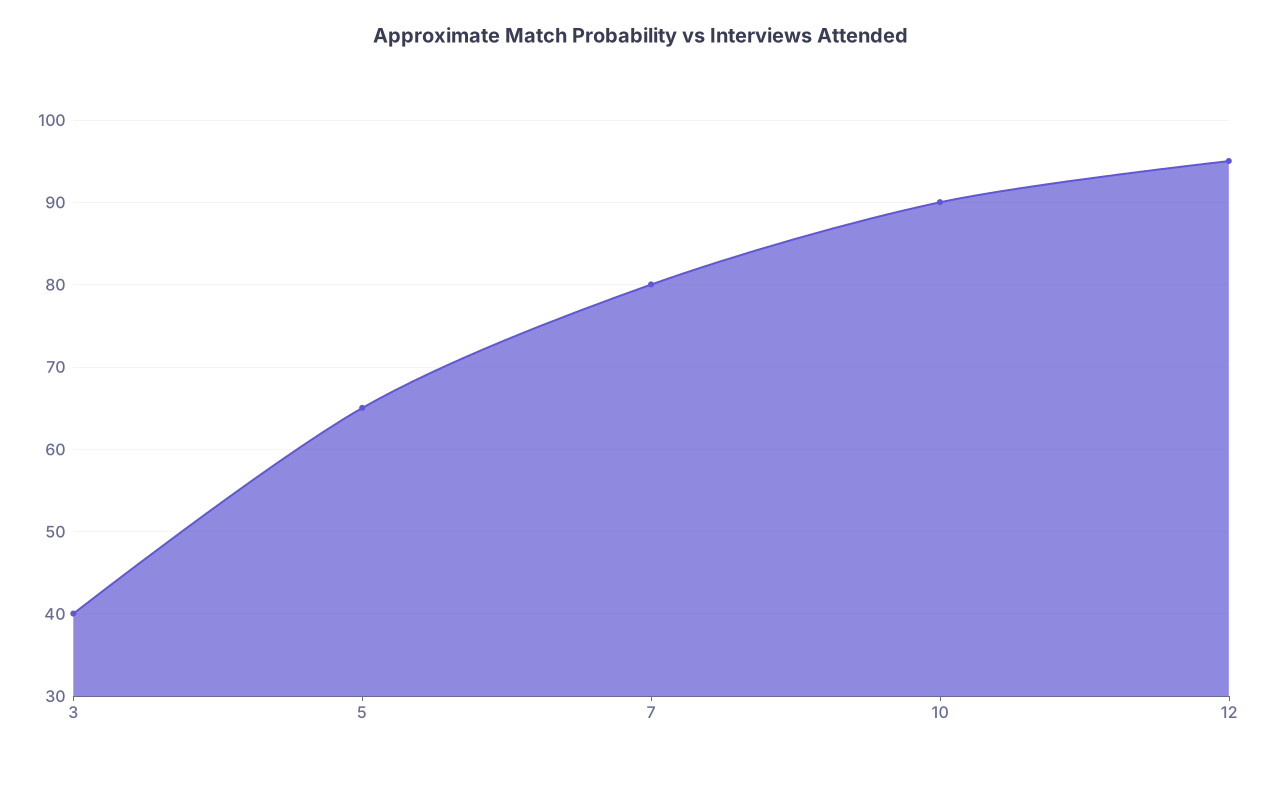
| Category | Value |
|---|---|
| 3 | 40 |
| 5 | 65 |
| 7 | 80 |
| 10 | 90 |
| 12 | 95 |
People panic-add 20 programs in October without any strategy. You are not doing that. You are using interview data to see if there is a genuine risk problem.
Putting It All Together: A Month‑by‑Month Snapshot
Sometimes it helps to see the whole year laid out in one shot.
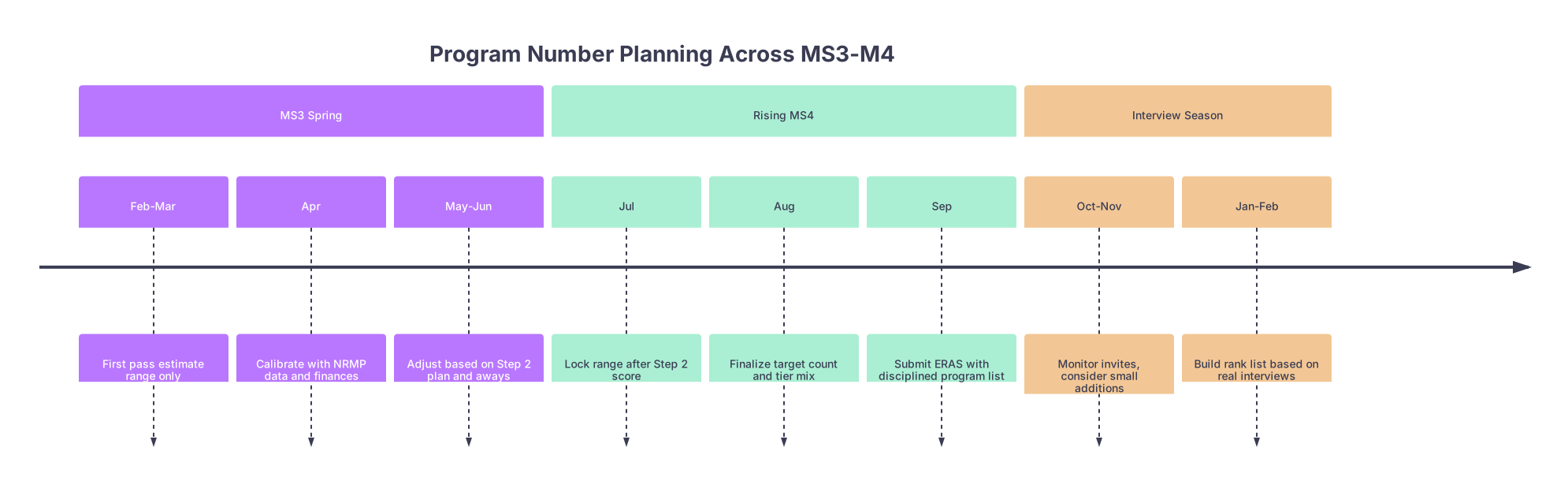
| Period | Event |
|---|---|
| MS3 Spring - Feb-Mar | First pass estimate range only |
| MS3 Spring - Apr | Calibrate with NRMP data and finances |
| MS3 Spring - May-Jun | Adjust based on Step 2 plan and aways |
| Rising MS4 - Jul | Lock range after Step 2 score |
| Rising MS4 - Aug | Finalize target count and tier mix |
| Rising MS4 - Sep | Submit ERAS with disciplined program list |
| Interview Season - Oct-Nov | Monitor invites, consider small additions |
| Interview Season - Jan-Feb | Build rank list based on real interviews |
By now the pattern should be clear:
- February–March: Order-of-magnitude estimate.
- April–June: Refine based on objective data and what you can still change.
- July–September: Commit to a specific target and program mix.
- October–November: Small, data-driven tweaks only.
Today, do one concrete thing: open a blank document, write your likely specialty at the top, and type three lines—your current Step scores, your approximate competitiveness (strong / average / below-average), and the rough program range you think you will need. Then compare that guess to NRMP data for your field. If your “feelings” and the data disagree, adjust the number now, not in September.