
The way most residents “plan” for fellowship when choosing how many programs to apply to is backward. They look at last year’s NRMP charting outcomes, panic, and then carpet-bomb ERAS. That’s lazy, expensive, and often hurts them later when they actually try to match a competitive fellowship.
You can do better than that.
If you care about a future fellowship, how many residency programs you apply to cannot be separated from which programs you apply to. Volume without targeting is just noise. Your job right now is not “apply to as many as I can afford.” Your job is: engineer a match that positions you for the next match.
Let’s walk through how to do that, concretely.
Step 1: Get Honest About Your Fellowship Goals (Now, Not “Later”)
You do not need a perfectly defined fellowship plan. But you do need a direction.
Here’s why: different fellowships care about different things, and different residencies are better launchpads for them.
Broad categories:
Super competitive, academic-heavy fellowships
Think: GI, cardiology, heme/onc, pulmonary/critical care, derm onc, IR, neonatology, complex ortho subspecialties.
These care a lot about:- Program reputation
- Research output
- Letters from recognized names
- Strong in-house fellowship
Mid-competitive / region-driven fellowships
Think: sports med, palliative, geriatrics, hospitalist-focused tracks, many anesthesia subspecialties.
These care more about:- Solid clinical training
- Fit and recommendations
- Geographic ties
- A known pipeline from your residency
Less competitive / “access” fellowships
Think: many community-based fellowships in less desirable locations.
These can be more flexible on research/pedigree if your clinical reputation is excellent.
You don’t need to tattoo “GI or bust” on your forehead. But you should at least know:
“I’m probably going to want a competitive academic fellowship”
vs
“I just want to be broadly trained and maybe do fellowship if it fits”
vs
“I’m almost certain I’ll want fellowship X, and it’s hyper-competitive.”
That answer should change how many and what type of residency programs you apply to.
If you’re vaguely interested in heme/onc, you cannot treat your residency list like someone who’s dead-set on community primary care. That’s how people trap themselves.
Step 2: Understand How Residency Program Type Affects Fellowship Chances
This is where everyone hand-waves. Don’t.
Here’s the blunt reality I’ve seen over and over:
Large academic centers with in-house fellowships
Pros:- Name recognition
- Built-in fellowship pipeline
- Tons of research
- Faculty who are known nationally and write heavy-hitting letters
Cons: - Brutal competition for “their own” fellowships
- You can get buried in a class of 40 residents
- Political; one bad rotation with the wrong attending can kill your shot
Strong hybrid / university-affiliated community programs
Pros:- Often send a few residents into good fellowships yearly
- More chances for you to stand out as a “top resident”
- Sometimes less cutthroat while still respected
Cons: - May have less structured research
- Might not have in-house fellowship in your field
- You’ll need to be more proactive to build a “fellowship-ready” CV
Pure community programs with little academic activity
Pros:- Excellent hands-on clinical exposure
- You can be “the star” easily if you work hard
Cons: - Weak or no research infrastructure
- Few or no alumni in top fellowships
- Program leadership may not know how to advocate for you to academic PDs
If you’re serious about a competitive fellowship, the third category is a handicap. Not impossible. But you’re starting uphill.
Step 3: Translate That into Application Volume Strategy
Now let’s talk numbers. Because that’s why you’re here.
You’re not asking, “What’s a safe number overall?” You’re asking:
“How many programs should I apply to given that I want a future fellowship, and how should that mix of program types look?”
Here’s a working framework. Adjust for your specialty competitiveness and your application strength.
First, classify yourself honestly
- Strong candidate for your specialty
- US MD, high Step 2 (or strong COMLEX), minimal red flags
- Decent research, decent letters
- Average candidate
- Mid-range scores, some minor gaps, or generic letters
- Riskier candidate
- Lower scores, gaps, visa needs, or a reapplication
Now layer your fellowship goal on top.
Step 4: Sample Mixes – How Many Programs & What Type
Let’s assume Internal Medicine as an example, because it’s the classic fellowship pipeline specialty. You can adapt this logic to peds, gen surg, anesthesia, etc.
Scenario A: Strong IM applicant, wants competitive fellowship (GI, cards, heme/onc)
Your mistake here would be to think “I’m strong, I only need to apply to a handful of elite academic places.” That’s cocky and dangerous.
Target mix:
- Total applications: ~30–45 programs
- Rough breakdown:
- 10–15 high-tier academic centers (big names, in-house fellowships)
- 10–15 solid university-affiliated / hybrid programs with strong fellowship match lists
- 5–10 “safety” programs that still send at least some people to fellowship
What matters more than the raw number is this:
Each program on your list should have a track record of sending residents into your desired field. Not just “a fellowship exists at our hospital.”
Keep this mental rule:
“If I matched at my weakest program on this list, would I still have a realistic shot at my fellowship with hustle?”
If the answer is no, that program doesn’t belong on your list if fellowship is non-negotiable.
Scenario B: Average IM applicant, leaning toward competitive fellowship but not 100% certain
Here’s where people mess up the worst. They build a list tailored only to matching somewhere and then discover PGY-2 they want GI. By then, they’re at a place that hasn’t sent anyone to GI in five years.
Do this instead.
Target mix:
- Total applications: ~45–70 programs
- Rough breakdown:
- 10–12 higher-tier academic programs where you’re at the lower end but still plausible
- 20–30 solid mid-tier university-affiliated / hybrid programs with at least some history of sending people to your area of interest
- 10–20 community programs that:
- Have alumni doing fellowship
- Or have faculty with academic connections
You’re using volume not just for safety, but to give yourself options across program type. You don’t want a final rank list that’s 90% places where fellowship is a long shot.
Scenario C: Riskier applicant, still wants a fair shot at fellowship
This is the hardest group. I’ve seen it work, but it requires ruthless planning.
Target mix (again, for something like IM):
- Total applications: ~70–120 programs (yes, that many)
- Rough breakdown:
- 5–8 aspirational academic programs where you’d be a reach but might get one or two looks
- 20–35 university-affiliated / hybrid programs that are historically fellowship-friendly but more forgiving on scores
- 40–70 community programs that:
- Have at least one or two grads in fellowship each year
- Or have recent grads at mid-tier university fellowships
Notice: I did not say “apply to every community program that exists.” You’re not just trying to get a residency. You’re trying to get a residency that isn’t a dead end for fellowship.
This is where most riskier applicants shoot themselves in the foot. They panic, apply to 120 programs with zero filter, and end up matching at a place that doesn’t even send people to fellowship. Then PGY-2 they realize they’re stuck.
Use the extra volume strategically, not blindly.
Step 5: How to Check If a Program Actually Supports Fellowship
Do not trust marketing blurbs. “Strong record of graduates obtaining competitive fellowships” is meaningless without data.
Here’s what you actually check:
Program website – fellowship match list
- Best case: a public list by year: where each resident went, and into what specialty.
- If your target fellowship appears every year or two, that’s good.
- If it’s once five years ago, and nothing since? That’s not a pipeline.
Ask current residents (even over email) very precise questions:
- “In the last 3 years, how many residents applied to [cards/GI/etc], and how many matched?”
- “Are there in-house mentors in that field who regularly work with residents?”
- “Are there opportunities for research with that division, or do residents have to find outside projects?”
Look for in-house fellowship vs external placements
- In-house: can be great, but also political.
- External: tells you how your residents are viewed elsewhere.
PD’s track record
You’d be surprised how much it matters to have a PD who actually picks up the phone and sells you to fellowship PDs. During interviews, listen for language like:- “Our residents match X, Y, Z fellowships regularly.”
- “We personally advocate for you and make calls.”
If a program dodges specifics when you ask about fellowship, that’s a red flag.
Step 6: Adjusting Volume by Specialty Competitiveness
Different core residencies have very different baselines for “how many programs.”
Here’s a rough feel (US MD/DO, no extreme red flags):
| Residency Type | Common Range |
|---|---|
| Highly competitive (Derm, Ortho, ENT, Plastics) | 60–90+ |
| Upper-mid (Gen Surg, Anes in popular regions) | 40–70 |
| Core pipeline (IM, Peds, Psych, FM) | 25–60 |
| Less competitive / broad need | 20–40 |
Now overlay fellowship ambition:
- If you want a very competitive fellowship, aim for the higher end of these ranges and shift toward program types with strong academic output.
- If you’re fellowship-open but not fixed on something ultra-competitive, aim mid-range, but keep at least 50–60% of your list at places that place into fellowships consistently.
- If you’re more fellowship-agnostic, you can bias slightly more to clinical/community programs and keep total volume closer to the middle.
Step 7: Regional vs Reputation – What to Prioritize
Another bad habit: applicants over-prioritize geography if they want competitive fellowships later.
Reality:
- Training at a mid-tier academic program in a less “desirable” city that reliably sends residents to GI/cards/heme-onc beats a shiny coastal community program that never sends anyone to those fellowships.
- For fellowships, it often matters who can write your letters and what they’ve published, not whether you were happy living near your college friends.
That doesn’t mean you ignore your life. It means if fellowship is a priority, you give extra weight to:
- Presence of academic divisions in your field of interest
- PD and chair with national presence
- Ongoing clinical trials or publications in that subspecialty
If two programs are equivalent on fellowship potential, then choose by geography. Not the other way around.
Step 8: Common Dumb Mistakes – And How to Avoid Them
I’ve seen these blow up good people’s futures:
“I’ll figure out fellowship interests once I’m a resident.”
Translation: “I will let fate decide how hard my life will be when I suddenly want GI from a tiny community program.”
Fix: Pick at least a direction now. Competitive vs not. Academic vs not.“Any residency is fine; fellowship will save me later.”
Wrong. Fellowship PDs care a lot about:- Where you trained
- Who trained you
- Your research environment
- Institutional reputation
Applying to 100 programs that are all the same type
Example: 100 small community IM programs with no research.
Fix: Use your volume to diversify across tiers and program styles.Not checking actual fellowship match data
If a program cannot tell you where their grads go, there’s a reason.
A Simple Visual: How Your Priorities Shift
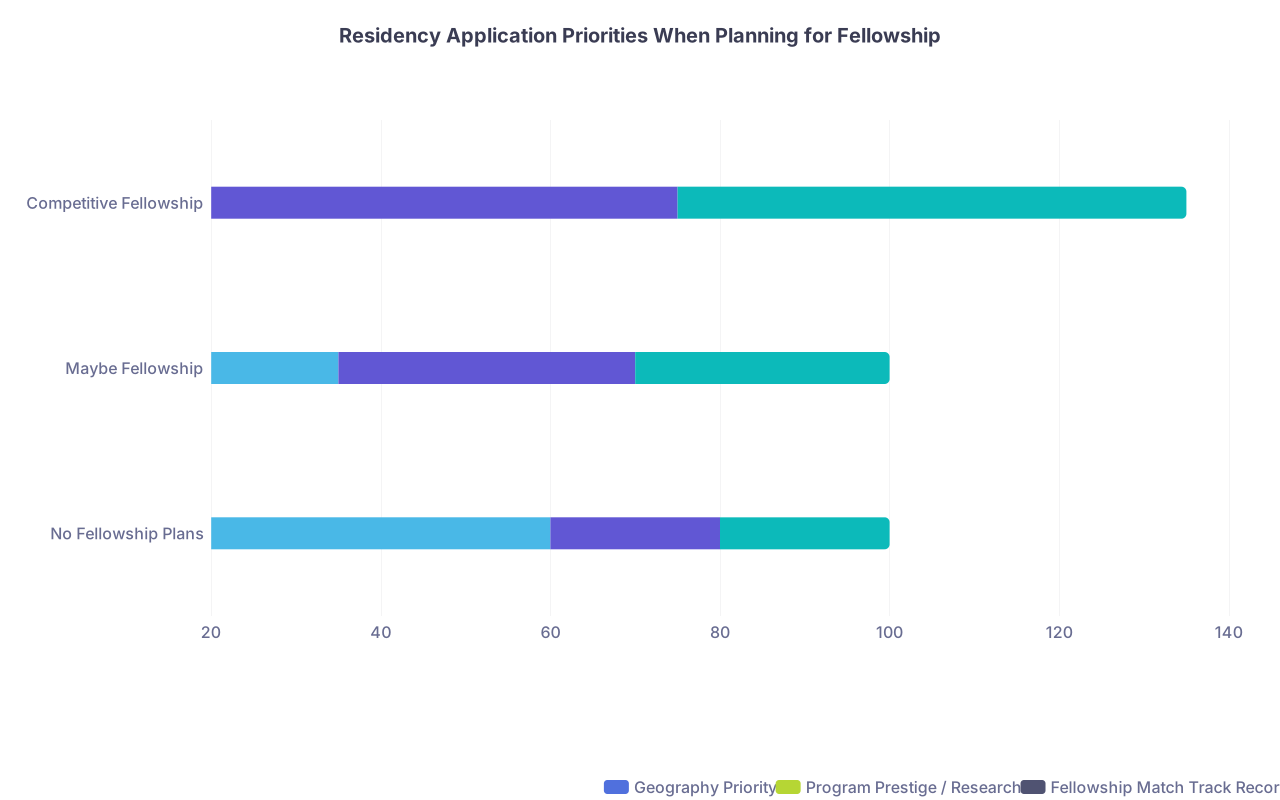
| Category | Geography Priority | Program Prestige / Research | Fellowship Match Track Record |
|---|---|---|---|
| No Fellowship Plans | 60 | 20 | 20 |
| Maybe Fellowship | 35 | 35 | 30 |
| Competitive Fellowship | 20 | 55 | 60 |
As your commitment to a competitive fellowship goes up, your tolerance for “random community program that never sends anyone to GI” should go down. And yes, that may mean applying to more programs to get a usable mix.
Putting It All Together: How to Build Your List in Practice
Here’s a concrete, step-by-step workflow you can actually do in one or two evenings.
Define your likely fellowship direction
- Write down: “Most likely: ____. Backup: ____. Might be okay with no fellowship if ____.”
Decide your baseline range
- Look up your specialty’s typical application ranges (from NRMP, talking to residents).
- Place yourself at low/mid/high end based on your risk factors.
Allocate percentages by program type
For someone aiming for a competitive fellowship:- 30–40% academic flagships
- 40–50% mid-tier academic/hybrid with strong fellowship match
- 10–20% community programs that still have decent fellowship outcomes
Research fellowship outcomes for each candidate program
- Spend 3–5 minutes per program:
- Website
- Google “[Program Name] residency fellowship match”
- Check if there are fellows in your target field
- Spend 3–5 minutes per program:
Remove programs that fail your “worst-case” test
- If you land there and never get fellowship, will you regret it forever?
- If yes, and fellowship is very important to you, drop it.
Expand or contract list to hit your number
- If you’re only at 25 programs and your target is 45–50, fill in with programs that:
- Have at least some fellowship pipeline
- Are not all clustered in the same hyper-competitive region
- If you’re only at 25 programs and your target is 45–50, fill in with programs that:
Here’s a quick mental model for your “final list” check:

| Step | Description |
|---|---|
| Step 1 | Draft Program List |
| Step 2 | Optimize for fit and geography |
| Step 3 | Remove or demote those programs |
| Step 4 | Add more mid tier academic and hybrid |
| Step 5 | Finalize Application List |
| Step 6 | Fellowship Important? |
| Step 7 | Each program has recent grads in my field? |
| Step 8 | Enough diversity of tiers and types? |
If you run your list through that logic, you’ll avoid most of the long-term pitfalls.
FAQ (Exactly 3 Questions)
1. What if I truly have no idea whether I want fellowship or not? How should that change my application numbers?
Treat yourself as “fellowship-possible.” That means two things. First, aim for at least the middle of the normal application range for your specialty rather than the low end; you want options. Second, make sure at least half of your list are programs with a functioning fellowship pipeline, even if you’re not sure you’ll use it. You don’t lose anything by having that option, but you absolutely lose flexibility if you end up at a program where nobody leaves for fellowship. Indecision now should push you toward slightly more programs and a more academically capable mix – not fewer.
2. Is it ever smart to apply to a very small number of “elite” programs if I want a top fellowship later?
Not unless your application is genuinely at the top of the pile for your specialty: stellar scores, meaningful research, no red flags, strong mentorship, and clear support from well-known faculty. Even then, I wouldn’t go below 20–25 programs in most specialties. Elite residencies can absolutely help for competitive fellowships, but they’re also flooded with applicants just like you. Spreading your applications across a few tiers of strong programs gives you a safer path to being a standout resident instead of the 18th best person in an elite class fighting for the same two GI spots.
3. I matched already and just realized I want a competitive fellowship, but my program isn’t very academic. Am I doomed?
Not automatically, but your path is steeper. Your job is now to behave like the “fellowship gunner” at an academic place without the built-in infrastructure. That means: become the absolute top resident clinically; seek out any subspecialist in your interest, even if they’re the only one; initiate research or QI projects yourself; network at regional and national meetings; and ask your PD directly for help strategizing your fellowship plan. You might need to apply more broadly and more geographically flexibly for fellowship, but I’ve watched residents from modest community programs match into good fellowships by being undeniable. It just requires more deliberate hustle than if you’d started at a program built for that pipeline.
Open a blank spreadsheet tonight and list 15–20 programs you’re already considering. Add three columns: “Has my target fellowship?”, “Recent grads in that field?”, “Would I still be okay here if I never matched fellowship?” Fill it out honestly. If more than a third of your list fails those questions and you care about fellowship, your application volume and program mix need to change before you hit submit.